Author: murmurphy.eth
In the Web3 field, X (formerly Twitter) is absolutely the core battlefield for project operations and market expansion. For practitioners and investors, X is not only an excellent platform to enhance personal influence, but also an opportunity to explore new opportunities. This article will reveal the recommendation algorithm and share practical and feasible operation strategies to help you quickly improve content exposure and interaction.
This article will start from the perspective of X's official recommendation algorithm, analyze the algorithm logic, and share simple and practical operation strategies to help you quickly open up the situation.
Friendly reminder: Don't want to see the details of the recommendation process? Directly jump to the "Tweet Guidance Strategy and Rhythm Management" and the "Efficient Traffic Driving and Leverage Strategy" sections to get the practical secrets.
X (Twitter) Recommendation Algorithm Process
The core of Twitter's "For You" timeline recommendation system is to predict user interest in each tweet based on a large amount of user interaction data, the specific process is shown in the figure below:
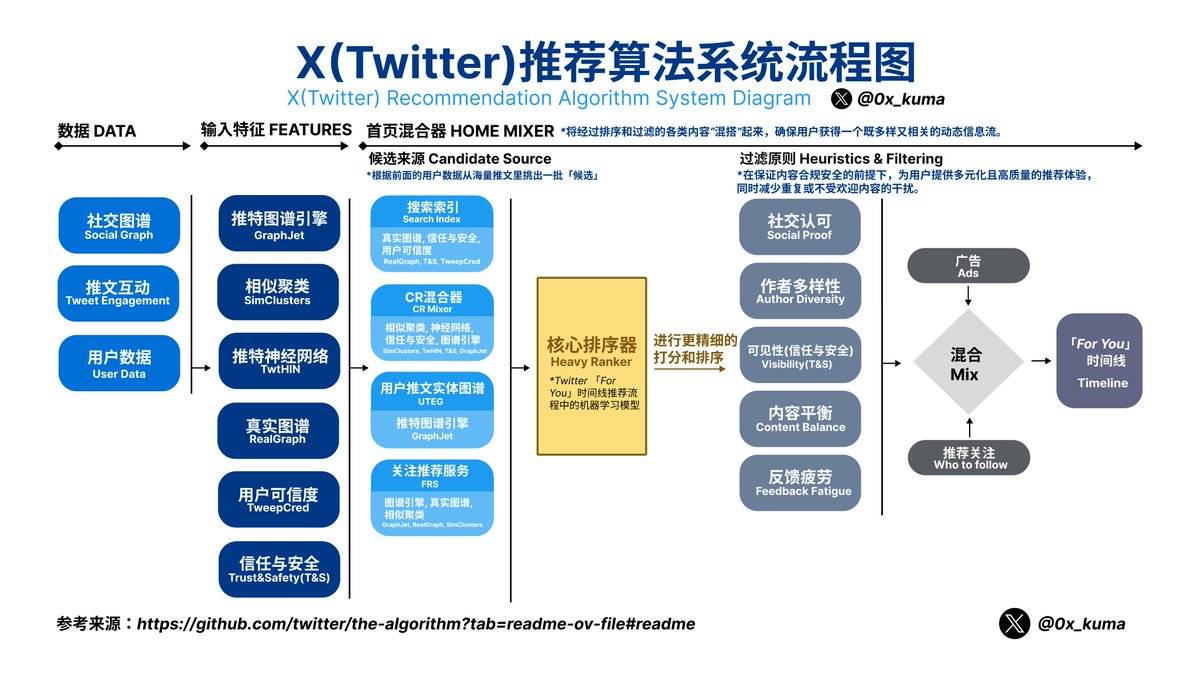
Step1. Data Collection (Data) These data together form the "raw materials" of the recommendation system, providing a solid foundation for subsequent feature extraction and model training, ensuring that the algorithm can accurately capture user interests and behavioral characteristics.
Social Graph: The social graph collects the follow-up relationships and interaction situations between users, helping to build the user's social network and provide a basis for subsequently identifying the user's social circle and active relationships in the recommendation.
Tweet Engagement: Track user interactions with tweets, such as likes, comments, and retweets. Reflect the popularity of the content and the intensity of user interest, and provide key data for the algorithm to evaluate the quality and relevance of the tweets.
User Data: Collect information about user personal preferences, usage habits, and historical behaviors to help the model more accurately identify and predict user interests and behavior patterns.
Step2. Feature Extraction (Features) After obtaining the raw data, the system will use a series of "tools" to deeply process these data to form feature indicators that can be used by machine learning models.
GraphJet: Real-time graph engine for analyzing the two-way interaction between users and tweets.
RealGraph: Real graph captures real social relationships and interaction patterns.
SimClusters: Use clustering algorithms to group users or tweets with similar interests, and discover potential associations.
TwtNN: Deep learning model that can extract multi-dimensional features and more accurately capture user interests.
TweepCred: Measure the credibility and influence of users on the platform, providing a reference for trust assessment.
Trust & Safety: Specifically responsible for detecting and filtering illegal or harmful content, ensuring the safety and compliance of recommended content.
Through these tools, the system can transform the complex raw data into structured features, laying a solid foundation for the subsequent algorithm to accurately determine which tweets are worth recommending.
Step3. Candidate Source (Candidate Source) In the candidate generation stage, the system quickly filters out potential content that matches user interests from the massive number of tweets, providing a data foundation for subsequent ranking. This stage is mainly achieved through four channels:
Search Index: Extract tweets related to current trends through keywords or popular searches.
CR Mixer: Mix, de-duplicate, and filter the candidate list, and output it to the core ranker.
UTEG: Establish a relationship graph between users, tweets, and the keywords or topic entities contained in them, helping the algorithm understand the deep connection between users and content.
FRS: Recommendation of follows can identify accounts that you may be interested in but have not yet followed, and introduce their tweets as candidates, increase account diversity, and help you discover more high-quality content.
Overall, this stage ensures that the candidate list includes both current hot spots and reflects the user's long-term interests through multi-dimensional and multi-channel filtering, laying a solid foundation for accurate ranking.
Step4. Ranking Engine (Heavy Ranker) At this stage, the system uses a deep neural network to evaluate each candidate tweet. It first calculates the predicted probability of the user for different interaction types (such as likes, comments, retweets, etc.), and then multiplies these probabilities by the preset weights and accumulates them to obtain the comprehensive score (score) of each tweet. The higher the score, the more likely the tweet will appear on the timeline.
According to the default weight settings published by Twitter on GitHub on April 5, 2023, the weights and meanings of different interactions are roughly as follows:
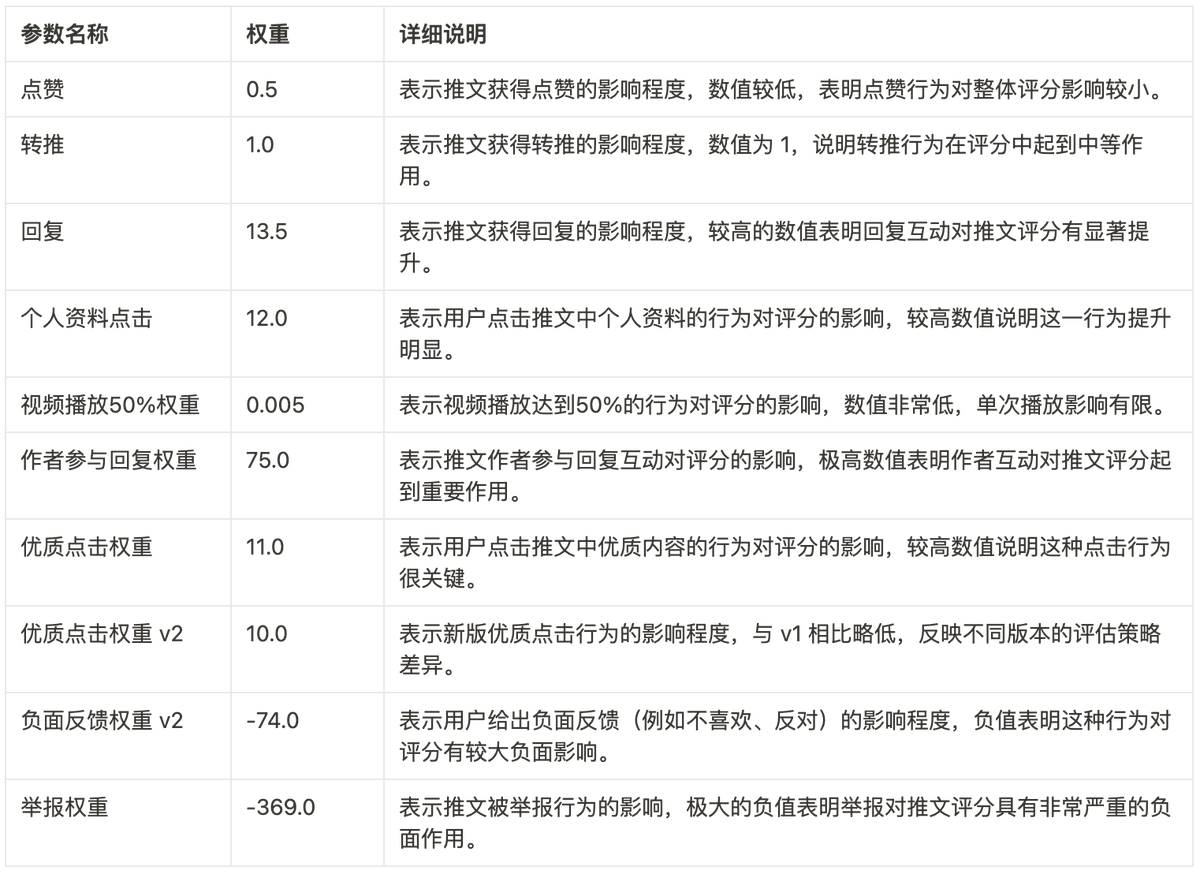
By weighting various positive and negative interactions, the Heavy Ranker can quickly identify which content is most likely to be favored by users and which content needs to be reduced in recommendation.
Step5: Heuristics & Filtering The ranked content will undergo further adjustment by a series of rules to ensure that the recommended content is both diverse and meets platform requirements. This process will check the overall heat and social recognition of the tweets, while also focusing on the diversity of the authors to avoid too much content from the same source. In addition, if the tweets contain violations, sensitive information, or excessive repetition, the system will also reduce the visibility or filter them to ensure user experience and content safety. This step is like the "final check", reducing the ranking or filtering out potentially repeated, illegal, or inappropriate content.
Step6: Mixing and Timeline Generation Finally, the system will add advertising content and new accounts recommended for you to the tweets that have been ranked and filtered in the previous steps, aiming to present you with a rich and balanced information timeline. The system will continuously adjust based on your new behavioral data to ensure that the content continues to match your interests.
In a nutshell: Twitter layers of filtering and presenting the content most suited to user preferences through the process of data collection, feature extraction, candidate generation, ranking and filtering, and mixed output.
Tweet Guidance Strategy and Rhythm Management
To get more exposure for your tweets on the target user's timeline, you need to start from the candidate generation and core ranking two key links, ensuring that the content can be included in the candidate list and also get a high score in the ranking stage. Here are some effective little tricks:
1⃣Basic Interaction: Promote Likes, Comments, and Retweets
Tweet replies have the highest weight score in the ranking engine, and extended interactions (e.g., the original author responding after a reply), the weight can be as high as 75.0. This two-way interaction is an extremely strong positive signal, indicating that the tweet not only attracted users but also triggered further interaction from the author, significantly increasing exposure. Ask open-ended questions or controversial topics in the tweets to attract readers' comments. At the same time, don't forget to actively respond to the opinions of commenters and engage in in-depth discussions on users' questions or ideas. This not only increases the number of replies, but also makes the readers feel valued, further enhancing account stickiness.
2⃣Advanced Interaction: Guide Page Clicks and Extended Reading
Attracting others to click into your homepage through a tweet and have further interactions on your other messages (weight 12.0) indicates that the user is not only interested in the content itself, but also wants to learn more about the author's other works.
You can set clear guidance in the tweets to encourage clicking on the homepage. At the same time, use the pinned tweet or curated list (Moments) function to summarize your best content, making it convenient for homepage visitors to quickly access and generate more interactions.
3⃣Stability and Explosion: Balance Long-term and Short-term Interactions
The "long-term (50 days) + short-term (3 days or even 30 minutes)" rolling aggregation feature of Twitter means that the platform not only focuses on your performance over a longer period, but also tracks your recent or real-time dynamic performance. Specifically:
Long-term performance: Regularly publish high-quality long-tail content (such as daily macroeconomic data analysis), continuously accumulate stable interactions, and establish brand weight.
Short-term burst: Seize hot spots and fan active periods, quickly output real-time dynamics, and strive to obtain high interactions in a short period of time, thereby improving the performance of the content in the short-term aggregation data.
In addition, long-term and short-term data are constantly being updated, and the platform will "watch" your new performance at any time. Therefore, it is recommended to regularly monitor interaction data and fan growth. Once a decrease in short-term interaction is found, adjust the topic selection or release time in time to avoid affecting the long-term data performance.
4⃣ Group interaction: expand the social graph and stimulate natural discussion
Through real account-to-account mentions, the platform's "Real Graph" will capture the natural interactions between users, and the "Real-time Graph Engine (GraphJet)" will update your social graph data in real-time. In this way, not only can active users be identified, but more users can also see the connections between you and your partners, thereby gaining additional exposure. Interactions in the comment area are also very valuable, such as liking/replying to comments, and staying for more than 2 minutes, with weights of 11.0 and 10.0 respectively.
💡 Of course, the power of a combination punch will be greater. For example, write a series of tweets around the same topic from multiple angles. Then take one of the main tweets as the "entry point", and add links to other related content in the comments or on the homepage, so that multiple articles are interconnected. The series content and hyperlink information increase the relevance of the candidate tweets, not only expanding candidate generation and social graphs, but also possibly triggering additional interactive behaviors (such as clicking into the homepage) to improve interaction signals. And this content linkage can also trigger high interactions in the short term, while forming a long-term content matrix, helping you maintain stable performance in the rolling aggregation (50 days + short-term) statistics.
This series linkage strategy not only enriches the content ecosystem, but also meets the platform algorithm's evaluation standards for interaction and relevance, thereby helping to improve overall exposure.
Efficient traffic driving and leverage strategies
1⃣ Heat leverage: Quickly respond to and follow up on hot events
In the data collection stage, the system will incorporate the high-frequency interactions and user attention brought by hot events into "Tweet Engagement" and "User Data", and regard the "freshness" or "timeliness" reflected in them as key features. Since these features can help the algorithm judge the current heat and relevance of the content, tweets that quickly follow up on hot spots are more likely to be prioritized in the candidate generation stage, and continue to gain points in the "Heavy Ranker" due to the rising interaction volume, ultimately gaining higher exposure opportunities in the "Mixing".
An effective method is to seize the immediacy of hot events, publish relevant comments or insights in the first time, and occupy the first-mover advantage. After posting, continue to update the views or supplement information according to the progress of the event to ensure that the tweets maintain activity. The system will use interaction and comment data to judge the freshness of the content, and give it higher weight in subsequent scoring and recommendation, allowing your content to maintain an advantage throughout the entire recommendation process.
2⃣ Controversy leverage: Create controversy and discussion points
By proposing unique insights or controversial topics, you can quickly trigger a large amount of discussion and replies, forming a strong interaction signal. Especially when the topic attracts more KOLs to participate in forwarding and commenting, the tweet has the opportunity to gain exposure to a wider range of users. However, when using the controversy leverage, it is necessary to ensure that the discussion remains within a reasonable and rational range, and avoid negative feedback (such as hiding, blocking, reporting, etc.) due to violations or sensitive content. Because the weight of such negative actions is as high as -74.0 to -369.0, it may not only affect the exposure of that tweet, but also have a negative impact on the entire account.
3⃣ Celebrity leverage: Interaction with hot personalities or institutions
Interactions with hot personalities or institutions, especially interactions from high-influence accounts, will allow the system to judge the account to have relatively high "TweepCred" and transmission potential, which is directly reflected in the user's "Social Graph". Such interactions not only enhance the social value of the content itself, but will also be further amplified through deep learning models, thereby gaining higher exposure in the final "Mixing".
Therefore, you can increase exposure by mentioning or @ing relevant hot personalities or institutions, and timely interaction may also attract their responses, promoting secondary dissemination. This strategy helps to push your content to a wider social network, further enhancing credibility and transmission effectiveness.
Summary
Maintain stable and high-quality output, be good at seizing short-term hot spots, and use diversified interaction techniques. Add to that continuous data tracking and timely adjustment of strategies, and you can perfectly cope with algorithm weight changes. If you have other valuable insights, feel free to share them in the comments.
Thank you for reading all the way here! If you find these contents helpful, welcome to follow my account @0x_kuma, and likes, comments and reposts will be the greatest encouragement for me!