In the wave of blockchain, Sui has become a dark horse in the Web3 domain with its high performance and innovative ecosystem layout. And today, on March 27, 2025, the Sui ecosystem welcomes a heavyweight new member - the decentralized storage protocol Walrus (WAL). Walrus made a strong debut with a financing scale of $140 million and a fully diluted valuation (FDV) of $2 billion, officially launching on top exchanges like Upbit, Bybit, and Kraken at 6 PM.
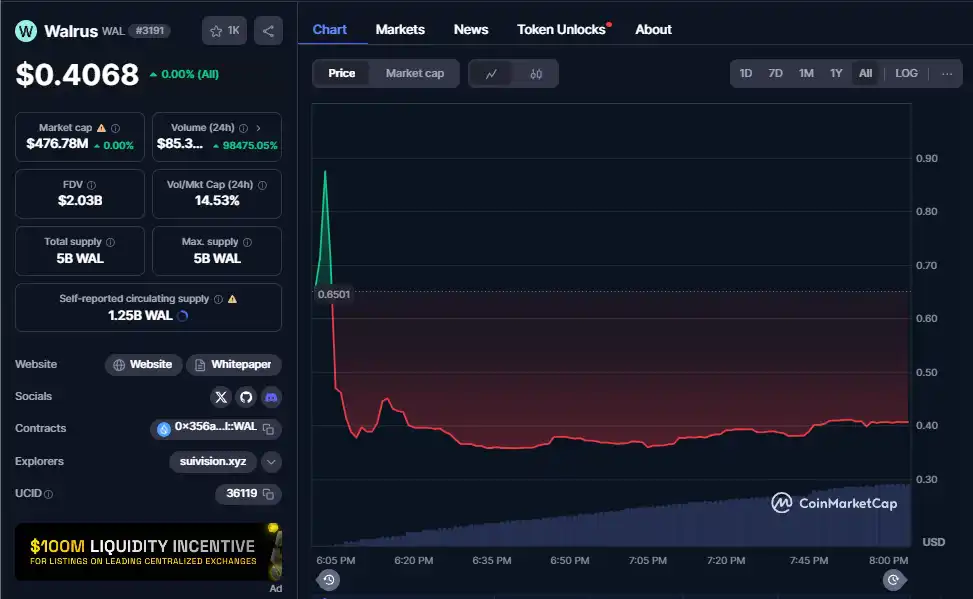
On its first day of listing, WAL's price quickly rose to $0.87 before falling back to $0.39, demonstrating the market's keen interest. As an important part of the Sui ecosystem, Walrus not only injects new vitality into the decentralized storage field but also raises expectations for the future of the Sui ecosystem. So, what makes Walrus unique? How does it aim to reshape the decentralized storage landscape with Sui's support? Let us explain.
[The rest of the translation follows the same professional and accurate approach, maintaining the technical nuances and blockchain terminology.]Walrus's RedStuff encoding is more "down-to-earth". It mainly uses a simple operation called XOR (equivalent to "addition and subtraction") to complete data encoding and decoding. This method is like solving problems with the logic of 1+1=2, which is fast and efficient. It is precisely because of this simple and efficient operation that Walrus can handle larger files, support more storage nodes, and truly achieve scalable decentralization.
3. Storage Proof: From "Individual Checking" to "Holistic Verification"
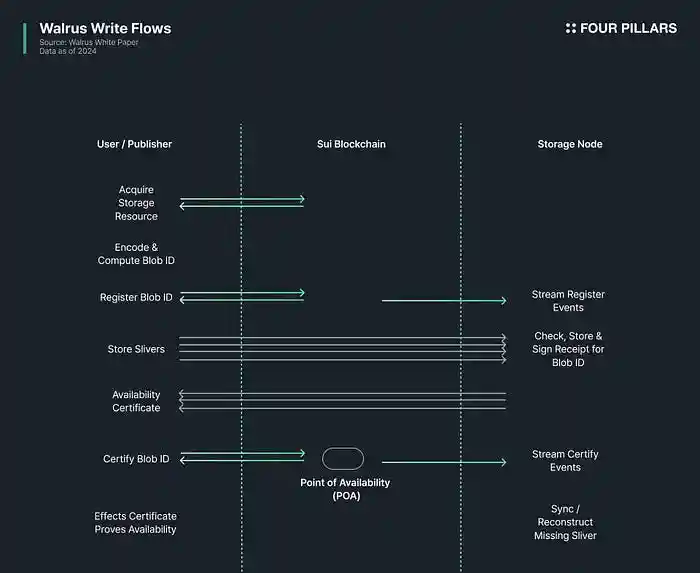
In decentralized storage, there is a challenge: how to ensure that your friend (storage node) is really helping you store files and not secretly deleting them? Traditional solutions would check each file individually, like a teacher checking students' homework one by one, which is time-consuming and labor-intensive. Walrus is smarter, designing a "holistic verification" mechanism - challenging storage nodes as a whole, rather than checking files individually, to confirm whether the data still exists. This approach reduces verification costs from "linear growth" (more files mean more effort) to "logarithmic growth" (easy even with many files), significantly improving system efficiency.
4. Collaboration with Sui: Clear Division of Labor, Doubled Efficiency
Walrus's technical architecture also relies on Sui's support. Sui is like a "commander", responsible for coordinating and managing all storage nodes, such as deciding who stores which slices and how to distribute rewards. Walrus focuses on "doing the work", which means slicing, storing, and recovering data. Sui's high-performance blockchain can quickly process these coordination tasks, ensuring smooth system operation. This division of labor allows Walrus to concentrate on optimizing storage functions, doubling efficiency.
Tokenomics: WAL's Distribution and Utility
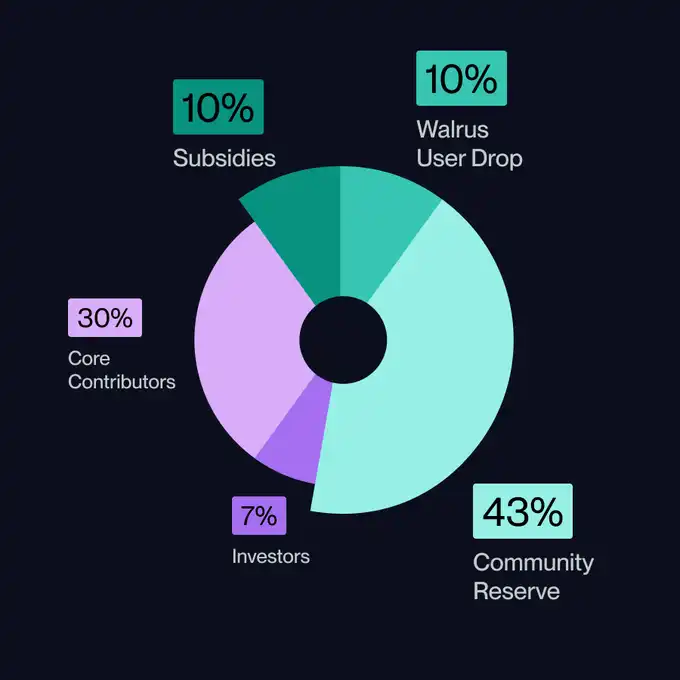
Walrus's tokenomics design aims to incentivize community participation and ecosystem development. WAL token distribution is as follows: over 60% allocated to the community, including 10% for user airdrops (distributed to early adopters with some reserved for future distribution), 43% for community reserves (used to fund developers, incentive programs, etc.), 10% for storage subsidies (supporting storage nodes); 30% allocated to core contributors, rewarding early developers; 7% allocated to investors. This community-oriented distribution model ensures long-term sustainable ecosystem development.
WAL tokens play multiple roles in the Walrus ecosystem. First, it is the primary tool for paying storage fees, with users needing to use WAL to pay for storing and reading data; secondly, WAL is used to incentivize storage nodes, who earn WAL rewards by storing data and responding to read requests; additionally, WAL is a governance token, allowing holders to participate in protocol parameter adjustments, such as determining storage fee pricing models or reward mechanisms. Through these uses, WAL not only drives the Walrus ecosystem's operation but also grants the community greater participation rights.
Conclusion: Can Walrus Become a Leader in Web3 Storage?
From technological innovation to ecosystem empowerment, Walrus is undoubtedly a new star in the Sui ecosystem. Through RedStuff encoding and programmability, it solves the pain points of decentralized storage, opening new possibilities for Web3 applications. Testnet data and performance on its first day of listing further prove its potential. However, the decentralized storage track is highly competitive, with veteran players like Filecoin and Arweave still holding important positions.
Walrus needs to continuously focus on technological implementation, ecosystem expansion, and community building to stand out in the Web3 storage field. In 2025, can Walrus become a leader in decentralized storage? Let's wait and see!
Welcome to join BlockBeats official community:
Telegram Subscription Group: https://t.me/theblockbeats
Telegram Communication Group: https://t.me/BlockBeats_App
Twitter Official Account: https://twitter.com/BlockBeatsAsia