Article source: Talking Outside the Lines
One of the hot topics these past few days is probably Ghibli, mainly because a few days ago (March 25th), ChatGPT announced a 4o image generation function where you can directly use image-to-image functionality in the GPT-4o dialogue box. You can upload an image, input a simple instruction (like transforming the image into a Ghibli cartoon style), and then GPT can generate a new image based on the original image and instruction, as shown in the image below.

The Ghibli style refers to the unique visual style presented in animation works created by the famous Japanese animation studio Studio Ghibli, with well-known works including "Spirited Away" and "My Neighbor Totoro".
This was originally just a ChatGPT update, but as some big names began sharing their Ghibli-style images on social platforms, such as Musk sharing a Ghibli-style image on X on March 27th, the Ghibli trend skyrocketed.

Subsequently, with the push from influencers, a Ghibli token emerged. With the continuous rise of the topic and some KOLs shilling, the Ghibli token (on Solana chain) quickly multiplied by over a hundred times in less than a day. Today (March 28th), two Ghibli tokens (on Solana and BSC chains) were directly listed on BA Alpha, as shown in the image below.
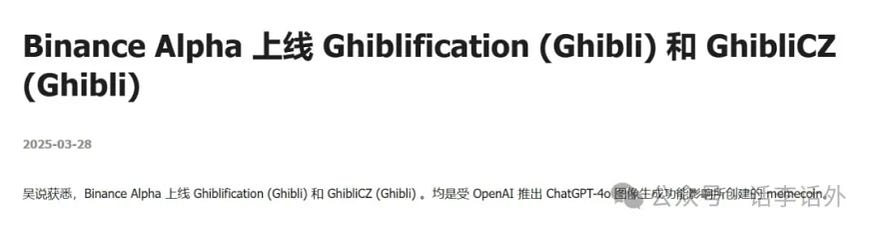
Of course, it is not recommended to chase high prices now. Interested readers can search and learn more about the Ghibli story, and we won't discuss too much about meme coins here.
[The rest of the translation follows the same professional and accurate approach, maintaining the original structure and meaning while translating to English.]
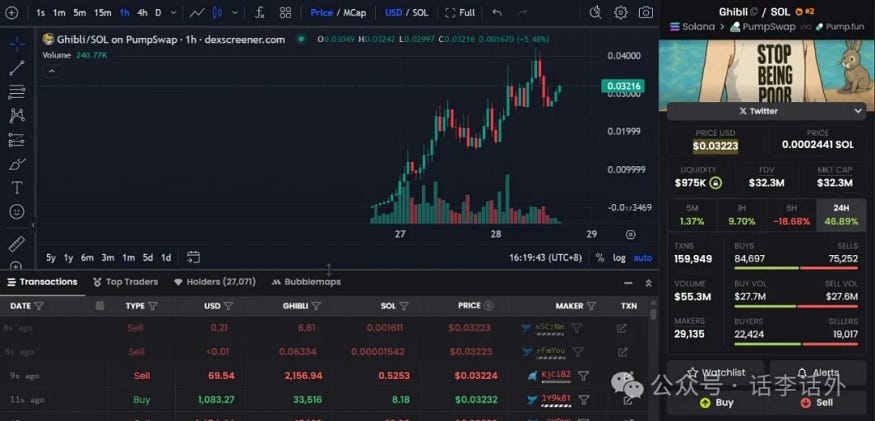
Of course, there is also an issue of trading volume. For example, as shown in the image above, Ghibli's 24-hour trading volume is 5.5 million USD, which more represents the trading activity or turnover frequency. A high trading volume does not directly mean that the token's price will be raised.
In summary, most people may pay more attention to market capitalization (including trading volume), but in terms of price influencing factors, liquidity might be more important, especially for tokens with low liquidity. Do not be misled by high market cap or high trading volume, because their prices can be easily manipulated by whales (large holders or project parties).
3. Let's briefly discuss Pendle and related topics
In the previous article (March 26th), we mentioned Pendle, and then someone continued to ask: Why are you paying attention to Pendle? Can I still buy this coin now?
As for why we are focusing on Pendle, this is not really a problem. If you have been following our content for a long time, you would know that we have focused on many projects, and we have mentioned Pendle multiple times in our historical articles, as shown in the image below.

As for whether Pendle can still be bought now, I cannot provide specific buying and selling advice (I do not provide any specific trading-level buying and selling guidance). If you have the impulse to trade Pendle, one of the simplest methods is to refer to the approach in our article from last year (November 12th, 2024) and conduct necessary research before deciding whether to participate. In that article, we used AAVE as an example and listed several simple ideas and methods for quickly screening projects, as shown in the image below.

Actually, setting aside price factors, for projects like Pendle and AAVE, I have always believed they belong to the category of good projects because they can generate sustainable income and maintain relatively positive construction, unlike projects that merely survive by hyping air concepts (like most memecoins).
Regarding the current market development trend or the hot topics everyone is focusing on, they can be roughly divided into two types:
One is a super-short-term narrative, such as the quick-pass projects like Ghibli mentioned above.
One is a medium to long-term narrative, such as DeFi, Stablecoin, and RWA that we mentioned in the articles from the past two weeks, as shown in the image below.
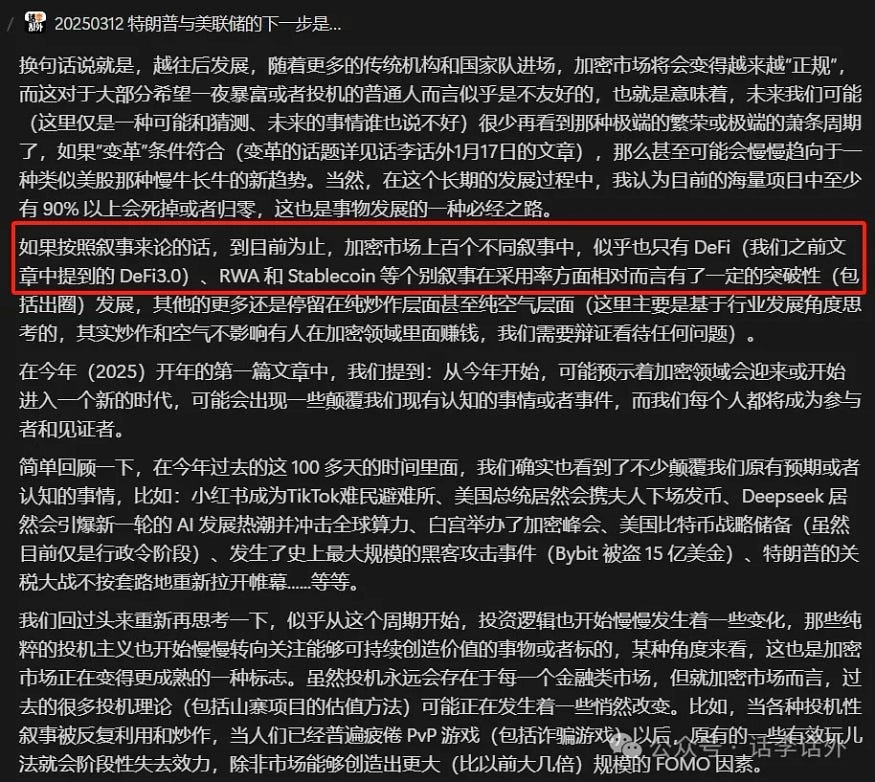
So, why do we recommend that everyone pay more attention to opportunities in DeFi and RWA? The main supporting logic here is actually Stablecoins.
Many people are focusing on the price changes of specific tokens, but if we carefully think about it, we can find that a different characteristic of this cycle is that we seem to be experiencing a Stablecoins Bull. According to the latest on-chain data, the current stablecoin scale has reached 234 billion USD, continuously developing rapidly since around October last year and continuously breaking historical records, as shown in the image below.
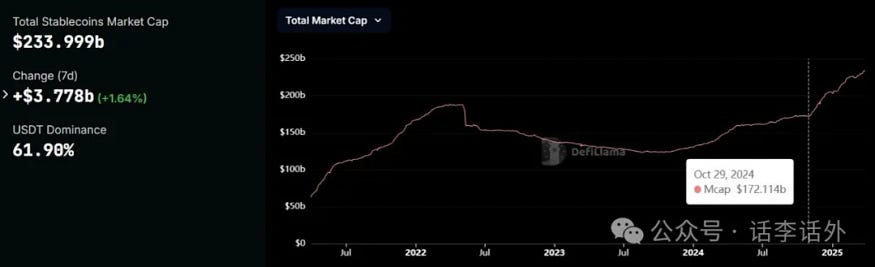
Currently, Stablecoins is a very large industry, not just for the crypto market, but even many indescribable industries are popular in using Stablecoins for settlement.
I wonder how many people still remember the White House Crypto Summit on March 8th. Although the meeting's results disappointed the market, we cannot ignore an important message Trump revealed: Trump hopes to sign stablecoin legislation before August.
In fact, while the US government has been shouting about crypto currency strategic reserves, what they might want to do more is focus on stablecoins. Plainly speaking, the US actively promoting stablecoin legislation is essentially hoping to continue expanding the US dollar's global dominance.
Moreover, through recent news, we can discover that some US institutions are actively advancing their stablecoin strategies, such as: Fidelity Investments is planning to launch its own stablecoin, Wyoming plans to launch a stablecoin called WYST in July, and Trump's family-supported World Liberty Financial will launch a stablecoin called USD1...
It can be foreseen that if the US's friendly stablecoin legislation is implemented in the future, it will inevitably further promote global stablecoin adoption, allowing the US dollar to continue becoming a global currency in new domains.
Given this premise, what opportunities can we have?
There are roughly the following possible opportunities:
First, participate in institutions or projects related to stablecoin issuance.
For example, we all know that USDC is issued by Circle, a company composed of Coinbase and other companies. While we as individual investors cannot directly participate in Circle, if we change our perspective, indirectly investing in Coinbase stocks seems to be a theoretically feasible method.
For instance, stablecoins like USDE and DAI, we can also indirectly participate by investing in tokens of Ethena, MakerDAO (MakerDAO was renamed to Sky last year, and Dai was renamed to USDS).
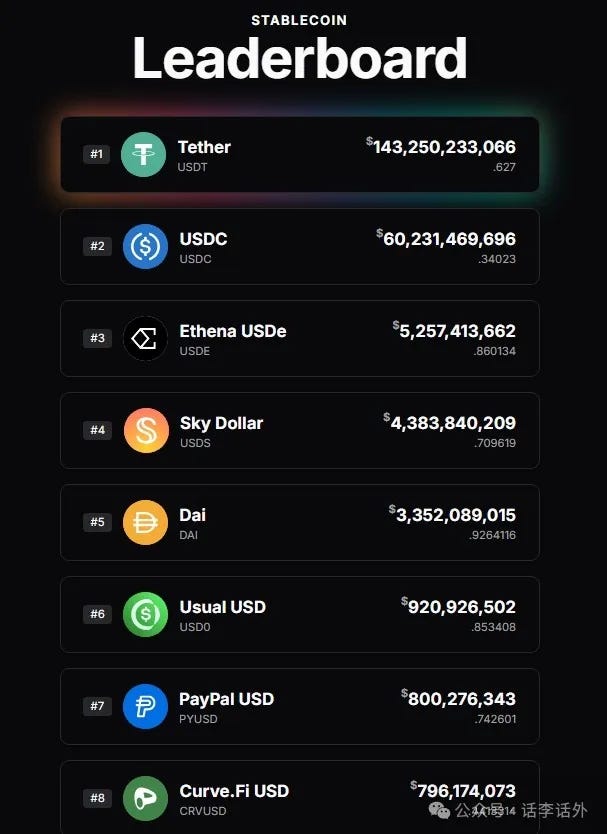 Second, participate in on-chain DeFi and RWA projects.
For example, in the lending field, representative projects like AAVE, in the yield field, representative projects like Pendle, etc. A large proportion of the TVL in such DeFi protocols is composed of stablecoins, and TVL is one of the important reference indicators for a DeFi project's development (in other words, as stablecoins increase, the protocol's TVL will increase, which will continue to drive the protocol to generate more Fees and Revenue, creating a positive cycle).
In other words, if stablecoins continue to thrive, protocols like AAVE and Pendle will benefit and may be reflected to some extent in token prices.

Similarly, RWA is a field that some institutions are actively laying out. Currently, in the RWA category, stablecoins are also an important component (other components include US Treasury bonds, private credit, real estate, etc.)
Of course, the things we mentioned above definitely have risks. For example, COIN stock prices will be affected by factors like company performance and macro conditions, and tokens like MKR and AAVE are similar. Do not make large investments (or even speculate) in related projects just because of the stablecoin trend. Before making any decisions, conduct more comprehensive research and investigation.
Article source:
https://mp.weixin.qq.com/s/WjL_Qu1nvoPOfcuDpxcaXw