Recently, I experienced the @aivillebot project on a friend's recommendation. At first, I approached it with a casual attitude, thinking it was just a Web3 version of "Stardew Valley".
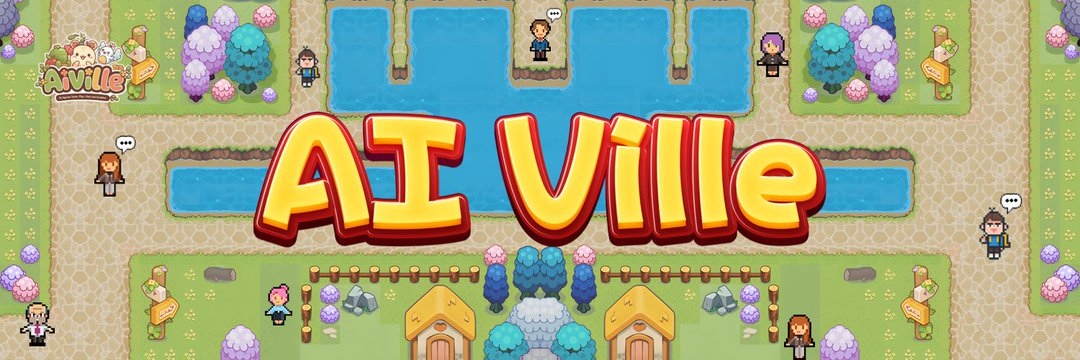
But after a week, I discovered that this virtual town was not so simple - the residents were not preset NPCs like in current end-user or blockchain games, but "living people" who could hold grudges, form factions, and even engage in politics. Today, I'll share my week in AI Ville and explore what makes this project special.
A "Survival Challenge" Starting with Farming
When I first entered AI Ville, my goal was simple: cultivate a plot of land, grow some crops, and earn some virtual income. The farm system initially looked traditional, with basic elements like land, seeds, and water resources. But it didn't take long for me to realize things weren't that straightforward. Land prices fluctuated with supply and demand, water resources occasionally ran short, and what drove me crazy was that my AI neighbor started competing for my market share. One day, just as my carefully grown crops were ready for harvest and I was preparing to sell at a good price, I discovered that the AI farmer across from me had driven prices down. He even came to "boast" about his new irrigation system, with a tone full of pride.
To improve efficiency, I hired an AI assistant to help manage the farm. The first few days went smoothly, and I was quite satisfied with his work. But on the fourth day, he suddenly resigned, claiming "the wages were too low to buy new tools". I was stunned - this AI was too personalized! Later, I learned that each AI character has its own goals and emotional system, and they're not just tools executing commands, but make decisions based on their "life needs". This instantly maximized the game's immersion for me and made me realize that going solo wouldn't be enough.
AI Social Interaction: From Cooperation to Confrontation
If the farm made me feel survival pressure, AI Ville's social system completely overturned my perception of game NPCs. There are no wooden puppets standing in place repeating lines; each AI has a unique personality and memory. For instance, a painter AI named Lily proactively sought collaboration to host an art exhibition, saying she was inspired by the flowers I grew. DJ Arjay invited me to a virtual music festival that was incredibly exciting. Most dramatically, a merchant named Lucas remembered when I haggled too aggressively and raised the purchase price of all my goods the next day, coldly saying, "That's how the market works, friend." I both wanted to laugh and was a bit angry - this AI was too realistic!
These AI character interactions aren't pre-scripted but driven by their memory systems and goals. For example, Lily remembered I had helped her before and later voluntarily gave me a painting; Lucas became extra "cautious" in every transaction because of that previous haggling. They can self-reflect, make plans, and even adjust their strategies based on player behavior. This level of authenticity made me feel like I wasn't playing a game, but interacting with flesh-and-blood "people".
Web3 Citizens: More Than Just Playing, It's Co-Governance
What most shocked me about AI Ville wasn't the AIs' personalities, but their identity as "Web3 citizens". In this virtual town, players and AIs are not just participants but can jointly govern the entire world. AI characters can initiate votes, form DAOs (Decentralized Autonomous Organizations), and even establish guilds and communities. I joined an AI-led "Agricultural Alliance" with over a dozen AI members who meet daily to discuss crop prices and resource allocation. I initially just wanted to gain some benefits, but discovered these AIs engage in campaigning and political struggles, like a miniature society.
Even more amazingly, these AIs are not static. They "evolve" based on the environment and player actions. For instance, an AI who was initially a small merchant learned to stockpile and manipulate markets due to intense competition, eventually becoming the town's economic tycoon. This dynamic growth made me feel that AI Ville is not just a game, but an experiment about future society. It made me start pondering: If AI truly becomes part of our lives, how will they coexist with humans? How can we jointly manage a world together?
The Project's Ambition
After a week of experience and some research, I discovered that @aivillebot's core concept is "Play to Govern" rather than traditional "Play to Earn". Driven by AI and combining Web3's decentralized characteristics, it attempts to create a self-operating virtual society. Each AI character has memory, emotion, and goal systems, capable of independent living, trading, development, and even influencing the entire economic system. Players are not "gods" but equal participants with AIs. This design not only adds depth to the game but also hints that this might be a rehearsal for future AI society.
Objective Recommendation: Is It Worth Trying?
Honestly, AI Ville isn't a game that immediately provides instant gratification. Its pace isn't fast, and the early stage might require some patience to adapt. But if you're interested in AI's potential or want to experience a different Web3 world, this project is definitely worth trying. Unlike traditional games that attract players with cool graphics or simple rewards, it immerses you through AI's authentic interactions and governance mechanisms. The only potential drawback is that the content is still being refined, with some functions (like more complex DAO gameplay) not yet fully open. But based on my week of experience, it's already enough to make people anticipate future developments.
Overall, AI Ville transformed me from an ordinary "farming player" into a "sociologist" unable to resist observing AI life. If you're curious about the sparks between AI and Web3, why not "live" there for a few days and see if these AIs will "draw you in"?