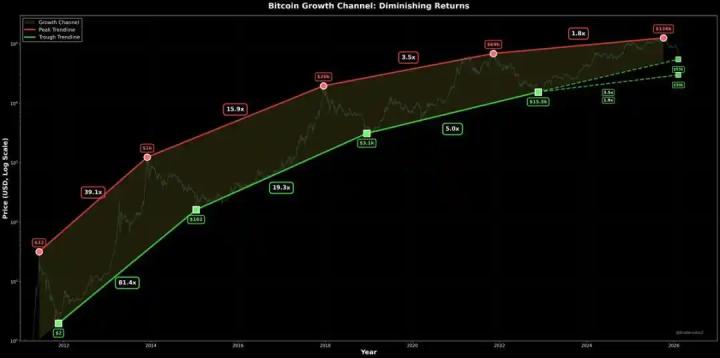
PANews reported on April 1st that according to Cointelegraph, a recent report by Fidelity Digital Assets questioned whether Bitcoin's price has already experienced its cyclical "peak and decline" or whether Bitcoin is on the edge of another "acceleration phase". According to Fidelity analyst Zack Wainwright, Bitcoin's acceleration phase is characterized by "high volatility and high returns", similar to the price trend when Bitcoin broke through $20,000 in December 2020. Although Bitcoin has reflected an 11.44% loss this year and the asset has fallen nearly 25% from its historical high, Wainwright stated that the recent performance after the acceleration phase is consistent with Bitcoin's average pullback range compared to previous market cycles.
Wainwright believes that Bitcoin is still in the acceleration phase but is gradually approaching the end of this cycle, as March 3rd was the 232nd day of this cycle. Previous peaks would typically last slightly longer before entering the correction period. Wainwright noted: "The acceleration phases in 2010-2011, 2015, and 2017 peaked at 244, 261, and 280 days respectively, indicating that each cycle's acceleration phase would be slightly extended."
Recently, many international and US listed companies have been purchasing or expressing interest in purchasing Bitcoin. Although it is difficult to determine the impact of institutional investors' Bitcoin purchases on its price, Wainwright said a noteworthy indicator is the number of days Bitcoin reaches new highs within a consecutive 60-day period. Wainwright stated: "In previous acceleration phases, Bitcoin typically experiences two significant increases, with the first rise in this cycle occurring after the election. If a new historical high is imminent, its starting point will be close to $110,000."