In the rapidly evolving decentralized AI field, OpenLedger is redefining the construction, fine-tuning, and commercialization of AI models as the next-generation blockchain network. With the vision of democratizing artificial intelligence, OpenLedger is building a full-stack infrastructure that allows contributors to be more than passive ecosystem participants, becoming stakeholders in a decentralized network with transparent, scalable, and verifiable value distribution. The project has received support from top-tier capital firms like Polychain Capital, Borderless Capital, HashKey, as well as industry leaders such as Sreeram Kannan, Balaji Srinivasan, Sandeep Nailwal, and Kenny Li, quietly building the infrastructure layer that will make decentralized AI move from possibility to practicality.
In its innovative technology matrix, OpenLoRA represents a breakthrough—this model service framework redefines the efficiency, scalability, and cost-effectiveness of fine-tuning AI models. To understand the significance of OpenLoRA, we first need to examine the systemic deficiencies in current AI infrastructure.
Core Pain Points: Centralized AI and Inference Bottlenecks
Despite the accelerating adoption of AI applications across industries, most innovations remain monopolized by centralization. AI models are typically trained and deployed by tech giants, enclosed behind proprietary APIs, with opaque training datasets and untraceable value attribution mechanisms.
More importantly, as fine-tuning AI models (especially for vertical domain-specific applications) becomes increasingly prevalent, a critical bottleneck has emerged: model services.
Core Challenges in Model Deployment:
• High GPU Costs: Each fine-tuned model typically requires an independent instance, with expansion costs growing exponentially
• Latency and Throughput Trade-offs: High concurrency often leads to response delays or model accuracy degradation
• Memory Limitations: Traditional deployment frameworks require pre-loading multiple models, with extremely low memory utilization
• Rigid Personalization Services: Large-scale deployment of user-specific models faces both technical difficulties and economic feasibility barriers
The market urgently needs a model service solution that can simultaneously handle large-scale personalization, low cost, high efficiency, and native decentralization.
OpenLoRA: A Paradigm Shift in Model Services
OpenLoRA is OpenLedger's solution. This high-performance, scalable framework can serve thousands of LoRA (Low-Rank Adaptation) models in parallel on a single GPU, not only significantly reducing operational costs but also opening possibilities for a new generation of AI applications.

OpenLoRA's Breakthrough Features:
• Dynamic Adapter Loading: Using instant loading mechanism instead of full pre-loading, freeing GPU memory
• Real-time Model Fusion: Supports runtime multi-adapter merging for integrated inference
• Streaming Quantization Processing: Supports token streaming and 4-bit quantization for ultra-low latency real-time inference
• High-Performance Metrics:
Token Generation Speed: 2000+/second
Latency: 20-50ms
Memory Consumption: <12GB (Traditional frameworks require 40-50GB)
• Developer-Friendly: Simple API enables adapter loading, merging, running, and unloading, perfectly adapting to productization scenarios
Benchmark Testing: Quantifying OpenLoRA's Advantages
The latest performance tests confirm OpenLoRA's comprehensive superiority over traditional model service frameworks.
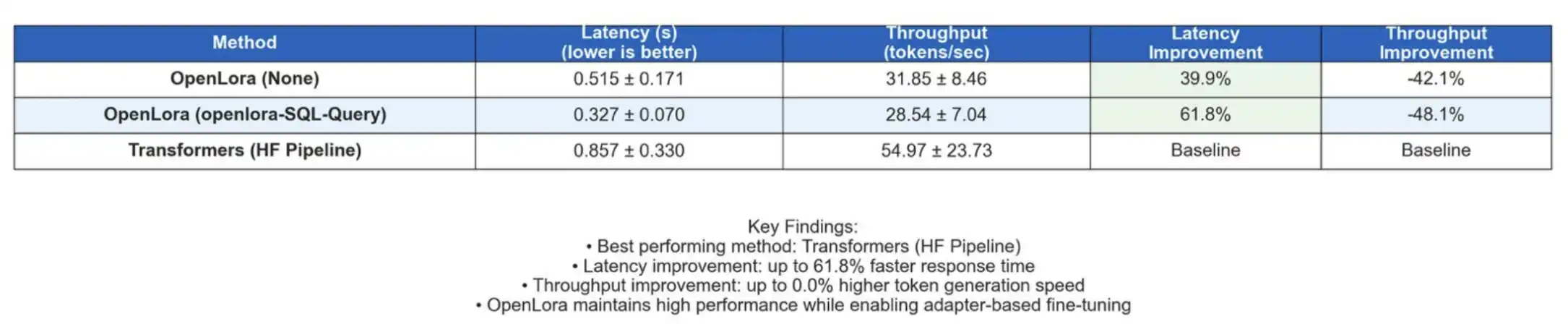
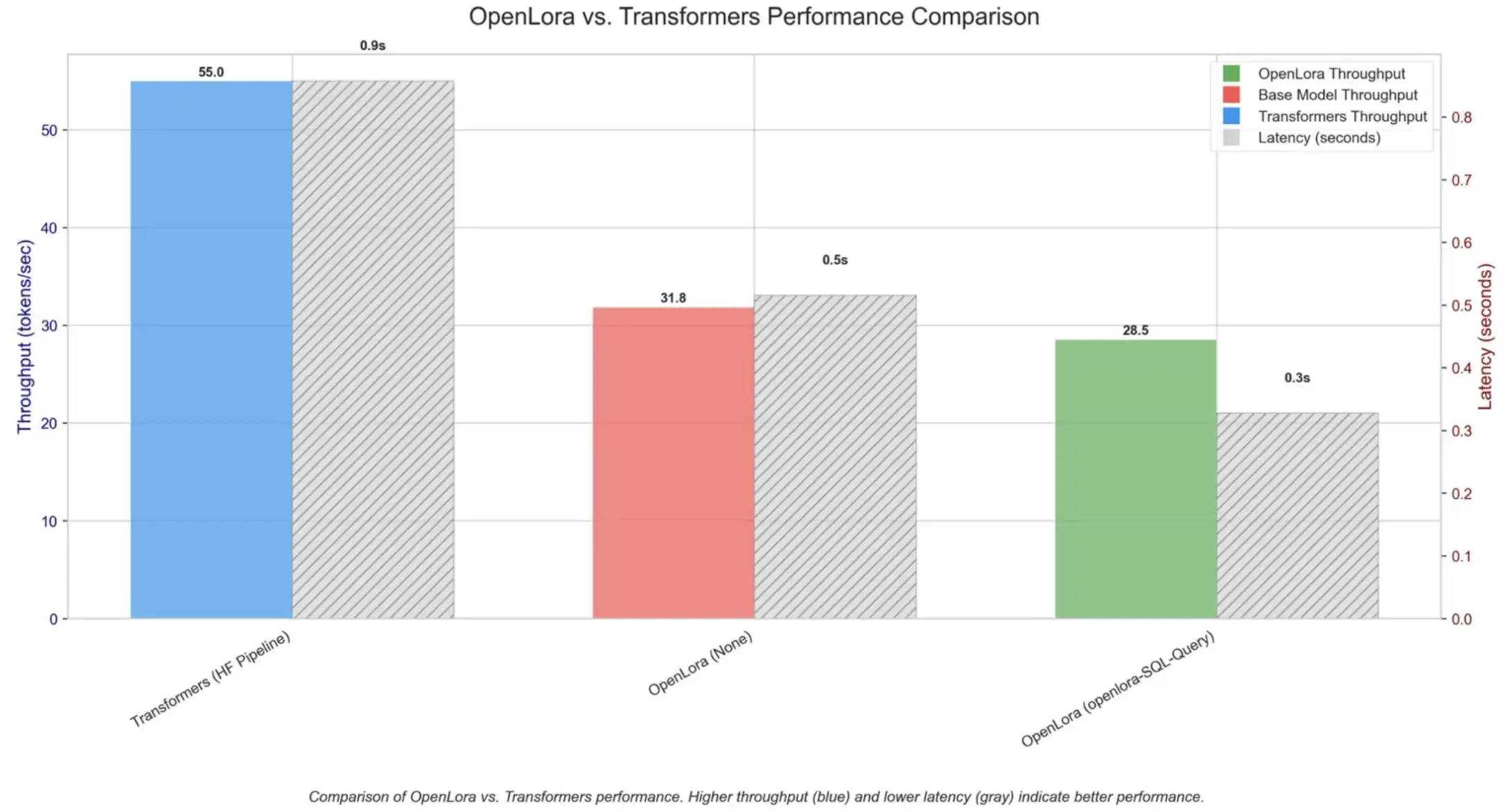
In comparative testing, OpenLoRA's token generation speed reached over 4 times that of traditional solutions, with significantly reduced memory consumption. Even under high concurrency loads, it maintains an extremely low 20ms latency while requiring less than 12GB of video memory to serve thousands of LoRA adapters. These metrics have been verified across multiple hardware environments, indicating OpenLoRA's continuous leadership in throughput and efficiency. This performance leap establishes OpenLoRA as the preferred infrastructure for scalable real-time AI deployment in decentralized environments.
For developers looking to deploy personalized assistants, multi-domain agents, or build real-time AI services, the OpenLoRA architecture completely eliminates GPU resource burdens.
Built on OpenLedger's Native AI Blockchain Infrastructure
OpenLoRA is not a standalone service but deeply integrated with the OpenLedger blockchain network designed for AI applications. This infrastructure includes:
• ModelFactory: GUI-based LoRA/QLoRA model fine-tuning engine
• Proof of Attribution: Cryptographically ensuring data and fine-tuning contributors' rights
• Datanets: Decentralized data network providing high-quality vertical domain training data
These layers collectively form the foundation of "Payable AI"—in this new paradigm, models are not only decentralized and transparent but can also distribute value based on user contributions. OpenLoRA further advances this mission by solving the final obstacle in the technical stack—large-scale, low-cost model deployment for practical applications.
Testnet Progress
To prepare for mainnet launch, OpenLedger has initiated a public testnet, creating a freely participatory decentralized ecosystem. Participants can earn points through:
• Running testnet nodes
• Completing Datanets tasks
• Contributing quality data
• Inviting new users
These points will be linked to OpenLedger's tiered reward mechanism, with early contributors receiving first-mover incentives at mainnet launch. Notably, participation has an extremely low threshold:
• Mobile (Android) and browser extension nodes can be deployed in 30 seconds
• No technical background required, participation mechanism designed for scalability
It's worth noting that China has become one of the most active participation regions, with testnet traffic ranking among the top globally. Out of 24.8 million recorded requests, China's contribution is at the forefront.
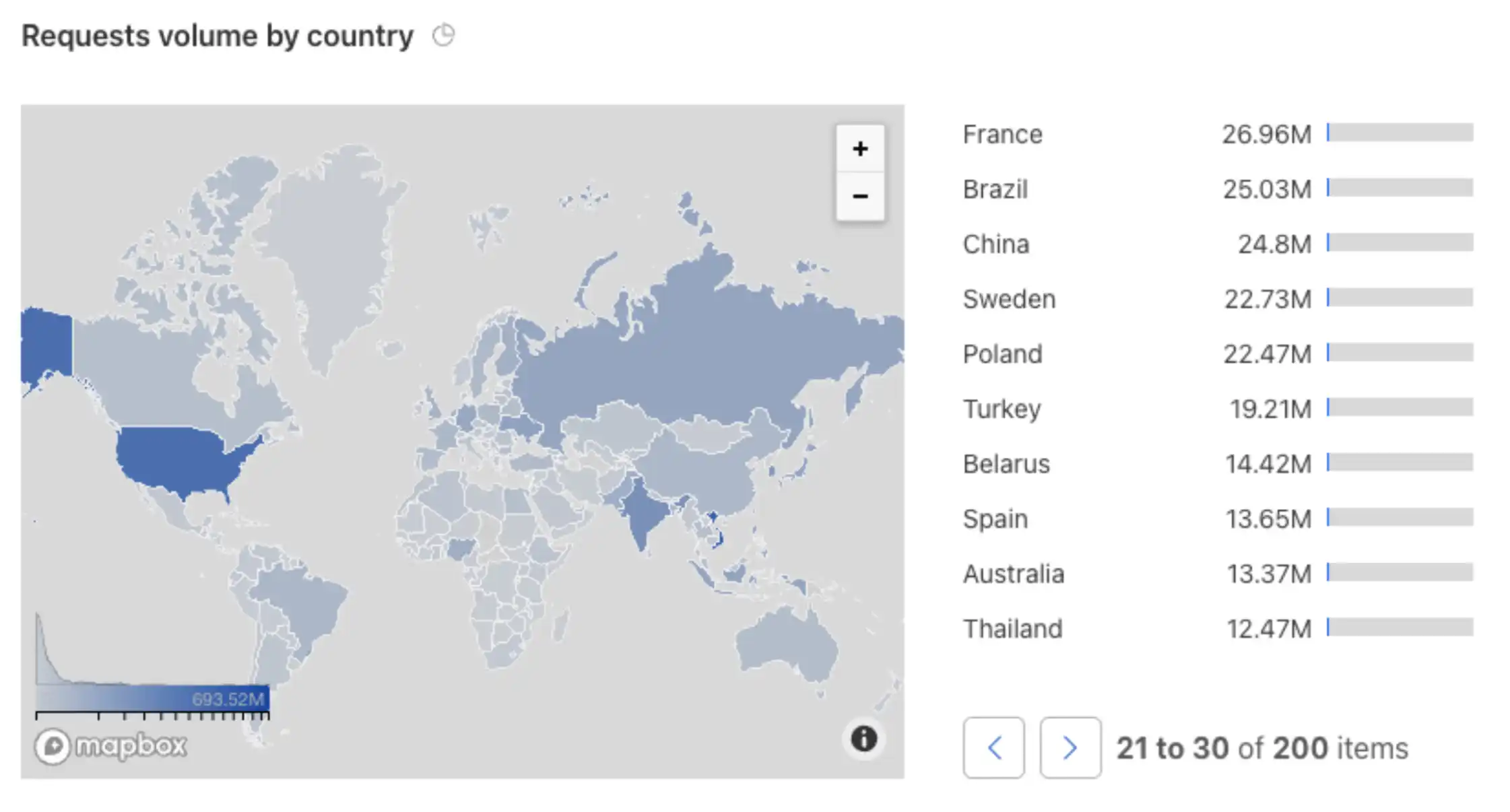
This sends a strong signal: Chinese developers, researchers, and AI practitioners are actively embracing OpenLedger's vision, seeking more economical, decentralized, and scalable alternatives to traditional AI infrastructure.
Future Outlook
OpenLoRA has already empowered applications in multiple domains:
• Professional scientific advisors
• Localized legal assistants
• Web3 data-based trading co-pilots
• Real-time on-chain communication translation
Future developments will support zero-shot LoRA adapters, multi-GPU deployment, and inference capabilities on edge devices and mobile platforms.
Why OpenLoRA? Why Now?
AI needs decentralization, not just for ideological purity, but for practical scalability, trust, and innovation needs. OpenLoRA eliminates the final technical bottleneck in decentralized AI—large-scale model services—with disruptive efficiency. This is not just a tool innovation but a call to participate in shaping the next-generation AI infrastructure. With OpenLedger's ModelFactory and Proof of Attribution mechanism, developers can now transparently and precisely fine-tune, deploy, and commercialize AI models. And
OpenLoRA's emergence finally enables all this at scale and on-demand, without bearing astronomical GPU costs.
Join the OpenLedger ecosystem, follow our X account for the latest decentralized AI updates, version releases, and ecosystem information.
Welcome to join BlockBeats official community:
Telegram Subscription Group: https://t.me/theblockbeats
Telegram Discussion Group: https://t.me/BlockBeats_App
Twitter Official Account: https://twitter.com/BlockBeatsAsia