Mysten Labs Launches a Brand New Decentralized Key Management Solution on the Sui Testnet.
Written by: Alex Liu, Foresight News
As the Web3 ecosystem continues to mature, issues such as privacy protection, access control, and key management have become increasingly prominent. On April 5th, Mysten Labs launched a new decentralized key management solution called SEAL on the Sui Testnet. Below, we will provide a detailed introduction to SEAL from multiple dimensions, including its technical architecture, application scenarios, developer experience, and future prospects.
Background
In the traditional Web2 era, data encryption and access control often rely on centralized key management services (KMS), such as AWS KMS or GCP Cloud KMS. However, these solutions cannot meet the requirements of decentralization, transparency, and user self-control in the Web3 ecosystem.
Addressing this pain point, Mysten Labs launched SEAL, aiming to achieve secure data encryption and access control in a decentralized manner, helping developers avoid relying on a single trust party when building decentralized applications (DApps), thereby achieving more flexible and secure data protection.
The emergence of SEAL solves the limitations of traditional solutions when protecting massive on-chain data, which often suffer from single scenarios or dependence on centralized services. Through SEAL, developers can achieve data encryption and access management across storage systems and application scenarios without compromising security and performance, providing a universal and efficient security solution for Web3 applications.
Technical Architecture
SEAL adopts a multi-layered technical solution to ensure secure and efficient data encryption, mainly including the following key components:
On-Chain Access Control
SEAL utilizes Move smart contracts on the Sui blockchain to implement access control. Developers can define access policies in smart contracts, precisely controlling who can access decryption keys and under what conditions access is allowed. This on-chain rule ensures transparency, making the permission verification process immutable and thus enhancing data security.
Threshold Encryption
In traditional single-point trust key management methods, centralized key storage easily becomes an attack target. SEAL adopts threshold encryption technology, distributing decryption keys across multiple independent backend services. Only when the preset minimum number of keys is reached (such as the t-out-of-n model) can the complete key be recovered. This mechanism effectively disperses risks, ensuring overall data security even if some key servers are attacked.

Client-Side Encryption
SEAL emphasizes encryption and decryption operations performed on the client-side, meaning users complete the encryption process locally. This way, even if SEAL's servers or intermediate nodes are invaded, they cannot obtain plaintext data, further enhancing the system's privacy protection capabilities.
Storage Agnosticism
Unlike some solutions that can only encrypt specific storage systems, SEAL has storage agnosticism. Whether it's Walrus, a decentralized storage on the Sui chain, or other on-chain or off-chain storage systems, SEAL can provide compatible encryption solutions. This flexibility allows developers to choose the most suitable storage solution based on project needs without worrying about encryption mechanism adaptation.
Application Scenarios
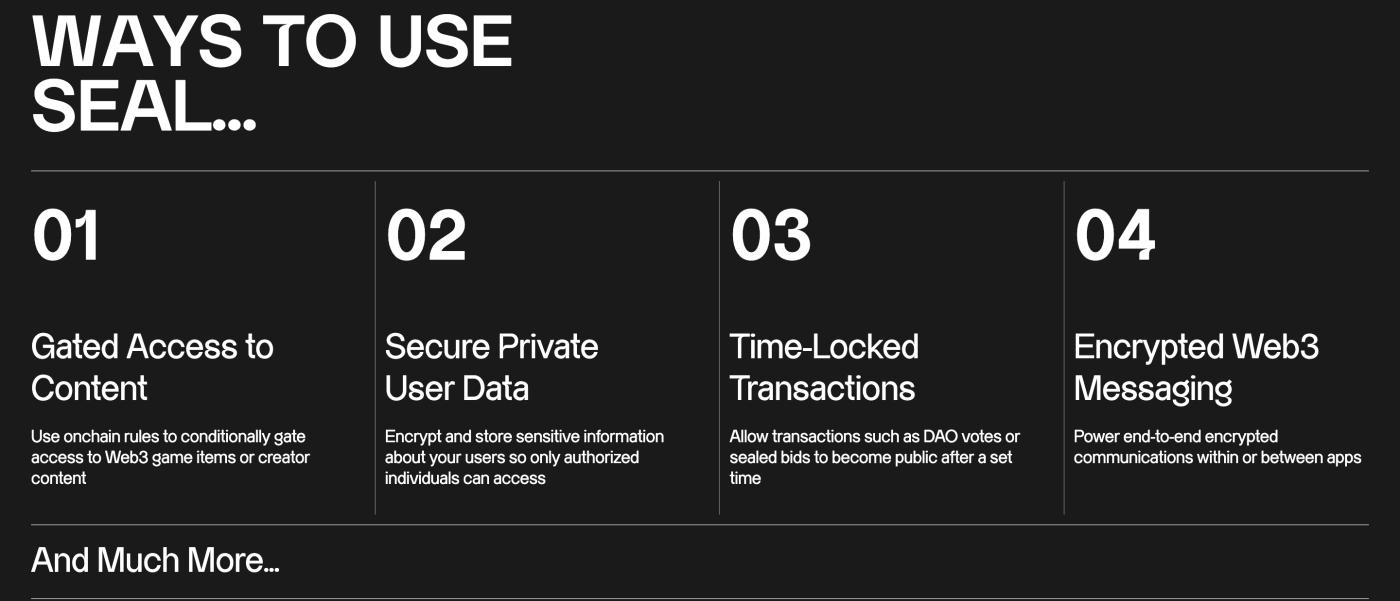
SEAL's flexible and diverse application scenarios also demonstrate its broad practical value. Here are several typical application cases:
Content Monetization and Threshold Access
In the current digital content distribution field, more creators want to implement paid reading or membership subscriptions by encrypting content. Using SEAL, creators can encrypt high-quality content, allowing only users holding specific Non-Fungible Tokens or paying subscription fees to decrypt and view. This model is similar to an on-chain version of Patreon or Substack, protecting content copyright and achieving precise user paid access.
Private Messaging and Data Transmission
In decentralized chat and social applications, user privacy protection is particularly important. SEAL supports end-to-end encrypted message transmission, ensuring that message content can only be read by communication parties, even on public chains. Developers can use SEAL to build secure and reliable decentralized instant messaging applications, addressing privacy leakage issues in traditional social platforms.
Non-Fungible Token Transfer and Time-Locked Transactions
As an important asset on the blockchain, the security of Non-Fungible Token transfers is of great concern. SEAL can be applied to time-lock encryption of Non-Fungible Tokens, setting ownership transfer or unlocking to occur only within a specific time window. This method is not only suitable for closed auctions but also provides technical support for DAO voting and other decision-making processes.
User Sensitive Information Storage
In medical, identity verification, and other fields, users' sensitive data requires strict protection. SEAL can encrypt data stored in Walrus or other storage systems and ensure that only authorized users can view it through on-chain access control, providing a decentralized and efficient solution for data privacy protection.
Developer Experience
SEAL is innovative in technology while providing developers with comprehensive SDK and toolchains, reducing integration and deployment difficulties. Through the SEAL SDK, developers can call encryption, decryption, and key management interfaces without delving into complex cryptographic principles. Although there are currently no established ecosystem projects, the official provides detailed documentation and a sample APP, with code providing detailed guidance to help developers quickly build and debug applications in the testnet environment.
Additionally, SEAL's beta version is open on the Sui Testnet, allowing developers to test various scenarios and submit feedback to Mysten Labs for continuous function improvement in future versions. Developer-friendly and easy-to-integrate characteristics make SEAL the preferred tool for Web3 developers.
Future Prospects
Although SEAL currently has mature basic functions, Mysten Labs has not stopped here. In the future, SEAL's development directions may include:
- Multi-Party Computation (MPC): By introducing MPC technology to achieve more distributed decryption operations, making the key management process more secure and reliable.
- Server-Side Encryption: In specific scenarios, to meet lightweight front-end application needs, server-side decryption solutions may be supported in the future, providing developers with more flexible choices.
- Digital Rights Management (DRM): Drawing from traditional media industry experience, developing DRM technology similar to Netflix and YouTube platforms to protect digital content copyright while ensuring user-side security.
The addition of these functions will further expand SEAL's application boundaries, making it not just limited to data encryption and decryption, but becoming a comprehensive decentralized data security platform that provides solid security guarantees for the entire Web3 ecosystem.