Originally launched to satirize cryptocurrency speculation, Dogecoin became a speculative asset due to Elon Musk's influence. His social media activity and public support played a central role in shaping DOGE's trajectory.
BeInCrypto spoke with Erwin Bolloder, policy director of the European Blockchain Association. Musk blurred the lines between parody and promotion, causing people to assign real-world value to memes and raising ethical concerns in the process.
The Beginning of Dogecoin
In late 2013, software engineers Billy Markus and Jackson Palmer joined forces to create Dogecoin. It was the first meme coin in cryptocurrency history. The main purpose was to lightly satirize the confusing cryptocurrency craze.
Born from the "Doge" internet meme, this meme coin primarily featured Shiba Inu, often meant to humorously mock irrational cryptocurrency speculation.
Despite its satirical origins, Dogecoin quickly gained dedicated online followers. Tesla CEO Elon Musk was also captivated by it.
Today, he is considered a key figure in the community, and Dogecoin has become a speculative asset contrary to its initial philosophy.
"Musk's involvement transformed Dogecoin from a satirical internet token to a speculative asset class. His tweets and appearances made Dogecoin a cultural product rather than a financial instrument. It became a type of performance art with economic consequences. Ironically, the coin created to mock irrational investment became a symbol of irrational investment." – Erwin Bolloder, Policy Director of the European Blockchain Association
Beyond symbolic support, Musk also had specific impacts. A prime example is Tesla's decision in early 2022 to accept Dogecoin for selected products. This significantly strengthened Dogecoin's position and demonstrated its practical potential.
Musk also did not hesitate to express his affection for Dogecoin through social media.
Musk's Tweets and Their Impact on the Dogecoin Market?
Elon Musk was an active Twitter user even before acquiring the platform. He shared numerous posts mentioning Dogecoin. Each tweet had a significant impact on the meme coin's visibility and price performance.
Two years later, when Musk declared on X that "Dogecoin is the people's cryptocurrency," trading volume increased by over 50% overnight.
Soon, retail investors began blindly following Musk's endorsement. However, not everything went smoothly. Musk's unpredictable statements were accompanied by extreme volatility.
"Musk blurred the lines between parody and promotion. This made people assign real-world value to memes. Without him, it would have remained a niche internet joke. But with him, it became a symbol of speculative absurdity." – Erwin Bolloder
When Musk called Dogecoin a 'scam' on Saturday Night Live in May 2021, the coin lost more than a third of its price within hours.
"Dogecoin lacks a clear roadmap, underlying revenue, or utility, and has limited development activity. Therefore, its valuation is particularly driven by sentiment. In such an environment, an individual's actions can lead or destroy market perception, especially when that individual is one of the wealthiest people with the most followers in the world." – Erwin Bolloder
Then in January 2025, President Trump appointed Musk as the head of a newly established agency to reduce federal spending.
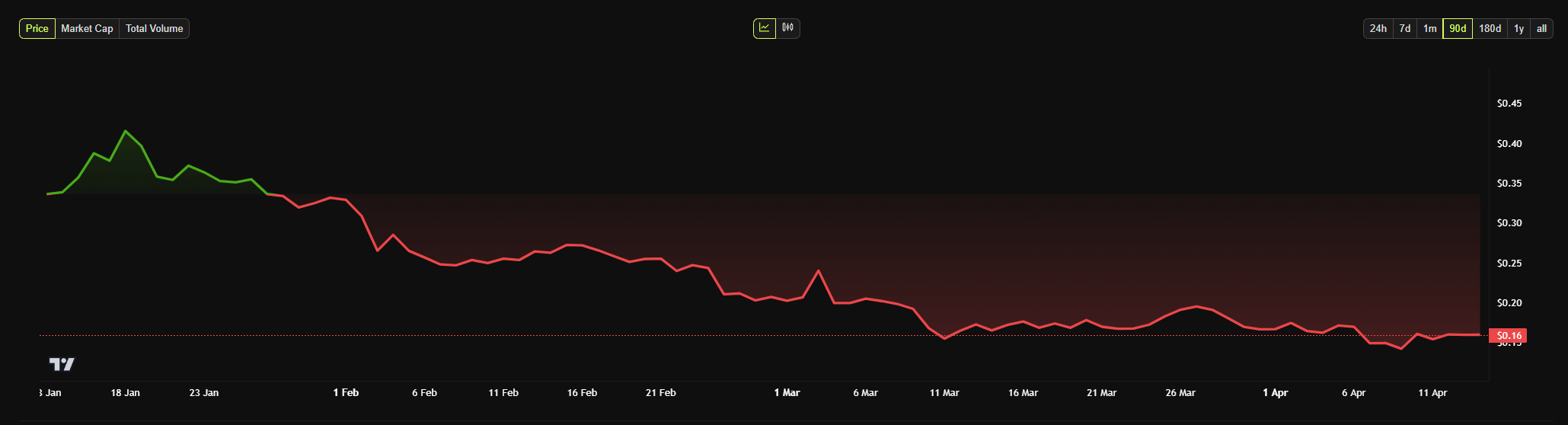
However, since the Department of Government Efficiency was officially established, DOGE's price has been plummeting. Valued at $0.36 on January 20th, it has fallen to $0.15 today.
Dogecoin price chart since January 2025. Source: BeInCrypto
A recent Finbold report revealed that Musk may now be having an opposing influence on Dogecoin's value and sentiment.
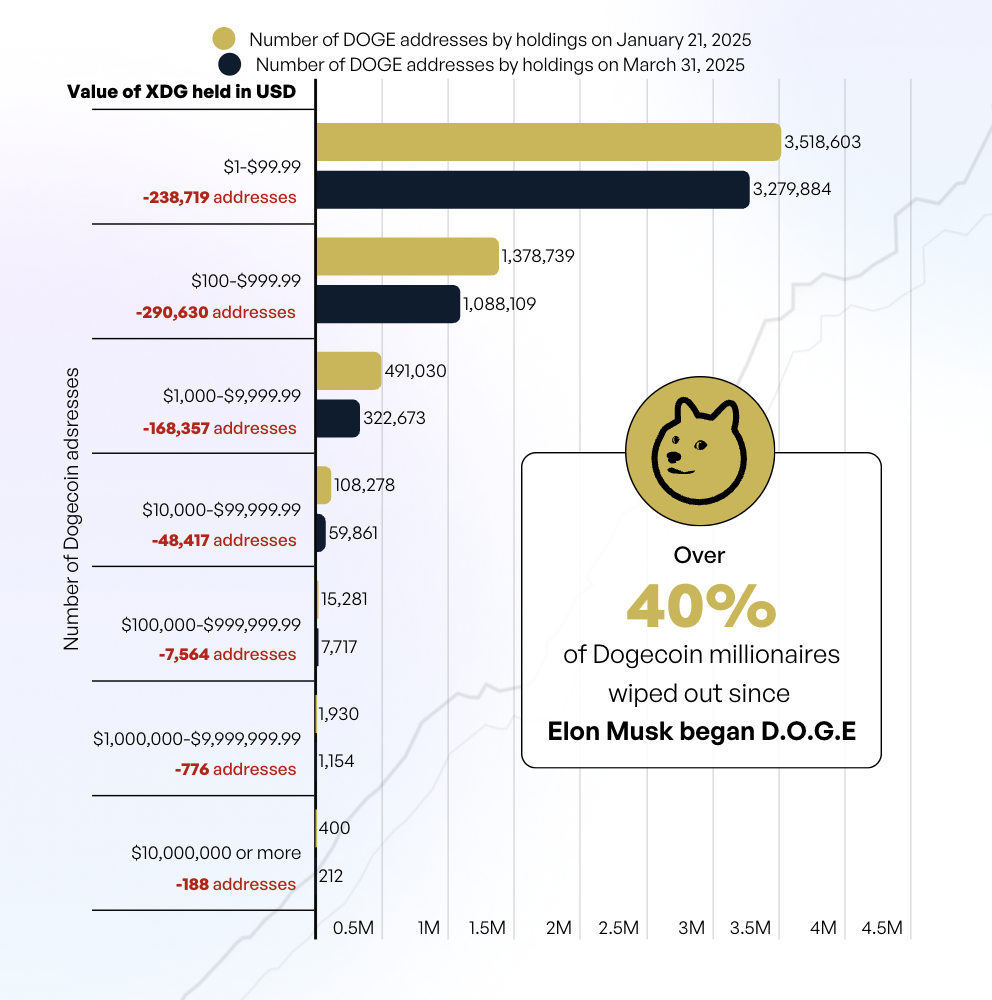
Data shows that the number of Dogecoin millionaire addresses dropped by over 41% between January 21st and March 31st. The cryptocurrency addresses decreased by 964 in two months.
Notably, the report highlighted a significant decrease in the proportion of the wealthiest Dogecoin addresses. Addresses holding between $1 million and $9.99 million decreased by 40.21% in the first quarter of 2025.
Even more striking, addresses holding over $10 million decreased by 47%, dropping from 400 to 212.
In conclusion, Dogecoin whales are selling their tokens.
Over 40% of Dogecoin millionaires have disappeared since Elon Musk started D.O.G.E. Source: Finbold.
"Musk's influence remains a critical variable in Dogecoin's valuation, with the decline of high-value addresses closely coinciding with his D.O.G.E. announcements, suggesting a correlation. However, attributing the entire reversal solely to Musk overlooks broader macroeconomic factors such as rising interest rates, increased cryptocurrency regulation, and decreased retail investor interest since 2021." – Boloder
It is difficult to assess the exact impact of Elon Musk's D.O.G.E. leadership on Dogecoin's performance, but his substantial influence on the cryptocurrency has become clear.
The ethical considerations of his influence have become hard to ignore.
**Ethical Concerns of Billionaire Influence**
According to Boloder, the Dogecoin case demonstrates the risks of parasocial investment behavior, which involves placing misplaced trust based on a celebrity's reputation or charisma.
It also shows that relying on uncritical support can lead to significant financial losses for retail investors.
The ethical issues of billionaires influencing [volatile markets like cryptocurrencies](https://kr.beincrypto.com/base-news/95249/) present considerable complexity.
"On one hand, Musk has the right to express personal views on assets like Dogecoin and participate in public discourse. However, his excessive influence means his statements can cause actual financial damage or enthusiasm among retail investors who often cannot access sophisticated risk models. Ethically, there are strong arguments that when exercising such influence, especially in markets with minimal safeguards, one should assume a higher standard of responsibility." – Boloder, BeInCrypto
Due to the unregulated nature of the cryptocurrency industry, it is currently difficult to precisely determine the extent to which Musk's actions should be held accountable.
**Musk's Influence: Market Manipulation?**
Although presented as personal opinion, Musk's tweets clearly impact Dogecoin's price, creating a legal gray area for potential market manipulation under U.S. Securities and Commodity Laws.
"According to SEC regulations, market manipulation includes intentional actions designed to control or artificially influence market prices. Dogecoin is not officially considered a security and thus outside traditional SEC jurisdiction, but the CFTC could investigate it through its anti-manipulation authority for commodities." – Boloder
The Dogecoin case is not the first instance of a high-profile individual influencing the market in a manner that is manipulative but not explicitly illegal.
Boloder highlighted two cases from different periods in the 20th century: when renowned banker JP Morgan manipulated the market during the 1907 panic and when investor George Soros broke the Bank of England in 1992.
Their manipulations were technically legal but impacted market outcomes. However, this was the 20th century, and their influence was proportionally much smaller.
"The difference today is that social media provides immediate reach to millions of investors, amplifying potential impact. Thus, even if Musk's tweets are packaged as personal thoughts, their predictable price influence can be seen as a form of market signaling, intentional or not." – Boloder, BeInCrypto
In fact, the SEC and legal experts are already discussing the potential influence of Elon Musk's Dogecoin financial market activities.
**$258 Billion Lawsuit**
Elon Musk is currently facing a $258 billion class-action lawsuit alleging he operated a Dogecoin pyramid scheme.
Filed in June 2022, the lawsuit claims Musk deliberately promoted Dogecoin through tweets, public appearances, and media interactions, generating high interest and increasing demand.
According to the plaintiffs, artificially raising Dogecoin's price benefited Musk and his companies while leaving significant losses for other investors when the price eventually dropped.
Due to the SEC's unclear legal classification of cryptocurrencies like Dogecoin, Boloder anticipates these claims will face challenges in court. Nevertheless, the lawsuit indicates growing attention to market manipulation by influential figures.
"Nonetheless, the lawsuit represents increasing legal pressure to define where promotional enthusiasm ends and financial misconduct begins. If regulatory bodies or courts determine Musk intentionally manipulated the market or misled investors, he could face civil penalties or be compelled to settle. The SEC's previous investigation into Musk's Tesla tweets, which led to settlement orders, shows the agency's willingness to act when market-influencing statements cross a certain line." – Boloder
Musk's influence on Dogecoin continues, and [its long-term impact on the Dogecoin community](https://kr.beincrypto.com/base-news/98702/) remains a subject of debate.
**Will Dogecoin Community's Resilience Persist?**
With Dogecoin whale addresses dropping by 40% in two months, questions have been raised about the meme coin's future strength and resilience.
However, DOGE's fundamental strength remains intact. That is its community.
"While initial high interest has faded, Dogecoin still maintains a highly loyal fan base. They deeply value the meme-centric culture, low transaction fees, and iconic branding. However, the large speculative forces that drove the initial peak have mostly departed in the absence of a sustained growth narrative or meaningful technological upgrades." – Boloder's conclusion.
In the future, traders will pay attention to whether Dogecoin's 'cult followers' will eventually decrease or if the strong community will maintain the 'OG meme coin'.
Disclaimer: The content above is only the author's opinion which does not represent any position of Followin, and is not intended as, and shall not be understood or construed as, investment advice from Followin.