A startup located in Poland, Clone Robotics, has stood out in the robotics industry with its AI biomimetic technology, successfully creating a robot called "Protoclone", currently hailed as the "most anatomically accurate robot in the world". This biomimetic robot, equipped with over 1,000 artificial muscles and 206 artificial bones, is opening a new era of human-machine collaboration.
Nature spent 3.8 BILLION years perfecting human anatomy.
Boston Dynamics ignored it.
Tesla dismissed it.But Clone Robotics copied it — creating 1,000+ synthetic muscles, 206 bones, and tendons that work EXACTLY like yours.
Here's why it changes everything about robotics 🧵: pic.twitter.com/2Fi9zYjaFS
— Ole Lehmann (@itsolelehmann) April 19, 2025
Table of Contents
ToggleBreakthrough Limits: Biomimetic Design Redefines Robot Physique
Unlike existing parkour robots (Boston Dynamics) or Tesla's Optimus prototype, Clone Robotics has taken an innovative path of mimicking human anatomical structure.
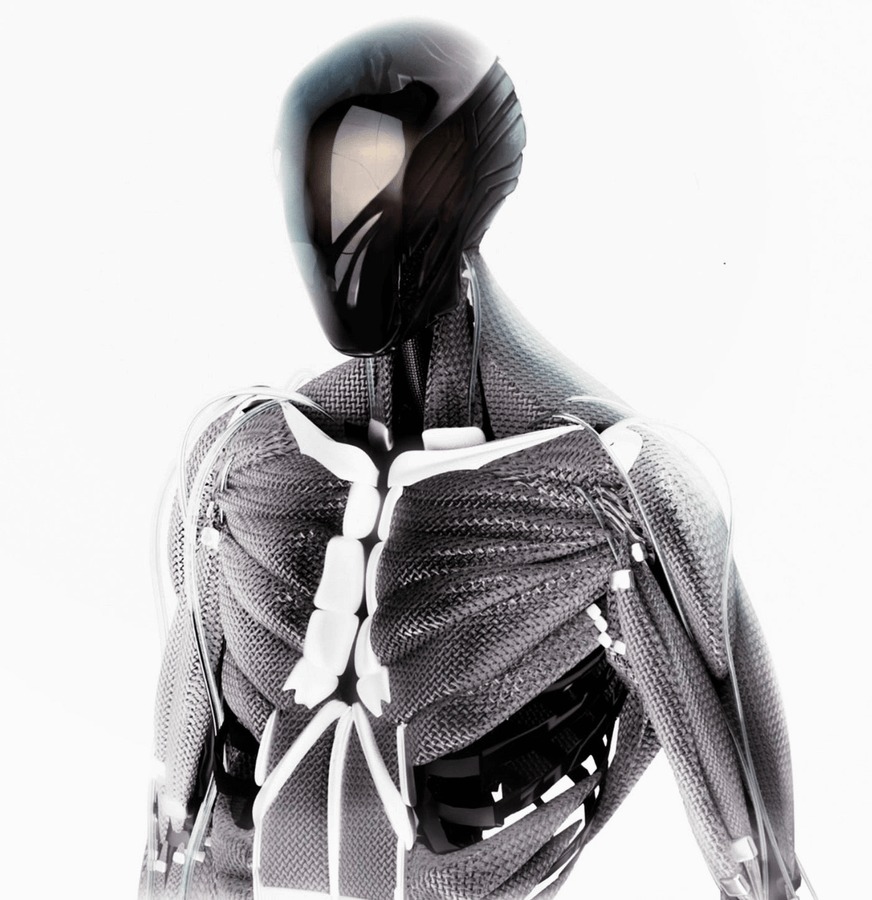
Clone Robotics' official website shows that Protoclone V1 is equipped with the following core technologies:
- Over 1,000 artificial muscles: Using Clone's proprietary Myofiber technology, these hydraulic muscles are 30% faster than human muscles, with a response time under 50 milliseconds.
- 206 artificial bones: Exactly the same number as human bones, with simulated joints, ligaments, and connective tissues.
- 500 sensors: Including 320 pressure sensors, 70 inertial sensors, and 4 depth cameras, providing precise environmental perception capabilities.
- Ultra-high degrees of freedom: The upper body alone has 164 angular degrees of freedom, with over 200 three-dimensional degrees of freedom overall, achieving near-human flexible movements.
Its precise and complex composition allows the robot to perform extremely fine actions, such as catching a ball or lifting weights, with a single-hand lifting capacity of 30 kg, which is 60 times that of similar products on the market.
From Garage to International Stage: Polish Startup's Counterattack Story
Regarding Clone Robotics' origins, the company was founded by three engineers in 2021 in Poland, initially relying entirely on self-raised funds. As the technology stabilized and matured, the company leveraged Poland's low-cost advantages to expand its business to Warsaw and Silicon Valley in California, USA.
By combining Polish engineering prowess with American venture capital resources, the company has already received investments from Pioneer Fund, Tango, and Wikus Ventures, completing Seed VC-II round financing.
It is reported that Protoclone V1 will be available for pre-order by the end of 2025, with the first limited production of 279 units, priced at around $20,000.
Conquering Robots' Biggest Challenge: High-Precision Movement and Dexterity
Although current business-use robots excel at transportation and repetitive tasks, there is still a huge gap in performance for household and daily operations. Clone Robotics' biomimetic technology fills this blank, with Protoclone now able to autonomously complete delicate tasks such as setting the table, pouring water, or folding clothes.
Its precise muscle-skeletal characteristics not only show potential in industrial scenarios but also demonstrate enormous application value in smart home and personal assistant fields.
In other words, Clone Robotics' technology is not just an engineering breakthrough but may also be a solution to labor shortage problems. Protoclone has the potential to become an assistant in housework, long-term care, medical services, and customer service.
When it further develops voice and contextual understanding capabilities, it will truly enter a new generation of "intelligent assistants", becoming an important tool to improve quality of life.
Challenges Ahead, but Future Promising
Although Protoclone currently requires suspension support and cannot walk autonomously, with leg and mobility systems still under development, Clone Robotics has demonstrated the feasibility and potential of its biomimetic technology.
Integrating over 1,000 muscles and 500 sensors is a major engineering challenge, especially for a startup with limited resources. However, this innovation from Poland may be leading global robotics technology into a new turning point, making Europe the next stage of technological revolution.
Risk Warning
Cryptocurrency investment carries high risks, and its price may fluctuate dramatically. You may lose all of your principal. Please carefully assess the risks.