Source: Outlier Ventures; Translation: Jinse Finance xiaozou
Imagine an internet that no longer competes for your attention, but silently and efficiently serves you.
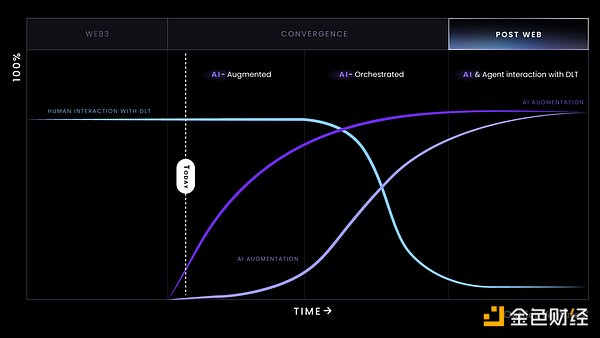
We are entering the "post-network era", where autonomous AI agents will become the primary actors of network behavior. Driven by the convergence of artificial intelligence (AI) and distributed ledger technology (DLT), this "machine-first" paradigm is not only reshaping how we browse the internet but will fundamentally transform enterprise operations, development, and competitive models.
Welcome to the Machine Economy era - where the rules of the attention economy become invalid, and entirely new business models are being born.
1. From Attention to Intent: Paradigm Shift in Internet Economics
For decades, network business models have been built around attention. Ad pushes, message alerts, clickbait headlines - all designed to extend user stay time. But in the post-network era, user delegation will replace direct interaction.
We are transitioning from the attention economy to the intent economy, where AI agents execute users' true intentions, completely bypassing attention-dispersing interaction designs. Businesses must shift from battling for eyeballs to constructing effective solutions that enable AI agents to efficiently achieve user goals. This transformation will dismantle existing models and give birth to new business forms centered on direct service to autonomous agents.
2. Emerging Business Models in the Machine Economy
The rise of the agent economy will open up numerous new tracks for entrepreneurs, focusing on meeting the needs of AI entities:
(1) Data Supply and Verification
AI agents are thirsty for data. They rely on filtered, contextualized, and verifiable datasets for decision-making. Companies providing trustworthy data (especially with traceability through DLT technology) will become the infrastructure of the machine economy.
(2) Decentralized Physical Infrastructure Networks (DePIN)
Autonomous agents generate massive infrastructure demands. DePIN will provide computing power, storage, and network connections for the machine economy. Building, operating, and maintaining DePIN networks will become significant opportunities.
(3) Agent-First dApps
Clumsy user interfaces are becoming obsolete. The key to dApp success in the post-network era is not directly serving users, but providing clear APIs, smart contracts, and composable protocols that AI agents can call. From DeFi to DeAI, developers building products for machines (not humans) will be the winners.
(4) Agent Development and Management Tools
Platforms helping teams build, deploy, monitor, and protect AI agents will trigger a gold rush, including agent development kits, cluster coordinators, AI firewalls, and agent performance dashboards.
(5) Dynamic Human-Machine Interfaces for Thin Web
Humans are not out of the picture, just changing interaction methods. The Thin Web will serve as a contextualized dynamic interface, meeting high-level needs like social connections and immersive shopping. AI will personalize and real-time integrate interfaces and content, generating customized experiences on demand.
(6) Real-World Asset Tokenization and Digital Goods
As assets like real estate and intellectual property accelerate tokenization, agents will need trusted platforms for creating, managing, and trading tokenized assets. Decentralized exchanges, RWA custody, and liquidity provision will see significant growth.
(7) Agent Trading Marketplace
Agents need secure trading. Building an agent trading marketplace with discovery mechanisms, reputation systems, and secure economic exchange has enormous potential.
(8) Delegation as a Service
Imagine hiring AI agents to manage travel, investment portfolios, or logistics. Companies can offer AI agent services in vertical domains, using trust frameworks like DLT to allow users to confidently delegate important tasks.
3. Deep Exploration of the Machine Economy's Complete Landscape
To deeply understand the post-network era theoretical framework, explore the rise of AI agents, asset tokenization, decentralized infrastructure, and the future evolution of the machine economy, please refer to our research article. (http://outlierventures.io/wp-content/uploads/2024/11/The_Post_Web_Thesis_Chapter-1.pdf)
4. How Builders Should Respond
In the post-network era, product interfaces will disappear. Agents are the users. Entrepreneurs, this means your products must have the following characteristics:
Machine readability
Credibility
Reliability
Composability
What matters is no longer the frontend interface, but the underlying functions, data access, and execution quality that AI agents can call. Although the machine economy seems to be leapfrogging, it is actually a natural progression. The foundational elements of Web3 over the past decade - decentralized infrastructure, token economics, digital identity - have already laid the groundwork. This is not the rise of machines, but the emergence of intent-collaborative infrastructure, presenting an excellent opportunity to build a smarter, more efficient future.