Key Points:
- Discussing the concept of "Future Data Leakage (Look-ahead bias)"
- Discussing the critical point in trading: Overfitting
- Double Top in 2021: The Biggest Challenge for Rigid Thinking
- Performance Review of Three Indicators and One Model
- How to set a more conservative threshold?
- If we go back to April 2021, with historical data only from 13 and 17, can the conservatively set threshold be triggered in April 21?
- Can the threshold set in this way be triggered at the second peak in 2021?
- If you don't think April 2021 is the top, then the second peak in 2021 is even less likely to escape the top, right?
What I want to say is:
Because the sample size of BTC historical data is too small, and if simply considering the previous few cycles,it is likely to fall into the trap of "future data leakage".
People at the first peak in April 2021 would not know the MVRV value at that time,which is actually the highest point of that cycle, because they could only see data from 13 and 17;similarly, when the second peak in 2021 appeared, the MVRV value was at an extremely low position,if the first peak was not escaped, naturally it would be impossible to escape the top based on the data of the second peak,thus missing the best opportunity to escape the top in 2021.
2. AVIV Indicator
AVIV can be seen as a corrected, more comprehensive MVRV, and compared to MVRV, it has a more obvious "mean reversion" characteristic.
But even so, the phenomenon of "peak (high point) reduction" is still very obvious:
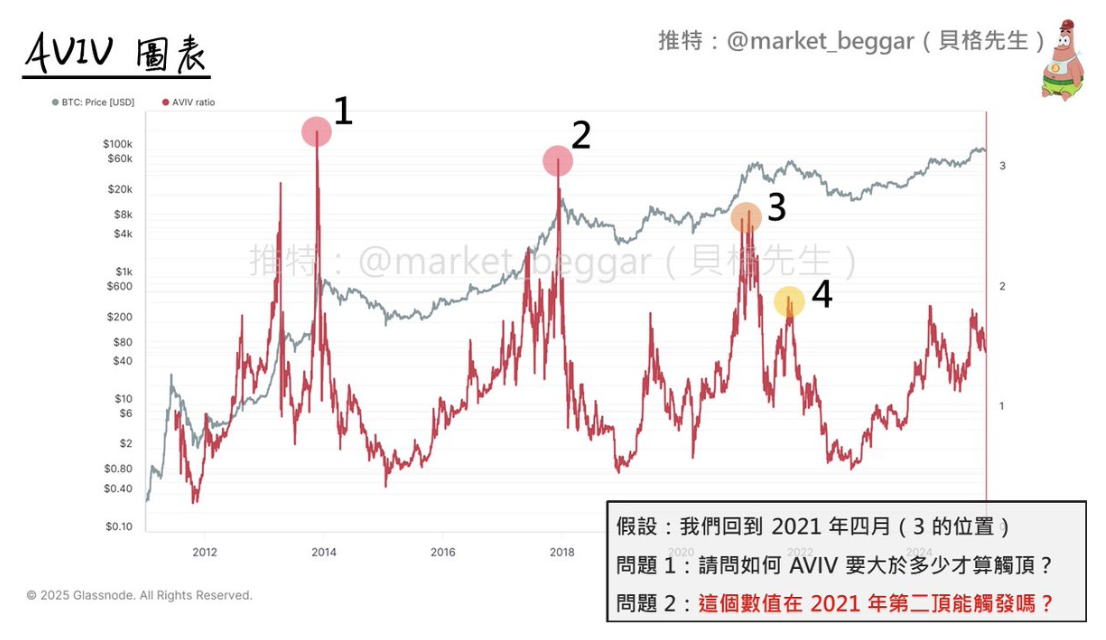 The 1, 2, 3, 4 marked in the image correspond to the tops in 13, 17, and the two peaks in 2021 respectively.
The same question, I'll directly copy the text above for readers to consider:
- How to set a more conservative threshold?
- If we go back to April 2021, with historical data only from 13 and 17, can the conservatively set threshold be triggered in April 21?
- Can the threshold set in this way be triggered at the second peak in 2021?
- If you don't think April 2021 is the top, then the second peak in 2021 is even less likely to escape the top, right?
RUP (Relative Unrealized Profit)
I have previously detailed the on-chain data RUP, and interested readers can refer to the content of the following two articles:
On-Chain Data School (IX): Market Barometer RUPL (I) - Data Introduction & Buy the Dips Application
A reader once asked: "I can understand the logic of RUP divergence, but should the historical highs that RUP has reached also be considered?"
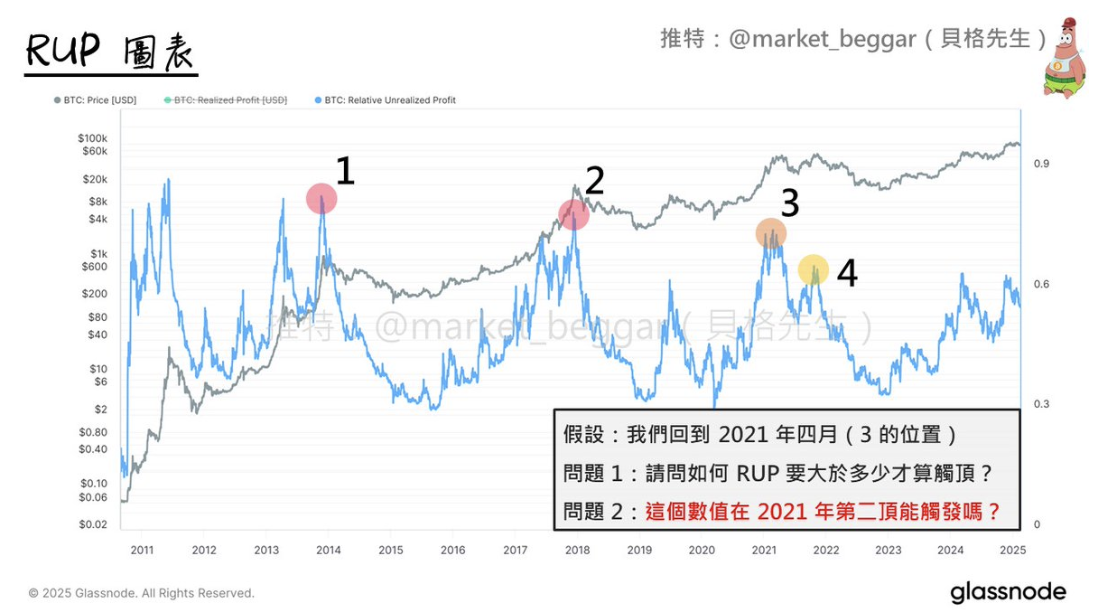 As shown in the image above, this is the historical chart of RUP, where 1, 2, 3, 4 mark the tops in 13, 17, and the two peaks in 2021 respectively.
It can be seen that even for RUP, which has been standardized for market value,the phenomenon of peak reduction still exists.
Another soul-searching question:
- How to set a more conservative threshold?
- If we go back to April 2021, with historical data only from 13 and 17, can the conservatively set threshold be triggered in April 21?
- Can the threshold set in this way be triggered at the second peak in 2021?
- If you don't think April 2021 is the top, then the second peak in 2021 is even less likely to escape the top, right?
4. Cointime Price Deviation Model
The Cointime Price Deviation model is one of the models I personally designed to observe tops,and the detailed content can be referenced in the previous post(On-Chain Data School (VII): A Brand New BTC Magical Pricing Methodology Involving ARK Research (II) ).
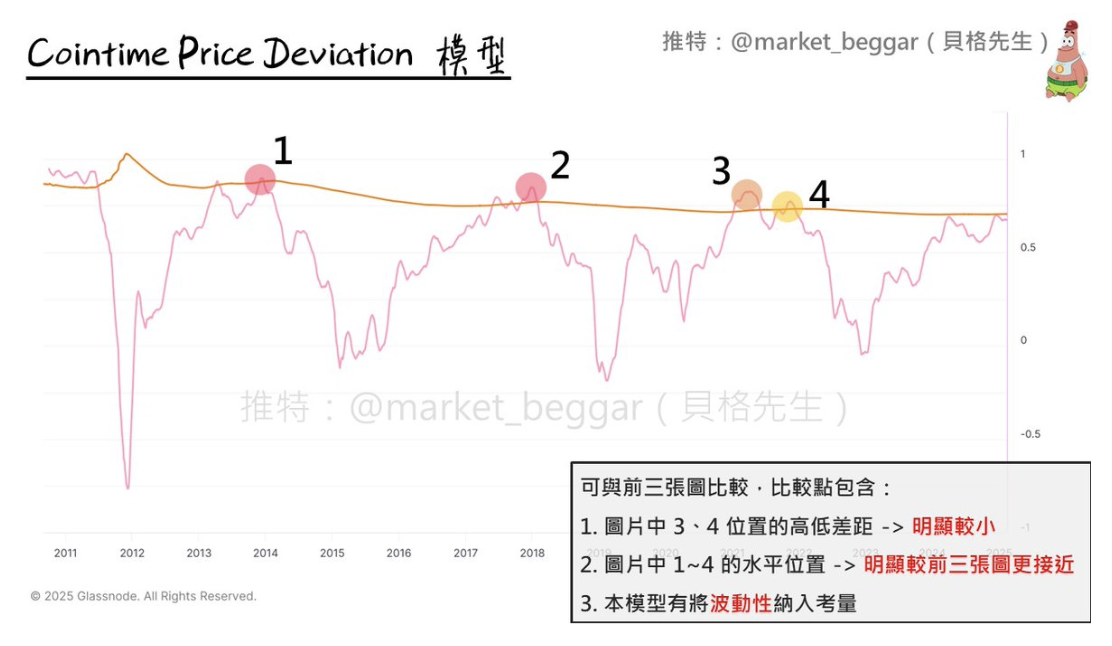 The 1, 2, 3, 4 marked in the image correspond to the tops in 13, 17, and the two peaks in 2021 respectively.
Readers can compare this image with the first three images:
- The value of the second peak in 2021 is smaller compared to the values of the previous three tops
- The values of the four tops are not far apart (but there is still a decreasing trend)
- Considering the decreasing volatility of BTC year by year
This is why I prefer to give logic to data and process it,only by doing so can we try to avoid overfitting and future data leakage problems.
Conclusion
This article mainly aims to popularize and explain the two concepts of "Overfitting" and "Avoiding Future Data Leakage", while introducing the special situation in 2021 as an example for my explanation.
This article is hardcore throughout, with slightly obscure content, and I hope it helps readers. Thank you for reading.