Editor's Note: Stablecoins break through the traditional payment trilemma of "better, faster, cheaper", providing users worldwide with an around-the-clock, low-cost, permissionless open payment network. They are evolving from intermediary tools to mainstream value carriers, and despite facing bottlenecks like fiat conversion, they have the potential to reshape the global financial landscape as network effects expand.
Following is the original content (slightly reorganized for better readability):
These three characteristics make stablecoins different from traditional payment systems and break an old rule: you cannot have all three at once. Any upgrade comes with a cost. Improving quality slows down delivery; accelerating production increases costs; reducing costs diminishes excellence. Builders usually choose to optimize one dimension - better, faster, or cheaper.
Historically, innovators could typically solve only two of the three, unable to address all problems simultaneously. Stablecoins solve this innovation trilemma.
This is crucial for retail users. Now, they can access an open payment network that operates 24/7, settles within seconds, and charges fees in cents rather than percentages.
Stablecoins are better. They represent the obvious next step in fund transfers. As the world gradually becomes fully digitized, it's natural for value itself to enter an essentially digital form. Stablecoins facilitate this evolution. They operate on open networks around the clock, storing and exchanging value more concisely than fiat currencies. Anyone can access them, and as I've written before, they are programmable.

Stablecoins are faster. Settlement speed depends on the blockchain, but even the slowest networks far surpass traditional payment systems. Ethereum transactions complete in about 12 seconds, TRON in about 3 seconds, and Plasma aims for millisecond confirmations. Traditional payment systems require hours to multiple working days. Faster settlements reduce opportunity costs, minimize monetary risks, and in emergencies, can quickly transfer funds to those who critically need them without delay.
Stablecoins are cheaper. Regardless of their blockchain, they have a lighter cost structure. Global transfer fixed fees are almost always more economical than the percentage fees included in card networks or international bank transfers. On Plasma, USD₮ transfers incur no gas fees, pushing marginal costs near zero and opening the realm of true on-chain micropayments.
Better, faster, cheaper. Stablecoins solve the previously mentioned innovation trilemma. But why is this important, and who will benefit?
Why is this important?
Stablecoins have attracted significant attention, but the "why" is often overlooked. The answer is simple: because they are better, faster, cheaper, and directly serve global retail users.
So far, we've analyzed stablecoins through the innovation trilemma. Now, let's look at the issue from a different perspective.
Mikey Kremer succinctly summarized the importance of cryptocurrencies in the digital world:
"The crypto ecosystem didn't invent a new financial system; it invented a new venue. By moving familiar services - payments, lending, market-making - into nominally 'permissionless' code, projects exploited the gaps left by over-regulated frameworks post-2008."
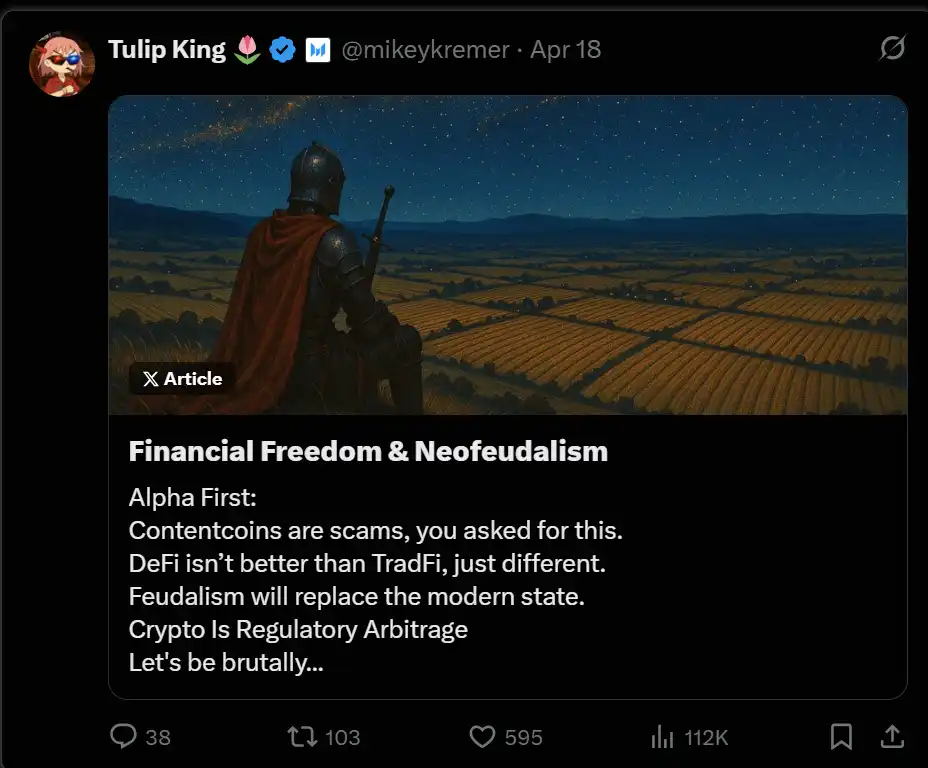
Stablecoins operate in an open field where anyone can connect - this is their greatest unlock for retail users.
In a sense, stablecoins are merely a tokenized form of dollars, nothing radical. But as Mikey astutely pointed out: "The real innovation is not the service itself, but the ability to provide it without permission."
This is the advantage of stablecoins: while breaking the "trilemma", they remain completely open and permissionless. Throughout history, true breakthroughs often come from transforming human collaboration methods, and money, as a core collaborative tool, has always co-evolved with society over centuries.
Yet, each monetary upgrade brings value transfer closer to the state. Today's payment systems are regulated, owned, and maintained by government-related institutions.
A core principle of Bitcoin is libertarianism. As more people globally wish to detach themselves from state control, they turn to Bitcoin.
Today, this pursuit of freedom also leads them to stablecoins.
For retail users, the simplest reason stablecoins are superior is that they exist for everyone. In this sense, the blockchain they depend on is essentially a permissionless payment system. People worldwide can connect and freely transfer funds in a better, faster, and cheaper manner.
But Stablecoins Are Not a Perfect Solution
Bottleneck Issues
Believing a new system has no flaws would be too idealistic. Stablecoins certainly have shortcomings. The most critical bottlenecks are concentrated in the "last mile" - the final settlement between stablecoins and fiat currencies. Key obstacles include but are not limited to:
·Liquidity and settlement issues: Large-scale stablecoin-to-fiat or fiat-to-stablecoin exchanges still heavily depend on decentralized banking channels and partnerships;
·Withdrawal and actual consumption problems: Conveniently using stablecoins for daily consumption or converting them to fiat still faces numerous frictions and remains less convenient than fiat;
·Local regulations and capital controls: Many countries have not yet established clear rules for stablecoins, and strict capital controls in some countries directly limit citizens' access to dollars.
Since the "last mile" still depends on the traditional financial system, global fund flows at this stage remain inevitably constrained by existing frameworks.
I believe stablecoins will ultimately become the default medium for value transfer. As that day arrives, these frictions will gradually disappear, and consumers will truly enjoy all the benefits stablecoins offer.
To achieve such a future, the network effects of stablecoins must continue to expand.
Network Effects
Stablecoins thrive on network effects. Monzo co-founder Tom Blomfield explains the essence of network effects: "Network effects differ from other growth - the product itself becomes better with more people in your network. WhatsApp and Skype are good examples, where the more friends you have, the more convenient and free it is to contact them."
This mechanism is highly applicable to stablecoins. As user numbers increase, so do merchants accepting them, more businesses begin integration, and the system's trust foundation accumulates.
Adoption typically follows two stages: initially, people still use cash as a mental anchor when accepting stablecoins; but over time, they actively choose stablecoins because they are indeed better, faster, and cheaper. At this point, network effects fully activate.
As stablecoin network effects continue to expand, they naturally become more suitable for broader retail users. Although stablecoins already have low entry barriers and are mostly on permissionless networks, global adoption is still gradually progressing. Two key forces truly drive adoption:
Organic network effect diffusion
Innovative approaches making stablecoins more applicable to daily life
The future of stablecoins is slowly but steadily unfolding through these means.
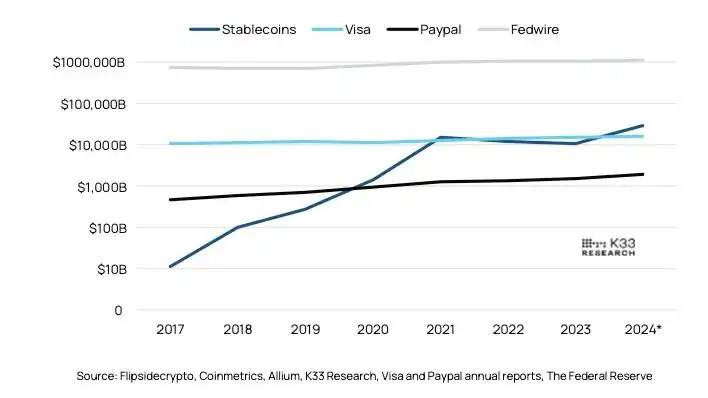
Shhhigurh precisely depicted the current state of this transformation in "The Stablecoin Paradox":
"The transaction volume processed by the stablecoin ecosystem is less than Visa or PayPal, but the average transaction amount is much larger. In 2023, Visa processed 276 billion payments, with an average of $54 per transaction; PayPal processed 25 billion, with an average of $61. Fedwire, on the other hand, only processed 193 million transactions, but each transaction was as high as $5.6 million. In comparison, stablecoins processed 2.6 billion transactions in 2023, with an average transaction amount of $4,200, precisely in the middle ground between retail and institutional transactions."
This passage reveals a key trend: stablecoins are currently in the "middle zone" - between everyday retail card swipes and institutional large-value transfers. They have not yet become the default track for processing small, high-frequency payments - Visa card swipes and PayPal clicks still dominate this layer.
However, given the obvious advantages of stablecoins in terms of cost, speed, and openness, their further penetration into everyday consumer payment scenarios is just a matter of time.
The World After Widespread Stablecoin Adoption
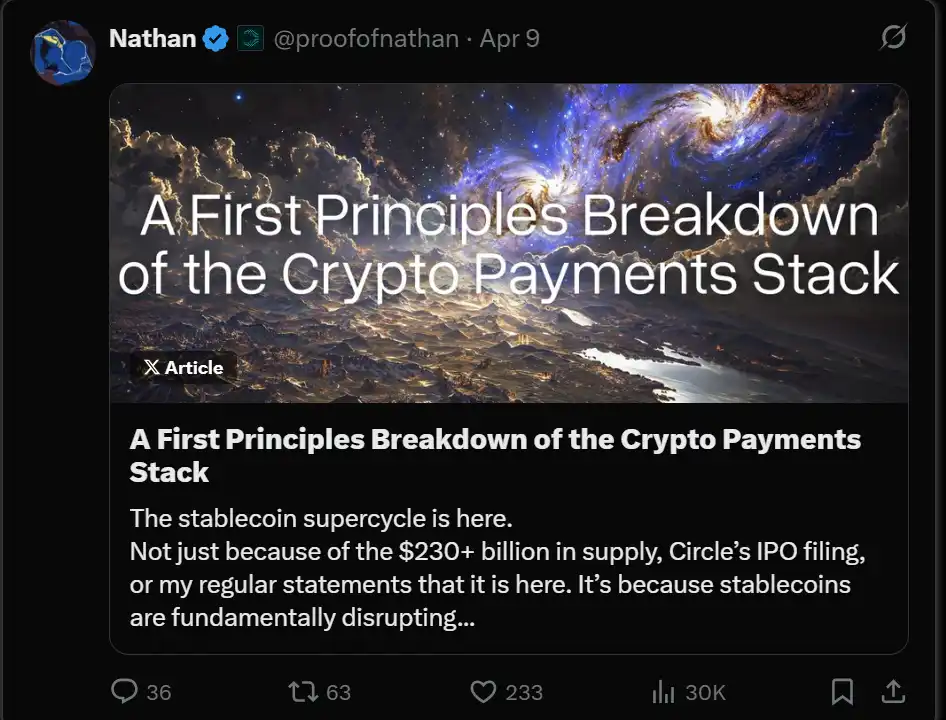
I have long thought about and written about how the future stack structure of a "stablecoin-based payment network" will be built.
If stablecoins truly become mainstream payment tools, we might see an entirely new financial interaction paradigm:
Wallet = Account, no need to open a bank account, global users only need one wallet address to send and receive payments;
Smart Contracts = Router, fund allocation, payment splitting, supply chain settlement, automatic execution of financial products, all completed on-chain;
On-chain Identity = Trust Layer, social graph, reputation system integrated with payment system, identity is credit;
Open API = Application Interface, any product can directly integrate stablecoin payments without intermediary institution permission;
Micropayments will activate long-tail scenarios, from content tipping, creator income, to real-time salary distribution, IoT device settlement, which will gradually become normalized.
In other words, stablecoins are not just a "digital dollar", but a key to opening a permissionless, real-time settlement, globally interconnected financial new world.
From the current "average transaction amount of $4,200" to the future "content tip of $0.42", this distance is built up slowly by infrastructure, regulation, experience, and network effects.
We are witnessing the construction of an era. Are you ready?
However, I rarely delve into the most ideal ultimate vision.
If retail adoption continues to grow exponentially, we will ultimately arrive at a situation where:
Stablecoins no longer need "seamless cash conversion" as support, but directly become the default currency form. Everyone uses stablecoins as the underlying payment layer, replacing fiat currency for daily settlements.
In this future world:
Value naturally circulates on-chain,
People are accustomed to transferring, receiving, paying wages, and shopping with stablecoins,
Merchants, enterprises, and even governments use stablecoins as their primary currency,
Traditional fiat currency becomes an "off-chain asset", while stablecoins become the mainstream "money" in real life.
In this "ideal utopia", stablecoins have completely triumphed. This is not just a transformation of monetary form, but a picture of a decentralized, transnational, real-time programmable financial infrastructure comprehensively replacing the old financial system.
Of course, we have not yet reached that future. But you can sense the direction of the trend: from marginal players to mainstream adoption, stablecoins are rewriting the ancient question of "what is money".

I'm obviously thinking too far ahead. That ideal future is still very different from our current world. The existing fiat currency system still feels "safe and reliable", although it has long been behind in terms of cost, speed, and accessibility. To achieve that future, the key is whether network effects can continue to expand.
Traditional network effects usually occur within "walled gardens", such as Facebook, Instagram, Monzo, Revolut - the more users, the better the experience, but the platform is closed.
Stablecoins have subverted this model: they run on open, permissionless blockchains, not in closed systems.
But even so, as more people use stablecoins for payments, the overall user experience will continue to optimize: more merchants, higher acceptance; faster transfers, lower fees; more user-friendly wallets, infrastructure, and interfaces; trust and liquidity are constantly accumulating.
Imagine: if every person in the world could access a borderless, permissionless, low-cost payment network at any time, "quick and cheap remittance" would no longer be a privilege, but a basic human right.
Final Thoughts:
All of this is happening because stablecoins genuinely bring benefits to ordinary users worldwide: easier to use, faster transfers, cheaper, and most importantly: anyone can use it without permission.

Welcome to join the official BlockBeats community:
Telegram Subscription Group: https://t.me/theblockbeats
Telegram Discussion Group: https://t.me/BlockBeats_App
Twitter Official Account: https://twitter.com/BlockBeatsAsia