Editor's Note: Ethereum faces fierce competition from new public chains like Solana, with its price not reaching new highs and activity declining. The Pectra upgrade and RISC-V proposal aim to enhance scalability, reduce fees, and maintain security and compatibility. Meanwhile, Solana has rapidly risen with its high efficiency and low cost, challenging Ethereum's position.
Below is the original content (slightly edited for readability):
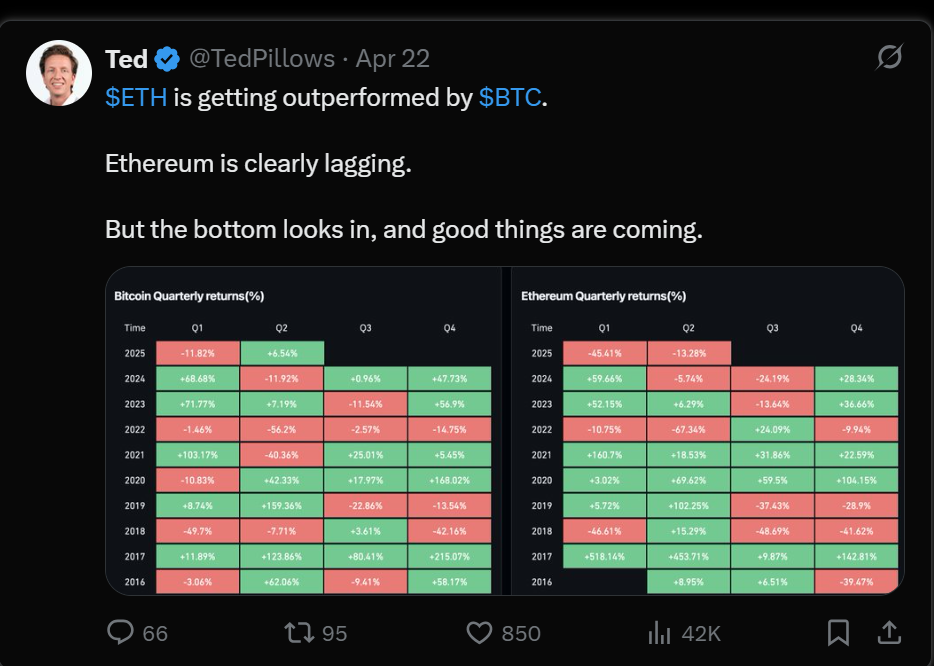
Ethereum's price has not reached a new high in 2025, with the ETH/BTC exchange rate falling to a five-year low (0.02), and narratives such as L2 and restaking have failed to effectively enhance its value. At the same time, transaction fees have dropped to their lowest level since 2020, averaging only $0.36 per transaction.


With @solana's user baseecre(asing daily active 3.25 million compared to Ethereum's 410,000), daily transaction volume far leading (35.99 million vs. Ethereum's 1.13 million), many are curious: How will this second-largest chain move forward?
Two major upgrades may reshape Ethereum's future
1. Upcoming Pectra upgrade
2. Vitalik's proposal to replace existing EVM with RISC-V technology
Pectra Upgrade (expected to go online on May 7, 2025)
The Pectra upgrade integrates two previously separate updates (the execution layer's "Prague" and the consensus layer's "Electra") into a") comprising 11 EIPs, aiming to enhance Ethereum's scalability, efficiency, and security.
Three Core Improvements of Pectra
1. Enhanced Scalability
Introducing PeerDAS and Verkle Trees technology to significantly improve transaction processing capacity
Optimize data storage, reduce node operation costs
Hash tree technology accelerates network synchronization speed
2. Lower Transaction Costs
Network congestion mitigation, with gas fees expected to drop significantly
EIP-7702 enables account abstraction, allowing users to pay gas with stablecoins instead of ETH
Batch transactions and custom security features improve wallet experience3. More Comprehensive Staking Mechanism>-(-term H transformation?)
Vitalik recently proposed a more radical idea: replacing the Ethereum Virtual Machine (EVM) with RISC-V technology, which move would fundamentally change Smart contracts p4>is V?
Unlike Ethereum's exclusive EofVM,sc ADVANTAGES include p>Open-source
Widely applied in mainstream computing hardware
More suitable for complex computations
More friendly to zero-knowledge proof (zk) technology
Why Replace the EVM?
1. Significant Performance Improvement:
V to execution efficiency by fold 100.
Dramatically reduced transaction fees.
Private transactions, and-functions will become feasible.
2. Better Support for ZK Technology:
Currently, zkEVM systems must first convert EEVM instructions to RISC-V, then generate zero-knowledge proofs, which a causes a 100 1000 times computational burden.
Native support for RISC-V will skip this conversion step.
For example, @SuccinctLabs' zkVM (SP1) can directly run smart contracts using RISC-V.
In summary: At a time when when L2 narratives and resthave not driven ETH's performance performance, the Pectra upgrade and RISC-V plan may be Ethereum's new "breakthrough" key points. The former is a short-term efficiency and fee reduction update, while the latter is a long-term revolution in smart contract underlying structure.

3. Developer Continuity:
These languages only only need to use RISC-V as a new backend target 4. Implementation Timeline:
is not an immediate change. Vitalik's proposal represents a long-term vision, expected to:
Be implemented gradually, taking about 2-3 years
Retain the system (EEVM interpreter) during the transition period
Ultimately enable Ethereum to compete with efficient chains like Solana and Monad
What Does This Mean for Ethereum's Future?
Ethereum is facing facing an existential challenge: maintaining its leading position as the primary smart contract platform while addressing performance bottlenecks that emerging blockchains have successfully overcome.
The Pectra upgrade addresses current urgent issues in staking, transaction costs, and user experience, while thesc focuses on Ethereum's most fundamental execution architecture, potentially providing it with a technical basis to compete with faster public chains while retsecurity and decentralization advantages.
What These Changes Meanrades Mean
Faster transaction processing speed
Lower fees
More possibilities for new applications (such as on-chain AI, privacy functions)
Improved scalability without compromising security
By advancing performance improvements while maintaining existing application compatibility, Ethereum is attempting to evolve without abandoning its core principles and ecosystem.
However, whether these changes are sufficient to maintain its market position in against faster-growing competitors remains to be seen.
If not Ethereum,, then who who? The latest data shows that the competitive landscape is changing significantly. While the top ten DeFi protocols still run on Ethereum, we have already seen warning signs of its diminishing lead.
Projects like @jito_sol and @JupiterExchange are rapidly developing on other chains, and @convergence onchain (Ethena's R'sWA chain) has completely left the ethereum Ethereum ecosystem. These dynamics suggest that Ethereum's leading position is not not set in stone.
According to @nansen_nansen_ai's data, Sol,ana surpassed Ethereum in total staked market value ((a significant milestone for the SOL ecosystem),), showing rapidly growing institutional confidence in Solana's staking infrastructure.

Meanwhile, Solana's revenue performance in the first quarter of 2025 exceeded all other public chains while maintaining extremely low transaction fees. This "high income + low user cost" user combination demonstrates Solana's efficient economic model.

These developments undmentsno doubt bring greater pressure to technical roadmap Although the Pectra upgrade and potential RISC-V transformation aim to address Ethereum's scalability and cost issues, Problems, solto gain market attention and share through its architecture.Original Link」 Human请问题目是否需要我翻译?
Welcome to join BlockBeats official community:
Telegram Subscription Group: https://t.me/theblockbeats
Telegram Communication Group: https://t.me/BlockBeats_App
Official Twitter Account: https://twitter.com/BlockBeatsAsia