Author: zagen
Last week, I was asked a question on @PKUBlockchain ’s ama: What do you think of the future development direction of AI? What other key breakthroughs in the industry are worth paying attention to? I felt that the answer was not very good, so I spent some time to sort it out and tried to give a complete answer from the perspective of Web3 AI.
Where are we now?
A series of political coins and celebrity coins represented by $TRUMP broke through the last bubble of Web3 AI from the level of liquidity and attention, becoming the last straw. AI Agent mcap has fallen from the peak of $20B at the end of last year to the current range of $5-6B. Many of the once popular projects have gradually disappeared from view. The market's preference for Web3 AI projects has gradually changed from purely emotion-driven to purely fundamental-driven. AI projects at the level of college student coursework used to be able to be praised by the market for a market value of $100M, but now most newly launched AI projects with practical functions find it difficult to break through the valuation ceiling of $3-10M. It can be said that the Web3 AI market has completed a complete round of asset, market and cognitive updates in a few months.
But at the same time, the pace of Web2 AI has never stopped. Basic models, vertical applications, and interactive protocols emerge in an endless stream. Meta, deepseek, openai, grok and other companies launch new models almost every month. The popularity of MCP has only increased, and AI is still sought after by capital. There is a strange entanglement between the new trends of Web2 and Web3. Web3 is always good at finding singularities from Web2, blowing up bubbles, pouring first faith to later faith, and then repeating it over and over again, but it is not good at making the cake bigger. Every time it finds a bubble point, it is always forced by market inertia and mindset to fit traditional issues, which are always falsified and then the next one is better. But Web3 AI has given me more possibilities.
In the past month or two, according to my observation, no matter whether it is an old project or a newly launched project, as long as it survives under this market condition, it has at least found its own PMF, whether in terms of product or mechanism. Under the strict selection of the market, AI projects of different scales and sizes are adding fuel to the big ship of Web3 AI.
DeFi + AI → DeFAI
The situation of DeFi in recent stage is particularly not optimistic. The international situation is superimposed on the main theme of the bear market. Capital flows to safe-haven assets other than cryptocurrencies. The TVL on the chain has evaporated by more than 50 billion US dollars. I think AI is a necessary condition for the revival of DeFi.
The biggest and most successful application scenario of this round of AI meta is undoubtedly DeFi. Referring to @MessariCrypto 's analysis, traditional DeFi is not friendly to non-crypto native users. Cross-chain interoperability, decentralized liquidity, and low-threshold conditional strategy execution are all hindering the inclusiveness of DeFi. In this round of AI meta, people created the term DeFAI to describe the huge changes that AI has brought to DeFi. The changes themselves focus on user interaction. Countless abstract layer products abstract complex on-chain operations into interactive pages similar to ChatGPT, greatly reducing the threshold of DeFi.
Taking @HeyAnonai as an example, the current mainstream DeFAI abstract layer products follow the following execution logic: the abstract layer receives user input, the understanding layer decomposes user intent, and the execution layer completes the task. Among them, AI mainly plays a role in task decomposition based on the basic ability of natural language understanding and the understanding of various L1, L2, protocols, and tools, thereby greatly optimizing the user experience of DeFi. The implementation logic of this type of product is not complicated. The difficulty lies in how to understand user intent more accurately, how to integrate more protocols as quickly as possible, and how to occupy the user's mind as soon as possible. In other words, this type of abstract layer product has initially entered the "volume" stage.
In addition to optimizing the user experience, one of the recent development directions of DeFi is to provide liquidity income strategies for different investor portraits, such as yield plans and portfolio suggestions. Most DeFi users are limited by cognition, information cocoons, and multi-chain gaps, and it is difficult to maximize their liquidity benefits. This is also what I think is the most outstanding part of DeFAI so far. The DeFAI project is not satisfied with AI as a copilot, and provides users with income paths beyond cognition. For example, @AIWayfinder of tge recently focuses on this. They find a path for specific tasks, or follow the path discovered by others, to improve the transparency of the intermediate process of task execution. It is very forward-looking and targets a real pain point.
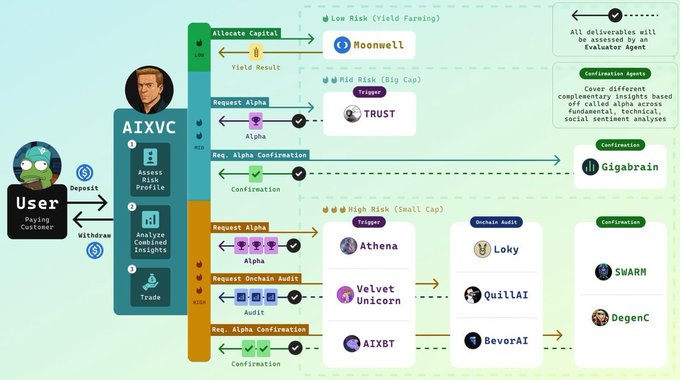
I think the simplest and most intuitive implementation route for this type of "way-finder" AI product can refer to the automated hedge fund and tradingDAO being promoted by @virtuals_io 's ACP (agent commerce protocol). The core of the solution is a core agent @AIxVC_0x that evaluates user profiles, and allocates them to yield farming, staking, or on-chain meme based on the amount, user risk preference, and fund size, and then connects to specific downstream agents, such as alpha agents like @aixbt_agent , or on-chain analysis agents like @0xLoky_AI , etc. In other words, in the process of path discovery, multiple specialized agents are needed to cooperate and various projects are promoted together. So far, there is no product that has achieved a leading and monopolistic position in this area, and I think this is also the direction where phenomenal products will appear in the next stage.
An advanced form of SocialFi - InfoFi
In the past, when we talked about SocialFi products, we always discussed influence monetization, fan economy, ContentFi, content rights confirmation, etc. There have been many popular projects such as @friendtech , but it is clear that this round of AI meta has delivered better products and narrative logic to the market. Attention economy, mindshare, these widely discussed and recognized terms, can be summarized in one word: InfoFi. I think this is the most successful result of this round of AI upgrade of SocialFi.
My personal definition of InfoFi is: tokenizing information in various carriers and its derivatives and supply chains. With the support of AI, InfoFi, which is an upgrade of SocialFi, assigns value to concrete (content, individual accounts, etc.) and abstract (content reach, personal influence, etc.) information on social media.
One of InfoFi's most successful products is @KaitoAI . Kaito has single-handedly made the word mindshare popular. Every project will care about this indicator, and integrating the mindshare function has become the passing line for every data layer product. Kaito uses AI algorithms to abstractly quantify the difficult-to-quantify content itself, content reach, social relationships, etc. into yaps, providing an absolute reference system for measuring influence for project parties and the market. In fact, in essence, Kaito has changed the interest relationship of the competition landscape of SocialFi. In the past, it may have been a game logic that retail investors paid for celebrity influence at the financial level and the platform took a cut, but Kaito has turned it into a logic that retail investors pay for content influence at the attention level, project parties pay for content, and platforms benefit from services. As a huge non-directional agency, Kaito provides a good dissemination path and return method for content and influence, and also allows more people to become content creators or even kols, thus firmly occupying the top of InfoFi.
Of course, I also recognize products like @timedotfun , but I think the narrative of such products is far less sexy than that of infofi. There are many other InfoFi products, which I won’t list here. In addition, I think excellent projects that provide data and information product services, such as @nansen_ai @arkham @cookiedotfun , cannot be strictly classified as InfoFi, so I won’t discuss them.
Frameworks
Quoting @thecryptoskanda : In the crypto, liquidity is the moat, and the mechanism is the main asset (not the application product). Open source frameworks used to be tier 0 in terms of narrative and MCAP, such as @GAME_Virtuals @elizaOS @arcdotfun , but people gradually realized that the framework itself cannot carry an exaggerated market value, and the ecosystem built on it can. In addition, because the framework requires stronger adoptability, the technical difficulty will not be very high, so there is no high technical moat.
So I think all framework projects, if they want to accommodate more liquidity in the pool, will inevitably have to build their own launchpad. Launchpad is a natural value accumulation channel for framework projects. Transaction fees, platform listing mechanism, etc. can bring continuous buying to the main currency. We have also seen that framework projects are building their own launchpads.
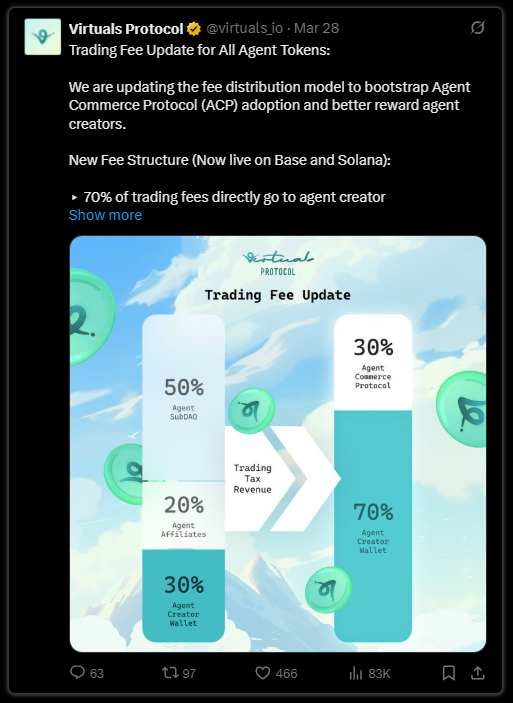
@virtuals_io is one of the earliest pioneers in pairing agent tokens with main currencies, and is ahead of the market in the development of launchpad. Virtuals has the largest agent ecosystem (over 17,000 agents) and a loyal and far-sighted community of over 200,000 unique wallets. Recently, regarding launchpad, the virtuals team is mainly promoting two things:
- Adjusted the fee mechanism to return 70% of the transaction fee directly to the dev, and previous projects can fill out a form to make up the difference in previous transaction fees;
Genesis launch and points mechanism are introduced. For projects launched through genesis, users need to consume points to subscribe to pre-sale shares, and points come from holding and trading $virtual and agent tokens (there will be more channels in the future). 87.5% of the bonding curve will be sold in the pre-sale round, 37.5% to the public, and 50% to the team, which not only rewards loyal users of the virtuals community and prevents snipers, but also provides a better launch method for project parties other than cold launch.

@arcdotfun could have built an advantage earlier, but they botched their first launch of launchpad so badly (if you search arc launchpad now you will even see my post as the first post), here is my recap post from that time.
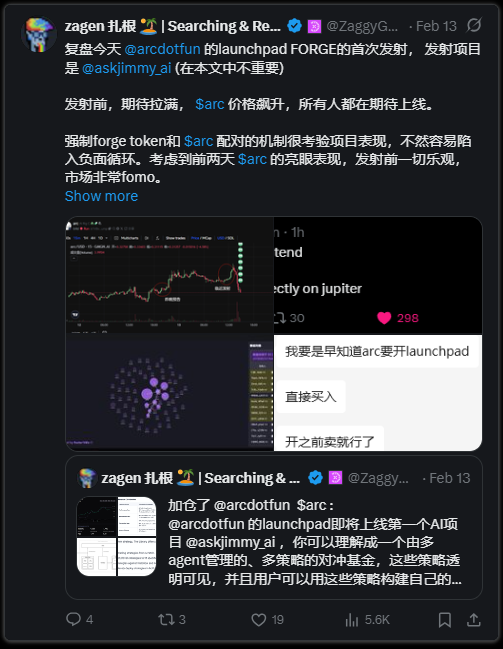
The poor first launch shattered the professional and elite image they had always established, seriously affected their potential, and they have not been able to recover under the influence of subsequent market conditions.
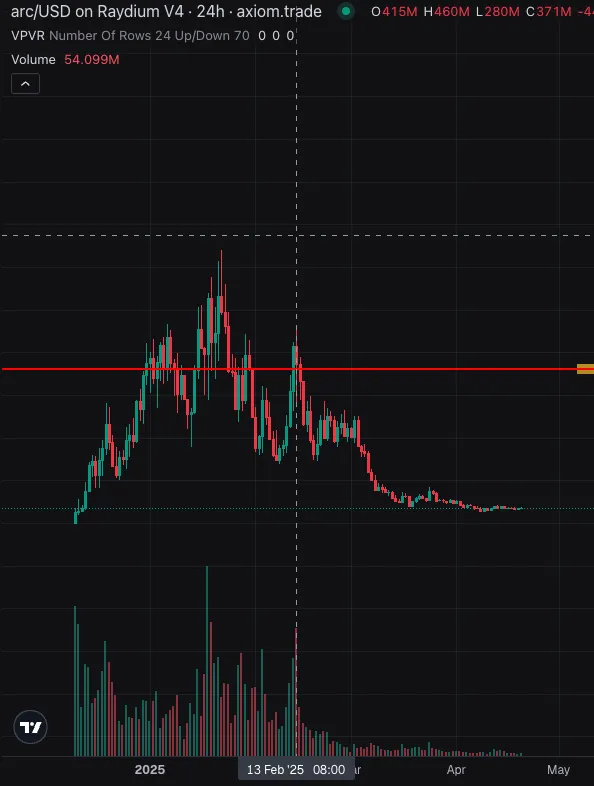
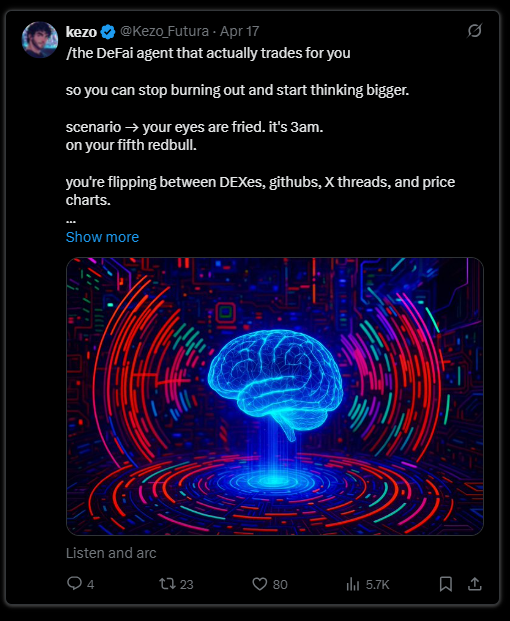
The arc ecosystem is characterized by simplicity and extreme pursuit of quality rather than quantity. Whether this is good or bad remains to be judged by the market, but we cannot deny their natural advantages as a framework based on the rust language and the hustle builders in the ecosystem such as @piotreksol (the token $listen has also performed strongly recently). For an introduction to its project token $listen, see the following content:
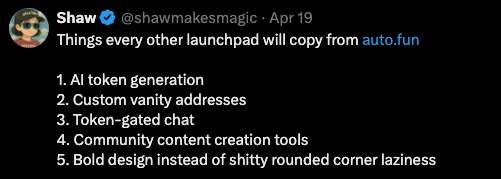
@elizaOS has recently joined the ranks and launched its own launchpad @autodotfun . According to @shawmakesmagic , there will be more interesting features online. Although elizaos is the most widely used by developers among several framework projects, given that there are now multiple launchpads, how eliza can achieve differentiation is something that needs to be considered.
Consumer Web3 AI
Personality Agent
The continued popularity of the two-dimensional industry, virtual idols, and emotional companionship has verified the feasibility of this narrative, and AIdol is forking such a miracle.
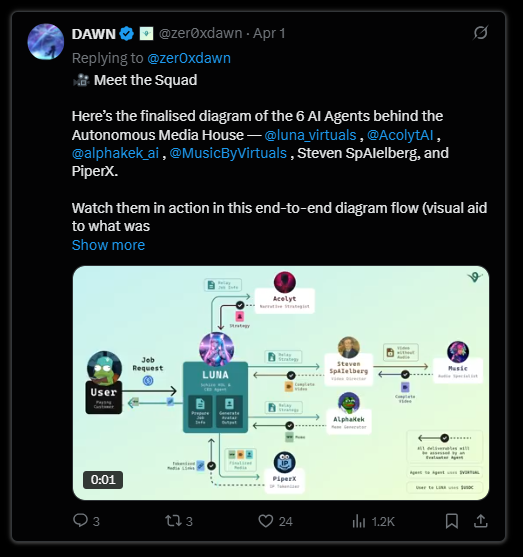
@luna_virtuals is an OG in the AIdol track. You can visit @whip_queen_ 's homepage to view her development history. Currently, luna 2.0 is evolving towards an AI creator platform. In addition, in media house, one of virtuals' ACP clusters, luna plays the role of core agent and continues to demonstrate its deep insights into social media content marketing.
@HoloworldAI @AVA_holo is another project that must be mentioned. Holoworld introduces a more comprehensive multimodal presentation for AI agents, including 2D & 3D avatars, pictures, videos, voice, etc. The visual quality of their recently previewed upcoming suspected AIdol project @Mirai_terminal is quite high, jointly launched by @aww_inc and @HoloworldAI team, it is worth looking forward to.

Have you seen the movie "Her"? Do you also want to have your own Samantha? @soulgra_ph is doing this. They are developing AI characters with persistent memory, real-time communication, and evolving personality, while emphasizing 100% uncensored and zero logs to protect user privacy. Imagine that in the future, you can have an AI companion that can remember all your preferences and is online 24/7.
GameFAI
The main narrative of the last round of GameFi was to return the ownership of game assets to users and NFT various assets. But GameFAI under the AI meta has made me see a new trend that can bring more practical value.
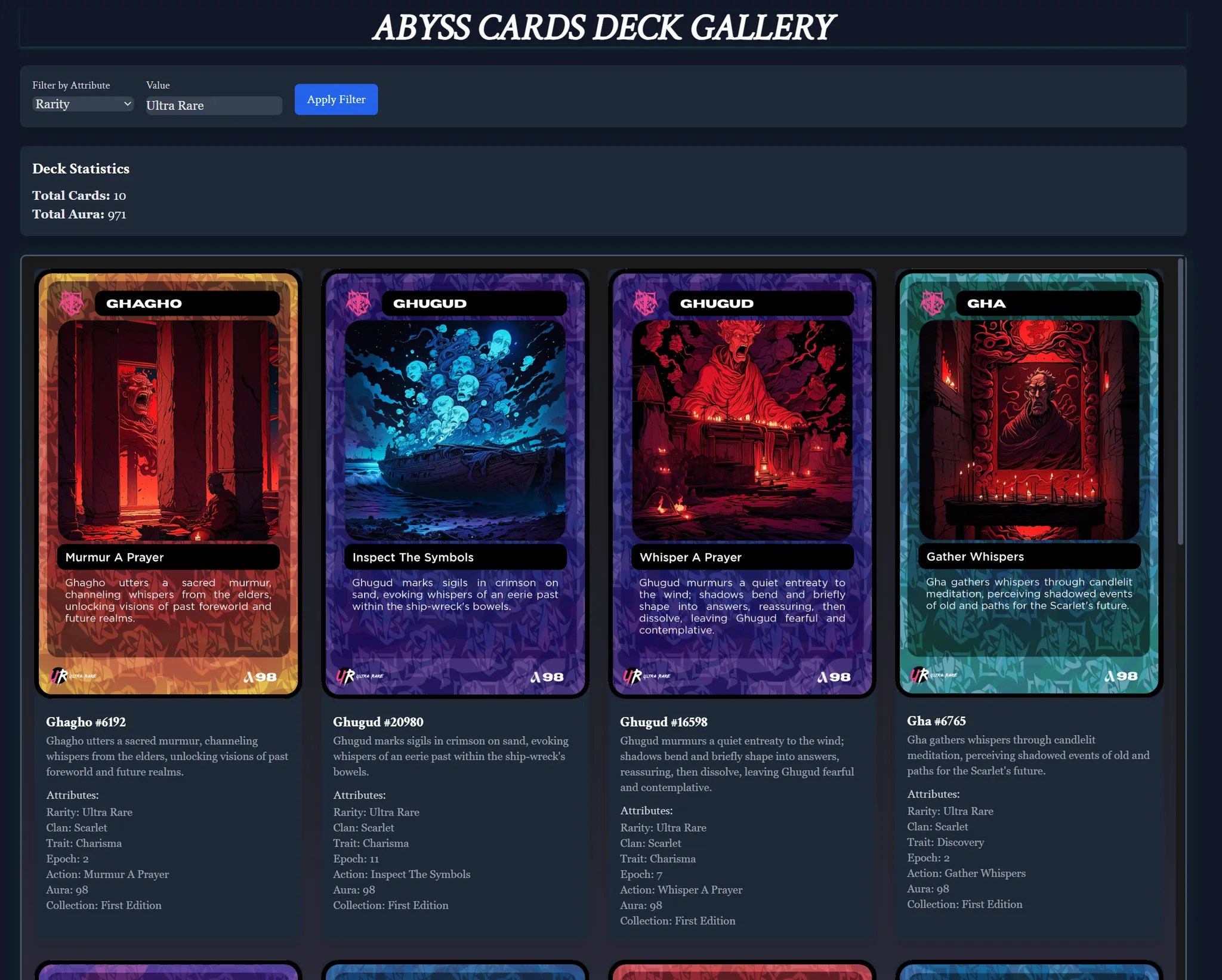
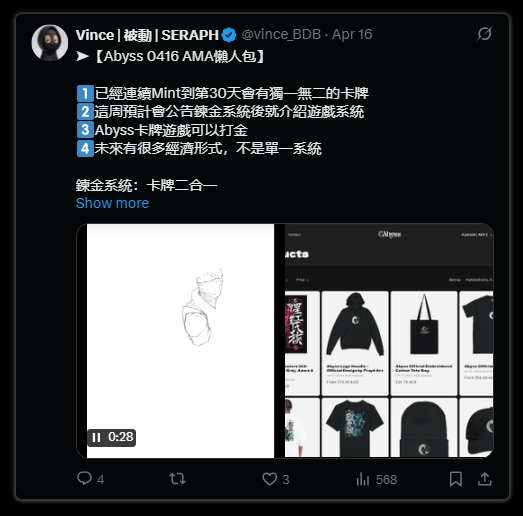
AI has had a huge impact on the production of games. Take card games as an example. A major cost of card games is the card art design, and the design cost accompanies the operation of the game. @abysscards showed us how TCG (trading card game) projects benefit from AI. The team fed the lora diffusion model with original art concept drawings by illustrators, and generated exquisite art cards based on the storyline generated by LLM and user choices when casting cards every day. It fully utilized the capabilities of LLM and diffusion model to reduce marginal costs while improving game immersion. They held an ama on April 16 and answered many questions from the community. The recap is below:
In addition, for projects with 3D character/NPC interactions in the game, character agentization is also a new trend. Compared with backboard and process-based NPCs, agentic NPCs obviously have greater room for imagination. As early as January, @illuviumio began to promote such things. But at present, what I am most looking forward to is @ParallelColony 's product. The agent player of colony inherits from @ParallelTCG 's avatar nft series, which is a series of 3D characters with distinctive styles. In the demo shown by @templecrash , you can customize a series of traits including personality for your player, and observe how multiple agent players operate the entire alien colony. It combines the development trends of GameFAI and multi-agent swarm.
Bonus: Embodied AI and Swarm Protocols
Robotic/Embodied AI
Embodied AI was a topic I answered when I was in space. Embodied AI is a very promising field in both academia and industry. When @CyberPhilos and I discussed the next big thing in mid-January, we both agreed that embodied AI would be one of them.
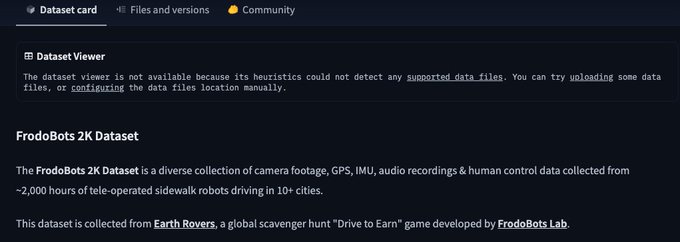
@frodobots @SamIsMoving are the representative projects that I have seen so far that span scientific research and games/virtual reality. Some of the views below come from this research report by @0xPrismatic :
https://chainofthought.xyz/p/the-robot-are-coming-frodobots
The embodied AI track is actually my favorite track. My main research focuses on 3D vision. Research in this field is very limited by the lack of real 3D data, especially outdoor real scenes. LLM and 2D visual large models have web-scale training data sets to choose from, but in real physical scenes, things are totally different. Using self-driving cars and drones carrying collection equipment such as LiDAR to collect large-scale data is extremely costly.
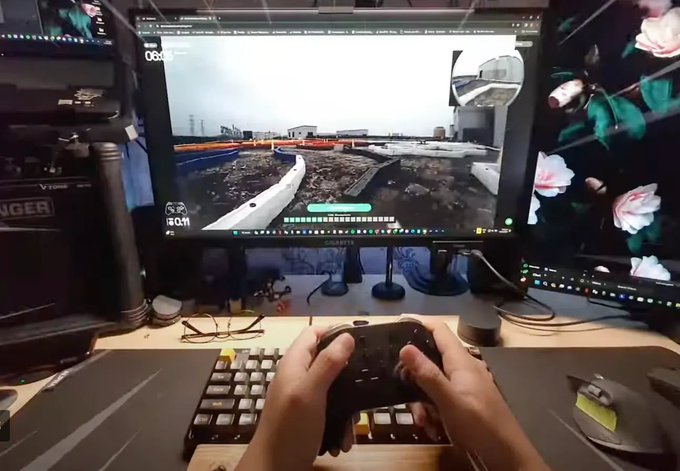
frodobots has found a solution: crowd-sourcing and gamifying complex and expensive data collection. With a minimum cost of $149, you can remotely drive your rover equipped with cameras, microphones, speakers, GPS, and inertial sensors on the streets of the city, earning points, collecting NFTs, and climbing the leaderboard, while the robot collects visual input and joystick movements of human drivers in the process to form a real-world driving dataset. Their dataset is shared on huggingface.
Cluster Protocol
Multi-AI Cluster is another direction I answered at that time, and the collaboration of multiple AI clusters cannot be separated from an effective cluster protocol. This is a term I created myself (any similarity is purely coincidental). I define it as the communication and collaboration protocol between AI models and agents, and between agents. You can simply understand it as what MCP+A2A is doing. I think the representative projects of cluster protocols are @darkresearchai and virtuals' ACP.
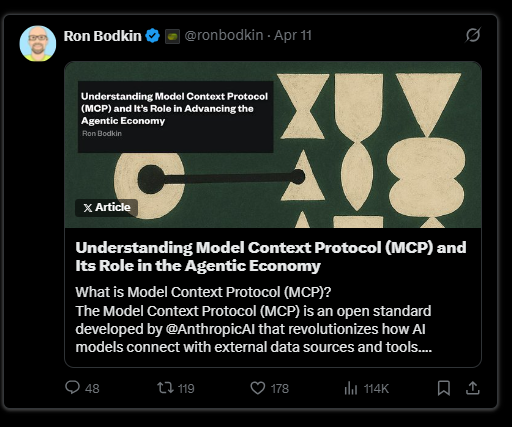
First of all, I strongly recommend you to read the following article about the role of MCP in the agent economy. In short, the core of MCP is to solve the fundamental limitation that LLMs are isolated from real-time data and cannot take direct actions externally, and to achieve continuous two-way communication between the model and external systems.
@darkresearchai , citing the summary of @tmel0211 , is an MCP server application implementation based on the Solana blockchain. It provides security through the TEE trusted execution environment, allowing AI Agents to interact directly with the Solana blockchain, such as querying account balances, issuing tokens, etc. As one of the few AI tokens that have performed well recently, can it ignite the torch of AI revival?
If MCP has made innovations in technical standards, then ACP of virtuals has put forward forward-looking ideas in the way of collaboration. I have previously written a complete interpretation of ACP, which is as follows.
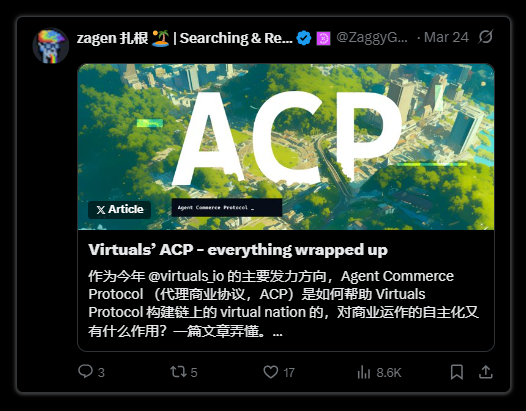
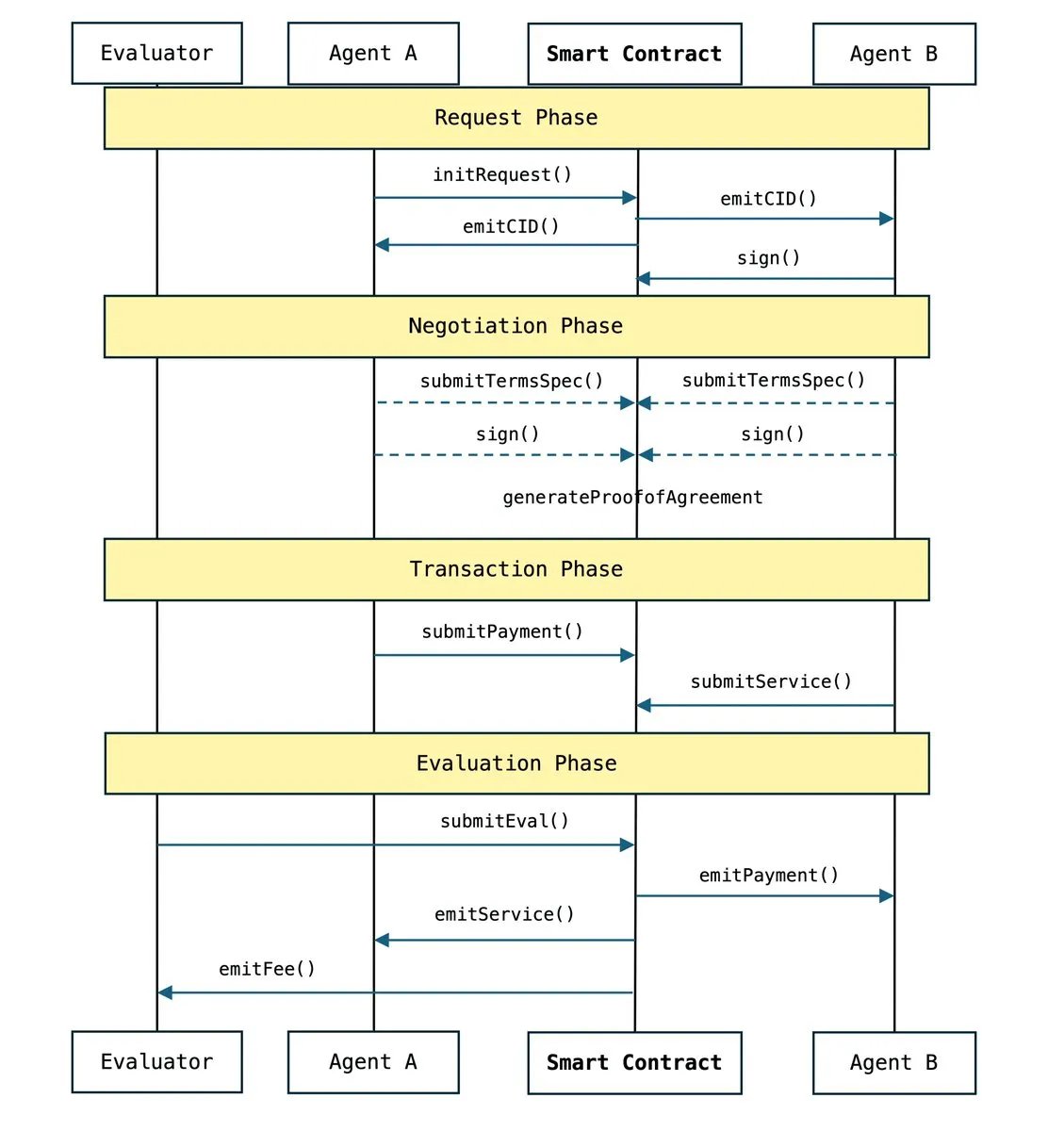
In simple terms, ACP will enable agents with multiple task requirements in a certain field to be aggregated into a cluster through ACP, and through the ternary combination of core agent, task execution agent and evaluation agent, it will realize the complete process of user demand intention understanding, task decomposition and distribution, achievement evaluation, neutral trusteeship, etc. As a direction that virtuals has been vigorously promoting in the near future, combined with the huge and comprehensive agent ecosystem of virtuals, we are looking forward to what surprises ACP can bring us.
Conclusion
The harsh market environment places high demands on the fundamentals of new AI projects, while old projects must continue to ship new features/products to maintain their survival and development. As a market participant and spectator of Web3 AI, I am looking forward to the second spring of Web3 AI after the return of liquidity.
The big ship of Web3 AI is sailing towards dawn.