TLDR
- This article will introduce a top and bottom detector provided by Glassnode website
- Explain the obvious but little-known flaws from a trading strategy development perspective
- Explain how to correctly review trading strategies, indicators, and models
Introduction to BTC top and bottom detector on Glassnode website
On the on-chain data website Glassnode, there is a BTC periodic top and bottom signal detector called "Cycle Change Detection Via Drilling Methods".
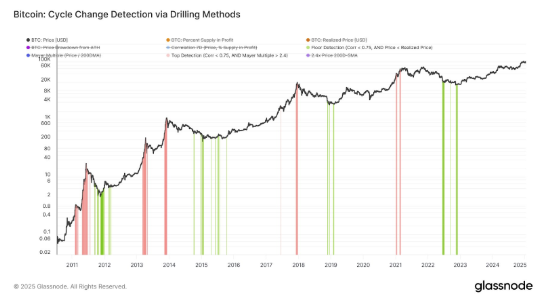 As shown in the picture above, this is the effect of the top and bottom detector. At first glance, the performance in the past three cycles seems to be pretty good, but in fact there are fatal problems .
We will talk about the problem part later. First, let me introduce to you the design principle of this model.
There are four main concepts used in the model:
- Realized Price
It can be regarded as the average holding cost of BTC in the entire market. I have introduced the details before, please refer to the previous post ( Chain Data School (I): Do you know what the average cost of BTC in the entire market is? ) .
- Mayer Multiple
The definition of the Mayer Multiple is "the ratio of Bitcoin price to its 200-day simple moving average", or in other words, "Bitcoin price/SMA(200)", which is equivalent to measuring "how many times the current price is MA(200)".
- PSIP (Percent Supply In Profit)
The definition of PSIP is "the proportion of profitable chips in the circulating BTC". I have written about the details before. Please refer to my previous teaching ( On-chain Data School (V): How many people are actually making money? Let me show you how to understand the objective sentiment indicator PSIP! ) .
- Correlation between price and PSIP
In theory, the price and PSIP trends should be highly positively correlated, because the higher the price, the higher the proportion of chips in a profitable state should be. Therefore, the original author believes that once the correlation between price and PSIP decreases significantly, the market sentiment is extreme.
After understanding the above four concepts, let’s talk about how this model detects tops and bottoms.
Bottom signal
The bottom signal appears when the following two conditions are met at the same time:
- Price is lower than Realized Price
- The 7-day correlation between price and PSIP is below 0.75
Top signal
The top signal appears when the following two conditions are met at the same time:
- Mayer multiple > 2.4
- The 7-day correlation between price and PSIP is below 0.75
From the perspective of trading strategy development, the model itself has major flaws
Imagine:
If someone today uses the above words to introduce you to this top and bottom detector, in addition to its high accuracy in history, the logic also seems very rigorous, so you decide to use this model to escape the top in this cycle...
This is how most retail investors are persuaded, and it is difficult for them to notice the flaws at first glance .
Next, let’s talk about what the problem is with this model?
Flaw 1: Parameters have the problem of looking for a sword on a boat
When I first saw this model, I asked myself a question: " Why is a correlation below 0.75 a warning sign? " Obviously, there is no clear logic behind this parameter setting. Given that the historical cycle of BTC is so short ( the number of samples is seriously insufficient) , the flaws of the "cutting the boat to find the sword" approach have clearly surfaced.
Flaw 2: The Meyer multiple itself is a complete waste of time
If the correlation between price and PSIP has some logic (deduction) in itself, then the Mayer multiple is a perfect example of trying to find a sword by looking at the marks on the feet. Simply using the ratio of price to SMA (200) to detect tops and bottoms seems to have performed well in history, but the problem is that market conditions change year by year. Why must the Mayer Multiple be > 2.4 when the top of this bull market appears ?
Flaw 3: The correlation filter is too poor and the strength of detecting tops and bottoms is too weak
When I saw the idea of "correlation between PSIP and price", I was actually quite interested. So I immediately used Glassnode to write a simple "signal based purely on correlation" to see the correlation between PSIP and price and its filtering effect.

As shown in the figure above, I set "correlation between price and PSIP < 0.75" as the condition, and a blue signal will be displayed once it is met.
Readers should have discovered this, right? The whole frequency is blue...
Therefore, the correlation itself can hardly be used as a powerful screen for top and bottom detection, or the parameter of 0.75 itself is problematic. If we have to give an explanation from the graph, the most we can draw is the conclusion that "signals appear more frequently when approaching the top", but the conclusion itself is still very rigid.
Following this line of thought, I simply removed the "correlation screen" in the model, leaving only the Realized Price for detecting the bottom and the Mayer Multiple for detecting the top as signals, and obtained the following simplified model signal chart:
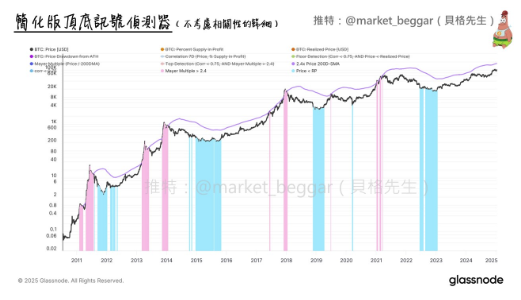
Have you noticed anything? There is hardly any significant difference in the effect.
Therefore, this picture directly confirms my previous inference: the correlation screen has basically no effect.
Summary of key points and conclusion
The main purpose of this article is to take readers to experience firsthand how to objectively judge and examine a trading strategy, model or indicator from the perspective of professional trading strategy development .
I often emphasize and warn my readers: "This bull market will be a bloody test for more than 90% of the top-escape indicators on the market." The more top-escape indicators there are, the better. The number is not the point . The point is whether there is a set of scientific and logical arguments behind the indicators .
In the Internet age, the amount of information has exploded, and countless seemingly awesome theories can be seen everywhere. In this environment, I think the most important thing is to have the ability to " think critically ."
Otherwise, readers can ask themselves: If I only wrote the model introduction in the first paragraph of this article today, how many people would choose to believe it directly? After all, it looks pretty impressive, doesn't it?
In addition, I would like to add one more thing: I personally believe that when it comes to choosing a buy the dips, there are actually more efficient indicators than Realized Price, because Realized Price takes into account the chips in the entire market, including those BTC that have not been moved for a long time and have been lost. I personally think that it lacks flexibility.
Below, I have made a picture of the key points of this article for your convenience:
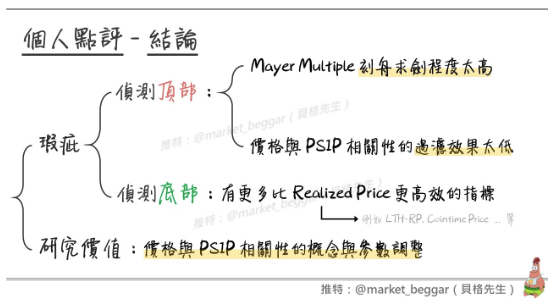 The above is today’s sharing. I hope it will be helpful to all readers. Thank you for your reading.