2024 is a milestone year for the Web3 industry. The market value of Crypto and the adoption of industry infrastructure have reached unprecedented heights, while the criminal industry has also begun to optimize its business or create new criminal paradigms using Crypto infrastructure more extensively. This report statistically analyzes and discloses the scale of major crypto crime types and clarifies the impact of compliance facilities on the criminal industry scale, calling on the industry and government to pay attention to the harm caused by crypto crimes.
Due to space limitations, this article only shows part of the report's conclusions and data. Welcome to download the complete version from the Bitrace official website.
Cryptocurrency Crime Situation Remains Severe
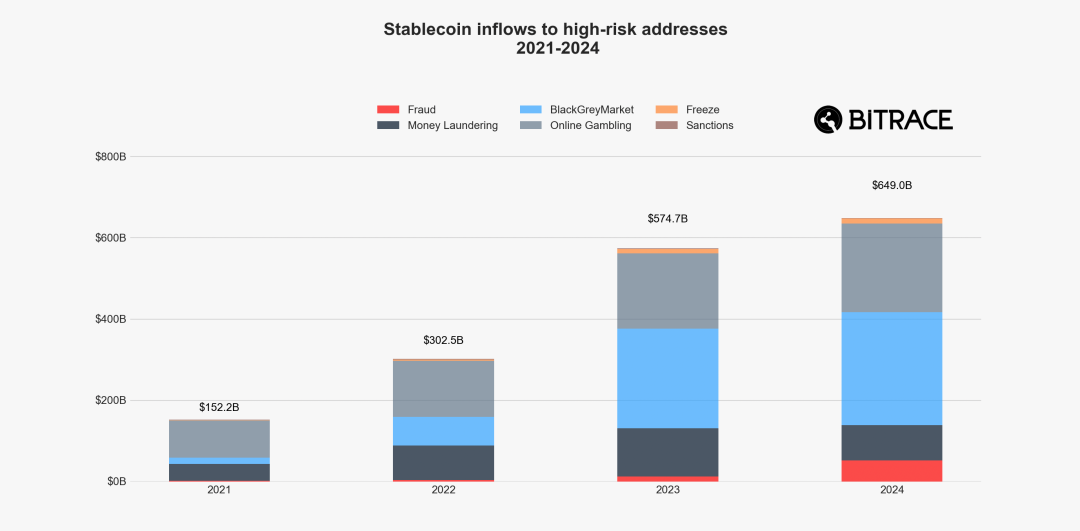
High-Risk Addresses Receiving Stablecoin Amounts
Considering that risk activities mainly occur on Ethereum and Tron networks, Bitrace defines blockchain addresses used by illegal entities to receive, transfer, and store stablecoins (erc20_USDT, erc20_USDC, trc20_USDT, trc20_USDC) on these two networks as high-risk addresses. In 2024, the total receiving scale of such high-risk addresses reached $649 billion, slightly higher than the previous year.
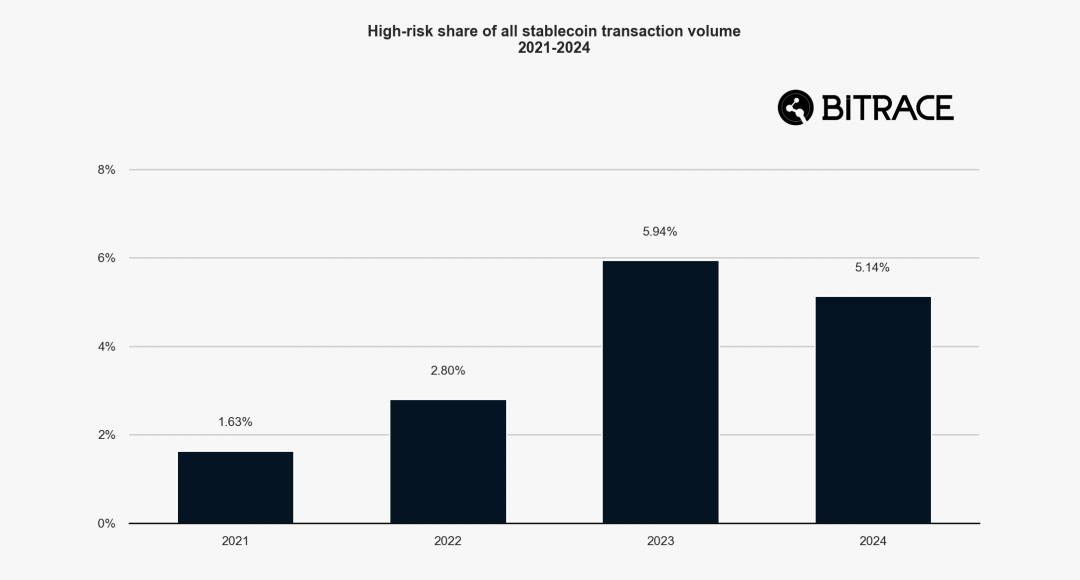
High-Risk Activities' Proportion of Total Stablecoin Transaction Scale
Calculated by transaction volume, these high-risk activities accounted for 5.14% of the total stablecoin transaction activities that year, a decrease of 0.80% compared to 2023, but still significantly higher than in 2021 and 2022.
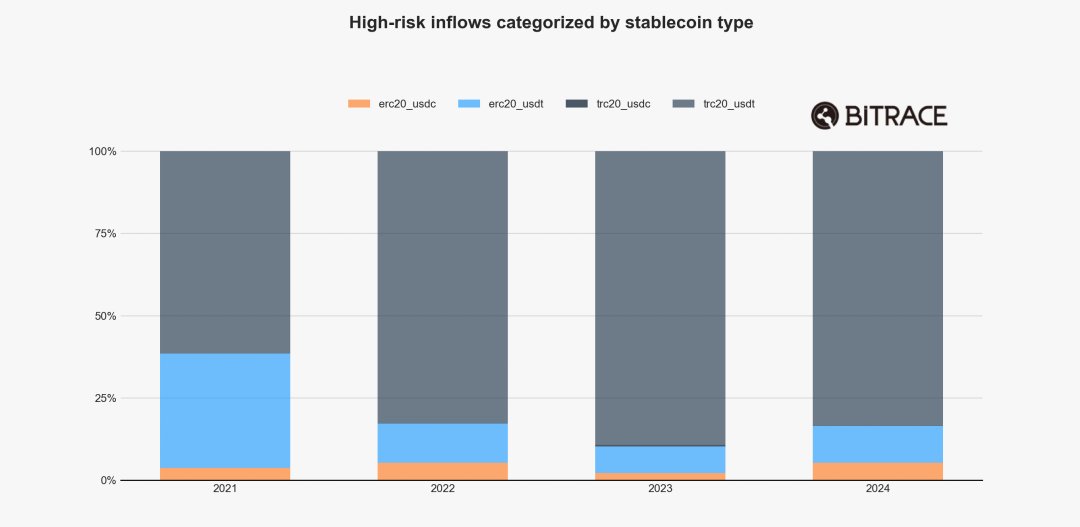
High-Risk Addresses Receiving Stablecoins Classification
Calculated by stablecoin type, USDT has occupied the main share in the Tron network from 2021-2024. However, in 2024, the shares of USDT and USDC in the Ethereum network have both increased.
Online Gambling Scale Continues to Grow
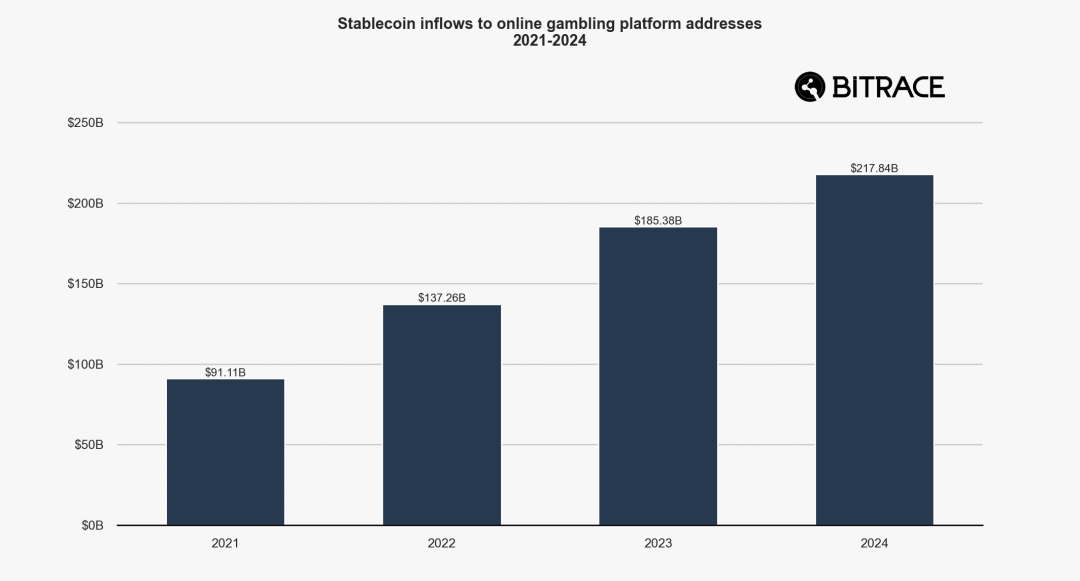
Online Gambling Platforms Receiving Stablecoin Amounts
In 2024, the fund scale of online gambling platforms and payment platforms providing deposit and withdrawal services reached $217.8 billion, an increase of over 17.50% compared to 2023.
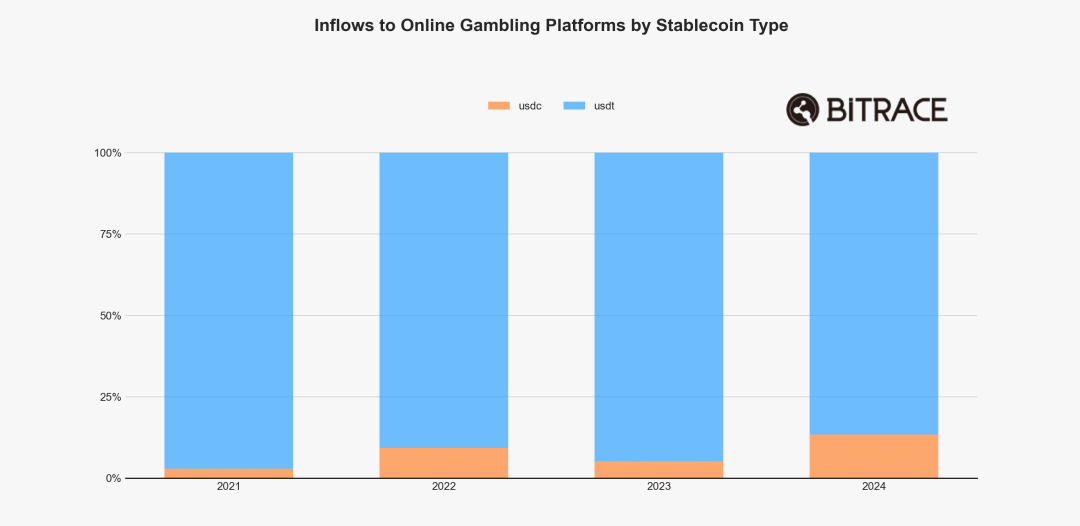
Online Gambling Platforms Receiving Stablecoin Classification
Statistically analyzing the stablecoin types used by online gambling platforms, USDC's share in 2024 increased significantly to 13.36%, far higher than 5.22% in 2023. This indicates that as USDC's market share increases, its adoption in online gambling has greatly improved, despite being issued and regulated by compliant entities.
Black and Gray Market Transaction Scale Undiminished
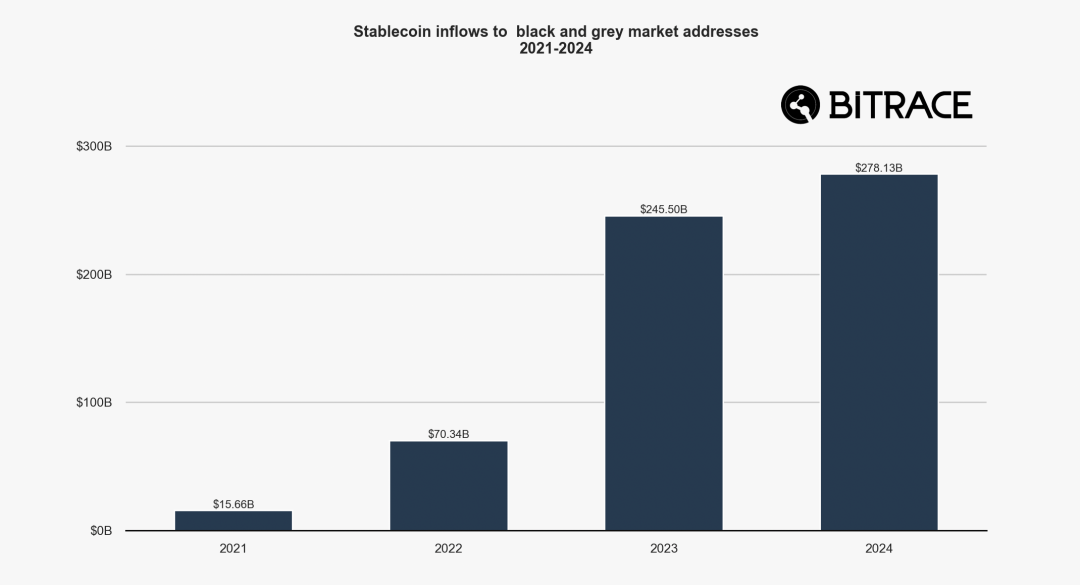
Black and Gray Market Transaction Addresses Receiving Stablecoin Amounts
In 2024, business addresses related to black and gray market transactions in Ethereum and Tron networks received funds of over $278.1 billion, slightly higher than in 2023, with transaction scales in these two years far exceeding those in 2021 and 2022.
Closely linked to the development of the black and gray industry are crypto currency escrow trading platforms, which can almost provide guarantee services for all upstream and downstream links of criminal activities, establishing trust among criminals.
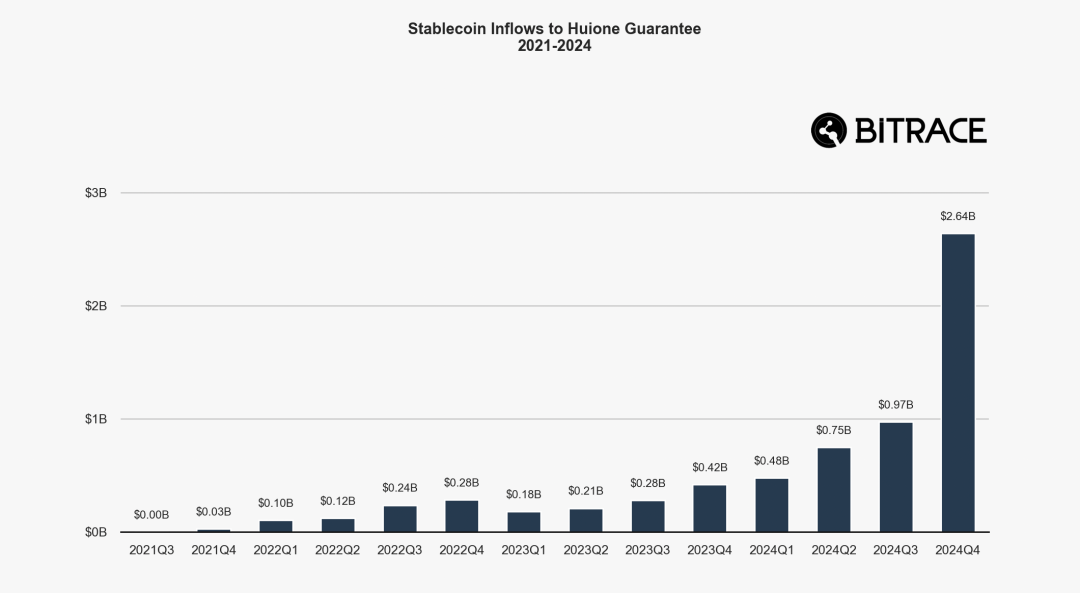
Haowanxin Escrow Receiving Stablecoin Amounts
The rise of Haowanxin and its competitors in Southeast Asia has unfolded alongside the gradual popularization of stablecoins in local real economic activities, a trend particularly evident in 2024, with its business scale expanding to $2.64 billion in the fourth quarter.
Crypto Fraud Scale Increases Dramatically
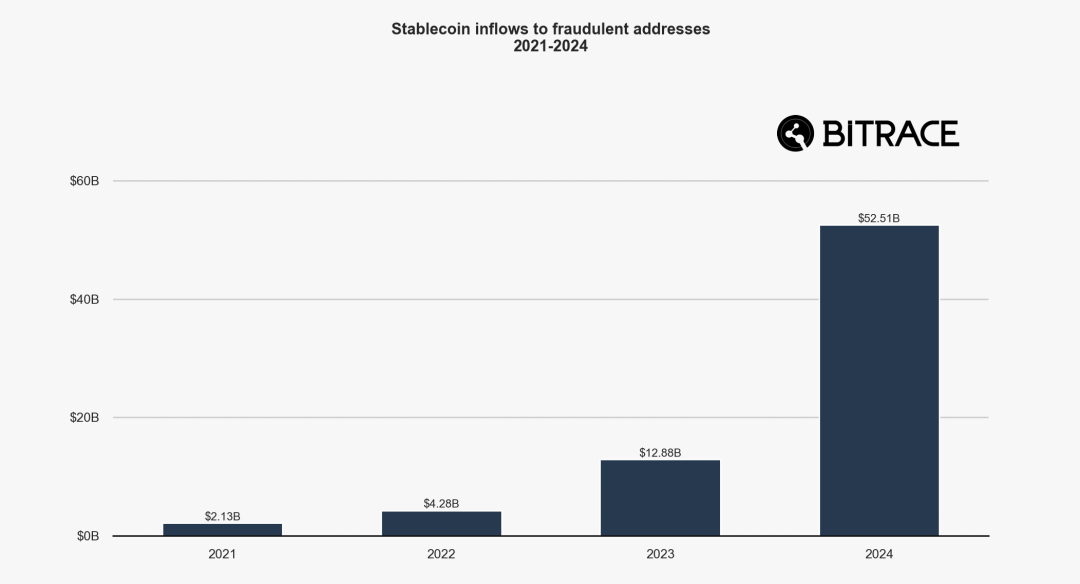
Fraud Addresses Receiving Stablecoin Amounts
In 2024, blockchain addresses associated with fraud activities experienced an explosive growth in stablecoin receiving scale. Compared to 2021-2023, the fund scale that year reached $52.5 billion, exceeding the total of previous years.
However, this surprising growth trend may not be entirely accurate, as the statistical value is limited by security vendors' statistical methods and the improvement of illegal entities' fraud levels. For example, as security vendors support more new public chains, more criminal incidents may be observed, meaning past events might not have been included in the statistics; cases occurring in centralized institutions or not actively disclosed by victims cannot be included in the statistics.
With improved statistical methods and increased case disclosures, these data will likely further increase in next year's investigation report.
Money Laundering Scale Begins to Shrink
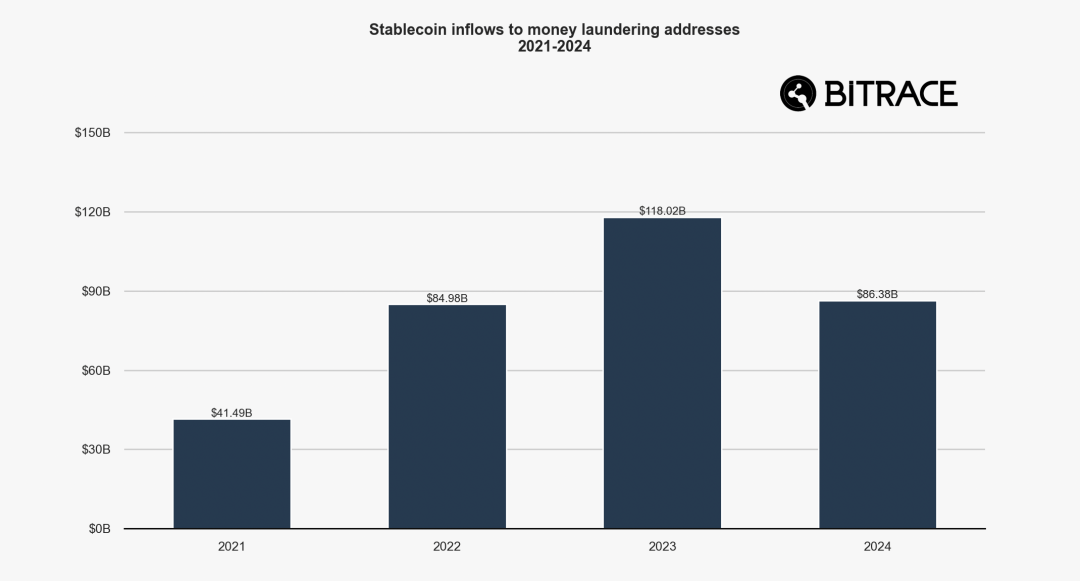
Money Laundering Addresses Receiving Stablecoin Amounts
In 2024, blockchain addresses related to money laundering activities received stablecoins worth $86.3 billion, slightly lower than in 2023 and on par with 2022. This value may indicate that major law enforcement activities and regulatory legislation by primary policy entities in the past two years have effectively suppressed the money laundering situation in the crypto industry.
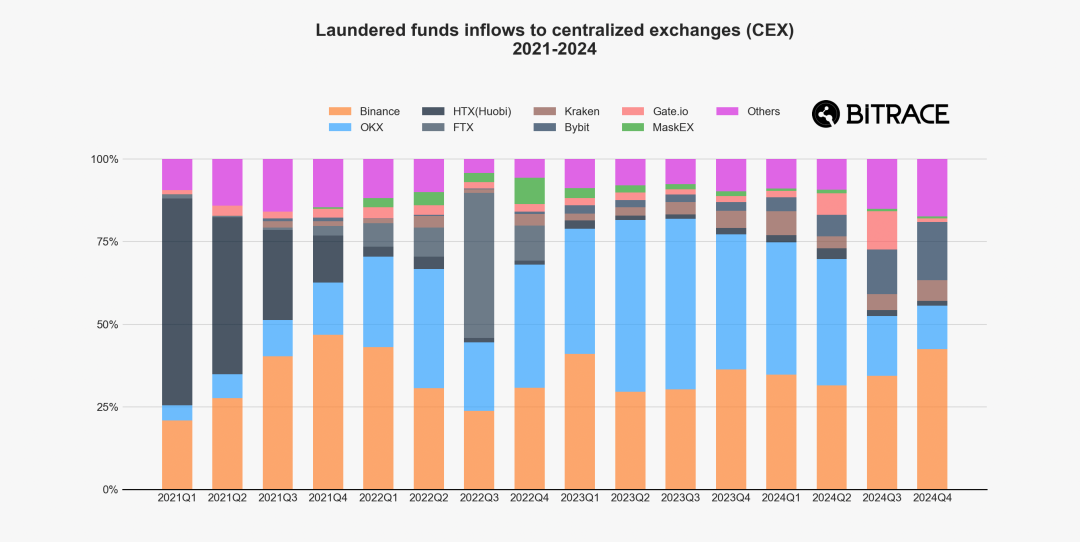
Proportion of Major Centralized Exchanges Receiving Money Laundering Stablecoins
Considering that centralized exchanges have inherent advantages in fund realization compared to other entities and are more likely to be favored by money laundering groups, Bitrace conducted a fund audit of hot wallet addresses for major centralized crypto exchanges.
Similar to the fraud section's investigation, the scale of platforms receiving money laundering funds is generally proportional to their business scale, but OKX's proportion has significantly decreased in recent quarters, which may be a result of its compliant operations.
Stablecoin On-Chain Freezing Activities Increase Significantly
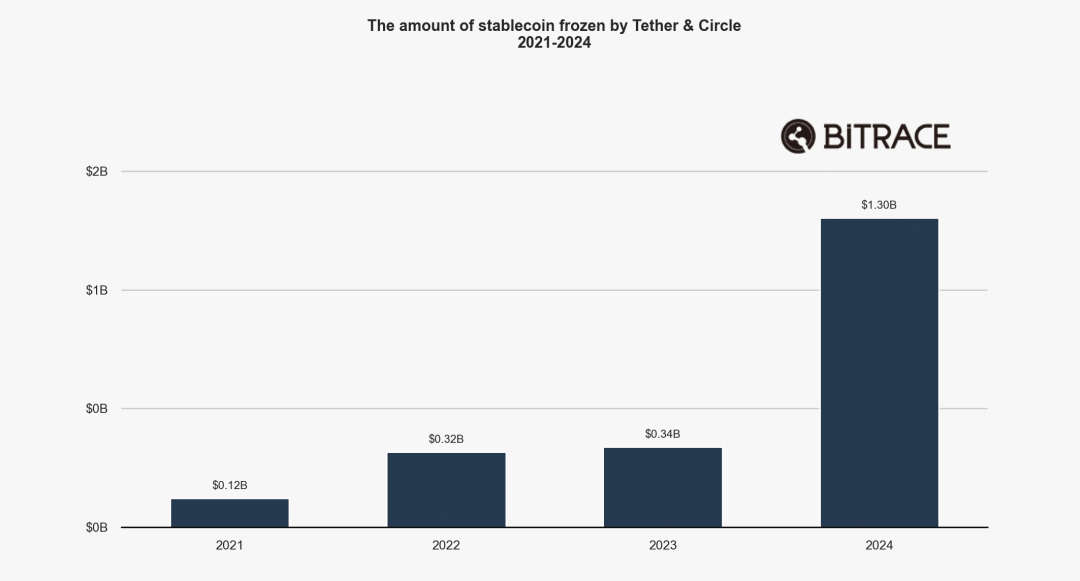
Tether and Circle Frozen Stablecoin Amounts
2024 was a year of active law enforcement cooperation by stablecoin issuers. Tether and Circle jointly froze stablecoins worth over $1.3 billion on Ethereum and Tron networks, twice the freezing scale of the previous three years.
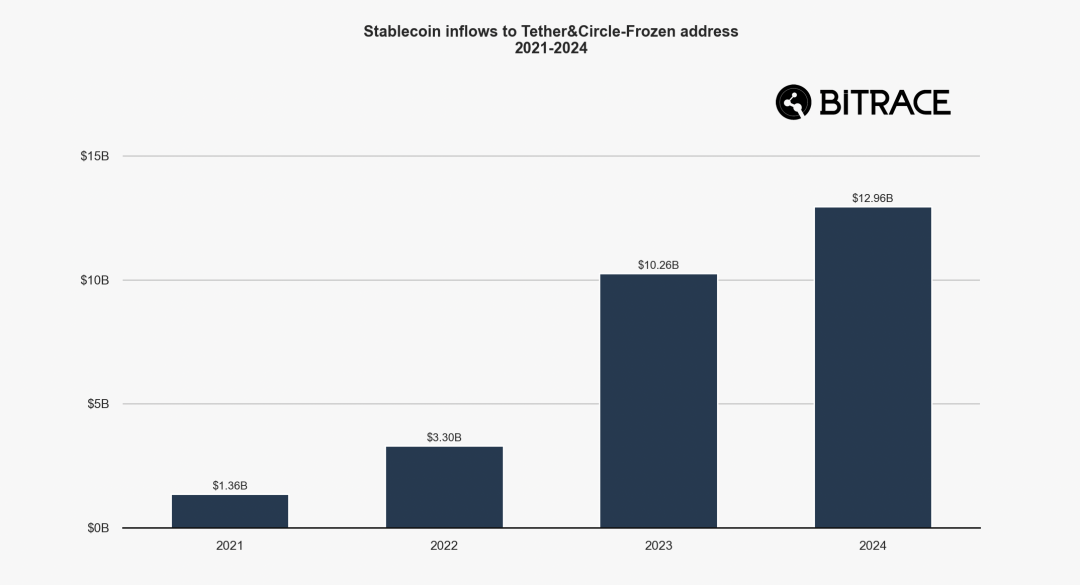
Frozen Addresses Receiving Stablecoin Amounts That Year
Statistics on fund transfer activities for frozen addresses in the same year show that the transaction scale in 2024 reached $12.9 billion, which is basically flat with 2023, indicating that on-chain crypto criminal activities had been active years ago but were only effectively combated in 2024.
*It is worth emphasizing that not all frozen address driving factors involve cases, and in this statistics, Bitrace did not exclude this portion, so the actual scale would be slightly smaller.
Sanction Trends of OFAC and NBCTF
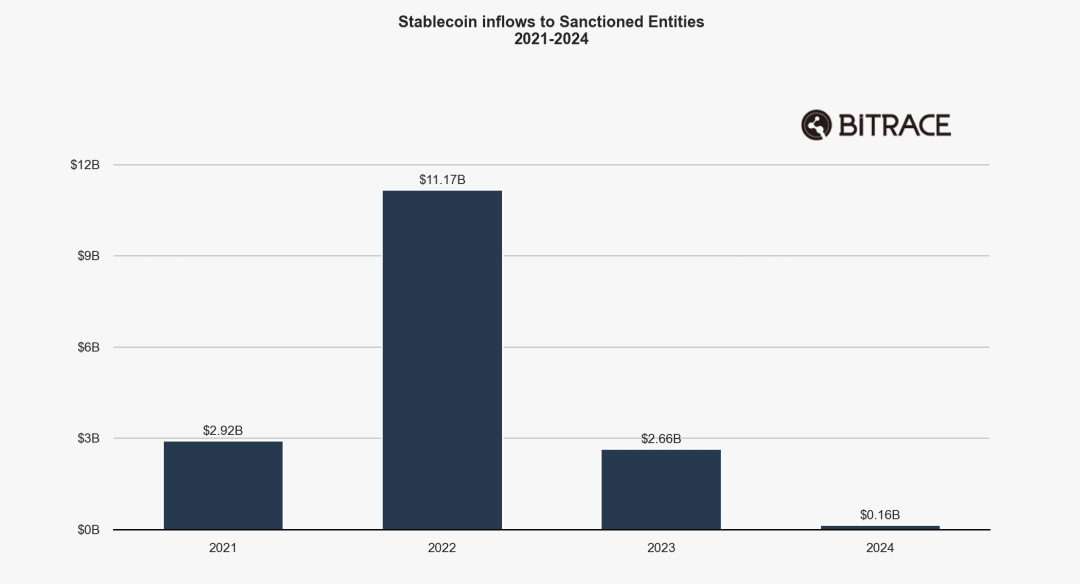
Stablecoin Amounts Collected by OFAC and NBCTF Sanctioned Entity Associated Addresses
The Office of Foreign Assets Control (OFAC) under the US Treasury and the National Bureau for Counter Terror Financing (NBCTF) of Israel are two institutions related to sanctions and counter-terror financing, with significant cooperation in combating terrorist financing and financial networks related to terrorist organizations like Hamas. By statistically analyzing blockchain addresses related to sanctioned entities disclosed by these two organizations, the overall fund scale peaked in 2022 and has been declining annually since.
Although government regulatory measures can have a massive impact on sanctioned entities' businesses, they have little effect on criminal groups using these infrastructures for illegal activities, as the anonymity and permissionless nature of crypto technology make such entities difficult to sanction and highly replaceable. Regulatory bodies should conduct more in-depth investigations into crypto crimes and take corresponding law enforcement actions against criminal groups.
Regulation Brings Positive Impact to Hong Kong
2024 is a year of accelerated compliance in the crypto industry. Globally, major regulatory agencies have shifted from a wait-and-see attitude to more active involvement, driving the industry towards a more standardized and transparent direction. Taking Hong Kong as an example—
Hong Kong's compliance policies have constructed a safer, controllable crypto ecosystem through clear legal requirements, customer fund protection, combating illegal activities, attracting institutional funds, and aligning with international standards. This not only reduces direct financial losses from hacker attacks, platform bankruptcies, or legal penalties but also lowers indirect risks by enhancing market trust and stability. For crypto entities, while compliance costs increase in the short term, they significantly reduce the possibility of funds being exposed to uncontrollable risks in the long run.
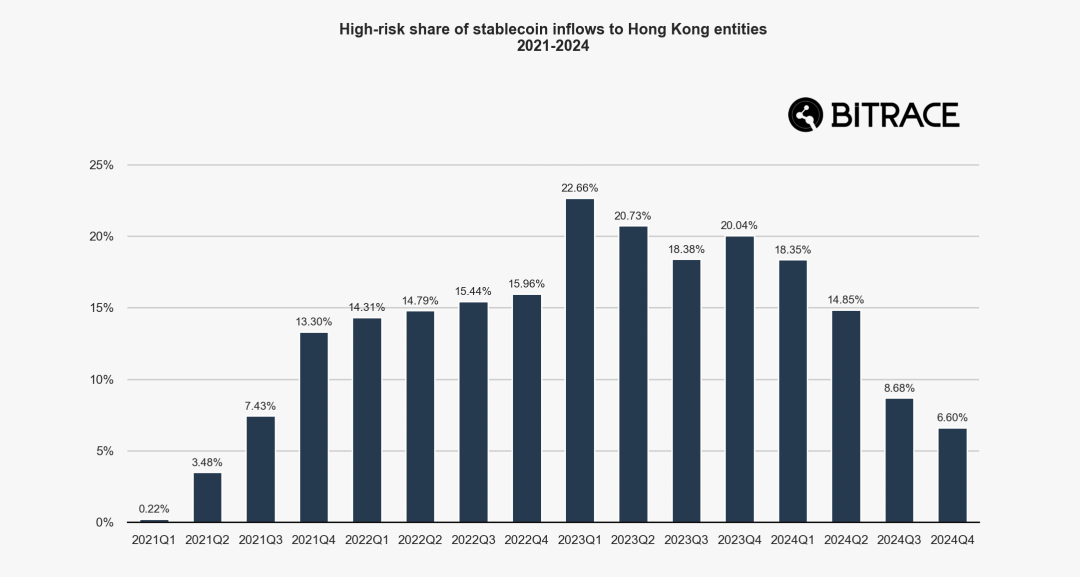
Proportion of High-Risk Funds in Stablecoin Income of Hong Kong Web3 Entities
By analyzing funds for VATP and VAOTC addresses primarily serving Hong Kong customers, data shows that the proportion of risk stablecoins flowing into the local market drastically decreased after the third quarter of 2023, indicating that local stablecoin transaction activities related to risk activities have been effectively suppressed following compliance policy releases and several landmark crypto-related cases.
Summary
2024 is a year of comprehensive industry revival and a crucial year when major economies begin to seriously address the industry. Although the scale of crypto crime remains unchanged, top-down compliance and regulatory policies, along with bottom-up industry self-discipline, have already brought positive impacts to crypto industries in some countries and regions.
The industry will embrace a safer and more trustworthy future, which we believe is self-evident.