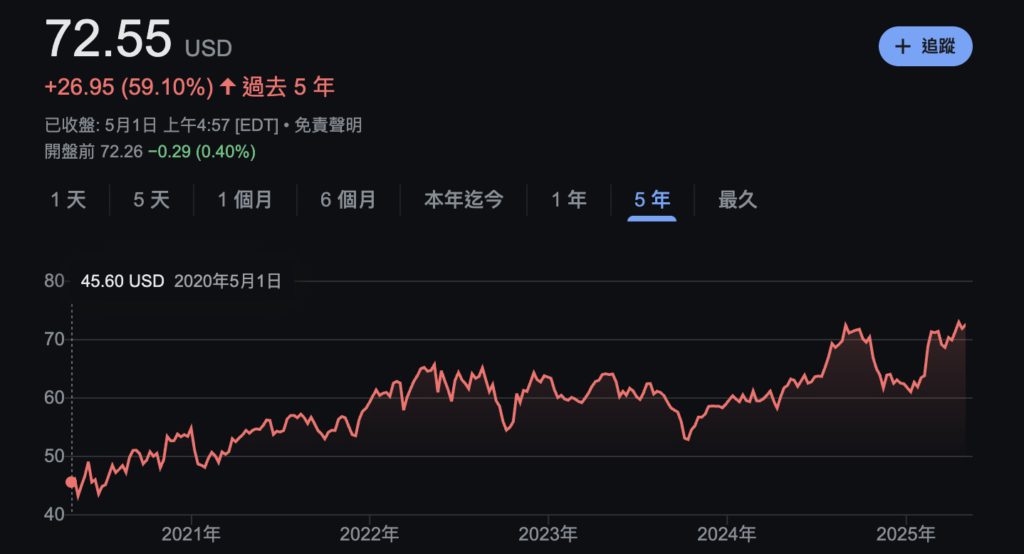
After US President Trump launched the tariff war, it triggered turmoil in the global risk market. Both US stocks and cryptocurrencies have been under huge selling pressure in the past few months. However, Coca-Cola's stock, which has always been known for its resilience, has stood out amid the recent sharp fluctuations, breaking through $73 last week to set a record high.
Buffett, who has been buying Coca-Cola shares at a high price since 1988, has also made considerable profits. His Berkshire Hathaway is the largest shareholder of Coca-Cola. Buffett even promised that Coca-Cola will be a permanent holding of Berkshire.
According to the Bloomberg Billionaires Index as of the end of April, Buffett, who successfully escaped the top and continued to hold on to blue-chip stocks, is the only one among the world's top ten richest people to maintain positive growth this year, worthy of his title of stock god.
 On the Wall Street Journal Podcast, the host discussed the event of Coca-Cola's stock price hitting an all-time high. Can ordinary investors avoid losses if they follow Buffett's example? And pay attention to the investment value of the seven technology giants and consumer staples under the influence of tariffs. The following text area will help you to compile and edit the transcript:
Telis: Hello everyone. I am Telis Demos. I write for the Wall Street Journal's "Talk on the Street."
Gunjan: I am Gunjan Banerji, Chief Market Writer at The Wall Street Journal. This is the Wall Street Journal Weekly Review, where we'll keep you one step ahead in the world of money and investing.
Telis: Every week, we have conversations with industry insiders and members of the Wall Street Journal newsroom about stocks, bonds, tariffs, lots of tariffs—
Gunjan : A lot of tariffs.
Telis: Well, you know what? Let’s get straight to the point because there is a lot going on in the market right now.
Telis: I think the biggest concern for everyone in the coming week will be economic data. There are three major data releases. The first is of course the (non-farm) payrolls report, which will be released this Friday.
The last jobs report was actually pretty strong. 228,000 jobs created. However, the unemployment rate rose slightly to 4.2%. Sometimes, these numbers move in slightly different directions. Technically, they are different surveys. So, we'll be watching to see if the economy remains strong. Then, I think the highlight will be the GDP report.
Many indicators, such as the closely watched Atlanta Fed report, have been predicting that GDP may shrink in the first quarter of this year. It was 2.4% in the fourth quarter of last year. So, this is going to be a pretty significant slowdown. Not all economists expect the economy to shrink. The consensus is actually for 1% growth in the first quarter. So, compared to the fourth quarter, it is still a slowdown, but not a shrinkage.
And then of course, there's PCE, the Fed's favorite inflation measure. The two data that make up this indicator, CPI for consumers and PPI for producers, have both cooled a bit recently. But certainly, the Fed, you know, Chairman Powell called this a challenging situation for the Fed. You know, maybe inflation is cooling, which in theory might support a rate cut to ensure the economy doesn't go into reverse.
But of course, there's that big T, tariffs, looming, and the Fed really has no idea what effect tariffs will have on prices. So, this puts them in a difficult position, much to the chagrin of the president. He doesn't quite understand the dilemma the Fed feels. He would rather just -
Gunjan: I don’t really understand.
Telis: He would rather just cut rates.
Gunjan: So, this is really interesting and at a time when everybody is worried about whether we are going to go into a recession, this is going to be a very, very important week for economic data, right?
Telis: Do you think the market is ready to respond? Are we going to have an active market week with the data?
Gunjan: So far, there has been a huge gap between how people feel about the economy and the markets and what the physical data shows, right? Employment data has remained good so far. Spending data has also held up well so far. But at the same time, consumer confidence is at one of the lowest levels since 1952.
So I think the key thing to watch is whether we'll see some of the data start to break down a little bit, or if it's too early to tell because that data is actually from before Liberation Day (Trump announced reciprocal tariffs ).
Telis: Do you think the market will be comforted by the good data, or will the market look through it and say, "The best is yet to come"? These data do not yet truly reflect the impact of tariffs. Tariffs may have begun to affect the data, but they have not yet reached the level where tariffs will really take effect.
Gunjan: Yes, because people are so pessimistic about the economy. So will this eventually start to filter through to lower spending? Maybe people will start laying off employees or something. I think that uncertainty is showing up in some of the pricing in the market. I looked at some data on the options market. Options traders are betting that the S&P 500 will move 1% or more every trading day through at least May 23, either up or down. So, that means that people expect the crazy volatility that we've seen over the last few weeks to continue.
Telis : Well, let's talk about bonds, there's been a lot of crazy volatility there as well. But I think as the data comes out we'll get more information about what's happening in the bond market, where the money is flowing, who's buying, who's selling, and so on.
In the coming weeks, we will also see a new round of Treasury auctions starting around next week or so. What's interesting is that what we've seen so far is not as dramatic as I thought the big moves in the bond market would be and what we would have imagined. You know, are foreign governments selling off U.S. Treasuries as part of a trade war, right.
Gunjan: We haven’t seen a lot of that, right?
Telis: We don’t. No, they actually—
Gunjan: And that’s what everyone is worried about.
Telis: So far, the best information that we have on foreign government holdings of U.S. Treasuries, you know, we have some data through about the first week of April. No significant changes were shown. In fact, it increased slightly. Of course, this is just a proxy indicator.
It’s hard to know exactly what happened until you look back on it. We do know that investors are definitely, you know, selling Treasuries, or more accurately, I would say deleveraging, right? People are reducing risk, so they are closing their positions. That’s especially true for hedge funds, which borrow heavily to make leveraged bets to boost returns. They don’t want to do that kind of borrowing anymore. They want to take risks in that way.
So, we know that happened. But right now, what we're seeing is that the 10-year Treasury yield is not skyrocketing. Things have calmed down to some extent.
Telis: I will say this though, gold is going up like crazy.
Gunjan: Oh my god, it’s crazy.
Telis: All that glitters is gold, which hit another all-time high last week. I don’t know why we’re not expecting that to happen next week as well. You can look at it from several perspectives. One, risk aversion, you know, and it's also the other side of a weaker dollar. As the dollar weakens, more dollars are needed to buy gold. So it's not surprising to see this happening.
Gunjan: For the past four years, my mom has asked me to buy gold every time she sees me. And let me tell you, she nailed that macro trend. I think there is something very important to focus on in the next few weeks.
The Big Seven vs. Consumer Staples
Gunjan: How are the Magnificent 7 trading performances? I mean, this has been the hottest trade on Wall Street and the general investing public for the last few years. Meta, NVIDIA, Tesla, you name it, all seven of them are down this year.
As of this recording, all seven have underperformed the S&P 500. So, one of the most crowded trades that everyone was rushing into, is showing cracks. I think we'll get a better idea of what it's like over the next few trading days as those big tech stocks report some of their earnings.
Telis: Who reports earnings?
Gunjan: We will hear from Meta, Amazon, Apple. Of course, Tesla, you know, is down over 30% because a lot of people don't like the fact that Musk is spending so much time on government programs.
Telis: And he said he would spend less time on Dogecoin-
Gunjan: Yes, and we'll see what this means for Tesla's stock price going forward.
Telis: Yeah, so I would say, these are the seven things that you want to focus on over the next week.
Gunjan: Yes, that’s right. So, that brings us to our interview this week, because while the Big Seven Tech haven’t been doing well, stocks like Coca-Cola, Consumer Staples, McDonald’s, Walmart, etc. have been performing very solidly lately.
Telis: So, this is the other side? If you don't buy tech stocks, you buy the opposite, you know, McDonald's, Walmart.
Gunjan: I mean, that seems to be what people are doing these days.
Telis: Well, we invited Markus Hansen to talk about whether now is the time for household names to shine. We are talking about Coca-Cola, Kellanova, they make products like Pringles, Cheez-Its. And then there's Mondelez, the company that makes Oreo and other snacks.
Markus Hansen is a portfolio manager and research analyst at Vontobel Asset Management. This is an investment firm focused on U.S. and international stocks. They own one or two stocks, and they invest in different sectors, luxury goods, technology, and also, we are talking about consumer staples here. These are things like food and beverage brands, essentials, the things that you need rather than want no matter what’s going on in your life.
We should note that as part of this conversation we will be talking about stocks held by Vontobel. This includes Coca-Cola, PepsiCo, Mondelez International and Swiss chocolate maker Lindt & Sprüngli. It also owns stakes in technology companies, including Amazon, Google and Microsoft, and luxury brands such as Ferrari, Hermès and Richemont.
Markus also invested in the Vontobel fund which holds these targets. So, we’re going to be diving into a lot of conversations that are happening around these household names. What economic uncertainty means for the world's largest consumer brands and whether now is the time to diversify internationally, plus how tech and luxury stocks might perform during this period of global turmoil.
…
Markus: Hello. Thank you for having me.
Gunjan: So, we are in the middle of a very important earnings season. It feels like there are too many uncertainties right now, with the ongoing trade war.
Markus: Yes.
Gunjan: This is a very interesting time and I think everyone is trying to understand how companies and business leaders are going to navigate this moment. We recently had a guest say that what investors should focus on is companies' future guidance, but I couldn't help but think of United Airlines, which issued two sets of guidance.
Markus: That’s interesting, isn’t it, yeah.
Gunjan: How do you think about this issue now?
Markus: Yeah, look, every earnings report is important because basically, that’s the guide that market analysts and investors use to navigate the ups and downs of the economy. This time is special because financial reports do matter. Based on some scattered data, the first quarter was actually relatively strong from an economic and earnings perspective.
What people are really looking for is that visibility that we lack right now. There is a term that is circulating, called VUCA economy, which stands for Volatility, Uncertainty, Complexity and Ambiguity. This can be traced back to a military mindset after the end of the Cold War.
You mentioned, for example, traditionally recession-resistant companies, which happen to be food and staples stocks. But a lot of those food and staples stocks have also been around for a long time. As an example, you know, let me just mention Coca-Cola, which is going to report earnings in the next few weeks. This is a company that is over a hundred years old, has operations all over the world, and has seen almost everything in the world.
This is the type of company you want to hear from to see if it has a strategy in place. How to deal with these problems? And it's not just a question of tariffs, there's also the question of secondary effects. What is the impact on consumers? Are people nervous? Are you seeing transactions move toward value or premium? It’s companies like these, along with some of the larger retailers in the United States.
So, you know, Walmart is a great example. Huge market share, which does give a lot of credibility to their guidance and how they're responding and what they're seeing on the ground. So, we're going to see a lot of headlines about this, and those are what a lot of people are going to pay attention to.
Telis: So, is guidance still a reliable indicator of anything right now?
Markus: Yeah, that’s a good question because you see, at the end of the day, most businesses don’t operate on a quarterly basis, but the good ones do have a perspective. You know, at the end of the day, they're deploying billions of capital. These are truly global players. They operate in multiple jurisdictions. The analyst community, as well as the investment community, want to understand how you redeploy the capital you earn and where your ability to grow the business lies.
At the end of the day, we all want to invest in businesses that can grow over time. Why? Because there's a gentleman in Omaha who's been doing this for decades, and he would say the greatest --
Gunjan: It’s Warren Buffett.
Markus: Yes, that’s right. Yes, that's right.
Telis: Catch the big, big, big.
Markus: Ultimately, the ultimate driver of wealth growth over time is compound interest. And you realize compound interest through surplus. Dividends are also important. I know we forgot about dividends for a while with the tech rally and all that.
But the types of companies we're talking about, historically have been the ones that you have in your portfolio that reflect that. So, back to your question about guidance. Yes, we would like to know your business model and what makes your algorithm unique. How has it weathered periods of volatility in the past? What might be different this time? What similarities might there be?
Safe-haven investments: consumer staples and international brands
Telis: So when we talk about consumer staples, we mean companies that make things that people need no matter what, right?
Markus: That’s right.
Telis: Maybe they won’t travel. Maybe they're not going to, you know, buy an expensive new TV that they don't need, but people need to eat, right? They'll continue to buy canned soups and, you know, soft drinks, and things like that.
You know, what's happening now is not just about, you know, how people's pocketbooks are going to experience the economy, but like, are things going to get to them, right? Like, you know, companies use ingredients from all over the world to make these things.
The machines that they rely on might not be able to get parts, you know, ship them. So when the recession in question is not just something like a business cycle thing, but something like a very deliberate one, like if we were to change global trade patterns for political reasons, can we still say that consumer staples companies are still recession trades? In this case, is it still a recession-proof company?
Markus: Yeah, so that’s what’s interesting, because part of it is self-inflicted in a way, because it was a political decision, an executive decision, not something that was forced upon us. To be fair, some companies are already preparing for this because remember, this is the second round of this administration. We’ve seen tariffs before.
You know, this is nothing new. What's alarming is the scope of the tariff negotiations, and then the scale. You know, we're in this 90-day grace period right now on most things. There is this 10% basic customs duty. I think most companies were prepared for that level because they had early warning, but what was less clear was what would happen above that level.
More importantly, the nature of the news flow, how the negotiations are conducted. We are talking about 70 countries negotiating. Now, there may be four big players who will ultimately set the rules of the game, but negotiating 70 trade agreements adds complexity and whether we are able to handle it.
Going back to your original point, necessities, the good thing about them is that these are the things you have to find no matter what. Usually, you gravitate toward what you know best. We've seen this reinforced during COVID, companies that have historically been able to deliver on time. If we go back 20 years, the general financial trend was towards asset-light. Get rid of everything from trucks to warehouses. Outsource everything. That’s great financial engineering.
Ironically, what we've seen post-COVID is the realization that in times of uncertainty, this can actually be very disruptive because you can't guarantee your supply. Again, I think this is an area that's emerging, whether we're looking at food, retail, or even any supplier, I think this reshaping of the industrial landscape is something that is likely to intensify and play out in the future.
Gunjan: So how do you find companies that are less risky in this environment? Because you can't rely on them for guidance. I just want to share a statistic. Number of times the word “uncertainty” was mentioned by large banks
Markus: Yes.
Gunjan: It has increased by more than 300% from season 4 to season 1. This is a statistic from bank analysts.
Markus: It has replaced AI as the buzzword in everything, yes.
Gunjan: Yes. So, the bank analysts at Truist tracked this data. But at the same time, they noted that analysts' earnings forecasts have remained largely unchanged since January.
Markus: That’s crazy.
Gunjan: The banks are saying, you know, this is just one example, right? It's not targeting banks. Like we didn’t know what was going to happen. The analyst who covers them said, "We really don't know, so we're just keeping everything the same." So, as an investor, how do you find a company that you think has a stable future?
Markus: That’s actually a good question and that’s something the market is trying to figure out by going up and down and trying to bring some kind of certainty to where that number might land.
So, the first part of the answer is prediction. At the moment, this will cause some damage, but the damage is somewhat controllable because the timeline is somewhat manageable. If we don't get some kind of guidance in the coming weeks on how the trade talks are going to resolve.
When I say a few weeks, it’s probably three or four weeks. We need to see the first results come out because once you see the first one, you can say, okay, this can be replicated in other ways. So, let's see what happens next.
If it drags on, the longer volatility drags on, the more negative it will be for everything from guidance to market valuations. Your second question or initial question is how do you find certainty? So in Vontobel, the bank has been around for a hundred years. We've been doing this in the United States for 40 years. We look for high-quality growth companies, one of the key attributes of which is earnings predictability.
Predictability comes from three main drivers. The company’s track record in terms of moat, franchise, history. We look back at their past achievements and how they can grow in the future. What is it about their business that allows them to maintain this predictable sustainability? Now, this can be anything from a slow but steady, good grower to a company that can grow in the high single digits and provide a nice dividend.
Remember in investing, this is where dividends become important. Great companies that can not only give you some earnings growth but also support your company's valuation. Yield, the cash return to shareholders has always been a dividend paying company. These are the companies we found in this space. So the Coca-Cola that I mentioned is probably a good example.
Coca-Cola is actually owned by that very savvy investor (Buffett) , who is also in Omaha. This is a great company. Why? Because of what it sells, it's a fairly simple project. It's a beverage, a flavored beverage, whether it's seltzer with bubbles or whether it's premium water or something else.
They have the largest distribution network on the planet. They have operations in almost every country on earth. Not only has this company had a very nice compounding of earnings, but it has also had a dividend that has been growing consistently for over 60 years. So, it has bond-like properties, or even better, because the coupon grows, and you have some of the surplus compounding. A company like PepsiCo is very similar.
Mondelēz International is another name that we own, and for those of you who are not familiar with it, it's the sweet and savory business that was spun off from Kraft Foods, and the main brand is the Oreo cookie. You know, always there, very good business. They had Cadbury chocolates and a few other things, as well as pastries.
It's actually more of an international company, with two-thirds of its business outside the United States. These are all great long-term companies that meet the attributes you mentioned. These are things people want to have. There is the convenience factor. It also involves the food or beverage factor, with pricing power and the ability to respond. And because these companies have been around for a long time.
You know, Mondelez International is part of Kraft and has a long history. They’ve actually been through world wars, recessions, SARS before COVID, a host of other things, changes of government, inflation. They experienced hyperinflation. So, they are in the market where they operate. So, there’s a lot of learning and proven management and a lot of playbooks that can be used to deal with it.
Back to the original question about guidance. These are the companies that are, not only the ones that can provide some credibility to the guidance, but I think the market, we're looking for understanding what's going on, why you're operating everywhere. You know, you get feedback from politicians, economists, what's going on. What are you seeing from the consumer, you know, the single biggest driver of the U.S. economy, the American consumer, what are they doing? Are they downgrading their consumption? Are they upgrading their consumption? Are they hesitant? This will be key because if there is any damage at the consumer level, you will see it most here.
Telis: There's one trade that's been going on lately, you know, it's been up and down like everything, and that's, you know, really looking at Europe again as a hot area to invest in because it seems like there's some fundamental changes going on within the European Union. There’s more potential there than I think people have realized for some time. So you see, now Vontobel's headquarters is in Switzerland, right?
Markus: Exactly, yes.
Telis: I know you own many international brands.
Markus: Lindt & Sprüngli, yes.
Telis: Is there a reason why you might want to own more European stocks? You know, even without considering what will ultimately happen with tariffs. Have you increased your holdings, or do you think now is a good time to increase your holdings in European companies and European brands? You know, owning Lindt now instead of Hershey's simply because Europe is changing. Is there any truth in this?
Markus: So the short answer is, yes, meaning we don’t actually pick by country. We look for the best companies. So in the international market, I think there are great companies that you can own.
So if we take an example, you know, we're talking about food companies, but on the luxury end, for example, the best companies on the planet, in terms of pricing power, long-term growth, Hermes, Ferrari, just to name two. You know, Ferrari, I know it makes cars, but it's a luxury company that happens to have wheels, but it has all the good building blocks in its P&L, high margins, high return on invested capital, a huge backlog of demand, great predictability.
You mentioned Lindt. Great chocolate company. The great thing about food companies is that they tend to be local for local production. So even though, they, Lindt is a Swiss company, all of its American production and chocolate is sold here. There may be some high-end luxury goods that they ship over, but for the most part, they produce them here, they produce them in Europe, they produce them in Asia.
Telis: Does this give them some degree of immunity from tariffs?
Markus: Absolutely.
Telis: Because they make it in the United States for Americans.
Markus: Absolutely, absolutely. That’s what’s interesting about food companies. Now, there are bits and pieces of their business that may be impacted, but this makes them more predictable in times of recession like this.
Investment strategy and market outlook
Gunjan: So given that you're relatively optimistic about the ability of these large companies to navigate this situation and adapt to change, are you seeing bargains everywhere? Are you snapping up, you know, names like Coca-Cola or Mondelez International? You mentioned a few of them. Like what are you doing in your portfolio right now?
Gunjan: Do you hold more now?
Markus: We are now taking this opportunity to look at some things from the past. So like everything else, we do put a fair valuation on what we think is a great company.
There are some great companies, but the market is not stupid. It recognizes a great company. So, you have to be disciplined in the size of your holdings. There are some great companies that have experienced nice pullbacks, providing opportunities to add to holdings. There are some areas -
Gunjan: For example, can you give some examples?
Markus: Now, I don’t want to say it, but I would say in the technology sector.
Gunjan: Okay.
Markus: It can be said that these companies had very high valuations at the end of the year. If you remember, we also had that spike in January. We always want to look at the charts. Graphs are always interesting. You look back and remember, okay, we came from here, and this is why it went down. There are a couple of tech names where we do believe the market is probably overestimating the impact of what's going on and are able to see through that as well.
Crisis creates opportunity. You know, to use that term, there's a famous British saying, "Keep calm and carry on." And Mr. Buffett is famous for, "Be fearful when others are greedy," and you know, "Be greedy when others are fearful."
There is definitely an element of fear in the market that creates some opportunities. So specifically speaking of the names here, we actually use Lindt as an example. That's not a name we held last quarter, but the stock pulled back on concerns about various tariffs. They updated the data, and we knew after we did our homework, look, this is local to local.
They have the capability, their pricing power is fantastic. If you buy one of those cute little Lindt bunnies, it tends to be a fancier chocolate, you know, good quality, and they’ve dealt with various crises in the past. That is an opportunity to accumulate and own. And that stock has been performing pretty well, just as we expected. But there are always opportunities, which is why I think internationally, you need to look for that as well.
Despite the market correction, international stocks are actually still relatively cheap. This is true both in terms of price-to-earnings ratios in terms of absolute valuations, as well as dividend yields and how they will weather the storm. But yes, it is an opportunity.
Telis: Markus is buying the dip.
Gunjan: Swiss asset managers recommend buying Swiss chocolate during tough times.
Markus: Always take the opportunity to look for great companies whose business hasn't changed dramatically, and whether they have encountered these kinds of problems before. It's obviously a combination of the cost side of potential supply shocks, but also the ability to pass on costs to consumers. And a lot of times, looking back there are a lot of good examples that prove this.
Telis: Okay, we have one last question for Markus after the break.
…
Gunjan: Welcome back.
Gunjan: In 30 seconds or less, which investment in the market are you most bearish on right now given this trade war?
Markus: So, I think it's fair to say that some of the areas that were probably overhyped in terms of AI chips are getting a bit of a reset here, and that's the US market in particular, which is too concentrated on the Big Seven. Some of these Big Seven names in tech, I think their future returns are overestimated and priced in ahead of time. Just a joke here, if you're familiar with the original movie, The Magnificent Seven, only three other cowboys survived to the end.
Telis: Spoiler alert, sorry guys.
Markus: We have invested in three of the Big Seven names in tech, and we particularly like them because of the names themselves, not because they are the Big Seven in tech. I think we are seeing a reset in market concentration and there is some room left. So, there are some names among the Big Seven that I would still stay away from for now.
Telis: So, do you think the Big Seven will no longer be the Big Seven?
Markus: You remember before the tech giants there were FAANG and in the past there was Nifty 50. There’s always something new coming out the other side. I think the breadth of the market is expanding which is healthy. I think diversification of the market outside of the U.S. is also a healthy thing.
Gunjan: Well, Markus, thank you so much for being here and thank you for this great conversation about consumer staples.
Markus: Thank you for having me. I would love to come again. Thanks.
Telis: Yeah, it was great this time. Thank you, Markus.