Event highlights:
Movement Labs is investigating whether it was misled into signing a market-making agreement without full knowledge. The protocol placed control of 66 million MOVE tokens in the hands of an unidentified middleman, leading to a massive sell-off worth $38 million immediately after the tokens went live.
Internal contracts show that Rentech, a company with almost no digital footprint, appears on both sides of the transaction: on the one hand, it is a subsidiary of Web3Port, and on the other hand, it appears as an agent of the Movement Foundation, which has aroused doubts about the behavior of "self-dealing".
Insiders at the Movement Foundation initially warned about the deal, calling it "potentially the worst agreement they've ever seen"; experts pointed out that the agreement could be structured to artificially raise token prices before dumping the tokens on retail investors.
The episode exposed deep divisions within Movement’s senior leadership: The conduct of executives, legal counsel and ad hoc consultants who pushed the deal forward despite internal opposition is now under scrutiny.
A financial agreement that was originally intended to help launch the MOVE crypto token turned into a token-dumping scandal that not only led to a trading ban on Binance but also sparked a fierce internal dispute within the team.
Contract archives obtained by CoinDesk reveal the crux of the crisis and explain how the incident spiraled out of control.
Blockchain project Movement — the developer of the MOVE cryptocurrency — is investigating whether it was induced into signing a financial agreement without its full knowledge, according to internal documents reviewed by CoinDesk. The protocol gives a single entity unusually concentrated control over the MOVE token market.
This agreement resulted in 66 million MOVE tokens being quickly dumped into the market the day after the MOVE token was first listed on the exchange on December 9, causing the price of the token to plummet and sparking strong doubts from the outside world about "insider trading." It is worth noting that the project has been endorsed by World Liberty Financial, a Trump-backed crypto venture capital platform.
Movement Labs co-founder Cooper Scanlon said in an April 21 Slack employee message that the company is investigating why more than 5% of MOVE tokens originally reserved for market maker Web3Port were transferred through an intermediary called Rentech. He noted that “the Foundation was led to believe that Rentech was a subsidiary of Web3Port, which is clearly not the case.” Rentech denies any false statements or misleading conduct.
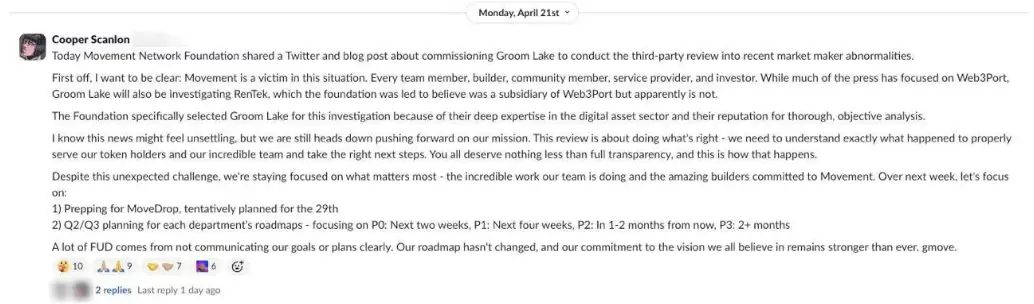
A Slack message from Movement co-founder Cooper Scanlon. Rentech is spelled "Rentek". (Source: CoinDesk)
According to an internal memo from the Movement Foundation, the contract signed by Movement and Rentech actually loaned out approximately half of all publicly available MOVE tokens to a single counterparty. That gives the entity unusually large control over the still-early-stage token. Several experts told CoinDesk that the arrangement is highly unusual.
What is even more worrying is that the version of the contract obtained by CoinDesk shows that it contains an incentive mechanism to "induce manipulation of token prices to a fully diluted valuation of more than $5 billion, and then dump the tokens to retail investors and distribute the profits proportionally." After reviewing the files, veteran crypto project founder Zaki Manian said: "It's crazy to even participate in a contract written in black and white."
Market makers were originally hired to provide liquidity for newly issued tokens, usually by buying and selling them on exchanges through funds borrowed by token issuers, thereby stabilizing prices. But this role is also easily abused, allowing insiders to quietly manipulate the market and cash out large amounts of tokens without immediately alerting the outside world.
A series of contract archives obtained by CoinDesk sheds light on a gray area of weak regulation and opaque legal structures in the crypto industry — loopholes that often turn public-facing projects into private tools for the benefit of a few.
Although rumors of market-making abuse are common in the crypto community, the specific details behind them are rarely made public.
The market-making contract reviewed by CoinDesk shows that Rentech appeared as both an agent of the Movement Foundation and a subsidiary of Web3Port in the agreement signed with the Movement Foundation. This "dual identity" arrangement theoretically enables it to dominate the terms and profit from them.
Ultimately, Movement’s partnership with Rentech resulted in wallets associated with Chinese financial company Web3Port quickly selling $38 million worth of MOVE tokens the day after the token was listed on the exchange. Web3Port claims to have worked with projects such as MyShell, GoPlus Security, and the Trump-backed World Liberty Financial.
Due to the misconduct, the exchange Binance subsequently banned the market-making account, and Movement also announced that it would launch a token repurchase program.
Similar to the stock option mechanism in startups, tokens in crypto projects usually have a lock-up period to prevent insiders from selling large amounts of tokens in the early trading stages of the project.
However, Binance’s ban decision has triggered market doubts about Movement - it is generally believed that the project party may have reached some kind of early unlocking agreement with Web3Port, although Movement denies this.
Mutual accusations
Movement is one of the most popular crypto projects in recent years. It is positioned as a new generation of Layer 2 blockchain, aiming to improve the scalability of Ethereum based on the Move programming language launched by Facebook.
The project was founded by two 22-year-old young men, Rushi Manche and Cooper Scanlon, who dropped out of Vanderbilt University. It successfully raised $38 million, became part of World Liberty Financial's investment portfolio, and attracted widespread attention on social media.
According to a Reuters report in January this year, Movement Labs was close to completing a $100 million round of financing, with a valuation of $3 billion.
CoinDesk interviewed more than a dozen people familiar with Movement’s inner workings (most of whom requested anonymity to avoid retaliation), among whom there were conflicting accounts of who led the Rentech deal — an arrangement that industry experts generally agreed was highly unusual.
Rentech head Galen Law-Kun denied that the foundation was misled during the contracting process and insisted that the entire structure of Rentech was built with the full assistance of Movement Foundation general counsel YK Pek.
However, according to an internal email and other communications reviewed by CoinDesk, Pek denied any involvement in the creation of Rentech and initially strongly opposed the deal.
Movement Labs co-founder Scanlon said in a message to employees that Movement was "the victim in this incident."
Movement is also investigating the responsibilities of co-founder Rushi Manche, who initially forwarded the Rentech deal to the team and pushed the proposal internally, and informal adviser Sam Thapaliya, who is also Law-Kun’s business partner, according to four people familiar with the matter.
Web3Port did not respond to multiple requests for comment.
“Probably the worst deal I’ve ever seen”
Although Movement initially rejected the risky market-making agreement with Rentech, it ultimately signed a revised version with similar content, relying solely on the guarantee provided by an intermediary with no track record.
In the extremely lightly regulated crypto industry, project parties typically divide the operating structure into a non-profit foundation and a for-profit development company. The developer (here Movement Labs) is responsible for technical construction, while the foundation manages tokens and community resources.
In theory, the two should remain independent to avoid securities regulatory risks. But according to internal communications reviewed by CoinDesk, Rushi Manche, an employee at Movement Labs, appears to have also taken a leading role at the nonprofit Movement Foundation.
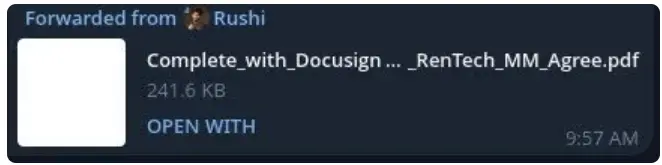
Rushi Manche, co-founder of Movement, forwards the first Rentech contract to an employee in the Movement ecosystem. (Source: CoinDesk)
On March 28, 2025, Manche sent a draft market-making agreement to the foundation on Telegram, stating that it needed to be signed as soon as possible.
November 27, 2025: Rentech proposes a draft market making agreement to Movement. In the agreement, Rentech is the borrower and Movement is the lender. The agreement was ultimately not signed. To protect privacy, CoinDesk has hidden some personal names in the disclosed archives, and some names have been pre-masked in the original archives.
The draft proposes to lend up to 5% of MOVE tokens to Rentech, a company with no digital footprint at all.
The foundation's legal counsel, Pek, said in an email that the agreement "may be the worst agreement I have ever seen." In another memo, he warned that the move would hand over dominance of the MOVE market to an unidentified outside entity. Marc Piano, the foundation's director in the British Virgin Islands, also refused to sign the agreement.
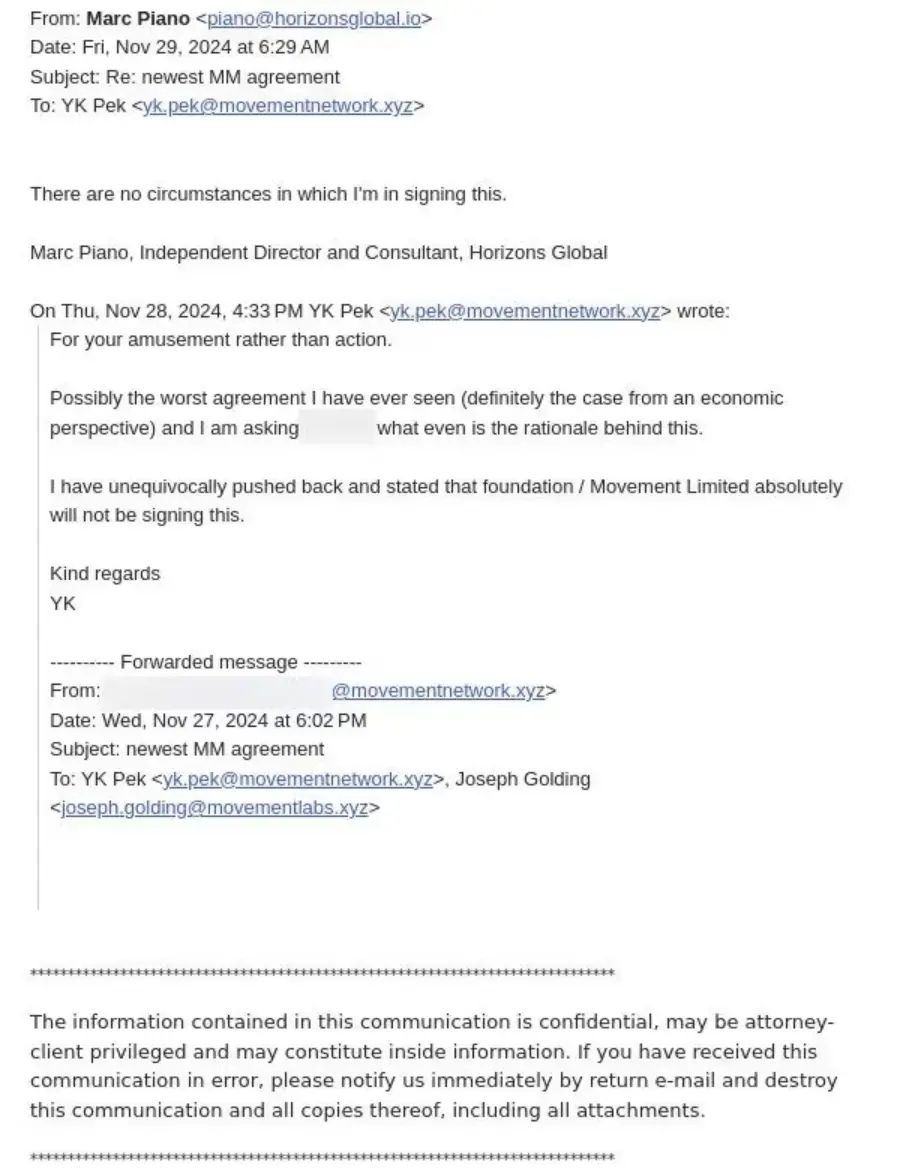
The Movement Foundation's general counsel YK Pek and director Marc Piano react to the Rentech deal (via CoinDesk)
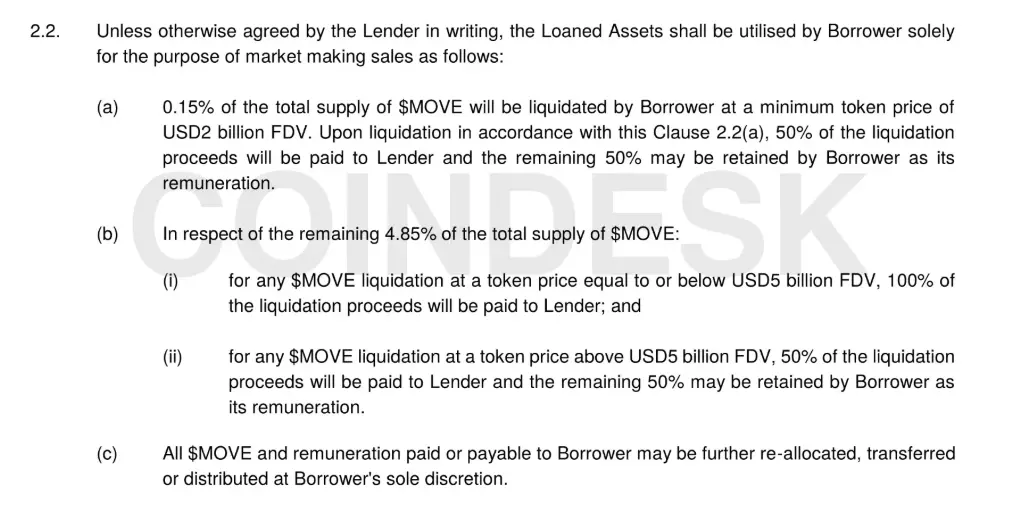
A highly controversial clause in the contract allows Rentech to immediately liquidate its holdings if the "fully diluted valuation" of MOVE tokens exceeds $5 billion and share the profits with the foundation in a 50:50 ratio.
Manian pointed out that this design actually encourages market makers to artificially raise the price of coins and then sell large quantities of tokens at high prices to make a profit.
Although the Movement Foundation ultimately rejected the draft, negotiations with Rentech are continuing.
Rentech then claimed to be a subsidiary of Chinese market maker Web3Port and offered to provide $60 million of its own collateral, a move that in part impressed the foundation, according to three people familiar with the negotiations and legal filings obtained by CoinDesk.
On December 8, 2024, the Movement Foundation finally signed a revised market-making agreement with Rentech, removing some of the most controversial terms. This includes the removal of a clause that would allow Web3Port to sue the foundation for compensation if it fails to list MOVE on a specific exchange.
On December 8, 2025, Rentech and Movement entered into a revised market making agreement. In the agreement, Rentech is still the borrower, but its identity is clearly marked as "Web3Port" in the archive (the name has been blurred in the archive), and the Movement Foundation is the lender. The agreement has been formally signed. CoinDesk has redacted some of the names of individuals in the archive for privacy reasons, and some names were originally obscured.
Although the revised agreement was drafted by Pek, the foundation's legal counsel who had previously opposed the transaction, its core content is still highly similar to the original version: the agreement still allows Web3Port to borrow 5% of the total MOVE tokens and sell them for profit under a certain mechanism, although the method of fund allocation has been adjusted.
The borrower in the new contract is named Web3Port and is signed by a director of Rentech.
It is worth noting that domain name records show that on the day the agreement was signed, the domain name web3portrentech.io belonging to the email address used by the director had just been registered.
Already had an appointment
According to three people familiar with the matter, when the relevant person in charge of the Movement Foundation officially signed the agreement on December 8, he did not realize that Web3Port had signed another agreement with "Movement" a few weeks ago.
On November 25, 2024, Rentech signed a market-making agreement with Web3Port (the name of Web3Port has been blurred in the archive). In the agreement, Rentech is the lender and Web3Port is the borrower. Rentech is also referred to as "Movement" in the file. The contract was obtained by CoinDesk with portions redacted and individual names removed to protect privacy.
This version of the agreement shows that Web3Port has already reached an agreement with "Movement", and its terms are highly similar to the initial market-making proposal that the Movement Foundation had previously rejected. In this contract, Rentech is listed as the representative of Movement.
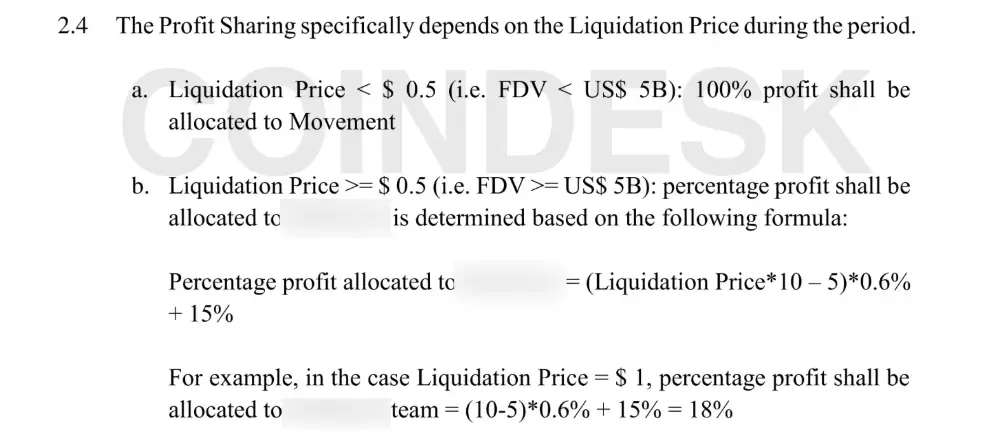
Web3Port’s contract with Rentech allows borrowers to liquidate assets at 50% of their profit. (Source: CoinDesk)
The agreement is structured similarly to the November 27 contract, explicitly allowing market makers to liquidate MOVE tokens when the price reaches a certain target — one of the core provisions of the old agreement and a key issue that industry experts like Zaki Manian are particularly wary of.
"Shadow Co-Founder"
According to people familiar with the matter, there is a lot of speculation within Movement about who is behind the relationship with Rentech. This collaboration eventually led to the token sell-off in December last year, and also plunged Movement into a public opinion storm.
According to Blockworks, the agreement was first circulated internally by Rushi Manche. Manche was briefly suspended last week pending an investigation.
Manche responded to CoinDesk and said: “Throughout the market maker selection process, the MVMT Labs team trusted multiple advisors and members of the foundation team to provide advice and help design the transaction structure. It is clear that at least one member of the foundation represented the interests of both parties in this transaction, which is something we are currently investigating further.”
The incident also raised questions about Sam Thapaliya's role. He is the founder of the encryption protocol Zebec and one of the advisors to Manche and Scanlon.
Communications reviewed by CoinDesk show Thapaliya was copied on an email from Web3Port to the “Movement team,” and also appeared in other emails related to market-making arrangements, alongside Rentech and Manche.
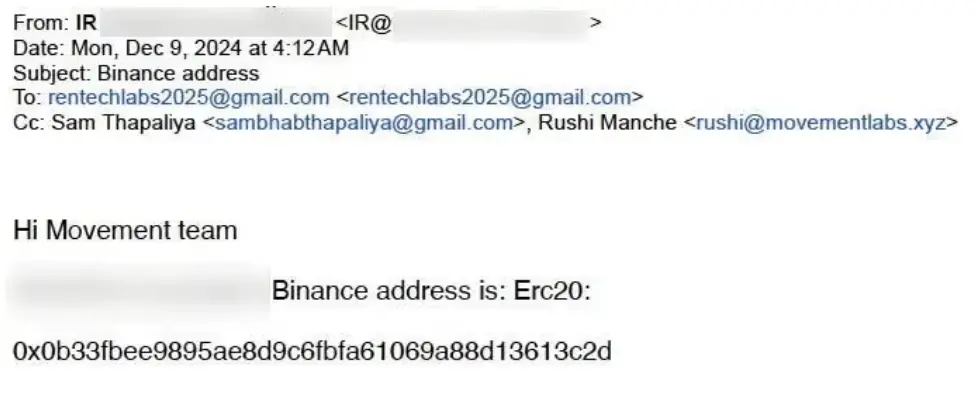
Web3Port copied Sam Thapaliya and Rushi Manche in the email to Rentech (the email was obtained by CoinDesk)
One employee said: From what I understand, Sam is a close advisor to Rushi and to some extent a shadow third co-founder. Rushi has always kept a low profile about this relationship and we usually only hear his name occasionally.
"We often have decisions made internally only to have them changed at the last minute," said another employee, "and whenever that happens, we know it's most likely Sam's idea."
Thapaliya was at Movement’s San Francisco offices the day the MOVE token went live to the public, according to three people who were present.
Telegram screenshots reviewed by CoinDesk also show that Movement co-founder Scanlon had commissioned Thapaliya to help screen the whitelist for the MOVE token airdrop — a strictly limited list of wallet addresses that can participate in the community's coin giveaway (which has been postponed several times before).
The arrangement reinforced the impression among some employees that Thapaliya’s influence within Movement far outweighed that disclosed to the outside world.
Thapaliya told CoinDesk that he had known Rushi Manche and Cooper Scanlon since they were college students and had advised Movement as an external consultant. He stressed that he has no shares in Movement Labs, has not received any tokens from the Movement Foundation, and has no decision-making power in either organization.
Who is Rentech?
Rentech, the entity at the heart of the token dispute, was founded by Galen Law-Kun, Thapaliya’s business partner. Law-Kun told CoinDesk that he set up Rentech as a subsidiary of Singapore-based financial services company Autonomy to connect crypto projects with family offices in Asia.
In response to CoinDesk’s announcement, Galen Law-Kun said YK Pek “helped set up and served as general counsel for Autonomy SG, which is Rentech’s parent or affiliate company.” He also claimed that, despite Pek’s internal opposition to the initial agreement with Rentech, he had suggested setting up Rentech’s structure to move the project online and was involved in drafting the first version of the contract, which was almost identical to the contract he later drafted and approved for the foundation.
However, CoinDesk’s investigation has not found any evidence that Pek set up Rentech on behalf of Autonomy or drafted the first contract.
In response, Pek clearly stated: I am not, and have never been, the general counsel of Galen or any of its entities. He further explained that a corporate administrative services company he co-founded did provide corporate secretarial services to more than 150 entities in the Web3 field, including two companies under Law-Kun’s name. But both companies were declared as having no assets in their 2025 annual reports, and neither is Rentech.
Pek said that he had spent two hours reviewing the consulting agreement signed by Law-Kun for a project in 2024; in addition, he had contacted me about the FTX-related filing deadline, and in August, he forwarded a Docusign NDA, which I only glanced at at the time and did not charge any fees.
Pek concluded: “I have absolutely no idea why Galen would claim that I was his general counsel, and I am confused and disturbed by this statement. He added that in email exchanges between Law-Kun and its corporate secretarial services partner, the other party was actually represented by a company called
Represented by private attorneys from the Hillington Group.
According to YK Pek: Both the general counsels of Movement Foundation (which I served as) and Movement Labs were introduced to GS Legal through Rushi Manche and were called the legal representatives of Rentech.
According to Galen Law-Kun, Pek was introduced by him to 10 projects as Autonomy's legal advisor, and he never objected or corrected this statement. Law-Kun also claimed that the introduction of GS Legal was just a formality as requested by Movement.
In a Slack message sent to employees, Movement co-founder Scanlon said the company has hired external audit firm Groom Lake to conduct an independent third-party investigation into recent abnormal market-making behavior.
In his message, he wrote: In this incident, Movement is the victim.