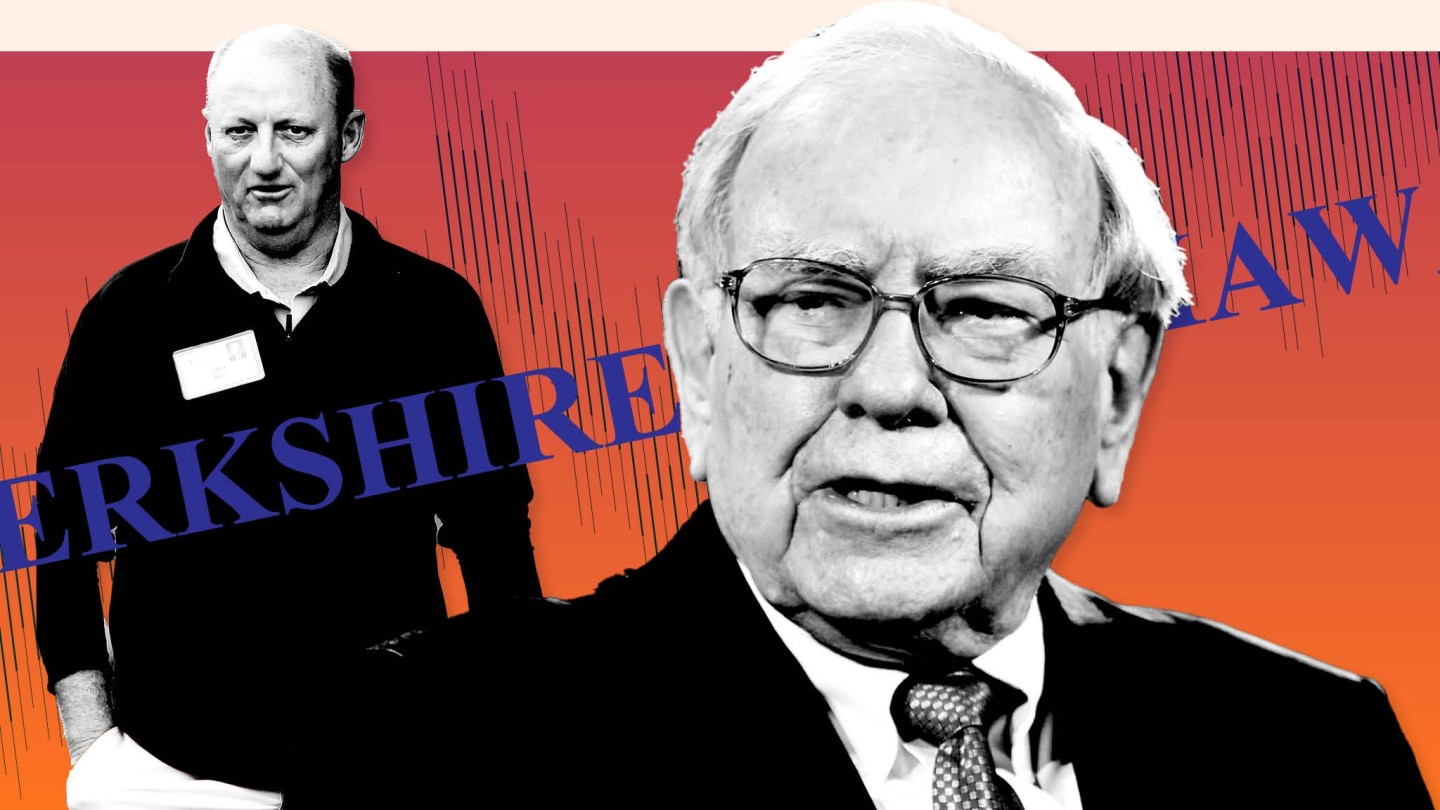
 At 9 p.m. Beijing time on May 3, the Berkshire Hathaway shareholders meeting will kick off in Omaha.
This year, Greg Abel and Ajit Jain will still be on the podium with Warren Buffett, especially Abel, as his successor, who will accompany him throughout the entire process.
The shareholders' meeting on May 1, 2020 was held online due to the impact of the COVID-19 pandemic. Abel and Jain represented the non-insurance and insurance businesses respectively and participated in the question-and-answer session with Buffett for the first time.
Since Charlie Munger's death in November 2023, Berkshire experienced its first annual meeting without Munger (2024), with Abel sitting to Buffett's left as his successor.
In his shareholder letter in February this year, Buffett mentioned Abel several times and specifically.
When discussing Berkshire's capital allocation, Buffett praised Abel for showing a patience similar to Munger's in investing in stocks and subsidiaries, and for being able to act decisively when opportunities arise.
Buffett wrote about his investment in Japan's five largest trading companies: "Over time, our appreciation for these companies has deepened. Greg has met with them many times, and I follow their progress regularly. I expect Greg and his successors to hold these Japanese investments for decades."
Buffett reminds us that Berkshire's 10-K filings are never "empty sweet talk and pretty pictures," and Greg's takeover won't change that.
"I am 94 years old, and soon Greg Abel will take over as CEO and begin writing the annual shareholder letter. Greg, like me, adheres to the Berkshire creed - that the report is not just an annual routine, but the responsibility of the Berkshire CEO to shareholders. At the same time, he also knows that once you start deceiving shareholders, you will soon even deceive yourself."
As the Buffett era draws to a close, understanding Greg Abel may be the key to understanding the direction of Berkshire Hathaway over the next ten or twenty years.
This year, Fortune magazine published an article titled "Meet the man picked to succeed Warren Buffett" written by Shawn Tully in the February/March issue. This is probably the most detailed introduction to Abel we have seen so far.
Abel is low-key, gentle and outgoing, and highly sensitive to numbers. People who know him well say that Abel is quite like Warren, but lacks some of his boss's signature acting talent.
As described in this feature, he does not prefer hands-off management like Buffett, but pays great attention to details and attaches great importance to the actual driving force of subsidiaries.
Jim Webber, former CEO of Brooks, once described it this way: "If you're not performing well, Greg will tell you directly and give you a few months to adjust."
Larry Cunningham, a professor at the University of Delaware, also commented: "Greg will not let those who fall behind continue to fall behind."
This style of focusing on execution and emphasizing improvement coincides with Berkshire's culture of emphasizing actual results and opposing empty promises, and has gradually earned Abel Buffett's high trust.
In the process, Abel demonstrated three qualities that are exactly the same as the "Oracle of Omaha": a talent for building trust, a keen eye for discovering opportunities, and the wisdom to avoid risks.
This article systematically tells the story of how Abel walked all the way from the small prairie town of Edmonton in Canada to the core of Berkshire, and how he accumulated today's trust and responsibility step by step from energy business to overall group management.
Very rich and exciting.
Smart Investor (ID: Capital-nature) has specially translated and organized this article as a footnote to this special moment today.
01 About Tariffs and Global Trade
“Warren, who is your successor as CEO?”
This question may be the most asked and long-unresolved mystery in the history of business.
Every year at Berkshire Hathaway's annual shareholder meeting, during the live Q&A session hosted by Warren Buffett and Charlie Munger, a shareholder always asks this classic question. The two helmsmen usually respond, "The board has appointed a successor, but we won't reveal the name." This has long become an indispensable part of the shareholder meeting weekend activities, along with the 5km long-distance race and See's Candies' coconut Bon Bon Candy dip display.
Until the afternoon of May 1, 2021 (when the shareholders' meeting was held online due to the COVID-19 pandemic), the situation finally took a turn. When answering questions about the company's future culture, the 97-year-old Munger unexpectedly blurted out: "Greg will continue this culture."
This "gaffe" ended the most watched and longest-running CEO succession mystery in business history.
Berkshire investors and observers immediately realized that "Greg" was Greg Abel, and two days later, Buffett officially confirmed in an interview with CNBC that Abel would take over the helm of Berkshire after he stepped down.
The revelation that Berkshire’s reign, which began in 1970 as the anti-Vietnam War movement swept college campuses, Elvis dominated the music charts and Nixon’s first presidency, will have a new successor sets an important beacon for Berkshire’s future development.
Abel, 62, has been one of the top candidates for succession since early 2018, when Buffett and Munger jointly appointed him as vice chairman and director along with another contender, Ajit Jain.
Since then, Abel has been in charge of all of Berkshire's non-insurance businesses - covering two major sectors: leading companies in the railroad, aerospace and energy industries where Abel came from, as well as a series of well-known consumer brands including Dairy Queen, Brooks Running and Benjamin Moore paint.
This dazzling array of diversified businesses constitutes the largest non-financial balance sheet in the United States and contributes two-thirds of Berkshire's non-investment income. Jain, 73, continues to be in charge of the insurance business segment.
Meanwhile, Buffett himself continues to manage his massive investment portfolio—a roughly $600 billion mix of stocks, bonds and cash that has fluctuated frequently in recent years—with the help of two of his longtime assistants, Ted Weschler and Todd Combs, who were once considered dark horse candidates to succeed him as CEO.
02 About investment in Japan
Abel and Buffett's intersection began when Berkshire entered the energy field a quarter of a century ago. Since he became the CEO of Berkshire Hathaway Energy (BHE) in 2008, he has gradually built an energy empire covering utilities, oil pipelines, natural gas plants, wind and solar power plants, and a huge transmission network. This sector has now become an important pillar of Buffett's business empire.
Today, Abel oversees businesses with annual revenues of about $270 billion - if calculated alone, BHE would rank among the top ten on the Fortune 500 list, surpassing Microsoft and Chevron (Berkshire itself ranks fifth).
In the process of gradually gaining Buffett's trust, Abel demonstrated three qualities that are exactly the same as the "Oracle of Omaha": a talent for building trust, a keen eye for discovering opportunities, and the wisdom to avoid risks.
As Buffett said in 2021: "There are a lot of smart people in this world, but some smart people do a lot of stupid things. Greg is a smart man, but he will never do stupid things."
Of course, the 94-year-old Buffett has not yet announced his retirement plans, and his outstanding performance at the May 2024 shareholders' meeting proved that his mind is still sharp.
But it cannot be ignored that Berkshire's overall performance is not as good as it used to be . From 1965 to 2003, Berkshire's average annual return was as high as 19.8%, surpassing the S&P 500 by nearly 10 percentage points each year. However, in the past decade, Berkshire's average annual return was 11.6%, lower than the S&P 500's 13.2%.
“The only reason a conglomerate exists is to beat the S&P,” said Dave Cote, who ran diversified manufacturing giant Honeywell from 2002 to 2017.
Buffett has long successfully fended off attacks from activist investors seeking to “unlock value.” Even after he’s gone, Berkshire will still have a strong defense.
Although Buffett has donated more than half of his Berkshire shares to charity (primarily the Bill & Melinda Gates Foundation) since 2006, he still controls more than 30% of the voting power.
In addition, he revised his will (last Thanksgiving) to leave nearly his entire estate to a charitable trust managed by his three children, Howard, Peter and Susan.
According to the will, the wealth will be distributed in installments to various charitable causes (including foundations managed by themselves) within ten years after Buffett's death.
Therefore, the large number of Berkshire shares held by this trust will effectively prevent potential threats to the company from activist investors for many years to come. At the same time, Buffett has designated Howard as his successor chairman, further consolidating Berkshire's defense system.
But as Class A shares held by the trust are converted into Class B shares for charity, outside investors, including fund managers, ETFs and individual shareholders, will gain increasing voting rights.
This transfer of power is likely to occur during Abel's tenure.
Although Berkshire's market value of nearly one trillion US dollars makes it difficult for private equity funds or industry giants to instigate a wholesale acquisition, the dispersion of voting rights may lead to harassment from aggressive investors.
03 About Cash in Hand
In sharp contrast to the world-renowned Buffett, little is known about Abel's background, personal style and management philosophy.
Apart from one or two events he attended with Buffett, he has never given exclusive interviews to the business media, and his major public appearances have been limited to the last three Berkshire shareholder meetings - last year he took over the podium seat from the late Munger (who died at the end of 2023).
Berkshire Hathaway Energy declined Fortune's request for an interview with Abel, but Buffett responded by email: "I am very pleased with Greg's performance. But I am no longer doing interviews. At 94 years old, not only have I played bridge more slowly, but many other activities have been reduced or eliminated. However, I still enjoy them and can still do a few things well."
However, through interviews with people familiar with Abel, reviewing his personal experiences and management philosophies shared publicly in the past, and his actual performance at Berkshire, a clear image gradually emerges: he is a leader who is very close to Buffett in spirit and temperament, but is likely to forge his own path.
Ultimately, for everyone watching Berkshire, there is only one real question: Can Warren Buffett, even his hand-picked successor, steer the greatest wealth-creating machine Wall Street has ever seen?
It will come as no surprise that Buffett's chosen successor is down-to-earth and affable: People who know Abel well say he has a lot of Warren in him, minus some of his boss' trademark showmanship.
Abel grew up in Edmonton, a Canadian prairie city known as the nation’s “oil capital” and famous for its boom-and-bust cycles. His mother was a stay-at-home mom who worked as a legal assistant, and his father sold fire extinguishers.
"It was a time when people were sometimes employed and sometimes unemployed," Abel recalled in an interview with the Horatio Alger Association, a longtime supporter of scholarships for extremely poor students. "But family and close friends always gave you the strength to dream."
His first business venture was delivering flyers door-to-door on a bicycle for a quarter cent a piece.
As a child, Abel - seen here with a messy Beatles-style haircut - then began collecting discarded soda bottles. He kept looking for better routes home so he could find more discarded bottles along the way. He would pick up as many as five bottles after school each week, and by the end of the week, his room would be filled with 20 bottles, worth about $1 in total.
After entering high school, he helped out at the company where his father worked, filling fire extinguishers.
Young Abel’s lifelong love of ice hockey began in his hometown of Edmonton, a city known around the world for Oilers legend Wayne Gretzky.
His introduction to ice hockey came from his uncle Sid Abel, a hockey Hall of Fame inductee who played for the Detroit Red Wings and Chicago Blackhawks for 14 seasons.
Little Greg practices on the ice every day until his parents urge him to have dinner. This rough sport has taught him the true meaning of teamwork. "Playing ice hockey will make you understand that it is easier to succeed by fighting for a team than by fighting alone," Abel said.
Until his mother Bev passed away in late 2022, he would call her every July 1 to do an in-depth analysis of the Oilers’ offseason signings and mistakes.
Abel’s down-to-earth Middle-America values fit in perfectly with the city’s ethos of Des Moines, where he now lives (Berkshire Energy is headquartered). He coaches his son’s youth hockey team at the Abel Ice Arena, which he built at his own expense and is located in the RecPlex, a large sports complex in Des Moines. This year, he stepped down as head coach and became an assistant coach to relieve some of the pressure.
According to his friends in Des Moines, if you met Abel at the Iowa State Fair or the Calgary Stampede, you would be more likely to think he was a local teacher or bank clerk than a man about to take over the most important job in American business.
"He had a relatable personality that made him fit in with any situation," said Mark Oman, a former Wells Fargo executive. "As a neighbor, he was the kind of person who was down-to-earth and easy to watch with the Oilers or an NFL game."
Abel has a great sense of humor, Orman added. When they watched the Olympics together last year, Abel joked that he had finally found a competition he could win: “I could go to the Iowa State Curling Championship.” After all, he quipped, curling has little competition in the Hawkeye State.
04 About Insurance and AI
Those who know him say Abel is a master at building strong relationships. "He makes friends with people the moment they meet," Orman says. "He's not an outgoing, showy type, but he's 100 percent friendly. No one creates a party better than Greg—not with theatrics, but with personalized attention to make sure everyone has a great time."
Even when he was busy, Abel was always willing to offer selfless advice.
Larry Cunningham, a professor at the University of Delaware and the author of several books on Buffett, lamented: "He has extraordinary wisdom, but the wonderful thing is that you will never feel stupid or irrational in front of him. He always makes people feel warm and relaxed."
Dawn Farrell, current chairman of pipeline giant Trans Mountain, became friends with Abel through their business collaboration and often sought his advice: "If I needed strong advice on some business issue that had nothing to do with him, he would always take the time to help me sort out my thoughts."
Former Honeywell CEO Dave Cote was particularly impressed by Abel’s involvement with the Horatio Alger Association, which provides scholarships to extremely poor students, many of whom have been abused, live in cars with their mothers, or have seen relatives torn apart by drugs.
Abel became president of the organization in 2018 and still plays a prominent role on the executive committee.
"He did a lot for these kids," said Cote. In addition, he believes that Abel is not only passionate about charity, but also humble and sincere. "With his position, he could have chosen to be indifferent and distant, to keep his distance to protect himself. I have seen too many people who are far less powerful than him, but act more superior."
Abel was able to win the competition for succession perhaps because his gentle and extroverted personality is closest to Buffett - this similarity contains significant business advantages.
Of course, you won't see Abel dancing with the University of Nebraska cheerleaders, riding a bull through the streets of Omaha, or singing "My Way" on the Today Show on a ukulele, as Buffett has done - these classic moments have made Buffett a legendary figure.
But Abel displays "big-man charm" in a unique way: he calmly walks through the audience of Berkshire's annual meeting with a microphone in hand, analyzing the technical details of utilities in plain language; he inherited Buffett's sincere charm that has helped the latter win the trust of everyone from regulators to stubborn founders - those founders are only willing to entrust their life's work to trustworthy people.
Aumann pointed out that Abel has the ability to digest a huge amount of information . Business partners revealed that he can even "speed read" balance sheets and income statements to quickly grab key data.
Buffett was amazed at his enthusiasm for work and joked that "Greg discovered a time-space rift in Des Moines that lasts more than 48 hours a day."
Abel's deep understanding of how business works, especially where every dollar goes, began during his time at the University of Alberta, where he initially focused on finance and then switched to accounting to better understand the relationship between the balance sheet and the cash flow statement.
After graduating in 1984, he joined PricewaterhouseCoopers (PWC) in Edmonton, and a few years later, he was assigned to the San Francisco office for a short period of time.
In 1991, Abel became an auditor for CalEnergy, the second largest geothermal power producer in the U.S. This experience shaped his management philosophy and helped him meet key mentors in his career.
05 About Patient Investing and Decisive Swinging
At the time, Buffett's childhood friend and Berkshire board member Walter Scott was looking to diversify his engineering company, Peter Kiewit Sons', by acquiring the debt-ridden CalEnergy, and he already had a man in mind to run the company: David Sokol.
Sokol, a 35-year-old business wizard, had just founded a waste-to-energy company in Omaha and successfully listed it, making a fortune.
Kivet acquired a controlling stake in CalEnergy for $28 million, and Sokol took over immediately, appointing 28-year-old Abel as the company's accountant.
Kiewit culture has profoundly influenced Abel's working methods and negotiation style.
It's a no-frills, no-frills company: Employees work throughout their lives, traveling to various locations to build dams, bridges, and oil platforms.
Sokol became Abel's trading mentor, while Scott, 20 years his senior, provided him with a leadership role model.
In 2020 (the year before Scott's death), Abel interviewed his former boss at a charity event in Omaha, guiding Scott to recall his experiences as a child mowing grass on a farm with a scythe, sleeping in a shed while surveying the Monticello Dam during college summer vacations, and working 18 jobs in 12 years.
Abel admitted that he loved visiting landmarks such as the St. Lawrence Seaway and the Garrison Dam, as he was fascinated by the projects that Scott had worked on. He listened to Scott's recollections with great admiration on the stage, and exclaimed from time to time: "Great, I love this story so much!"
David Wit, a technology entrepreneur who was a director of CalEnergy at the time, witnessed the operation of the iron triangle of Scott (Chairman), Sokol (CEO) and Abel (Financial Architect). He was amazed that this team not only dared to take risks in acquisitions, but also insisted on deeply understanding the financial data of the target and predicting potential risks before taking action.
"Scott has a unique eye," Witt told Fortune. "Greg has a combination of relatability and acumen: humble and hardworking, without any elitist arrogance, and more importantly, he really understands numbers."
During this period, CalEnergy began a series of acquisitions, including a British utility company, which Abel successfully built into a profit machine.
This achievement won Scott's high praise, and Scott recommended Abel's talents to his friend Warren Buffett.
They then acquired a major electricity supplier and renamed the company MidAmerican.
But utilities were a distant second in the energy frenzy of the late 1990s, as investors eagerly paid hefty premiums for companies like Enron, AES, and Calpine as they acquired transmission networks, power plants, pipelines, and utility assets in anticipation of a fully liberalized energy market.
China Energy focuses on acquiring regulated assets that have been neglected by the craze, and its monopoly position and stable customer base are exactly what emerging companies lack.
Scott was keenly aware that these "cash cow" assets were exactly what Buffett wanted.
In a 2002 interview with Andy Serwer of Fortune, Buffett recalled that Scott, who had left Kiewit to run the fiber optic company Level 3, flew from Omaha to Carmel, California, and pulled Buffett into a room at a dinner party at his sister's house to lobby for the acquisition of MidAmerican Energy.
"Walter pulled me into the room and told me that the utility had been trying to explain its business model to Wall Street analysts, but the analysts weren't interested because they were more focused on companies like AES and Calpine that were fast-paced and doing mergers and acquisitions," Buffett recalled.
Scott asked Buffett if he would be willing to work with him and the Sokol, Abel team to privatize MidAmerican Energy.
Buffett has always liked contrarian investing, and he was very excited about this idea. In October 1999, Berkshire announced the acquisition of a controlling stake in MidAmerican Energy, and Scott joined as a minority shareholder.
As the full liberalization of the energy market turned into a crisis, Sino-US Energy quickly became a "high-quality buyer" when major companies disposed of their assets.
In 2002, Williams Companies sold the Kern River pipeline, which connects the Rocky Mountains, Las Vegas and California, to MidAmerican Energy for $960 million, hundreds of millions of dollars less than its valuation two years earlier.
That same year, Sokol and Abel bought Northern Natural Gas Co., a 17,000-mile network of natural gas pipelines connecting the Permian Basin in Texas to the upper Midwest, for $928 million. The deal was about $600 million less than Dynegy had paid for it from Enron a few months earlier.
Serwer reports that Buffett recounts these successes "with the same excitement as if he had reeled in a giant tuna."
06 About the depreciation of the US dollar
Since 2007, Buffett has sent Sokol to reorganize Berkshire's problematic subsidiaries, taking over insulation material manufacturer Johns Manville and business jet operator NetJets.
The following year, Abel was promoted to CEO of MidAmerican Energy.
Sokol's outstanding performance as a "firefighter" once made many investors think that he was the most promising CEO successor. However, in 2011, Sokol suddenly resigned because he was questioned for personally purchasing shares of Lubrizol, a lubricant manufacturer, on the eve of recommending it to Buffett (Berkshire later completed the acquisition of Lubrizol). Fortune magazine tried to contact Sokol by email but received no response.
After Sokol's departure, Abel's promotion was a foregone conclusion.
After he took charge of the energy sector, he continued the strong profit growth momentum, cleverly used Berkshire's strong balance sheet to acquire assets at low prices, and used all cash flow to expand the business, creating the compound interest miracle that Buffett cherished.
In 1997, CalEnergy had revenue of $2.3 billion and profit of $139 million; by 2022, Berkshire Energy (BHE)'s revenue soared to $26.4 billion and profit reached $3.9 billion.
Abel also avoided a potential public relations crisis for Berkshire on environmental issues through a visionary negotiation and further solidified the company's image among environmentalists and regulators.
At the time, hydroelectric dams along the Klamath River in Oregon and Northern California were damaging Indian tribal fisheries. With his patient and flexible negotiating style, Abel brokered a deal: MidAmerican would close the dams, but only if they could continue to operate for a period of time to recoup some of the investment, while paying for the removal costs through state government bonds and a small increase in electricity prices.
The largest dam removal project in history was completed earlier this year, and the Klamath River is now flowing freely again, with a new fishery expected to soon benefit fishermen from local Native American tribes.
"It's about, how do you get the other side on board? How do we become long-term partners?" Abel said in a 2015 video interview, summarizing his negotiating style.
Whether serving as CEO of MidAmerican Energy from 2008 to 2018, or in overall charge of all of Berkshire's industrial businesses thereafter, Abel has demonstrated a strong, hands-on management style and has become an important promoter of green energy infrastructure in the United States.
Under his leadership, Berkshire has made a big push into solar energy and has also become the largest regulated wind utility in the U.S., operating numerous wind farms in Texas, California and the Midwest, particularly Iowa.
At the Berkshire annual shareholders meeting in May 2024, Abel announced that just a few weeks ago on Earth Day, strong winds enabled wind turbines to supply electricity, meeting the electricity needs of more than 800,000 Iowa customers of MidAmerican Energy. (In mid-2022, Berkshire acquired the 8% stake in BHE held by the Scott family and Abel for $8.7 billion, and Abel cashed out $870 million for 1% of his stake.)
Abel also brought significant improvements to the $165 billion manufacturing, services and retail division, which includes NetJets, Benjamin Moore, Clayton Homes and dozens of other subsidiaries, but excludes railroads and energy businesses, raising operating profit margins to 7.6% in 2023 from 4.9% in 2017.
Unlike Buffett who "let go of management", Abel is hands-on and never tolerates inefficiency.
Jim Weber, former CEO of Brooks running shoes, revealed that Abel visits the company's headquarters in Seattle several times a year to discuss company strategy with management. "If you are not performing well, he will tell you directly and give you a few months to adjust," Weber said in an interview at the 2021 Berkshire annual shareholders meeting.
Larry Cunningham also said in the interview: "Greg will not let the laggards continue to fall behind. If you don't perform well, you will get a call from him."
Buffett himself once admitted in an interview with CNBC in 2023: "Greg may be tougher than me in execution. He can leave with a smile after execution, and the people who are executed can also feel good."
07 About the work of the efficiency department
From the outside, Abel appears to be taking over a stable and well-managed business empire, but in reality, Berkshire faces a number of challenges.
The overall performance in recent years has been acceptable, but it has declined significantly compared to the glorious past. Some of the subsidiaries that were once booming are now performing poorly:
Auto insurance giant GEICO lags far behind its competitor Progressive in adopting connected car technology to price risk, resulting in market share loss;
BHE profits fall from 2022 peak due to wildfire compensation;
Among the five major railway companies in the United States, its railway company BNSF has ranked last in terms of return rate in the past two years. Buffett has publicly stated that BNSF urgently needs to "significantly reshape its cost structure."
Buffett himself admitted that some of Berkshire's companies have performed poorly for a long time and have some "lagging" business segments.
How will Abel respond to these challenges and can he continue Buffett's legend? This is not only related to the future of Berkshire, but also to Wall Street's confidence in this "wealth machine".
Abel can boost performance and revitalize underperforming businesses through a three-pronged approach. However, these measures will inevitably affect Berkshire's long-standing competitive advantage - the high degree of independence of its subsidiaries, which is the core of Berkshire's business ecosystem.
In the traditional model, Berkshire acquires high-quality companies at reasonable prices and grants them full autonomy. This "non-interventionism" enables it to act as a "buyer of last resort" in times of crisis. Adam Mead, an investment manager who wrote an authoritative book on Berkshire's financial history, believes that this is Berkshire's key competitive advantage.
Strategy 1: Set profit targets and replace CEOs when necessary
Buffett rarely sets profit targets for subsidiary CEOs, and he never replaces management directly due to poor performance. However, Abel may challenge this practice.
"He pushed us like any good executive would," says Dairy Queen CEO Troy Bader.
Abel's management style has been on display recently when he sent Adam Wright, a 47-year-old executive who had successfully run MidAmerican Energy, to take over the management of Pilot Travel Centers, the largest truck service center chain in the United States.
Wright, a former NFL halfback whom Buffett called an "outstanding executive," has begun renovating old convenience stores and improving the company's financial position.
Strategy 2: Establish an operations management team
This structure is new in Berkshire's history, but it may well become necessary.
It should be noted that Abel will have a lot of help - in the insurance business, the experienced Ajit Jain will continue to be at the helm; in the management of huge stock and bond portfolios, he can also rely on Todd Combs and Ted Weschler.
Legendary CEO coach Ram Charan pointed out: "Greg can't manage 80 subsidiaries himself." David Kass, a professor at the University of Maryland, believes that Abel can divide non-insurance businesses by industry, with each group of about 20 companies managed by a dedicated person.
Strategy 3: Integrate procurement and operations resources
Successful conglomerates like Honeywell and Danaher have achieved economies of scale by centrally purchasing raw materials and components and promoting "best practices" across their factories.
In contrast, Berkshire's current synergies are mainly financial, such as the headquarters being able to provide financing for Clayton Homes at interest rates lower than those available from banks or the bond market.
As Mead points out, Berkshire has not integrated on the purchasing side, for example, not encouraging its companies to jointly purchase aluminum or semiconductors, nor has it promoted the cross-selling of GEICO insurance.
Buffett acknowledged that as Berkshire grows, it will be impossible for the company to repeat the outsize returns of its first 40 years.
However, he believes Berkshire is still on track to outperform the S&P 500 by 1 to 2 percentage points. The most likely scenario is that Abel will largely stick with the basic formula that has made Berkshire successful:
In times of crisis, as a “buyer of last resort” with the ability to write checks worth billions of dollars;
Increase equity investment when the stock market is sluggish, and reduce holdings in a timely manner when valuations are high;
Actively repurchase shares when the company's market value is lower than its intrinsic value.
As for what is Berkshire's true "intrinsic value" - perhaps, except for Buffett himself, no one is closer to the correct answer than Greg Abel.