Author | Yiping @IOSG
Challenges Facing Crypto Infrastructure
Market Fatigue and Valuation Decline
The cryptocurrency infrastructure sector is experiencing significant market fatigue. After years of explosive growth, infrastructure project valuations are shrinking, and investors are becoming more discerning. This trend reflects a maturing market where technological innovation alone is no longer sufficient to achieve high valuations.
Innovation Challenges
Today's infrastructure projects face a key dilemma: most provide similar functions with minimal differentiation. Despite technological advances, we have not yet seen breakthrough use cases that can support entirely new application categories. Ecosystems struggle to provide compelling value propositions that would motivate established Web2 platforms like X or Instagram to migrate to blockchain. Beyond decentralization, these platforms have little reason to fundamentally change their existing operations. This fundamental adoption gap makes trading and speculation the dominant applications for most infrastructure layers, limiting the sector's transformative potential.
Infrastructure Overbuilding and Vacancy
Many infrastructure projects tend to focus on pursuing forward-looking technological innovations while overlooking developers' actual needs. They often concentrate excessively on elements beyond core functionality, such as privacy protection, trust assumptions, verifiability, and transparency. This overly advanced technological approach ignores the importance of short-term market acceptance and practical applications, not only increasing early market promotion difficulties but also making it challenging to obtain effective user feedback and validation.
The proliferation of such infrastructure projects has created a paradoxical situation - too many platforms competing for too few attractive applications. This imbalance has resulted in numerous "ghost chains" with extremely low actual usage and almost no revenue generation, creating unsustainable economic models primarily dependent on token appreciation rather than genuine utility.
For example, despite advanced ZKVM technology, the verifiability it provides cannot effectively address the actual challenges faced by blockchains at this stage, nor can it drive more Web2 applications to integrate with blockchain technology. Therefore, ZKVM technology currently appears more idealistic than practical as an infrastructure product.
In contrast, cloud computing directly responds to market-validated needs, such as efficiently managing server resources with different configurations, times, and locations. This need already has a mature market foundation. Cloud computing platforms directly satisfy developers' practical demands for rapid deployment, elastic scaling, and cost optimization through modular, interface-based server resources, database management, and storage services. By genuinely addressing enterprise and developer pain points, cloud computing technology quickly gained market recognition and ultimately developed into crucial infrastructure supporting the internet economy.
Breaking the Feedback Loop
A healthy crypto ecosystem requires an efficient feedback loop between application developers and infrastructure builders. Currently, this loop is broken - application developers are constrained by infrastructure limitations, while infrastructure teams lack clear signals about which features can drive actual usage. Restoring this feedback mechanism is crucial for sustainable growth. Despite these challenges, infrastructure development remains profitable, with 35 of the top 50 cryptocurrencies by market cap maintaining their own infrastructure layer. However, the standards for success have significantly increased - new infrastructure projects must simultaneously demonstrate specific use cases, substantial user attraction, and compelling narratives to achieve meaningful valuation.
Most Successful New Infrastructures in the Past Year
Evolution of Blockchain Infrastructure
Previous blockchain infrastructure cycles primarily focused on addressing Ethereum's limitations, with projects positioning themselves as "faster and cheaper" alternatives while offering almost no truly innovative features. Today, the landscape has changed dramatically, with recently successful projects introducing more diverse and specialized infrastructure solutions.
Most Influential New Projects
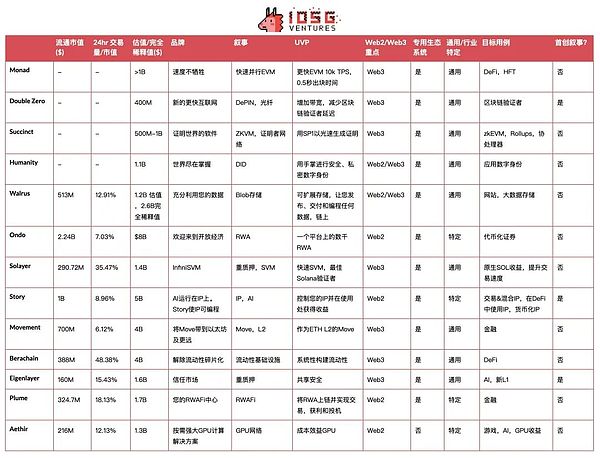
Over the past year, some infrastructure projects achieved remarkable results through TGE or major financing rounds. According to Cryptorank data, these projects represent the most influential new infrastructures in primary and secondary markets:
Blockchain Infrastructure
Movement: MoveVM Ethereum Layer2
Berachain: Liquidity Proof, EVM-compatible Layer1 Monad: High-performance EVM-compatible Layer1
Solayer: Restaking based on Solana ecosystem, ultra-high-speed SVM
Succinct: ZK Proof Generation Network and ZKVM
Emerging Infrastructure
Walrus: Blob Storage Solution
Aethir: GPU Computing Network
Double Zero: Decentralized Physical Fiber Network Infrastructure
Eigenlayer: Providing Ethereum Security for New Protocols
Humanity: Digital Identity Protocol Platform
Bridges between Web2 and Web3
Ondo: RWA Layer2
Plume: RWAFi Blockchain
Story: AI-Driven Programmable IP Platform
Below is a project data overview table (data as of 2024/4, for reference only):
Core Observations and Analysis
Based on the analysis of recent successful infrastructure projects and the current market environment, the following core observations can be distilled:
Market Maturity and Valuation Reshaping: From Technical Enthusiasm to Value Return
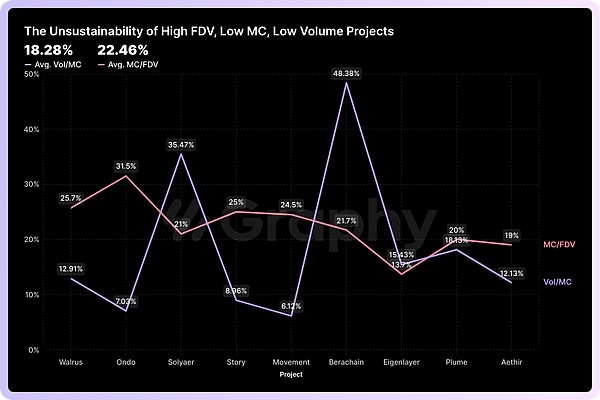
The most significant characteristic of the current market is the transformation of valuation logic. Early models that relied solely on technological narratives and high FDV (Fully Diluted Valuation) to attract investment are facing severe challenges.
Unsustainable Token Economic Models
Many projects exhibit high FDV, low circulating market cap (MC), and low trading volume. This suggests that future massive token unlocks will bring continuous selling pressure. Even if projects achieve technological progress, they may experience price declines due to token dilution, which could erode user confidence and create a negative feedback loop. This indicates that a sound, sustainable token economic model is crucial for the long-term health of infrastructure, almost as important as the technology itself.
Valuation Ceiling and Exit Challenges
Even successful projects seem to face an invisible ceiling of around $10 billion in valuation. This means that for investors to achieve extraordinary returns (such as 100x), they need to enter at an extremely early stage (valuation below $50 million), highlighting the importance of timing and early judgment. The market no longer easily pays for pure potential but requires more explicit proof of value.
Execution Trumps First-Mover Advantage
Not all projects that pioneered new narratives achieved the highest valuations. For example, while Double Zero, Story, and Eigenlayer were pioneers in their respective fields, many subsequent projects obtained equal or even higher valuations through stronger execution, better market timing, or more optimized solutions. This indicates that in an increasingly crowded market, high-quality execution, effective market strategies, and timing are becoming increasingly prominent.
Technical Pragmatism Emerges: Focus on Optimization, Integration, and Real Needs
The technological development direction of infrastructure shows a clear pragmatic tendency, with the market favoring solutions that can solve practical problems, optimize existing paradigms, or effectively connect with the real world.
Continuous Value of "Faster and Cheaper"
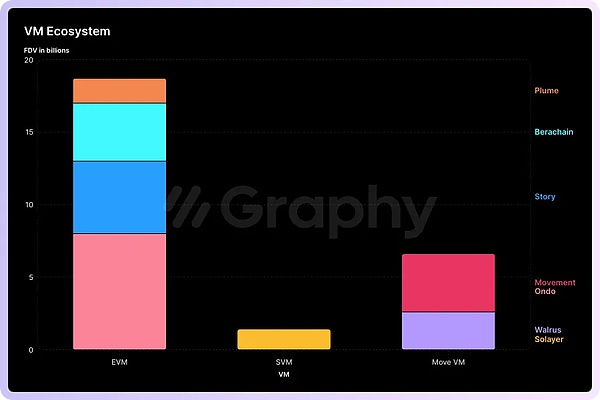
Although the market seeks breakthrough innovations, the demand for optimizing core blockchain performance remains strong. Projects like Monad, Movement, Berachain, and Solayer have gained significant valuations by improving the performance of existing virtual machines (EVM, MoveVM, SVM) rather than introducing entirely new paradigms. This indicates that improvements in speed, cost, and efficiency remain the core value proposition of infrastructure before finding the next killer application. Network layer optimizations (such as Double Zero) and security enhancements (such as Succinct, Eigenlayer) also fall into this category.
Embracing the Real World, Connecting Web2
Projects aligning with real-world applications and assets demonstrate strong market appeal. Ondo and Plume focus on RWA (Real World Assets), while Story concentrates on the programmability of IP (Intellectual Property), all of which have received high valuations. They apply blockchain technology to proven Web2 concepts (such as asset management, IP commercialization), infusing them with programmability, global liquidity, and new financial possibilities, lowering user understanding barriers and expanding application scenarios.
DeFi and AI as Value Anchors
From the perspective of target use cases, finance (DeFi, RWA) and artificial intelligence (AI) are the two domains currently most recognized by the market and capable of supporting high-valuation infrastructure. This suggests that infrastructure providing underlying support for these two high-potential fields is more likely to gain capital and market favor.
Some Narratives Cooling Down
Meanwhile, some infrastructure narratives once held with high hopes, such as pure gaming chains, Rollup-as-a-Service (RaaS), dedicated verification layers, multi-VM chains, Agent chains, some DePIN and Desci, have not yet produced billion-dollar leading projects in this cycle. This may reflect that these areas either lack technological maturity or have not yet found clear, large-scale market demand and sustainable business models.
Ecosystem Synergy and Precise Narrative: Dual Engines of Value Amplification
Beyond technology and market positioning, building a robust ecosystem and conducting effective market communication have become key levers for infrastructure project success.
Network Effects of Ecosystems
The vast majority of projects valued over $1 billion are dedicated to building or integrating into a dedicated ecosystem. Whether L1/L2 attracting developers to build applications or Eigenlayer providing shared security for other protocols, this reflects the importance of network effects. Ecosystems with multiple composable projects can create value far beyond isolated solutions, forming a positive cycle that attracts more users, developers, and capital.
Layered Narrative, Precise Communication
Infrastructure must simultaneously address two core groups: end-users and developers, whose needs and focus are entirely different. For end-users, complex technology must be transformed into an intuitive "experience" story (such as fast transaction speed, low cost, ease of use), emphasizing the direct benefits of technology. For developers, the "capabilities" of technology must be explained in depth (such as performance metrics, development tools, scalability, security), providing professional, precise information for assessment. Successful projects often adjust communication strategies based on different audiences, effectively conveying value propositions.
(Note: The translation continues in the same manner for the rest of the text, maintaining the specified translations for technical terms.)