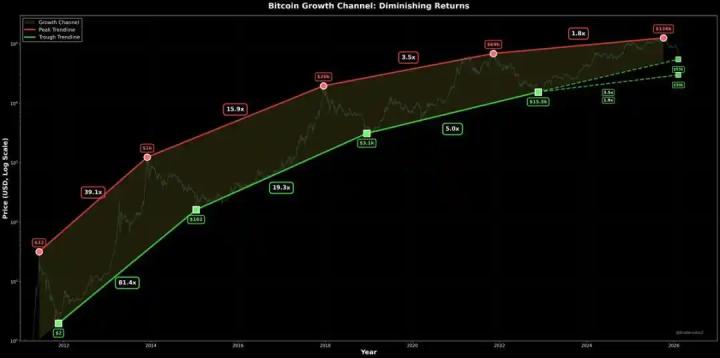
I ran 27,068 high-precision quadratic quantile regressions on Bitcoin price data from the last 5 years.
It took 11 hours of continuous compute time.
What does this analysis reveal—and why does it matter?
This chart breaks down how consistent each quantile has been over time by
This is one of four major analyses I am conducting to obtain the best possible baseline for modeling the upper quantiles.
I will use machine learning to model the decay function of the upper quantiles relative to that baseline.
I removed five years of data from the dataset, then incrementally added 10-day slices, running a quadratic quantile regression across all quantiles after each addition until the full dataset was restored.
I repeated the same procedure with 30-day and 90-day increments.
Notice how the 97 to 99.9 quantiles curve (decay function) is pretty stable.
Once we identify the ideal decay function, this quantile range can be modelled pretty reliably.
All this analysis was done with hourly data since July 17, 2010—130,000 data points—removing up to 5 years and then adding them back in 10-day, 30-day, or 90-day increments.
In essence, these tests identify the quantile whose curve is flattest (i.e., exhibits essentially zero curvature) and has remained reliably flat over the past five years.
Next, we run a linear quantile regression at that quantile and assess both the stability of the slope and
Sector:

From Twitter
Disclaimer: The content above is only the author's opinion which does not represent any position of Followin, and is not intended as, and shall not be understood or construed as, investment advice from Followin.
Like
Add to Favorites
Comments
Share
Relevant content