



Written by: Mankun
The recent notice issued by the Hong Kong Securities and Futures Commission (SFC) regarding staking services provided by licensed Virtual Asset Trading Platforms (VATP) introduces a clear regulatory framework for the Hong Kong virtual asset ecosystem, which will have significant implications. This move marks a notable change in the SFC's regulatory stance, aimed at providing structural regulations for staking activities while addressing the growing demand for policy clarity from investors and market participants.
Understanding Staking Mechanisms
Staking involves committing or "locking" virtual assets to a blockchain protocol to support its validation process (typically based on Proof of Stake (PoS) consensus mechanism). By staking assets, participants help validate transactions and maintain blockchain security, and in return, they usually receive rewards in the form of additional tokens.
Although staking provides investors with a way to generate passive income, it comes with multiple risks: stakers may face penalty mechanisms such as "Slashing" (where a portion of staked assets is confiscated due to validator mismanagement or misconduct). Additionally, staked assets are often locked for a fixed period, resulting in liquidity risks for investors.
SFC's Staking Guidelines
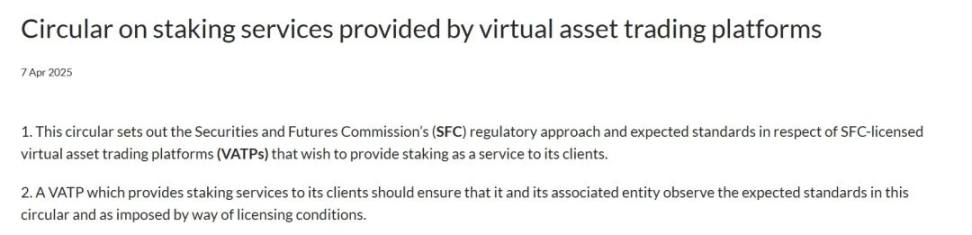
The SFC's recent circular outlines its regulatory approach for VATPs wishing to offer staking services to clients. The guidelines emphasize establishing clear standards for platforms providing staking services while ensuring investor protection remains a core concern. Here are the key points of the guidelines:
1. Control and Protection of Customer Assets
VATPs must maintain control over virtual assets involved in staking, ensuring they are not held by third-party service providers. This restriction aims to minimize mismanagement or fraud risks and safeguard customer assets in a regulated environment.
2. Operational Control and Risk Management
VATPs need to establish effective policies to detect errors, mitigate risks, and protect customer assets. Platforms must ensure they have necessary internal control measures to manage the operational complexity of providing staking services, including addressing potential conflicts of interest.
3. Transparency and Information Disclosure
A key regulatory requirement is that VATPs must provide clear and comprehensive information about staking services, including explaining associated risks (such as Slashing, lock-up risks, blockchain errors, and potential validator negligence). Platforms must also disclose fee structures, lock-up periods, unstaking processes, and third-party involvement in staking services.
4. Due Diligence on Blockchain Protocols and Third Parties
VATPs must conduct rigorous due diligence when selecting staking blockchain protocols and outsourcing any staking-related services to third-party providers. This ensures platforms can assess related risks and choose protocols aligned with their operational capabilities and risk management strategies.
5. SFC's Prior Approval
VATPs intending to offer staking services must first obtain written approval from the SFC. The SFC will attach specific conditions to the platform's license to ensure compliance with staking-related regulatory requirements. This adds an additional layer of oversight and accountability for platforms entering the staking market.
Commercial Motivations for Offering Staking Services
Exchanges and trading platforms gain clear commercial benefits by adding staking products:
First, staking creates new revenue streams. Exchanges can collect commissions or "service fees" from rewards users earn by staking tokens on the platform (for example, Coinbase charges about 25% of ETH staking rewards, Binance around 20%, Kraken about 15-20%, varying by asset). This effectively transforms idle customer assets into a recurring fee income source for the platform.
Second, staking locks in customer assets and enhances user "stickiness". When users delegate or lock tokens to earn rewards, these assets cannot be immediately withdrawn or traded, thus anchoring customer balances (and network effects) to the platform.
Third, staking services create a differentiated competitive advantage for exchanges. By promoting passive income products, exchanges can attract a broader user base (including those more interested in long-term staking returns than active trading) and signal their provision of comprehensive crypto ecosystem services (trading, custody, earnings, etc.). In the highly competitive crypto market, offering staking (and related yield products) has become a standard means for major platforms to compete and enhance perceived value.
Staking and Global Regulatory Trends
Global regulators are working to define the position of staking within existing legal frameworks.

The core controversy (especially in the US) is whether staking service returns are similar to securities interest (i.e., an "investment contract" under the Howey Test). The SEC under Chairman Gary Gensler has taken an aggressive stance:
Kraken Settlement
As one of the first major crypto exchanges to provide "staking as a service", Kraken supported multiple PoS chains (such as Ethereum, Polkadot, Cosmos), allowing clients to delegate tokens through its validator nodes. In February 2023, Kraken agreed to pay a $30 million fine and close its US staking program to settle SEC charges. The SEC argued that Kraken's staking service constituted an unregistered investment contract sale. Under the settlement, Kraken stopped providing staking services to US clients but continued operations overseas.
Coinbase Warning
Coinbase offers staking services on its retail platform (supporting token staking for ETH, Algorand, Tezos, etc.) and institutional business line (Coinbase Prime). In its 2023 lawsuit against Coinbase, the SEC specifically pointed out that its "staking" yield program constituted an unregistered securities offering. Coinbase publicly disputed this characterization, arguing that staking is a "legitimate business model" not subject to traditional securities law requirements. The lawsuit focusing on Coinbase's staking services highlights regulatory risks: the SEC views staking as a service potentially meeting the Howey Test's "investment contract" definition. (Notably, in February 2025, Coinbase announced that the SEC had withdrawn the lawsuit, seen as a signal of evolving regulatory attitudes, but the dispute remained unresolved as of 2024.)
However, there are exceptions, such as Binance.
The world's largest exchange, Binance, provides staking services through its "Binance Earn" suite (supporting flexible/fixed staking for dozens of tokens). Binance's staking model is similar: clients lock tokens on the platform and earn protocol Annual Percentage Yield (APY). Despite facing broad regulatory scrutiny on licensing, as of early 2025, US authorities had not directly brought charges against its staking products (Binance has delisted staking services in some regions to comply with local laws). However, Binance's staking business demonstrates the scale of this business: crypto staked through mainstream exchanges often reaches billions of dollars, with platforms attracting funds by advertising competitive yields.
Meanwhile, the SEC's view is also controversial. For instance, in early 2025, a bipartisan group of US senators urged the SEC to allow crypto exchange-traded funds (ETFs) to stake, arguing that staking is crucial to the security of many blockchain protocols. In other words, while US enforcement policy treats staking returns like bond interest, some legislators and industry groups believe this stance suppresses innovation and investor interests.
Regions outside the US take different approaches: the EU's Markets in Crypto-Assets Regulation (MiCA) does not prohibit staking; in fact, crypto asset service providers (including custodians and exchanges under MiCA) typically need to report to regulators how customer assets are managed (including assets used for staking). MiCA clearly regulates token issuance and stablecoins but largely leaves non-security tokens and related services to national regulators and anti-money laundering/know-your-customer rules. In practice, EU staking as a service might require providers to obtain a Crypto Asset Service Provider (CASP) license under MiCA/EMD2 or equivalent national permits, meaning compliance costs may increase but direct prohibition is less likely.
The situation varies across different jurisdictions: For example, Singapore's regulatory authorities implement licensing for digital asset brokers and custodians but do not prohibit staking, while countries like China and India adopt a more stringent anti-crypto stance (indirectly restricting staking through banning retail crypto exchange).
In this context, Crypto.com, Gemini (Gemini Earn), Kraken's overseas branches, and numerous small exchanges/custodians are offering staking or yield services (such as Crypto.com allowing users to stake CRO tokens for higher rewards; Gemini Earn—terminated after Genesis's bankruptcy—was a crypto lending product, indicating that yield products may involve lending rather than pure staking), but each platform faces unique challenges: Gemini Earn stopped payouts after Genesis froze customer funds; Kucoin in Singapore launched staking tokens by collaborating with validator companies.
Overall, leading trading platforms are actively launching staking services to meet customer demands, despite ongoing regulatory scrutiny. The global regulatory trend is also in a tug-of-war: key points of contention include investor protection, potential concentration risks in staking pools, and legal classification. US regulators have so far signaled that staking products might be considered "securities" under existing laws, while other regulatory bodies are still developing clear guidelines or maintaining a more tolerant attitude towards proof-of-stake network economic functions.
Key Risks and Operational Challenges
Staking services pose multiple risks to platforms and clients:
1. Custody and Network Security Risks
To stake on behalf of clients, exchanges must either take over user private keys or delegate staking to validator nodes. This significantly increases the platform's held asset value, making it a high-value target for hackers. Security vulnerabilities (or internal theft) could lead to massive losses. Moreover, since platforms actually control staked tokens, platform bankruptcy or fraud (as demonstrated by previous crypto industry events) could jeopardize staked funds. (Regulators note that staking services involve customer asset custody, involving custodial regulations and audit requirements.)
2. Technical/Operational Risks
Operating and maintaining validator nodes involves operational complexity. If nodes fail (software defects, cloud service interruptions, configuration errors) or are breached, they might be unable to participate in consensus mechanisms. For most proof-of-stake networks, this could trigger Slashing penalties, permanently destroying part of the staked assets (such as for double-signing or prolonged offline status). Therefore, staking platforms must establish robust redundant validator node infrastructure. Downtime during major network events (like hard forks or upgrades) presents additional risks: platforms must stay synchronized with protocol changes, or risk losing rewards or funds.
3. Liquidity and Market Risks
Staked tokens typically require lock-up periods or at least have unbonding delays (like Ethereum's minimum 2-week exit queue). If customers suddenly request withdrawal or selling crypto assets, they cannot act immediately. This poses liquidity risks for both users and platforms. Some platforms offer "liquid staking" derivatives or internal IOUs to provide apparent liquidity, but this introduces counterparty risks and potential mismatches. During market crashes, staked asset values might plummet like other crypto assets, and the inability to exit quickly could exacerbate losses.
4. Regulatory/Legal Risks
As previously mentioned, staking services exist in a regulatory gray area. Platforms' business models depend on litigation outcomes or rule changes (for instance, if regulators suddenly determine staking rewards are "interest" requiring registration, platforms might be forced to suspend services or register as securities entities). This legal uncertainty itself constitutes an operational risk.
5. Business and Competitive Risks
Providing staking services typically requires sharing rewards with customers (as yields are transparent and protocol-driven). If exchanges' reward commissions are too high, customers might shift to high-yield competitors or decentralized protocols. Conversely, low rates will squeeze platform revenues. Additionally, staking services are becoming commoditized: platforms lacking competitive yield rates or user-friendly staking options might lose market share to competitors with these advantages.
Mackun Law Firm Summary
Although staking services can bring substantial profits and attract customers, platforms must manage complex technical infrastructure and navigate evolving legal frameworks. Successful staking operations require robust custody security measures, clear risk disclosures, and flexibility to adapt to regulatory changes—all aimed at ensuring promised yields do not expose exchanges (or their users) to inappropriate risks.
For Hong Kong, the SFC's new staking guidelines reflect the dynamic evolution of local virtual asset regulation. By establishing staking service provision rules, the SFC seeks to balance virtual asset ecosystem development with investor protection. While the guidelines provide much-needed clarity, inherent staking risks remain. Both platforms and investors must engage in staking activities with a comprehensive understanding of potential pitfalls. The regulatory framework established by the SFC lays the foundation for future virtual asset development, and closely tracking the evolution of these regulations will be crucial as the industry continues to mature.


