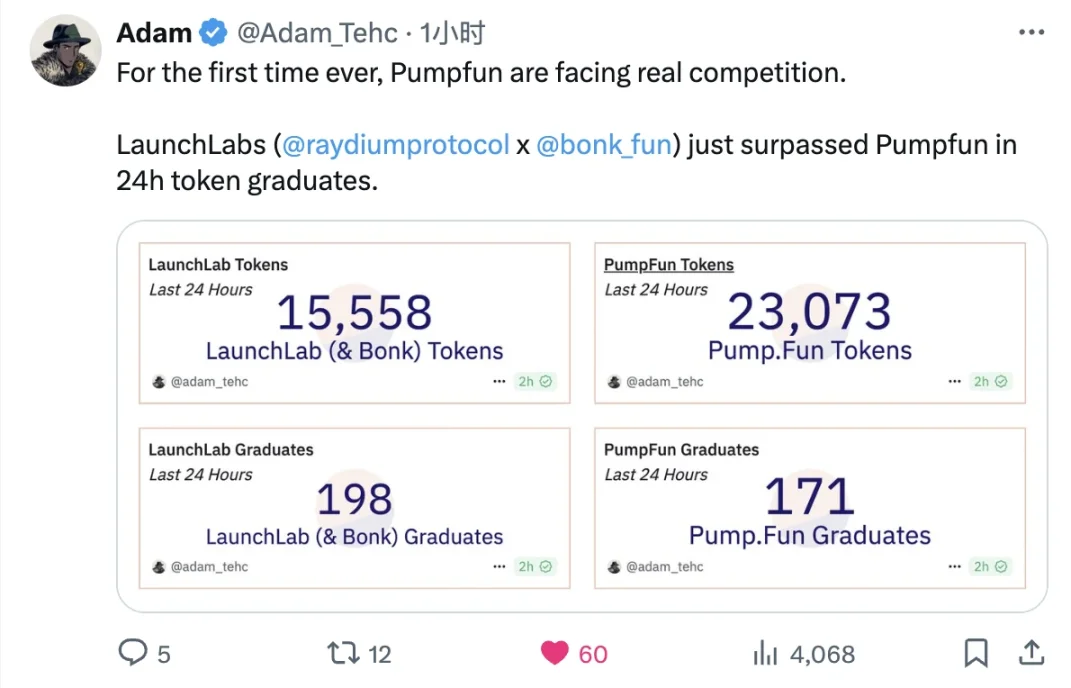
On May 13, on-chain data analyst Adam posted on X that the Dune panel data shows that in the past 24 hours, the number of graduated tokens from Raydium's token issuance platform LaunchLab (including third-party issuance platforms built on LaunchLab such as Letsbonk.Fun) was 198, surpassing Pump.fun's token graduation number of 171.
Adam commented that this is the first time in history that Pump.fun has encountered true competition.
Historical Grievances
The grievances between Pump.fun and Raydium have long existed.
In Pump.fun's early design, token issuance needed to go through two stages - "internal market" and "external market" - after token issuance, it would first enter the "internal market" trading stage, which relied on Pump.fun protocol's own Bonding Curve for matching. When the trading volume reached $69,000, it would enter the "external market" trading stage, at which point liquidity would migrate to Raydium and create a pool for continued trading.
However, on March 21, Pump.fun announced the launch of its own AMM DEX product PumpSwap. Since then, Pump.fun tokens entering the "external market" would no longer migrate liquidity to Raydium, but instead would be directed to PumpSwap - directly cutting off the traffic flow to Raydium and thereby reducing its trading volume and fee income.
In response, Raydium announced on April 16 that it had officially launched the token issuance platform LaunchLab, allowing users to quickly issue tokens and automatically migrate to Raydium AMM when token liquidity reaches a certain scale (85 SOL). Clearly, this was Raydium's direct counterattack against the aggressive Pump.fun.
LaunchLab's "Killer Move"
Although LaunchLab's token issuance function is largely similar to Pump.fun, its biggest feature is not in the issuance stage itself - LaunchLab's architecture supports third-party integration, allowing external teams and platforms to create and manage their own launch environments within the LaunchLab ecosystem. In other words, third parties can rely on LaunchLab's underlying technology (with the key point being that liquidity pools remain in LaunchLab and Raydium) to launch independent token launch frontends.
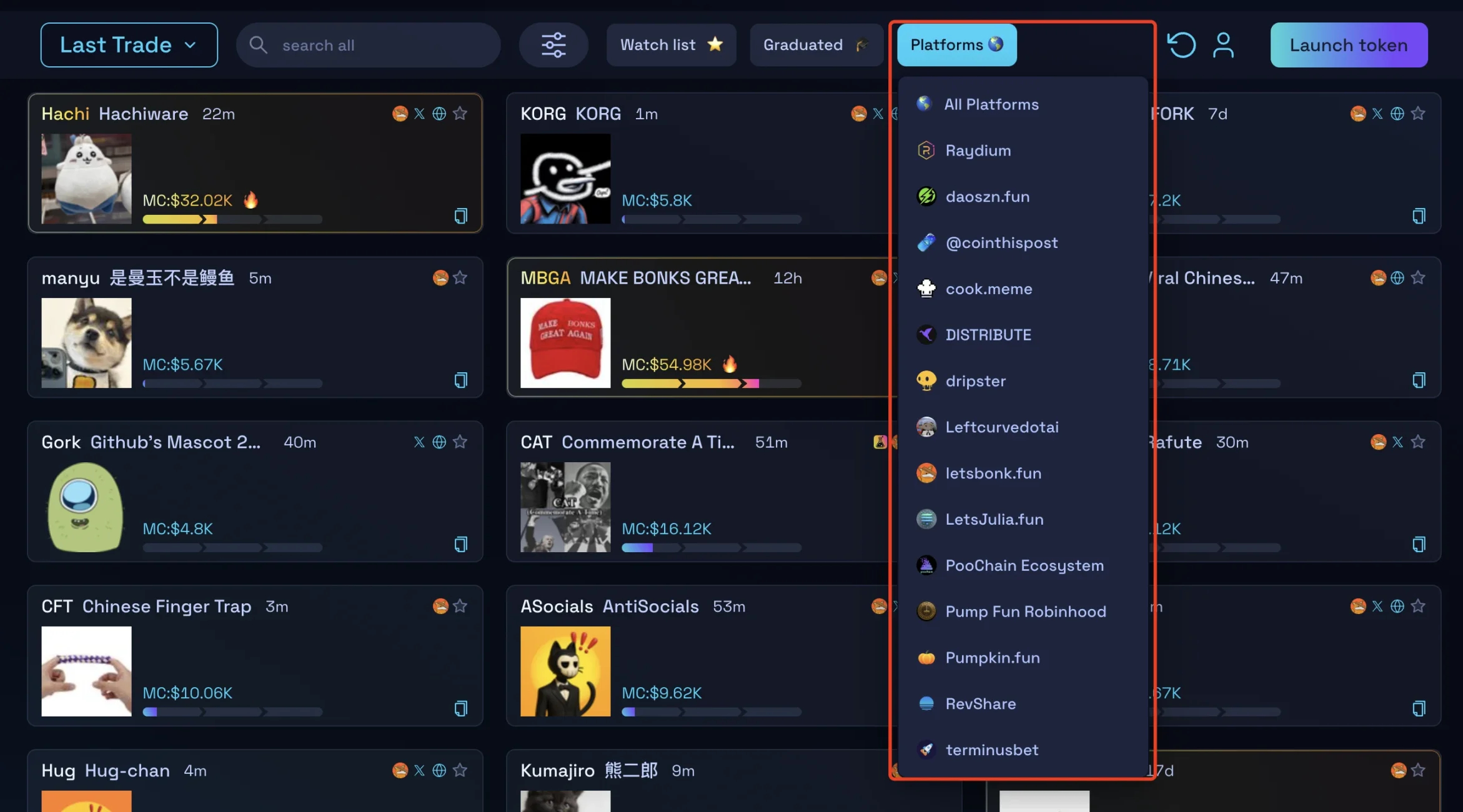
The official LaunchLab interface shows that there are already over ten third-party token issuance platforms built on LaunchLab, including the recently popular Bonk community token issuance platform Letsbonk.Fun - in fact, most of the graduated tokens in the current LaunchLab ecosystem come from Letsbonk.Fun.
In short, LaunchLab's strategy is to use third-party platforms like Letsbonk.Fun to "wolf pack" attack Pump.fun, and based on the current trend, this strategy has already shown initial effectiveness.
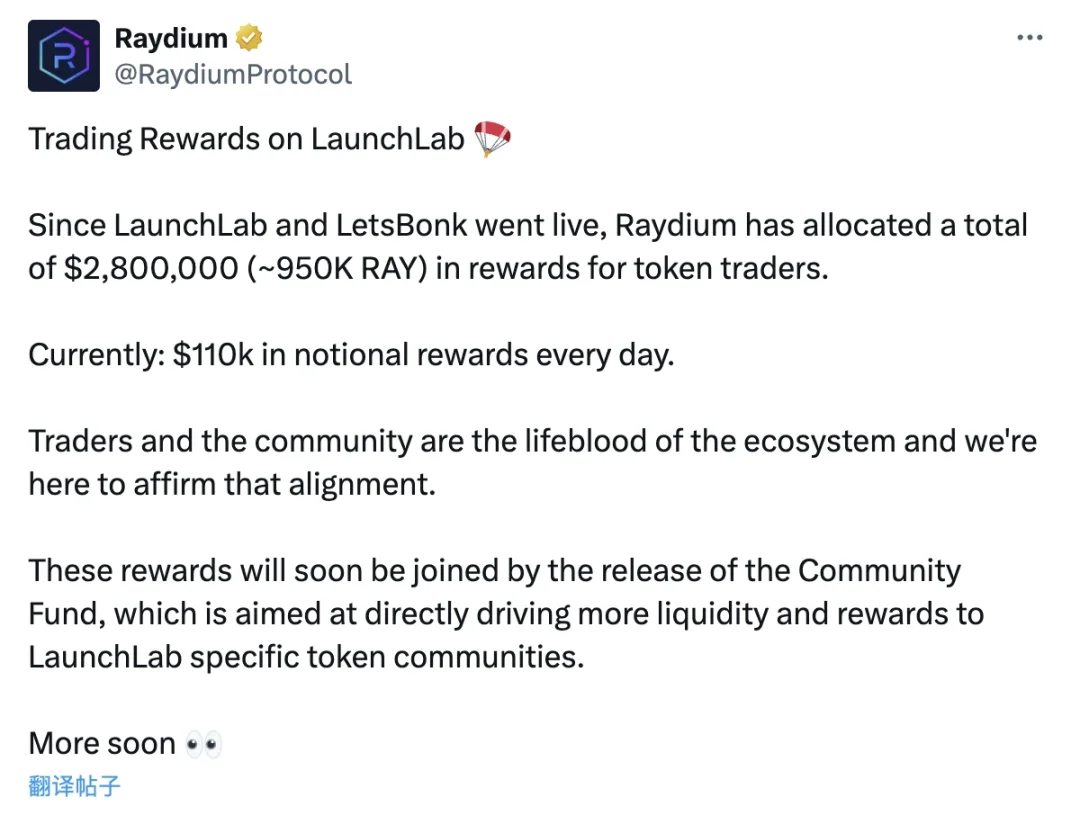
Additionally, Raydium started an incentive program ahead of Pump.fun to provide incentives for issuance and trading activities on LaunchLab and related third-party platforms.
According to the latest official disclosure, as of today, Raydium has distributed approximately $2.8 million (about 950,000 RAY) in rewards to traders on LaunchLab and Letsbonk.Fun, with current daily incentive release around $110,000.
Pump.fun Forced to Respond
Perhaps sensing the momentum of LaunchLab's "wolf pack", Pump.fun was finally forced to give up part of its cake to attract more user retention - last night, Pump.fun announced the launch of a "creator income sharing" mechanism, where token creators can receive 50% of the trading revenue share on the PumpSwap platform. From now on, as long as a token generates trading activity after its creation, the creator can continuously receive income. The official stated that this mechanism aims to incentivize more quality project parties to participate in ecosystem construction.
Meanwhile, another small incident occurred last night - Pump.fun's X page briefly blocked Letsbonk.Fun founder Tom and some Raydium contributors, but it's unclear what exactly happened...
Can the Meme Issuance Track Undergo a Reshuffle?
As shown in the graph, for most of the time since mid-2024, Pump.fun (green part) has occupied an almost dominant market position in Solana ecosystem meme issuance, until recently when emerging issuance platforms like LaunchLab (purple part) and Boop (blue part) began to gradually occupy a certain market share.
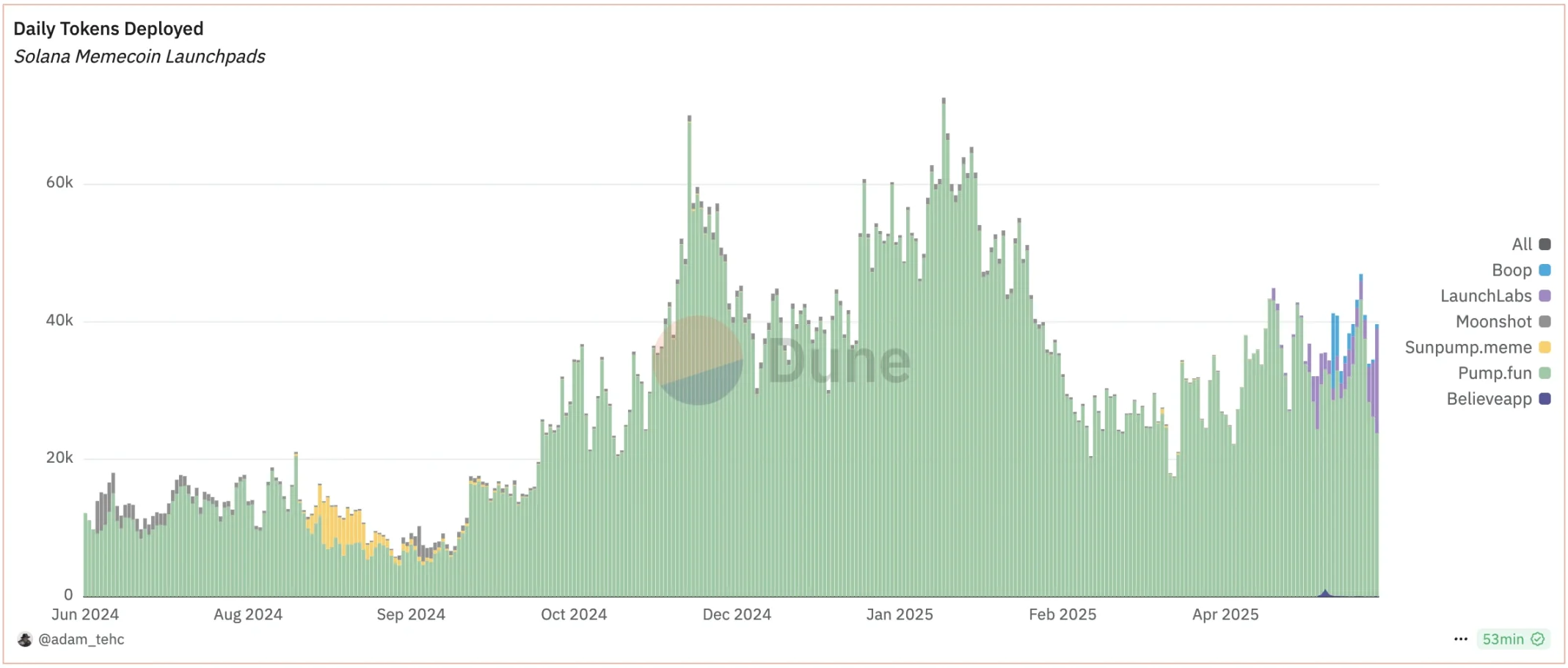
For any market, competition is not a bad thing for ordinary users, because more intense competition often forces existing interests to give up more profits and provide better user experiences - like the recent battle between JD and Meituan.
From an ordinary user's perspective, we might better look forward to LaunchLab continuing to exert force and see more new players like LaunchLab emerge.