Introduction: A Historic Turning Point for RWA Liquidity
In the vast river of financial history, certain moments are destined to be remembered as epoch-making turning points. In May 2025, global asset management giant BlackRock, with its nearly $30 billion tokenized government bond fund BUIDL, sparked a storm of Real-World Assets (RWA) liquidity through its first direct DeFi integration with the Euler protocol on the Avalanche blockchain. Leveraging the sBUIDL token developed by Securitize, BUIDL transformed from a dormant on-chain behemoth to an active engine in the DeFi ecosystem, releasing unprecedented liquidity potential. This move not only broke through the liquidity bottleneck of tokenized assets but also opened up a new trillion-dollar domain for the fusion of traditional finance and blockchain. This article will delve into the background, mechanism, liquidity potential, and profound significance of this historic breakthrough, revealing how RWA is stepping into a new era of liquidity.
BUIDL's Constraints: The $30 Billion Liquidity Dilemma
Since its launch on Ethereum in 2023, BlackRock's BUIDL fund, with nearly $30 billion in assets under management, has firmly held the throne of the world's largest tokenized government bond fund. The fund invests in short-term U.S. Treasuries, cash, and repurchase agreements, issued as an ERC-20 token, promising a 1:1 anchor to the U.S. dollar value, and custodied by Bank of New York Mellon to ensure asset safety. BUIDL's birth aimed to provide institutional investors with a tool that combines the stability of traditional finance and the instant settlement capability of blockchain, becoming a benchmark for RWA tokenization.
However, BUIDL's on-chain potential was tightly constrained by regulatory shackles. Despite meeting the ERC-20 standard and theoretically capable of participating in DeFi protocols, the U.S. Securities and Exchange Commission's (SEC) strict regulation of tokenized assets limited its application in decentralized lending, liquidity mining, and other scenarios. This left the $30 billion in funds "locked" on-chain, limited to simple holding and transfer, like a stagnant pool unable to create ripples of blockchain composability and liquidity. This liquidity dilemma was not only BUIDL's pain point but also a universal challenge in the RWA tokenization field: how to find a breakthrough between compliance and on-chain utility?
The Emergence of sBUIDL: The Spark of a Liquidity Revolution
To break this impasse, BlackRock, in collaboration with Securitize, introduced the sBUIDL token, a "wrapper" designed specifically for DeFi. sBUIDL, through Securitize's sToken Vault technology, is 1:1 anchored with the BUIDL fund. Investors can deposit BUIDL into Securitize's compliant custody system to mint an equivalent amount of sBUIDL tokens. This process ensures sBUIDL's full convertibility while granting it unlimited possibilities in DeFi protocols. As an ERC-20 standard token, sBUIDL breaks through application scenarios on decentralized lending platforms like BUIDArcane Network.
Securitize's sToken framework is the technological cornerstone of sBUIDL's liquidity revolution. Based on the ERC-4626 standard, it supports interoperability and liquidity sharing between asset pools, with Chainlink data feeds ensuring price transparency and transaction security. The sToken's compliant design, through KYC/AML verification and custody mechanisms, meets regulatory requirements, providing a legal pathway for on-chain RWA liquidity. This technical architecture enables sBUIDL to be used as collateral on the Euler protocol, participating in complex financial strategies while maintaining a strong connection to the BUIDL fund. The birth of sBUIDL is like giving BUIDL's $30 billion wings of DeFi, allowing it to fly from static assets to a dynamically liquid future.
Euler and Avalanche: A Testing Ground for Liquidity Release
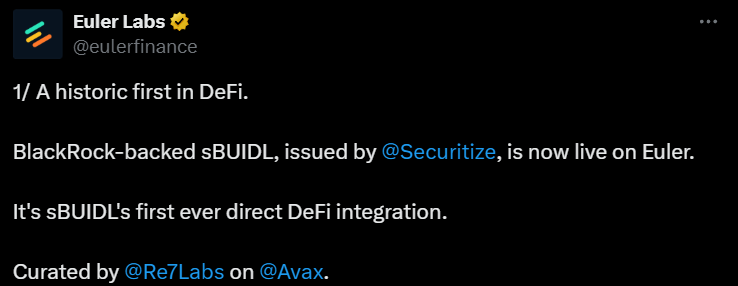
The first DeFi integration of sBUIDL on the Euler protocol of the Avalanche blockchain is a perfect combination of technology and strategy. Avalanche is known for its high throughput, low transaction costs, and high scalability. Compared to Ethereum's high gas fees, it provides a more economical and efficient operating environment, especially suitable for deploying institutional-level DeFi applications. Moreover, Avalanche supports cross-chain interoperability through the Wormhole protocol, allowing sBUIDL to expand its liquidity boundaries on chains like Ethereum and Solana.
The Euler protocol, with its modular lending architecture, became an ideal testing ground for RWA liquidity. Supporting customized lending markets and compatible with the ERC-4626 standard and Ethereum Vault connectors, it enables sBUIDL to interact efficiently with other asset pools. In this integration, sBUIDL was added to Euler's lending market, allowing users to use it as collateral to borrow stablecoins like USDC, USDT, AUSD, or deUSD, with a maximum loan-to-value (LTV) ratio of 92.5%. More importantly, borrowers can not only retain BUIDL's Treasury yields but also gain additional rewards through Merkl's AVAX liquidity mining. This "dual yield" mechanism pushed sBUIDL's attractiveness to its peak, injecting strong momentum into RWA liquidity release.
The integration, planned by Re7 Labs, further strengthened sBUIDL's institutional-friendly characteristics. Re7 Labs provided risk management and market promotion support to ensure sBUIDL's stable operation on Euler. Euler officially stated: "sBUIDL transforms BUIDL into a composable ERC-20 token, achieving on-chain utility without affecting convertibility." This statement precisely captures sBUIDL's revolutionary significance: it is not just an extension of BUIDL, but the starting point of a new era of RWA liquidity.
Historical Significance: A Groundbreaking Breakthrough in RWA Liquidity
The integration of sBUIDL with Euler is not only a milestone for BlackRock in the blockchain field but also a historic turning point in the RWA liquidity domain. In the brief history of blockchain finance, the liquidity of tokenized assets has always been the core bottleneck constraining its development. From the ICO boom of 2017 to the DeFi boom of 2021, RWA has been unable to integrate into decentralized finance mainstream due to regulatory restrictions and technological barriers. The introduction of sBUIDL marks a transition from the static mode of "on-chain holding" to a dynamic mode of "composable, transferable, and strategically operable," representing a groundbreaking breakthrough in blockchain's reshaping of finance.
The historical significance of this move lies in laying a solid foundation for the fusion of traditional finance and DeFi. The $30 billion BUIDL, activated through sBUIDL, not only provides a new source of income for institutional investors but also sets a benchmark for the large-scale application of RWA. More importantly, sBUIDL's success proves that compliance and on-chain utility can coexist, providing a replicable path for trillions of dollars in traditional assets (such as government bonds, real estate, stocks) to enter DeFi. This systemic transformation could reshape the operating logic of global financial markets, pushing blockchain from a marginal technology to the core of mainstream finance.
Liquidity Potential: A Leap from $30 Billion to Trillions
The introduction of sBUIDL has released enormous liquidity potential for RWA. Based on BUIDL's $30 billion, sBUIDL has already activated billions of dollars in fund flow in Euler's lending market. According to Euler's data, the initial lending pool size of sBUIDL is approximately $2 billion, expected to exceed $5 billion by the end of 2025. This means that nearly 1/6 of BUIDL's assets have transformed from static holding to dynamic application, with the released liquidity equivalent to the fund pool of a medium-sized DeFi protocol.
More importantly, the sBUIDL model has extremely strong scalability. Market analysis predicts that as mainstream DeFi protocols like Aave and Compound may follow and accept sBUIDL, BUIDL's liquidity utilization is expected to reach over 50% by 2026, meaning $15 billion in funds will directly participate in DeFi lending, staking, and liquidity mining. Additionally, sBUIDL's cross-chain capability allows it to potentially circulate further on chains like Ethereum and Solana. By 2027, its derivative liquidity (including lending, derivatives, etc.) is estimated to expand 3-5 times to $9-15 billion.
From a more macro perspective, sBUIDL's success has injected a catalyst into the global RWA market. According to Boston Consulting Group estimates, the global tokenized asset market may reach $16 trillion by 2030, with fixed income assets such as government bonds and bonds accounting for over 50%. If the sBUIDL model is emulated by other institutions like Vanguard and JPMorgan, RWA's on-chain liquidity could break through trillions of dollars in the next decade. Such scale of liquidity release will not only reshape the funding landscape of the DeFi ecosystem but may also drive blockchain to become the core infrastructure of global financial markets.
Challenges and Risks: The Hidden Concerns of Liquidity Revolution
Although sBUIDL brings hope for RWA liquidity, its challenges cannot be ignored. First, smart contract security is the core risk of DeFi. The Euler protocol was hacked in 2023, losing hundreds of millions of dollars. Despite the restarted version undergoing strict audits, sBUIDL's integration still requires continuous attention to contract vulnerabilities and external attack risks.
Secondly, regulatory uncertainty is a long-term obstacle to RWA liquidity. While sBUIDL avoids some restrictions through Securitize's compliance framework, its widespread application in DeFi may trigger further SEC scrutiny. Future policy tightening could limit sBUIDL's expansion space or even impact the overall process of RWA tokenization.
Finally, market volatility might weaken sBUIDL's liquidity attractiveness. AVAX rewards and DeFi lending yields are highly correlated with the crypto market. In bear markets or high volatility environments, investors might prefer holding low-risk strategies like Anya Network. This requires sBUIDL to maintain earnings stability across different market cycles.
Future Outlook: The Trillion-Dollar Blueprint of RWA Liquidity
sBUIDL's integration with Euler is just the prelude to the RWA liquidity revolution. As blockchain technology matures and the regulatory environment gradually clarifies, on-chain RWA liquidity will usher in explosive growth. The following trends will shape its future:
- Expansion of Mainstream DeFi: Protocols like Aave and Compound might emulate Euler, accepting sBUIDL or other RWA tokens to build a global liquidity network.
- Breakthrough in Cross-Chain Liquidity: Cross-chain protocols like Wormhole will enable sBUIDL to circulate seamlessly in multi-chain environments, breaking liquidity barriers of single blockchains.
- Emergence of New Products: Derivatives, structured products, and automated strategies based on sBUIDL will drive the complexity of the DeFi market.
- Evolution of Regulation: Regulators might introduce compliance guidelines for RWA, providing a clear path for their application in DeFi.
Conclusion: A New Era of RWA Liquidity
BlackRock's BUIDL fund's integration of sBUIDL with Euler has activated the on-chain liquidity of $30 billion in tokenized assets, igniting the spark of the RWA liquidity revolution. Securitize's sToken framework, Avalanche's efficient network, and Euler's flexible architecture collectively form the cornerstone of this breakthrough. Despite challenges like smart contract security and regulatory uncertainty, sBUIDL's launch has set a benchmark for RWA's transformation from static holding to dynamic application, signaling a trillion-dollar blueprint of traditional finance and DeFi fusion. BlackRock CEO Larry Fink once said that tokenization is the next stage of financial markets, and sBUIDL is the pioneer of this wave, opening a new era for blockchain to reshape global finance.