I. Mechanism Is Not Just a Tool, But an Expresser of Belief
In the prediction market system that relies on collective cognition to construct prices, the market mechanism of trading not only performs order matching functions but also carries judgments about future events.
The quality of a mechanism determines not only the efficiency of trading but also whether we can accurately capture and express the contours of "future possibilities".
For this reason, the two mainstream prediction market mechanisms—CLOB+CTF (Order Book + Conditional Token) and LSMR (Logarithmic Scoring Market Maker)—although having made achievements in the past few years, have exposed structural shortcomings in practice.
These problems are not just technical challenges but also reflect an incomplete understanding of the core issue of "how group beliefs are generated and measured".
II. CLOB+CTF: Market Fragmentation and Low-Efficiency Liquidity Brought by High Structuredness
1. Clear Concept, but Excessive System Fragmentation
The logic of CLOB+CTF is not complex:
1. CLOB provides a market interface for limit orders and matching
2. CTF breaks down multi-option events into a series of YES/NO binary contracts and adjusts supply and demand through automatic Token minting/destruction.
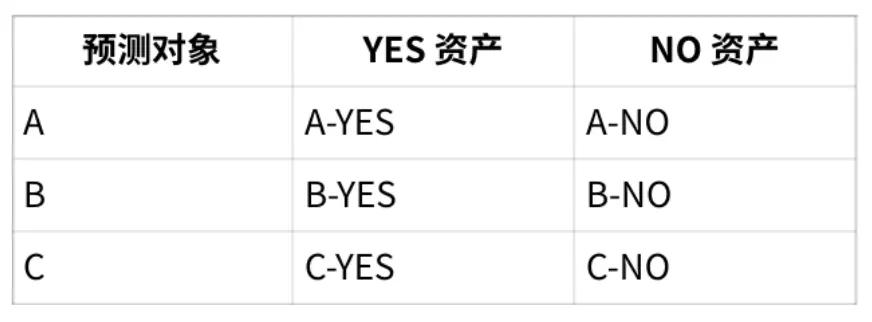
This mode is highly consistent with traditional financial markets, thus having a certain user cognitive basis.
However, once event options increase, the system will be forced to create multiple sub-markets, each with its own pair of Tokens and order book, therebygreatly increasing system complexity and user participation threshold.
2. Counterparty Dependence Leading to Liquidity Imbalance
CLOB is an order placement mechanism, thus essentially dependent on an active two-sided market. In most prediction markets, due to unstable user participation enthusiasm, event diversity, and information asymmetry, order depth is often severely insufficient,forming "order vacuums" or "one-sided squeezes".
The result is:
1. Users place orders without counterparties, causing price stagnation;
2. The market falls into an illiquid state, severely affecting user experience.
Although CTF can somewhat fill the counterparty gap by minting YES/NO assets, it itself becomes an arbitrage tool, makingprice signals more easily manipulated by short-term behavior rather than driven by long-term expectations.