Original | Odaily (@OdailyChina)
Author | Golem (@web3_golem)
Every time Web3 experiences a narrative explosion, it not only brings wealth effects to users but also opportunities for entrepreneurs. Meme is the most eye-catching narrative in this cycle, with wealth effects far exceeding traditional altcoins, causing many players to migrate from secondary markets and centralized exchanges to on-chain platforms, with labels like "P small general", "chain head", and "dev" becoming new user tags.
For entrepreneurs, the user demand in this Meme craze is fast and secure Meme trading tools, which undoubtedly became a competitive battlefield, giving birth to excellent Meme trading tools like GMGN, OKX Wallet, Bullx, and Axiom. In the Chinese-speaking region, GMGN is undoubtedly the most popular Meme tool, with monthly revenue at its peak exceeding millions, and daily revenue even surpassing Uniswap.
However, during GMGN's business expansion, the massive storage capacity and computing needs caused by the sharp increase in user numbers and transaction volume created significant pressure on the initially used AWS Aurora database, thereby hindering business growth. Many Meme trading tools have been eliminated on the beach due to inability to bear huge user traffic and data service pressure.
Ultimately, GMGN chose to migrate data from AWS Aurora to the open-source distributed SQL database TiDB, effectively improving system scalability and computing capabilities, enabling rapid processing of on-chain data and user growth during the Meme market's peak, increasing business agility by 30% while reducing operational costs by 50%.
Now GMGN supports multi-chain Meme trading, including Solana, BSC, Ethereum, Base, Tron, and Blast. According to Dune data, GMGN's transaction fee income on the Solana chain alone has exceeded $71 million, with 743,000 users. GMGN's successful experience can also provide reference for entrepreneurs in other Web3 tracks.
[The rest of the translation follows the same professional and accurate approach, maintaining the original structure and meaning while translating into fluent English.]The complexity of database architecture leads to high development and maintenance costs. GMGN is forced to build a data analysis team with big data processing and multi-blockchain professional skills to maintain multiple database instances, which not only increases the team's operational costs but also severely damages the agility that a startup like GMGN should have.
At the same time, the key to Web3 data services is ensuring that data is always accessible and not unavailable due to any single point of failure, which forces GMGN to maintain multiple database instances, but also undermines the agility and adaptability of GMGN's business.
TiDB Helps GMGN Improve Scalability and Reduce Costs
Facing these challenges, GMGN spent two weeks integrating all Aurora MySQL databases into a TiDB cloud solution, which helped improve scalability and reduce operational costs.
TiDB is an open-source distributed SQL database developed by PingCAP in 2015. Simply put, in the Web3 domain, TiDB can efficiently support large-scale on-chain data storage, OLTP queries, and real-time analysis to support quickly obtaining chain data insights, providing an efficient, reliable, and manageable database solution for data-based platforms.
Simplified Original Architecture, Reduced Operational Costs by 50%
First, TiDB helped GMGN simplify its database architecture. In the original architecture, different chain data (such as ChainA, ChainB, or ChainC) were stored in separate MySQL databases and then processed through a data platform. In TiDB's data architecture, all data from different chains is directly stored in TiDB, as shown in the diagram below.
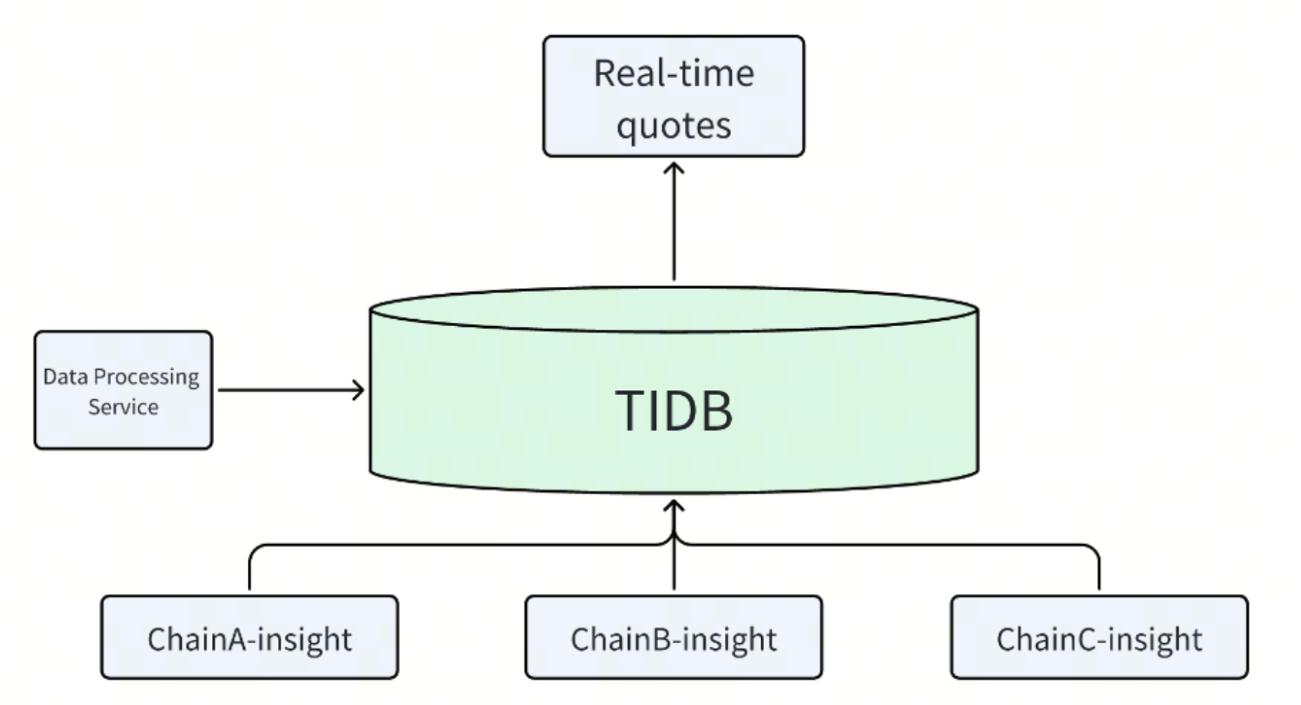
The benefit is that GMGN no longer needs to maintain multiple independent databases, reducing operational complexity and lowering operational costs by 50%. At the same time, with a unified data storage layer, GMGN only needs to import newly generated blockchain data into TiDB in real-time, making it easier to achieve data consistency and transaction management.
Provides Horizontal and Elastic Scalability
As a distributed database, TiDB's good horizontal scalability (by adding nodes to handle more load) helps GMGN seamlessly expand, handling rapid data and user growth without affecting performance.
Additionally, TiDB's elastic scalability perfectly matches the rapid changes in on-chain user traffic and data processing needs. In TiDB, computing and storage resources can be independently scaled, allowing online scaling or reduction of computing and storage resources as needed to flexibly respond to traffic peaks or data volume surges.
HTAP Functionality Significantly Improves GMGN's Data Query Capabilities
Facing issues with on-chain real-time query capabilities and complex query support, TiDB's HTAP functionality has significant advantages, supporting real-time online transaction processing (OLTP) and online analytical processing (OLAP), meeting the needs of real-time data writing and blockchain data analysis.
In practice, GMGN only needs to use some simple SQL queries to easily meet big data processing requirements, eliminating concerns about data synchronization, cleaning, and other processing issues. The average data query response time for normal business queries has improved to single-digit millisecond latency compared to before migration.
Business Agility Improved by 30%
The improved architecture of TiDB eliminates the need for GMGN's team to maintain multiple separate databases. TiDB automatically maintains multiple data replicas and has automatic fault detection and recovery functions, providing enterprise-level high availability to GMGN. At the same time, TiDB is a fully managed SaaS service that does not require GMGN to intervene in database maintenance and operations. With professional support from PingCAP, GMGN can quickly resolve issues and ensure stable business operations.
This provides GMGN with very reliable system stability, allowing it to focus on products and improving user experience, with business development agility increasing by 30%.
III. TiDB's Web3 Data Service Blueprint
Of course, TiDB is not "customized" for GMGN. In fact, many well-known Web2 and Web3 enterprises are already using TiDB's services, including Web2 companies like Meituan, Xiaohongshu, Xiaomi, and China Merchants Bank, and Web3 companies like a global top-tier DeFi data platform, Chaintool, and a top Asian decentralized wallet. TiDB has received over 37,000 stars on GitHub and is becoming an important data service provider in the Web3 domain.

TiDB's Web3 Service Cases
Looking across the entire Web3 industry, whether it's DEX, on-chain tools, or games, they all face challenges such as storage pressure, computing challenges, and insufficient complex data processing capabilities. Open-source distributed SQL databases represented by TiDB are solving these pain points for project parties.
Project parties no longer need to worry about whether the growth of on-chain node data will reduce user experience; whether increased user access frequency and data will cause server crashes; or whether a single node failure will cause business stagnation. TiDB is like an elastic and controllable foundation that allows Web3 entrepreneurs to focus more on iterating functionality and experience.
References
Full Text of Haze's Hong Kong Carnival Speech: GMGN Born to Be Fast
Dialogue with GMGN HAZE: From "Beating Stupid Dogs" to Advisor of Memecoin Trading Paradise