Written by: Fairy, ChainCatcher
Is it "Yap-to-Earn" or "Earn-to-Leave"?
In the Crypto world, "attention" is gradually becoming an asset that can be priced. Kaito, backed by top-tier capitals like Dragonfly and Sequoia, emerged as a star project in InfoFi, once considered an innovator in "information financialization".
However, after just a few months, more and more voices have begun to question its algorithmic mechanism and ecological impact. Kaito wanted to capture users' attention through AI algorithms, but now, the community seems to have lost patience first.
Creator Ecosystem Destroyed?
The issue of water content has been controversial since Kaito launched its "Yap-to-Earn" mechanism. The X platform is flooded with posts with similar styles of "industry in-depth analysis", seemingly professional with structured analysis, but actually hollow, with formal interactions, inefficient, repetitive, and created solely for earning rewards.
Community member @0xcryptoHowe once described Kaito's communication mechanism as a "Crypto version of elevator advertising". He pointed out: "Kaito's long-tail traffic effect is essentially like elevator ads, constantly repeating content in a closed space, pushing streams at different time periods." For the audience, this is indeed a method of quick memory and exposure, but problems arise: when the platform is occupied by "homogeneous content", and KOLs are pushed by algorithms to repeatedly produce content, the result is an information closed loop - like being locked in an elevator that never stops playing ads, unable to access truly valuable new content.

Meanwhile, Kaito's mechanism is questioned by many for "freeloading" on mid-tier creators' traffic. Crypto KOL @connectfarm1 once pointed out that some mid-tier accounts with content value starting at 500U are willing to accept far lower returns because of Kaito. This strategy not only depresses the real value of content but also forces some creators to express only 50% or even less of their capabilities.
Kaito may be changing the evaluation criteria of content creation, binding creators into a system driven by "algorithms" and "scores". As community user @0xBeliever said: "There are many criteria for judging KOLs, but Kaito's emergence has made it somewhat singular".
Team Frequent Slip-ups
Besides mechanism controversies, the Kaito team has also experienced some operational hiccups recently.
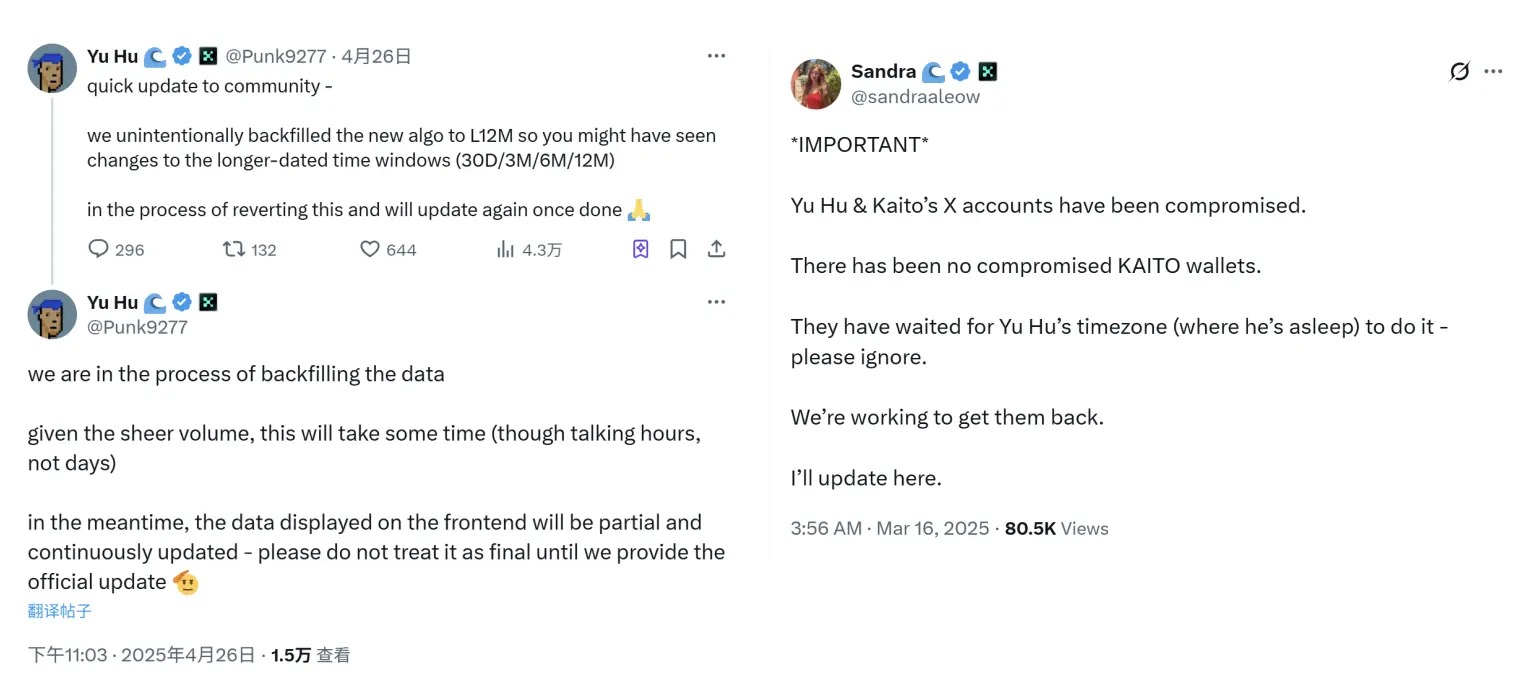
On March 16, Kaito AI and its founder Yu Hu's X account were hacked. Team member Sandra posted on X platform, saying "the attacker chose to launch the attack during the deep night in Yu Hu's time zone, controlling the account while he was asleep".
Then on April 27, founder Yu Hu posted that the platform accidentally backfilled the new algorithm to the past 12 months, causing users to see a longer time window, and the front-end data appeared incomplete.
Although these two incidents did not cause serious consequences, the consecutive minor flaws have raised concerns about its stability.
Algorithm Controversy of "Relationship Emphasis"
Kaito's core selling point is its AI-driven content scoring algorithm, claiming to identify valuable Web3 content. However, as users delve deeper, this algorithm frequently sparks controversy.
User @Jessethecook69 reached the global ninth and Chinese first place on the Kaito Yapper list in just 24 hours with only three "borderline" contents. This can't help but raise questions: Does such an algorithm truly filter valuable information?
Many users point out that Kaito gives low weight to reading volume, with the algorithm more focused on interaction performance between high-influence accounts. Worse, some ICT (Inner Crypto Twitter) have started to "huddle together", further amplifying this algorithmic bias.
Crypto KOL @sky_gpt directly stated that Kaito's algorithm is essentially designed to seize the KOL institutional market, severely damaging the ecosystem of ordinary creators. He pointed out that a 30w in-depth content he wrote scored almost the same as a 2k advertising post bought by a project, while non-Kaito related content is systematically suppressed in the algorithm. "The top 50 KOLs are eating well," he wrote, "Kaito is cutting off the path for new people to rise".

When new people are trapped by the algorithm's invisible ceiling, and creators are forced to cater to algorithmic preferences, we can't help but ask: Is an AI-driven content platform reshaping the information order, or reproducing old power logic?