Additionally, AIAC has added an interesting feature called "Emoji Points" to its website, similar to Yap points specific to certain AI Agents. Users can earn Emoji Points by discussing or interacting with an AI Agent on X, and these points may provide an opportunity for airdrops. This type of feature will be helpful in defining the community's "POW" contribution to a specific AI Agent.

Amber's "MicroStrategy Model"
While the community was discussing MIA, crypto KOL RUI "YeruiZhang" exclaimed that Amber Group's "AMBR" market value has reached three times that of Antalpha, yet its stock's daily trading volume is only one-third of Antalpha's. More interestingly, the on-chain trading volume and liquidity of Amber's AI project MIA "$MIA" have even surpassed its US stock main board stock, becoming a "high-liquidity anchor point" in Amber Capital's narrative.
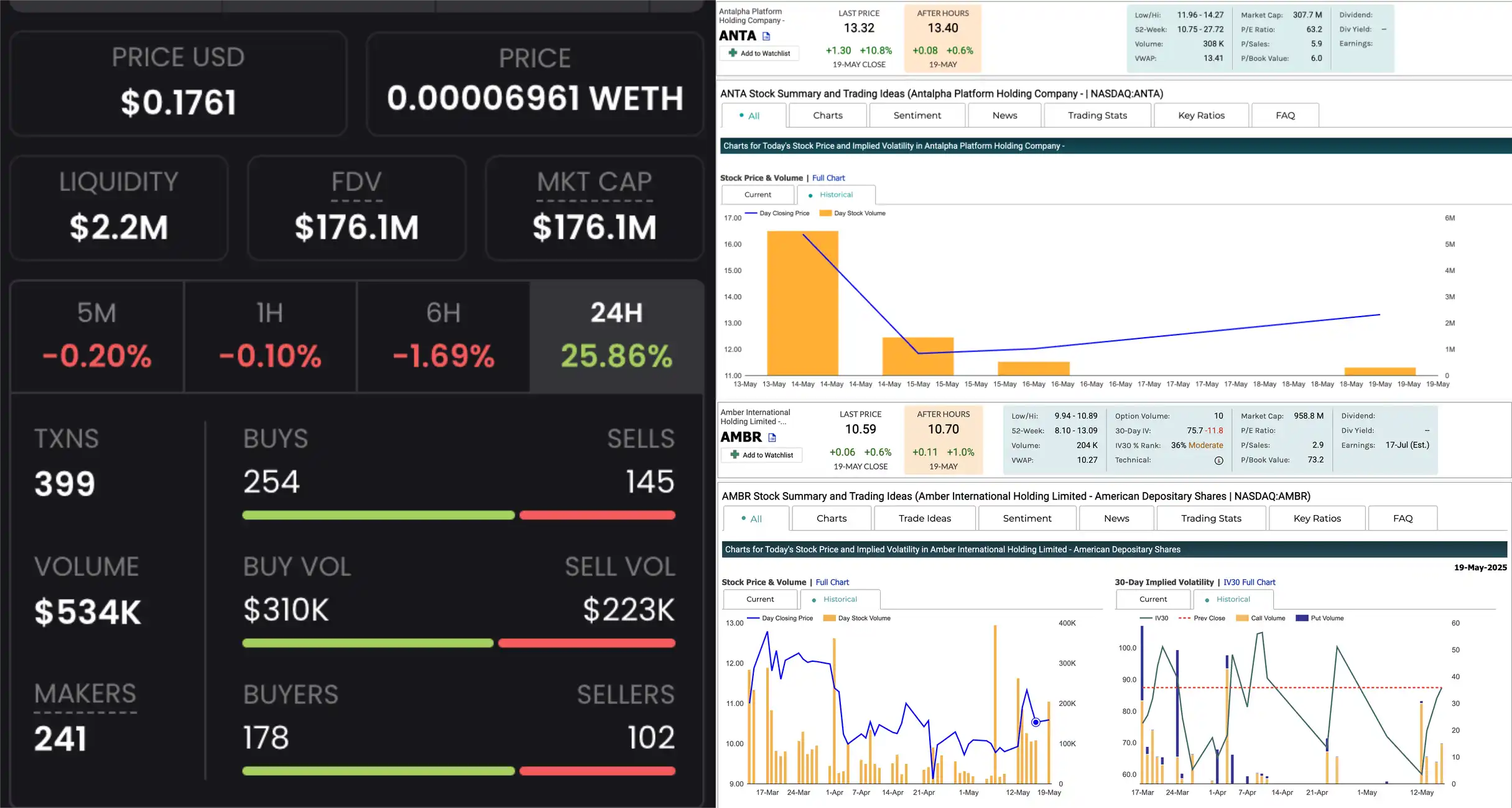
Before 2020, MicroStrategy, as a business intelligence software company, had long-term weak stock prices and low trading volumes. However, after announcing large-scale BTC purchases with company assets, the capital market's perception shifted from an "old-school software company" to a "Bitcoin ETF alternative on US stocks". The result of this strategy was significant: not only did market value soar, but trading volume also explosively grew, and it reshaped its valuation logic on Wall Street.
Amber is conducting a similar but more complex experiment, not just buying coins but also issuing coins, building an AI Agent ecosystem, and thereby redefining the company's business boundaries. One of the core motivations is to have Wall Street value it as an "AI company" rather than an "asset management platform".
Dov, founder of Mango Labs, directly stated that "Amber Group has become the next MicroStrategy", believing that "some companies can't get a 20x PE Ratio without AI, and even 100x PS won't be enough with AI".
Traditional asset management companies' price-to-earnings ratio (PE) is typically between 15 and 20 times. AI companies' valuations focus more on price-to-sales ratio (PS), with common PS multiples ranging from 50 to 100 times. This difference primarily stems from AI companies' high growth potential and network effects. Therefore, if the market views Amber as an "AI + Crypto" composite, its valuation model might shift from traditional PE to a higher PS multiple, leading to a significant market value increase.
Note:
PE "Price-to-Earnings Ratio" = Stock Price ÷ Earnings per Share, used to measure how much the market is willing to pay for each dollar of profit, typically used for valuing mature, profitable traditional enterprises. If a company's PE is 20 times, it means investors are willing to pay 20 dollars to obtain 1 dollar of the company's profit.
PS "Price-to-Sales Ratio" = Stock Price ÷ Revenue per Share, applicable to growth-stage companies not yet profitable, such as AI or SaaS, with valuations focusing more on growth potential. If a company's PS is 100 times, it means investors are willing to pay 100 dollars to obtain 1 dollar of the company's sales revenue.

Welcome to join BlockBeats official community:
Telegram Subscription Group: https://t.me/theblockbeats
Telegram Discussion Group: https://t.me/BlockBeats_App
Twitter Official Account: https://twitter.com/BlockBeatsAsia