Author: Luohan Lundao
In the decentralized utopia envisioned by web3 technology, the accuracy of information is always the top priority and the basic guarantee for the smooth operation of a trustless world. Therefore, in the blockchain ecosystem, a component called oracle is expected to promote information exchange. The research we introduce today focuses on the oracle problem in the blockchain and explores the difficulties and solutions faced by web3 technology in the real world.
Oracle, translated as "oracle", comes from the Latin word ōrāre, which means "to speak", or refers to the person or thing that conveys prophecies. 
The most important oracle in ancient Greece was the Delphic maxims. Currently, the one we are most familiar with is perhaps the Oracle Corporation, a database service provider named after Oracle. In addition, Oracle is also used to name an idealized estimator in statistical learning and high-dimensional statistical theory.
However, the "oracle" we are going to discuss today is a key infrastructure in the blockchain ecosystem (also translated as "oracle"). By definition, an oracle is a mechanism that writes external information of the blockchain into the blockchain, and is a bridge between smart contracts and the real world.
Some time ago, Professor Cong Lin from the Johnson School of Business at Cornell University gave a lecture on the Luohan Forum. He started with the difficulties faced by blockchain oracles and introduced a new concept: the Oracle Blockchain Trilemma. He believed that no oracle system could simultaneously meet the following three characteristics:
Decentralization
Truthfulness
Scalability
Afterwards, Professor Cong Lin shared how to alleviate this problem under the current technological background, and discussed the limitations of decentralized technology and the combination of centralized and decentralized ecosystems.
The blockchain ecosystem is not “open”
Although open blockchains such as Bitcoin and Ethereum have opened their doors to everyone, their ecosystems themselves are still closed. In other words, although we can freely join these two ecosystems, there is no natural bridge between Bitcoin and Ethereum .
In fact, for any two digital platforms, before we artificially introduce a communication channel, there is no interaction between the platforms by default. This lack of interaction exists not only between platforms, but also widely between platforms and reality.
Imagine two people sign a smart contract on Ethereum to bet on tomorrow's weather conditions. We know that this contract can only proceed after the real weather conditions are revealed in the real world. In order to promote the execution of the contract, we need to bring information from the real world (off-chain) to Ethereum (on-chain). It is precisely because of this independence between ecosystems that we believe that blockchain is not "open" enough, so oracles and oracle networks are needed to facilitate the exchange of information.
In practice, the prediction market platform Polymarket has achieved quite successful performance by relying on the oracle system of the UMA (Universal Market Access) protocol. This decentralized mechanism provides us with an excellent way to aggregate information. We also see that the oracle industry is cooperating with traditional financial institutions such as SWIFT and Google Cloud, and we also observe that practitioners are making some interesting attempts, such as how to introduce AI agents into the oracle network, automatically collect real-world information, and how to develop standards for interactions between chains to promote communication.
Let’s start with the problem of blockchain oracle
Next, we will first provide a detailed background on the oracle problem and review the development process of the oracle industry to solve this problem.
As we mentioned earlier, a single blockchain is an isolated system that does not have the authority to obtain external data. We need oracles to bring information to the blockchain. The reason why it is called a "difficult problem" is that we cannot ensure that this external information is accurate and reliable, especially when we rely too much on centralized oracles. Of course, this is not to belittle centralized oracles. In fact, they perform quite well in some areas. But in many scenarios, we still want a decentralized system.
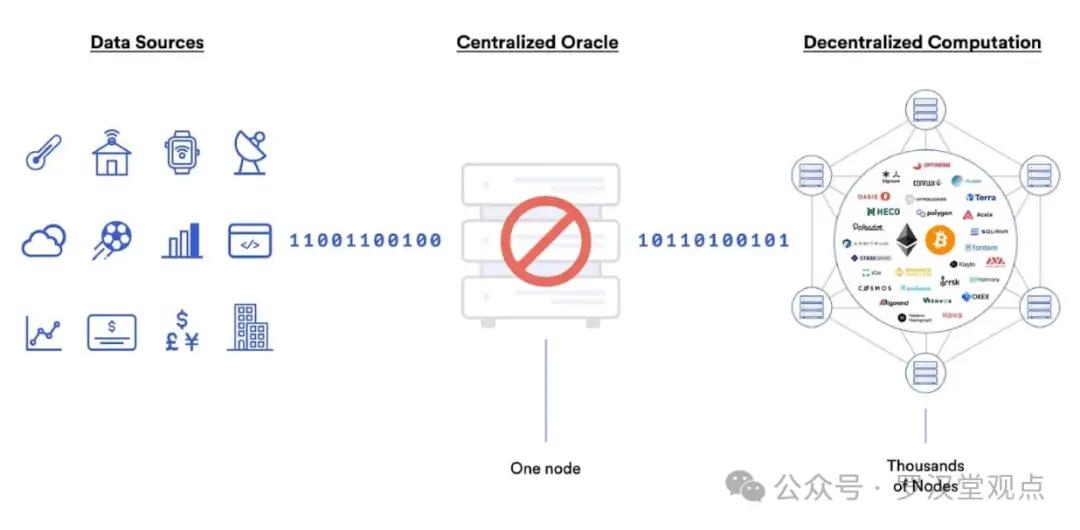
From an economic perspective, we are not trying to promote a certain form. If a decentralized system can help us achieve our goals (such as accuracy, fairness, inclusion, etc.), then we will naturally accept it. Moreover, based on current observations, our best choice is more likely to be a combination of centralized and decentralized systems . But in any case, at this moment we should pay more attention to the decentralized structures proposed by the industry and the progress they have made.
It should be noted that there are still many problems with decentralized oracle networks, such as collusion between oracle nodes, and when there are multiple equilibria and insufficient communication, we cannot be sure where we will go. In practice, we have also seen many accidents caused by decentralized oracle networks, such as the bZx oracle attack incident and the Pyth BTC price anomaly incident. For this reason, we need to better understand the advantages and limitations of oracle networks.
What is the Blockchain Trilemma of oracle
We will introduce a brand new concept: the oracle Blockchain Trilemma.
You may have heard of a similar concept called the blockchain impossible triangle , which states that a public blockchain cannot simultaneously meet the triple characteristics of decentralization, security, and scalability .
We believe that this new concept poses a more challenging problem. We know that for blockchain, all information is on the chain, such as Bitcoin, and all transaction information is available online, so the verification of information is not that difficult.
But for the oracle network, we need to aggregate a lot of information from outside the blockchain ecosystem, which means we first need to worry about whether this information can be trusted. Secondly, we need to think about how to aggregate and report the information and upload it to the blockchain.
To solve these problems, we need sophisticated mechanism design and information design to provide the right incentives, which is exactly where economists excel.
Specifically, the oracle Blockchain Trilemma means that no oracle system can simultaneously meet the three characteristics of decentralization, truthfulness, and scalability .
We can think of a simple example: suppose there is a basic fact here, but no node in the oracle network can perfectly observe this fact, and the observation of a single oracle will be interfered by noise.
But when there are enough oracles, we assume that the mean of the observations will be close enough to the true value. After observing their own signals, each oracle needs to decide what information to report to the system. They can report their own observations honestly, although there is a deviation from the true value. They may also lie, after all, only they know their own observations. After receiving reports from all oracle nodes, the system will sum up all the information and give the final prediction.
The above three characteristics are the properties that we hope the oracle network can possess in an ideal state. But let's imagine that if our oracle network has met the requirements of decentralization and scalability, a large number of oracle nodes will report information to the system, which will result in a single node's truthful report bringing very little marginal contribution to the entire system. When the cost of obtaining information for some oracles is too high, they will naturally have the idea of free riding. Due to this concern, the authenticity of the aggregated information is not the only equilibrium state. Similarly, the other two situations can also be argued.
Ouyang Shumiao (Oxford University): When the number of oracle nodes is large enough, according to the law of large numbers, the noise terms will cancel each other out to ensure that we can get an accurate signal. From this perspective, is it possible to balance the accuracy of information with the scale of the system?
Can we solve the problem?
As economists, we will try to solve these (strong-form) puzzles in a way that is unique to economics.
First, architectural innovation can alleviate the contradiction between decentralization and scalability to a certain extent . We just mentioned that the cost of summing up all information on the chain is quite high, but if we can let the oracle network complete the reporting and summing of information off-chain, and only upload the final summed information to the blockchain, the cost of this process will be greatly reduced, thereby ensuring scalability. More importantly, the reduction in costs will bring more positive results: more oracle nodes are willing to participate in the blockchain ecosystem, thereby promoting decentralization.
Second, the introduction of an early warning mechanism can enhance both authenticity and scalability . Specifically, when participants in the ecosystem believe that the current aggregated information is far from the true value, we allow them to issue an early warning. Subsequently, a trusted but costly third party can verify or refute the alarm. If the alarm is judged to be valid, the oracle involved in the failure will be punished, and the party that issued the early warning will be rewarded, and vice versa. This mechanism can cleverly balance costs, risks, and incentives to ensure the authenticity of information. However, since we often assume that the costly verification mechanism does exist and is difficult to manipulate, the reliance on trusted third parties naturally becomes a limitation of this mechanism.
Third, the current incentive design of blockchain is almost static, and as economists, we are more accustomed to thinking about dynamic incentive structures . Imagine that when the cryptocurrency winter comes, the value of the token decreases, and the incentives it can provide are limited. By introducing appropriate dynamic incentives, we hope that each oracle node can maintain good performance in the "winter" because they know that the reputation they build at this moment will bring considerable returns in the future. In this way, dynamic mechanism design can solve the problem of decentralization and authenticity.
However, even if we completely solve the Blockchain Trilemma of oracles, we still cannot fundamentally eliminate the security risks of blockchain , let alone guarantee the long-term sustainability of the ecosystem. Blockchain oracles have many vulnerabilities at both the technical and economic levels, and we need sound architectural design and mechanism design to improve these vulnerabilities .
What is the future of oracle networks?
In addition to providing data, oracle networks can also be integrated with industries such as finance and trade in a variety of ways. Integration with oracle networks will also affect the performance, stability and connectivity of blockchains and protocols.
For example, Professor Conglin’s recent research analyzed 4,988 DeFi protocols from the beginning of 2021 to November 2024 to assess the impact of oracle integration. They found that protocols integrated with decentralized oracle networks saw a 75% increase in protocol assets and a 43% increase in market capitalization within the first month after integration. This effect was particularly significant for protocols that completed integration before the application went live.
Looking ahead, the oracle network has outlined a promising direction for academic research and industrial development. In general, the oracle Blockchain Trilemma is still a core challenge. Future research should give priority to developing a recursive incentive mechanism that guarantees authenticity in a scalable system. Complete decentralization may not be our ultimate goal. A hybrid architecture that combines centralized and decentralized elements may be able to better balance speed, cost, and security. In addition, exploring efficient and robust governance models is crucial to solving the oracle Blockchain Trilemma and building a long-term sustainable governance architecture.
Chen Long (Luohan Hall): I really admire economists who work hard to combine mechanism design with technology. Today's research on web3 reminds me of the 1970s and 1980s, when a large number of quantitative practitioners came to Wall Street. But I think there is a fundamental difference between this and today's field: the current web3 is more revolutionary. They want to create a trustless world to replace the current system-dominated world. I have three questions and a final comment:
First, you just mentioned that you are not a fan of decentralized systems, you want to make sure that these systems are truly effective. Through your years of research and observation, what do you think are the real advances in this field besides DeFi?
Second, can you imagine another useful decentralized world besides cryptocurrency? And such a world is what we really need. If such a world really exists, what should it look like? Or the future will be a combination of centralized and decentralized worlds, where is the boundary between the two?
Third, how big is the impact of the oracle network you are talking about? Will it bring explosive (or quite high) growth at the application level? Decentralized systems seem to eventually integrate into this centralized world. In this way, are the marginal improvements brought by oracles very limited?
Finally, I have one more comment. I think that as you have shown us, trustworthy data is still very important, and this is closely related to the institutional context of the current world. I think the trustless world is still very far away from us, or in other words, this decentralized system is ultimately only a supplement to our real world, not a replacement. And the areas that can benefit most from it will be those that can combine the two in a complementary way.
Jungle: Your comment actually answered your question! First, regarding the progress, the progress of DeFi and decentralized systems is actually very slow compared to generative AI. I think the most successful application so far is stablecoins, especially in a multipolar world, they have the potential to maintain growth.
In addition, governments and institutions do not seem to be completely opposed to stablecoins, and even their attitude towards them is more open than that of central bank digital currencies. Another example is decentralized exchanges (DEX). Although they are not yet mature in scale and cannot challenge traditional exchanges, the mechanisms they introduce are quite interesting, and these emerging applications are quite active. And I think the tokenization of real-world assets must be a big deal. Whether we use centralized or decentralized systems, oracle networks are very relevant.
Regarding the second question, in fact, it is difficult for me to imagine a completely decentralized world, but this is actually very intuitive for economists. We know that everything is about trade-offs. Whether it is centralization or decentralization, they have their own advantages and disadvantages, and we are likely to get an optimal interior point solution. This is certainly not something that can please those blockchain enthusiasts who definitely want "decentralization for the sake of decentralization." There are always such groups, but I am skeptical about their ability to subvert any market forces. I think people are ultimately driven by incentives. If centralized systems are helpful, why not keep them? In this sense, what I can imagine is a world with a higher degree of virtualization that grows with web3.
Finally, given that we are considering a combination of centralized and decentralized systems, I think the impact of oracle networks is still quite large. Centralized systems have many problems, such as too high market concentration and too much market power held by a single digital platform. Recently, we have seen that JD.com has attracted a lot of public attention, and the platform has expressed their great sincerity to the deliverymen. But from an economic point of view, after a platform grows into a monopoly, none of us can guarantee that it will not turn around and exploit employees, suppliers and consumers.
I think a decentralized structure is a way to solve this problem. Otherwise, we will continue to discuss antitrust issues and have to split up a large platform, thus losing the benefits of scale.
In this sense, I think if we are in a hybrid model, the role of oracle networks will be very large, because oracles are the key to digitization, and digitization is a fundamental issue. If we are willing to believe in a Hayekian setting, that is, information is very localized, it will be very difficult to use centralized nodes to aggregate information, which just provides a reasonable motivation to build a decentralized system.
Chen Long (Luohan Hall): I think the right direction is to explore the inefficiencies in each world and find a mechanism that can combine the strengths of each.
Jungle: Another point is that when we think about information and trust, we even see that there is a trend towards decentralization even on centralized web2 platforms.
For example, due to the explosion of information, we no longer have a trusted, centralized source of information. At this point, how to verify information becomes a problem, which is very troublesome for the information production and aggregation of the entire society. Either we take the path of web3 and provide appropriate incentives for information sources, or we introduce more supervision and verification of information sources.
If we allow the platform to grow without any restrictions, to be honest, I don’t know how to trust this information. This is definitely a big problem for a society.
Tang Bo (HKUST): In the Blockchain Trilemma of oracles you introduced, which feature do you think is the most important? In a hybrid model combining centralization and decentralization, which functions do you think can be delegated to the centralized system? Which functions must remain decentralized?
Secondly, what do you think are the main challenges in combining AI and oracles? When the two are entangled, will we encounter new systemic risks or ethical dilemmas?
Jungle: Let me answer the second question first. I think it would be useful to have an AI agent that can constantly monitor and report information. This automated program can replace part of our work very well.
Secondly, when we need to stress test a system, we can use AI agents for simulation, which is also advantageous over traditional ABM methods. This is not only applicable to oracle networks, but can also be applied to traditional economic forms.
For related research, if your article contains both "AI" and "web3" buzzwords, considering that our profession is relatively conservative, some people may say "ah, you are just following the trend". This criticism is sometimes reasonable, but anyway, I think it is still challenging to write an academic article linking the two.
But for the industry, I think practitioners are exploring the combination of AI and oracles, although they may be a little too optimistic and are always eager to find the next growth point.
But this is why I have always believed that economists can participate in this industry and provide our insights. For example, what is real innovation? What is technically feasible but economically unrealistic? This requires our rigorous analysis.
Back to your first question, I think we have the same view on decentralization. The path of "decentralization for the sake of decentralization" is unlikely to work. On this basis, I think scalability is not very difficult. At least we have a lot of experience to refer to on the technical level. My personal opinion is that authenticity is more challenging and more important.
Whether it is the quality of off-chain information or the mechanism of aggregating information, these challenges require changes in the current mechanism, and we currently lack thinking about the optimal mechanism design, which is a huge opportunity for economists. When the Internet (dot-com) wave came, we were 20 years late. Now facing a new round of web3 and digital network waves, I think this is a great opportunity.