While the entire technology industry is still busy chasing the AI wave, Sequoia Capital has begun to think about the deeper opportunities behind this wave of technological revolution. At their annual AI Ascent conference, three core partners, Pat Grady, Sonya Huang and Konstantine Buhler, shared their unique insights into AI development trends and market opportunities.
This speech was not filled with daunting technical terms, but revealed in plain language how AI can change the business world and our lives. From market size to application layer value, from data flywheel to user trust, they revealed the key success factors for AI startups. More importantly, they predicted the arrival of the AI agent economy and how it will completely change the way we work. For entrepreneurs and investors, this sharing revealed a clear signal: the AI wave has arrived, and now is the time to move forward at full speed. Don't worry about the noise of the macro economy, the wave of technology adoption is enough to drown out any market fluctuations.
If you want to understand why Sequoia believes the AI market is ten times larger than cloud computing, how startups can win in this field, and how the upcoming "intelligent economy" will subvert our world, this interpretation provides you with a first-hand feast of ideas.
Market Opportunities: Why AI is a trillion-level shockwave
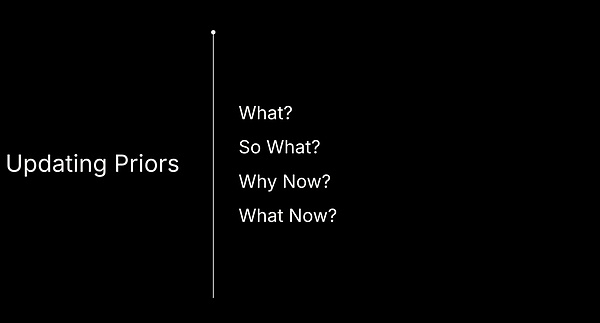
At the beginning of the speech, Pat Grady raised several key questions: What is AI? Why is it important? Why now? And what should we do? This framework comes from Don Valentine, the legendary founder of Sequoia Capital, who uses these questions to evaluate every emerging market.
At last year's AI Ascent conference, Sequoia showed a comparison chart, with the top line showing cloud computing transformation and the bottom line showing AI transformation. Cloud computing is now a $400 billion industry, larger than the entire software market when it was just starting out. If we follow this analogy, the starting market for AI services is at least an order of magnitude larger, or ten times larger than the early days of cloud computing. In the next 10 to 20 years, this market may become incredibly huge, far beyond our imagination.
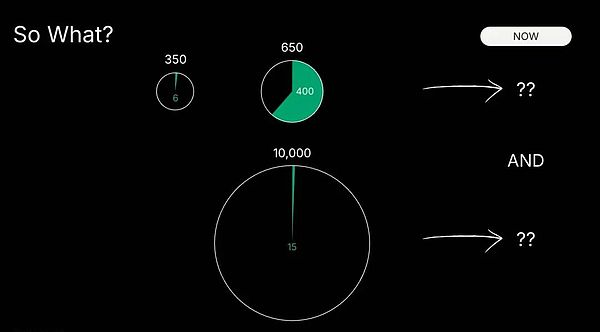
This year, Sequoia updated their views, believing that AI is not only eating the cake of the service market, but also eating the cake of the software market. We have seen many companies start with simple software tools and gradually become smarter, evolving from the "co-pilot" mode of assisting people to the "autopilot" mode of almost complete automation. These companies are shifting from selling tools to selling results, and from competing for software budgets to grabbing human resources budgets. AI is impacting these two huge markets at the same time.
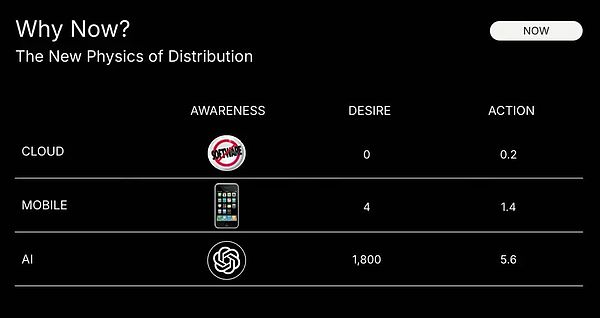
Each technological revolution in history has been bigger than the previous one, and AI is coming faster than any previous technological revolution. Pat explains why this is the case with a simple analysis: To analyze the physical laws of technology dissemination, you only need three conditions - people must know your product, they must want your product, and they must be able to get your product. Compared with the early days of cloud computing, the speed of AI's popularity is amazing. At that time, Salesforce founder Marc Benioff had to adopt various "guerrilla" marketing strategies to attract people's attention, and as soon as ChatGPT was released on November 30, 2022, the world's attention was immediately focused on AI. At the same time, the channels for sharing information have increased significantly, with Reddit and Twitter (now renamed X) alone having 1.2 billion to 1.8 billion active users per month. Internet users have also increased from 200 million in that year to 5.6 billion today, covering almost all households and businesses in the world.
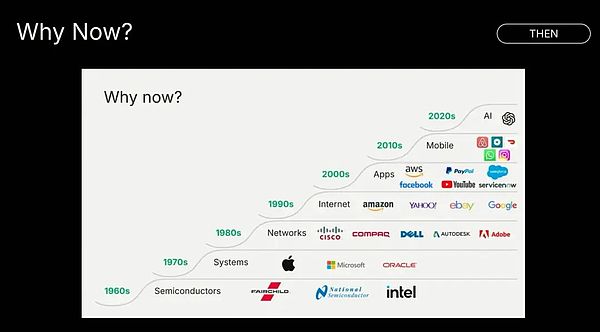
“It means the infrastructure is in place, and when the starting gun goes off, there are no barriers to adoption,” Pat explained. “This is not unique to AI, this is the new reality of technology distribution, the rules of physics have changed. The track has been laid.”
Application is the high value: How to win in the AI era
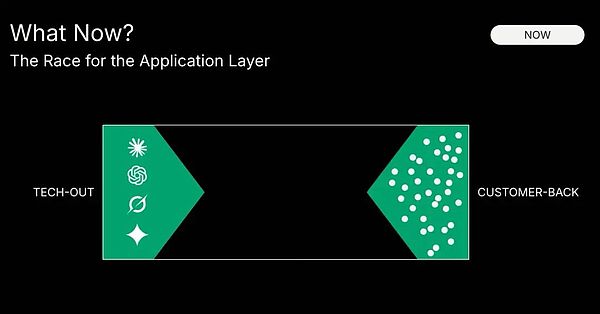
Looking back at several major technological revolutions in history, whether it is personal computers, the Internet or mobile Internet, most of the companies that have truly achieved revenues of more than $1 billion are concentrated in the application layer. Sequoia firmly believes that the field of AI will follow the same rule: the real value lies in the application layer.
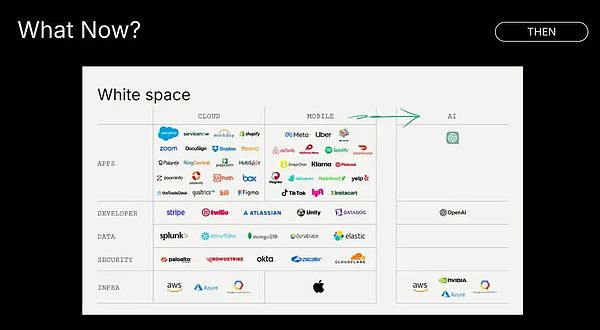
But the situation is different now. With the advancement of large models, they have been able to go deep into the application layer through reasoning capabilities, tool use, and communication between intelligent agents. If you are a startup, how should you deal with this situation? Pat recommends starting from customer needs, focusing on specific verticals, focusing on specific functions, and solving complex problems that may require people in the loop. This is where the real competition is and where the value is generated.
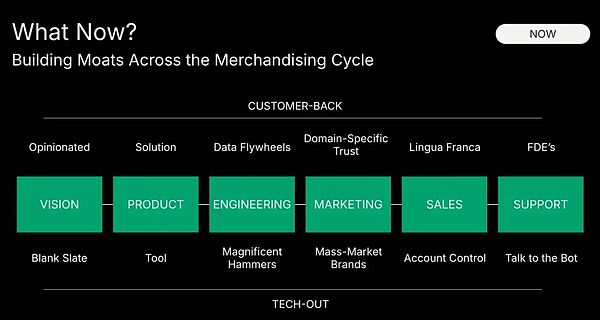
Is there anything special about building an AI company? Pat said that 95% of the content is no different from building a normal company - solving important problems, finding unique and attractive ways, and attracting excellent talents to join. Only 5% is unique to AI, and he emphasized three points in particular:
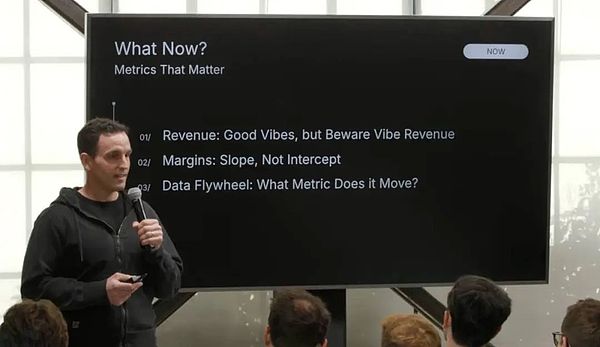
First, be wary of "vibe revenue." Pat explained that many entrepreneurs like "vibe revenue" because it feels good and the company seems to be growing fast, but in fact it may just be customers testing the waters rather than real behavioral changes. He advises founders to carefully check user adoption, engagement, and retention rates to see what people are actually doing with the product. Don't fool yourself into thinking you have real revenue when it turns out to be "vibe revenue," which will ultimately hurt you.
"At this stage of development, trust is more important than your product," Pat emphasized. "The product will gradually get better. If customers trust you to make it better, you'll be fine. If they don't trust you, you'll be in trouble."
Second, gross margin. Pat said they don't necessarily care what the startup's gross margin is now, because the cost structure in the AI field is changing rapidly. The cost per token has dropped by 99% in the past 12 to 18 months. If entrepreneurs successfully shift from selling tools to selling results and move up the value chain, the price point will also rise. Although the gross margin may not be ideal now, the company should have a clear path to a healthy gross margin.
Third, data flywheel. Pat asked the entrepreneurs in the audience: "Who has a data flywheel? What business indicators can this data flywheel drive?" He pointed out that if this question cannot be answered, then the so-called data flywheel may be just a fantasy. It must be linked to specific business indicators, otherwise it is meaningless. This is particularly important because the data flywheel is one of the most powerful moats that a startup can build.
At the end of his speech, Pat used an interesting metaphor: "Nature abhors a vacuum." He said that there is a huge "suction force" on AI in the market now, and all the macroeconomic noise, such as tariffs and interest rate fluctuations, is irrelevant. The upward trend of technology adoption completely drowns out any fluctuations in the market. "There is a huge suction force in the market, and if you don't seize the opportunity, others will. So, no matter what we said before about moats, indicators and the like, you are now in an industry that needs to run desperately. Now is the time to go all out and keep moving at the highest speed at all times."
From hype to real value: User engagement with AI has increased dramatically
Next, Sonya Huang reviewed the remarkable progress of AI applications in the past year. She shared an exciting data: in 2023, the ratio of daily active users to monthly active users (DAU/MAU) of native AI applications was very low, which means that although users are curious to try, they do not use it frequently, and the hype far exceeds the actual value. But now the situation has reversed dramatically. ChatGPT's DAU/MAU ratio has been climbing all the way and is now close to the level of Reddit.
“This is excellent news,” Sonya said excitedly. “It means more and more of us are getting real value from AI, and we are all learning together how to integrate AI into our daily lives.”
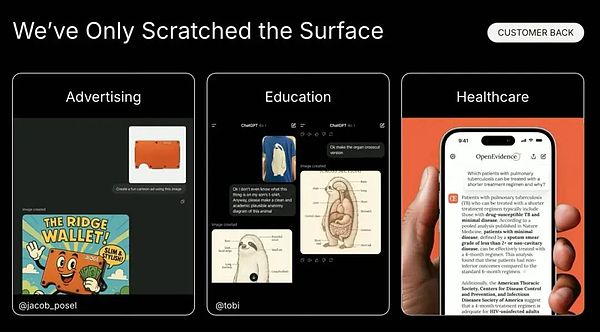
This use is both fun and interesting, and has profound practical value. Sonya admits that she has burned a surprising number of GPUs in her attempts to "Ghibliize" various images. But in addition to these fun applications, the more exciting ones are the deeper applications, such as the ability to create amazingly accurate and beautiful advertising copy in the advertising field, the ability to instantly visualize new concepts in the education field, and the ability to better assist in diagnosis in the medical and health field, such as OpenEvidence.
“We’ve only just scratched the surface of what’s possible,” Sonya said. “As AI models become more powerful, what we can do through this ‘front door’ will become more and more profound.”
The breakthrough of voice and the explosion of programming: two key areas
In 2024, there are two breakthroughs in the field of AI that are particularly worthy of attention.
The first is speech generation technology. Sonya calls it the "Her moment" in the field of speech, citing the story of Joaquin Phoenix falling in love with an AI assistant in the movie Her. Speech generation technology has completely crossed the "uncanny valley" from "almost mature" to a level that is almost indistinguishable from the real thing.
At the event, Sonya played a voice demonstration that sounded so natural that it was hard to tell whether it was human or AI. "The gap between science fiction and reality is closing at an astonishing speed. It feels like the Turing test has really come to us quietly."
The second key breakthrough is in programming. Sonya points out that this area has reached "screaming product market fit". Since Anthropic's Claude 3.5 Sonnet was released last fall, there has been a rapid "vibe shift" in the programming field. People are now using AI programming to do impressive things, such as someone using "vibe coding" to make a DIY alternative to DocSend.
“Whether you’re a seasoned ‘10x’ engineer or someone who knows nothing about programming, AI is fundamentally changing the accessibility, speed, and economics of creating software,” Sonya explains.
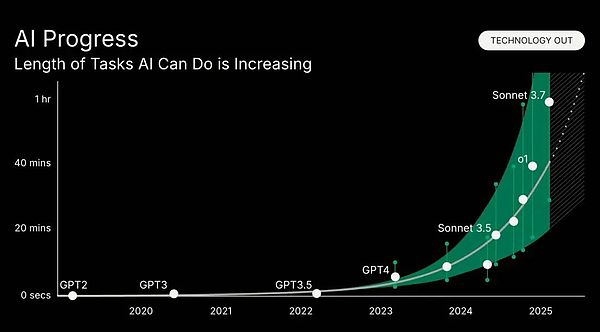
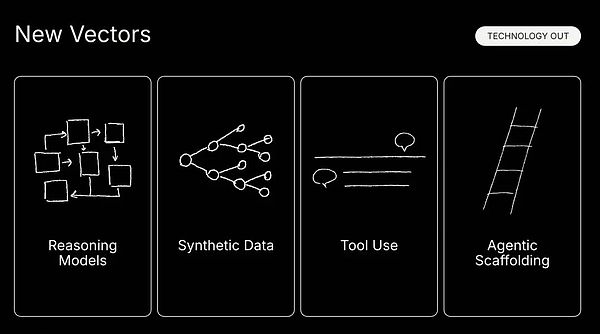
From a technical perspective, although the progress of pre-trained models seems to be slowing down, the research ecosystem is finding new avenues for breakthroughs. The most important progress is OpenAI's reasoning capabilities, while technologies such as synthetic data, tool use, and AI agent orchestration (AI scaffolding) are also developing rapidly, which combine to create artificial intelligence that can complete increasingly complex tasks.
Where is the value created? The battle at the application layer is heating up
Sonya recalls a debate she had with her colleagues about AI value creation. She admits that she was skeptical of GPT packaging applications at the time, while her partner Pat firmly believed that value would be created at the application layer. Now it seems that Pat was right. From the actual value creation, companies like Harvey and OpenEvidence that focus on starting from customer needs have indeed created huge value.
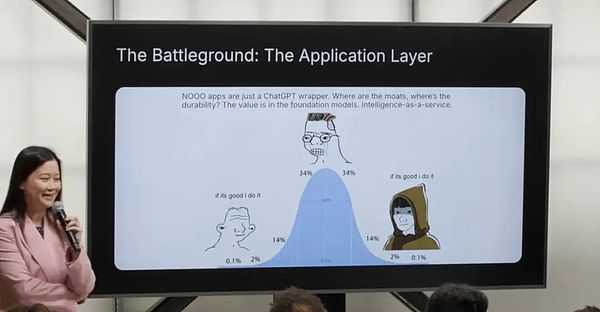
“We strongly believe that the application layer is where value ultimately converges,” Sonya said, “and as the underlying model increasingly penetrates this layer, the battlefield is becoming more and more intense.”
Of course, she also jokingly pointed out that the real winner might be Nvidia CEO Jensen Huang, whose company has reaped huge benefits from AI chip sales.
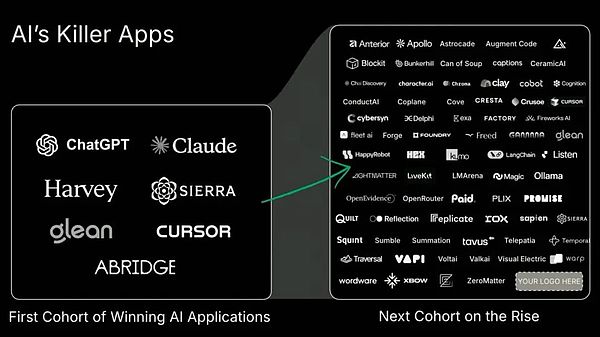
Sonya believes that the first batch of AI "killer applications" have already appeared. In addition to well-known applications such as ChatGPT, Harvey, Glean, Sierra, and Cursor, a group of emerging companies are emerging in various professional fields. She particularly mentioned that many new companies will be "agent-first", and the agents they sell will evolve from the current simply pieced-together prototypes to truly powerful products.
Vertical Agents: AI agents that specialize in a specific field
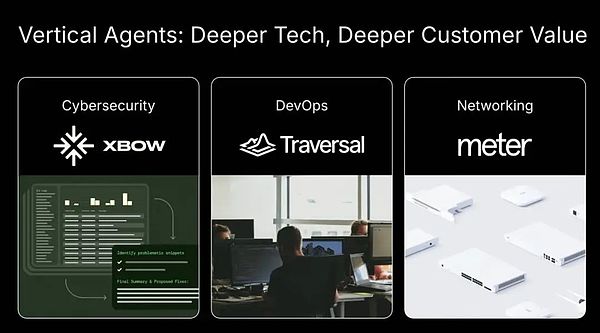
In the intelligent agent market in 2025, Sonya is particularly optimistic about the development of vertical agents. This provides excellent opportunities for entrepreneurs who are deeply engaged in a certain field. These vertical agents are trained end-to-end for specific workflows, using reinforcement learning techniques including synthetic data and user data to enable AI systems to perform well on very specific tasks.
There are already exciting early examples. In security, Expo has demonstrated that their agents can outperform human penetration testers; in DevOps, Traversal has created an AI troubleshooter that is better than the best human troubleshooter; and in networking, Meter’s AI has outperformed network engineers.
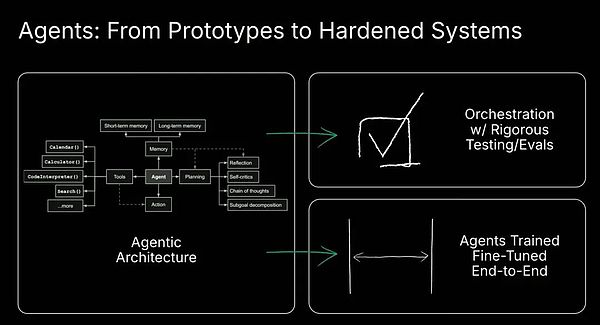
While still in its early stages, these examples give us optimism that vertical agents trained to solve specific problems could outperform today’s best human experts.
Sonya also proposed the concept of the "abundance era". Taking programming as an example, what happens when labor becomes cheap and abundant? Will we get a lot of low-quality AI-generated content? What happens when "taste" becomes a scarce asset? The answers to these questions will foreshadow how AI will change other industries.
The Agent Economy: The Next Big Phase of AI
At the end of the speech, Konstantine Buhler looked forward to the next important stage of AI - the " agent economy" . The AI Ascent conference a year ago began to discuss agents, when these machine assistants were just beginning to form a business model. Today, these machine networks, called "agent swarms", have played an important role in many companies and become a key part of the AI technology stack.
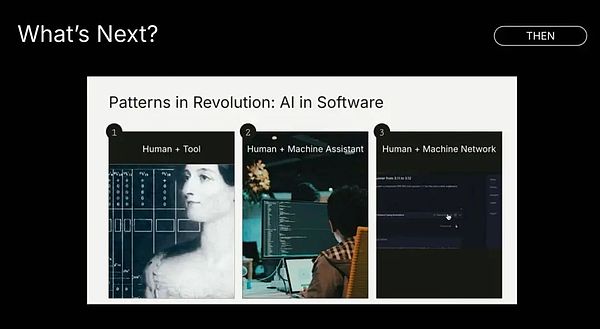
Konstantine predicts that in the coming years this will mature into an agent economy where agents don’t just pass information around, they transfer resources, trade with each other, record each other’s actions, understand trust and reliability, and have their own economic systems.
“This economy doesn’t exclude humans, it revolves around humans,” Konstantine explained. “Agents collaborate with humans, and humans collaborate with agents, and together they form this agent economy.”
Three major technical challenges in building an intelligent economy
To realize this ambitious vision, we face three key technical challenges:
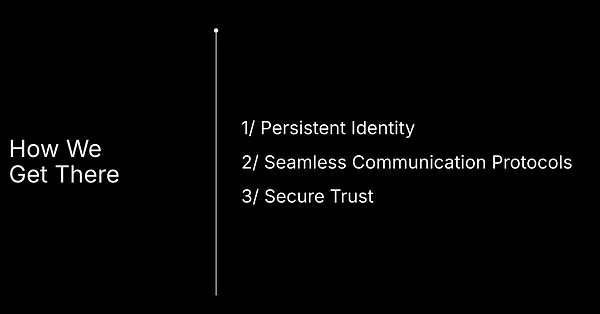
The first challenge is persistent identity. Konstantine explained that persistent identity actually consists of two aspects. First, the agent itself needs to remain consistent. If you deal with a person doing business and he changes every day, you are likely not going to work together for a long time. The agent must be able to maintain its own personality and understanding. Second, the agent needs to remember and understand you. If your partner knows nothing about you and can barely remember your name, this will also pose a challenge to trust and reliability.
Current solutions such as RAG (Retrieval Augmented Generation), vector databases, and long context windows attempt to address this issue, but significant challenges remain in achieving true memory, memory-based self-learning, and maintaining agent consistency.
The second challenge is seamless communication protocols. "Imagine what personal computing would be like without TCP/IP and the Internet," Konstantine said. "We are just beginning to build the protocol layer between agents." He specifically mentioned the development of MCP (Model Collaboration Protocol), which is just one of a series of future protocols for information transfer, value transfer, and trust transfer.
The third challenge is security. When you can’t meet with your partners face to face, the importance of security and trust becomes more prominent. In the intelligent economy, security and trust will be more important than in the current economy, which will give rise to a whole industry around trust and security.
From Determinism to Stochasticity: A Fundamental Shift in Thinking
Konstantine believes that the advent of the intelligent economy will fundamentally change the way we think. He proposed the concept of "stochastic mindset", which is completely different from traditional deterministic thinking.
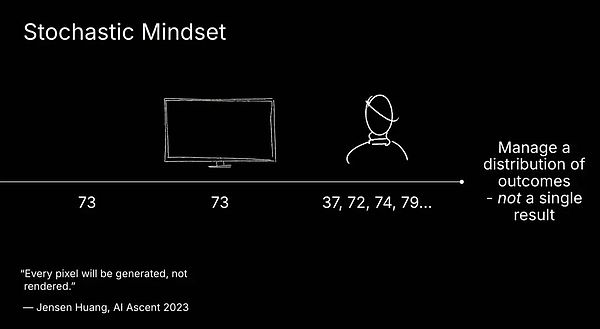
“A lot of us fell in love with computer science because it was so deterministic,” he explains. “You program a computer to do something and it does it, even if it segfaults. Now we’re entering an era where computing is going to be random.”
He used a simple example to illustrate: If you ask a computer to remember the number 73, it will remember it tomorrow, next week, and next month. But if you ask a person or AI to remember it, it may remember 73, or 37, 72, 74, or the next prime number 79, or even nothing. This shift in thinking will have a profound impact on the way we deal with AI and intelligent agents.
The second change is the management mindset. In the intelligent agent economy, we need to understand what agents can and cannot do, which is similar to the process of changing from independent contributors to managers. We will need to make more complex management decisions, such as when to stop certain processes and how to provide feedback.
The third major change is a combination of the first two: We will have more leverage, but significantly less certainty. “We are entering a world where you can do more, but you have to be able to manage that uncertainty and risk,” Konstantine said. “Everyone in this room is uniquely suited to thrive in that world.”
Leverage at its best: Reshaping jobs, companies, and the economy
A year ago, Sequoia predicted that various functional departments in the organization would begin to have AI agents and gradually merge, and eventually the entire process would be completed by AI agents. They even boldly predicted that the first "one-person unicorn company" would appear.
While the “one-person unicorn” has not yet been achieved, we are already seeing companies scaling at an unprecedented rate, with fewer people than ever before. Konstantine believes we will reach levels of leverage never seen before.
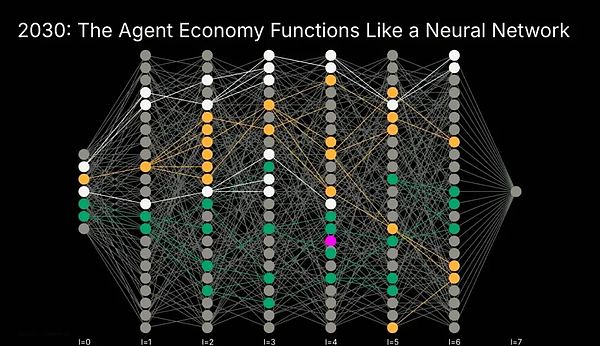
“Eventually, these processes and agents will merge into a network of neural networks,” he envisions. “This will change everything, reshaping individual jobs, reshaping corporate structures, and reshaping the entire economy.”
Through this speech, the three partners of Sequoia outlined a clear path for AI from its current development to its possible future evolution. From the macro analysis of market opportunities, to the insight into the value of the application layer, to the vision of the intelligent economy, they not only explained the What and Why, but more importantly, pointed out the How - how to seize the opportunity and create value in this trillion-level opportunity.
For entrepreneurs, this is not only a feast of ideas, but also a guide to action: seize the value of the application layer, build real rather than "atmospheric" revenue, establish a data flywheel, prepare for the upcoming intelligent economy, and always remember - now is the time to go all out and keep moving at the highest speed.