Quantinuum announced a "bombshell" in 2025, declaring that its "Helios" quantum computing system will be commercially available later that year, capable of supporting "at least 50 high-fidelity logical Qubits". If fully realized, this announcement would be a significant milestone for quantum computing, transitioning from experimental research to practical computational capabilities (especially in specific application domains). The company also demonstrated a record-breaking logical Qubit teleportation fidelity in May 2025, further proving its leading position in constructing high-quality logical Qubits.
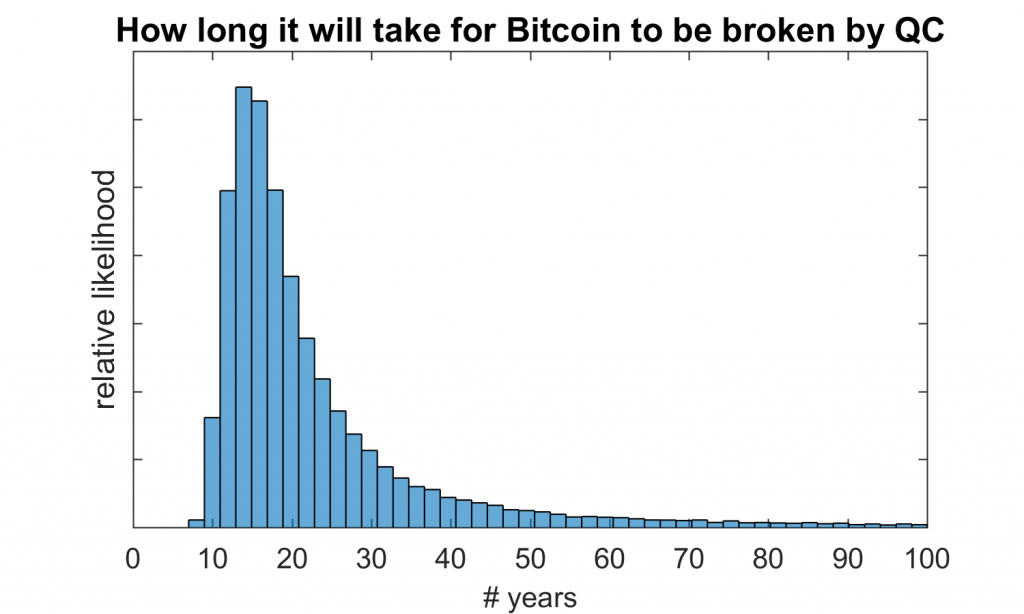
Nevertheless, experts' predictions about the emergence of a fault-tolerant quantum computer that could threaten Bit coin still differ. Some optimistic (or pessimistic, depending on the perspective) estimates suggest it might occur within the next 3 to 5 years, while others believe it will take at least a decade or longer. Importantly, the quantum threat is not a binary mutation, but a process of gradually increasing probability. Each hardware advancement and algorithm optimization silently shortens the countdown.
Bit coin's "Quantum Counterattack": Proactive Preparation or Closing the Barn Door?
Facing the increasingly clear quantum threat, the Bit coin community is not helpless. The cryptography community has long been researching "Post-Quantum Cryptography" (PQC), which includes new cryptographic algorithms believed to resist known quantum algorithm attacks. After years of screening, the National Institute of Standards and Technology (NIST) has announced the first standardized PQC algorithms, primarily including CRYSTALS-Kyber for key encapsulation, and CRYSTALS-Dilithium, FALCON, and SPHINCS+ for digital signatures.
For Bit coin, Hash-Based Signatures (HBS), such as SPHINCS+, are considered a strong contender because their security does not depend on mathematical problems yet to be extensively verified, but rather on the collision resistance of well-studied hash functions. SPHINCS+ is stateless (compared to its predecessors like XMSS), which is particularly important for the distributed nature of blockchain. However, hash-based signatures typically face challenges such as large signature volumes and longer key generation and verification times, which could put pressure on Bit coin's transaction efficiency and blockchain storage. Integrating these PQC algorithms without sacrificing Bit coin's core characteristics is a massive technical challenge.
[Translation continues in the same manner for the rest of the text, maintaining the specified translations for specific terms]Compared to other known Bitcoin security risks (such as 51% attack, major software vulnerabilities, increasingly tight global regulation), the uniqueness of quantum threats lies in their disruptive nature. While a 51% attack can cause double-spending or transaction censorship, it is difficult to directly steal private keys; software vulnerabilities can be fixed; regulatory pressure mostly affects compliance and application boundaries. However, once a quantum attack is realized, it would be a "dimensional strike" against the existing cryptographic system, directly threatening the ultimate ownership of assets.
Looking back at the history of cryptography, from the upgrade of DES to AES, to the gradual abandonment of the SHA-1 hash algorithm, each major cryptographic system migration has been a long process lasting years or even decades, led by centralized institutions (such as governments and standards organizations). While Bitcoin's decentralized governance model has given it powerful resilience and resistance to censorship, it may appear to be stumbling when rapid, unified action is needed to address global technological changes.
Conclusion: Exploring the Path Forward in the Quantum Mist
Quantum computing, the Damocles sword hanging over Bitcoin, with its falling point still unclear, already sends a chilling sensation. It poses the most profound long-term challenge to the entire cryptographic world, especially the cryptocurrency domain represented by Bitcoin.
The Bitcoin community is facing an unprecedented test: how to complete a life-or-death upgrade of the underlying cryptographic system while adhering to its core principles of decentralization, censorship resistance, and code as law. This is not just a race against quantum computer development, but a complex system engineering involving PQC algorithm research, standardization, Bitcoin protocol innovation, community consensus building, and global ecosystem collaborative migration.
The future path is full of uncertainty. Will it successfully evolve, transforming quantum threats into a catalyst for technological innovation and entering a more secure post-quantum era? Or will it fade away at the dawn of quantum computing due to consensus difficulties and migration challenges? As the wheels of history roll forward, the answer may be hidden in every decision, code submission, and heated debate within the Bitcoin community in the coming years. This is destined to be an ongoing story about innovation, risk, and resilience, and we, whether participants or observers, are on the eve of this magnificent transformation.