DeFi: Ethereum's First Product-Market Fit
From its inception, Ethereum has been dedicated to creating a global, trustless computing platform. After a decade of development, it has grown from an early technical experiment to become the core infrastructure for decentralized finance (DeFi), block space markets, and on-chain application ecosystems.
However, to understand how ETH reached its current state, we must start from a critical turning point—the product-market fit (PMF) of DeFi. During the bear market from 2018 to 2020, with the emergence of protocols like ERC 20, Uniswap, DAI, Aave, and Compound, Ethereum gradually evolved into a self-custodial, composable, and permissionless financial system infrastructure. The explosion of DeFi was a natural convergence of technological innovation and market demand. The "DeFi Summer" of 2020 marked the peak of this trend, with rapidly increasing total value locked and on-chain transaction volumes surpassing centralized exchanges for the first time, revealing ETH's network value. However, the subsequent high transaction fees exposed Ethereum's scalability bottleneck and hinted at future technological route transformations.
ETH's Value Turning Point: From EIP-1559 to The Merge
If DeFi demonstrated Ethereum's practical value, then the two upgrades of EIP-1559 and The Merge provided the logic for ETH's long-term value. In 2021, EIP-1559 was introduced, fundamentally changing Ethereum's fee mechanism. The previous "priority bidding" model was replaced by a base fee, with all users' fees no longer going to miners but being directly burned. This meant that the more active the network, the more ETH burned, reducing inflationary pressure and strengthening ETH's value support.
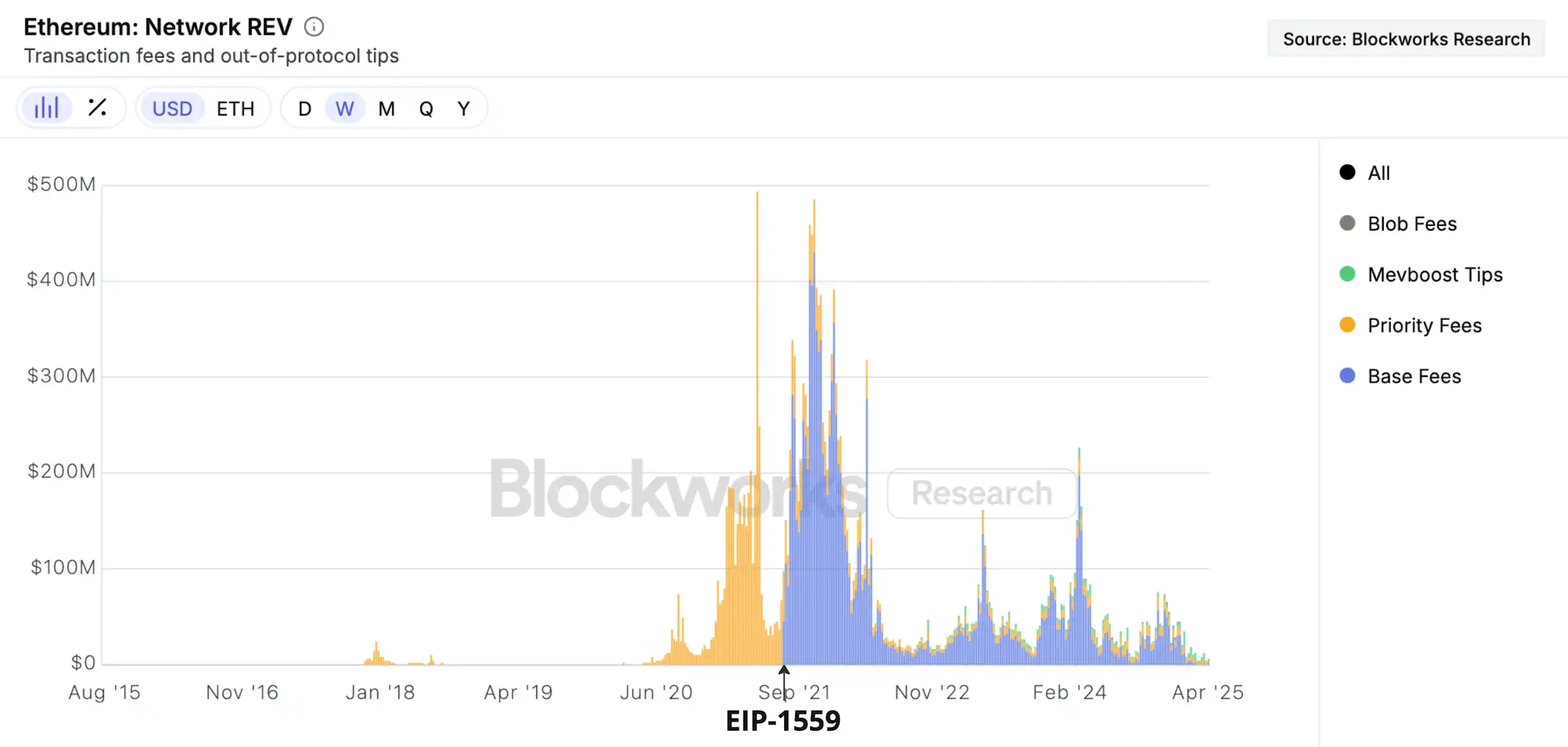
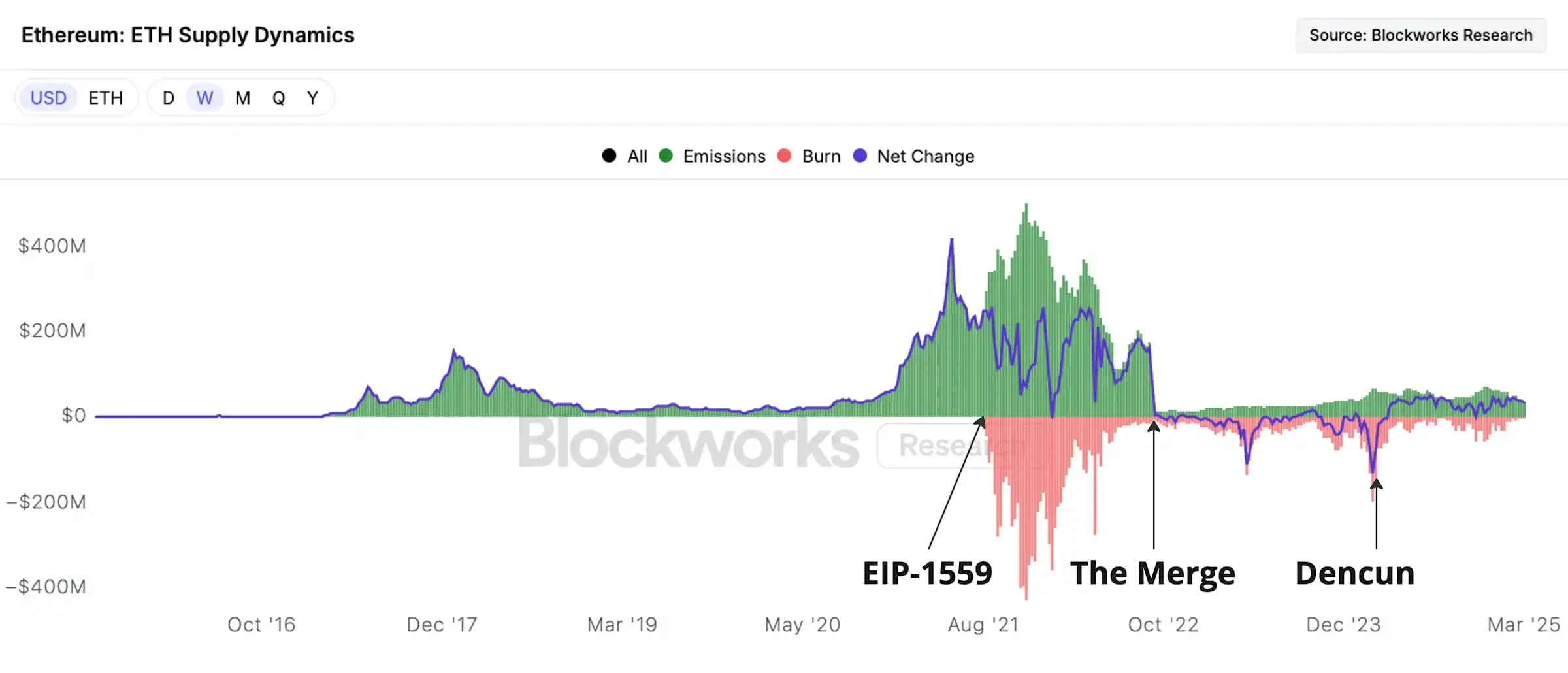
The indigo section shows that ETH began to achieve "value backflow" through the burning mechanism. In September 2022, Ethereum completed a historically significant upgrade: switching from Proof of Work (PoW) to Proof of Stake (PoS), marking the official implementation of "The Merge". This transformation was technically extremely challenging yet crucial—it reduced Ethereum's energy consumption by 8000 times and lowered the annual issuance rate for network security from 4% to less than 1%. Afterward, ETH's "net inflation rate" turned negative for a considerable period.
Long-term Belief in the Rollup Era: Cooperation or Parasitism?
Scaling is Ethereum's core challenge. Facing the trilemma of decentralization, security, and scalability, Ethereum ultimately chose the Rollup solution. Rollup moves transaction execution off-chain, writing only state changes and data to the mainnet, ensuring mainnet security while significantly improving transaction throughput. This transformed Ethereum from a mere "execution platform" to a "security layer + data availability layer", forming a "Rollup-centric" scaling route.
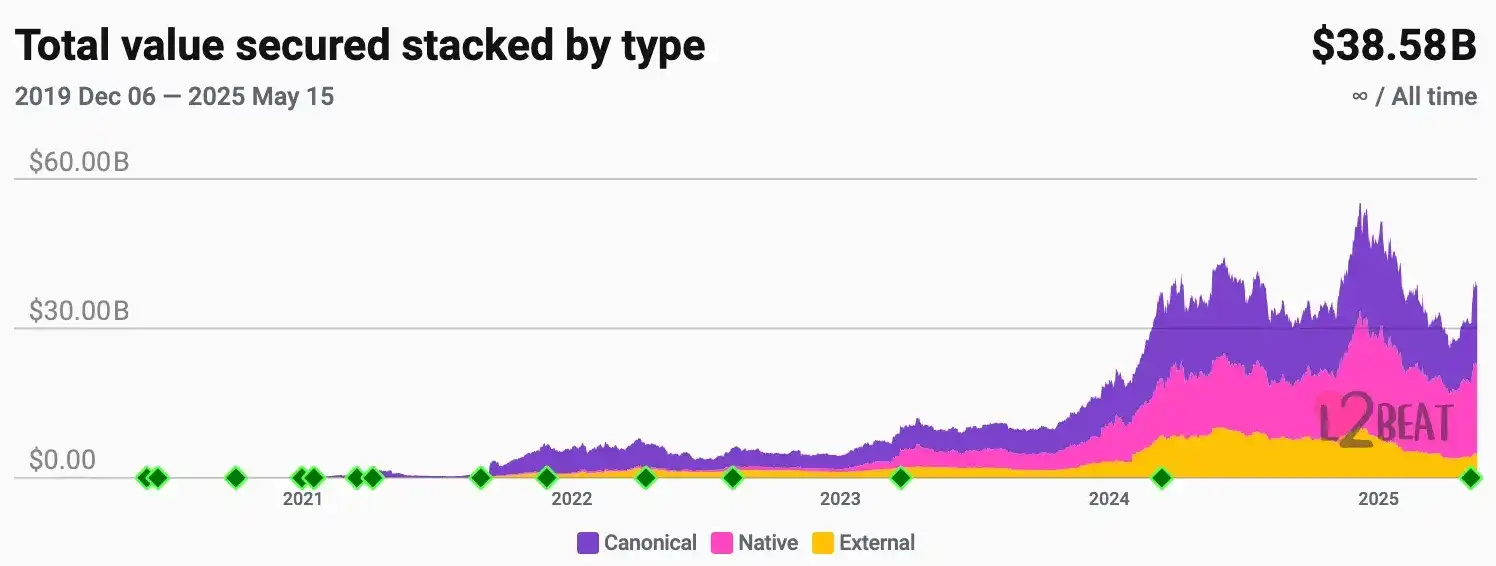
However, Rollup is more than a technical revolution; it has changed the logic of ETH's value flow. Previously, users paid fees directly to the mainnet, but now most transactions are completed through Rollup, reducing direct transaction demand on the mainnet. Rollup generates revenue by reselling block space, but after the Cancun upgrade, its direct fee expenditure to the mainnet significantly decreased, sparking "parasitism" discussions. In reality, Rollup is more of an "business expansion" for Ethereum, relying on the mainnet's security and data services to bring more users and transactions.
Although mainnet transaction demand has decreased, mainnet scaling and upgrades continue actively, aiming to increase processing capacity by hundreds or even thousands of times in the coming years, providing stronger security and data support for L2. Rollup and mainnet form a complementary ecosystem, both divided and collaborative, laying the foundation for Ethereum's sustainable development.
Ethereum Current Status Indicators: Crisis and Deep Factor Analysis
Since the FTX collapse in 2022, the crypto industry has maintained growth, but ETH's performance has notably lagged behind Bitcoin (BTC) and Solana (SOL). ETH's price is highly correlated with Ethereum network fees, and fee growth has been sluggish since 2022, especially compared to the 2018-2022 cycle and Solana's current performance, showing clear income pressure. There are three main reasons:
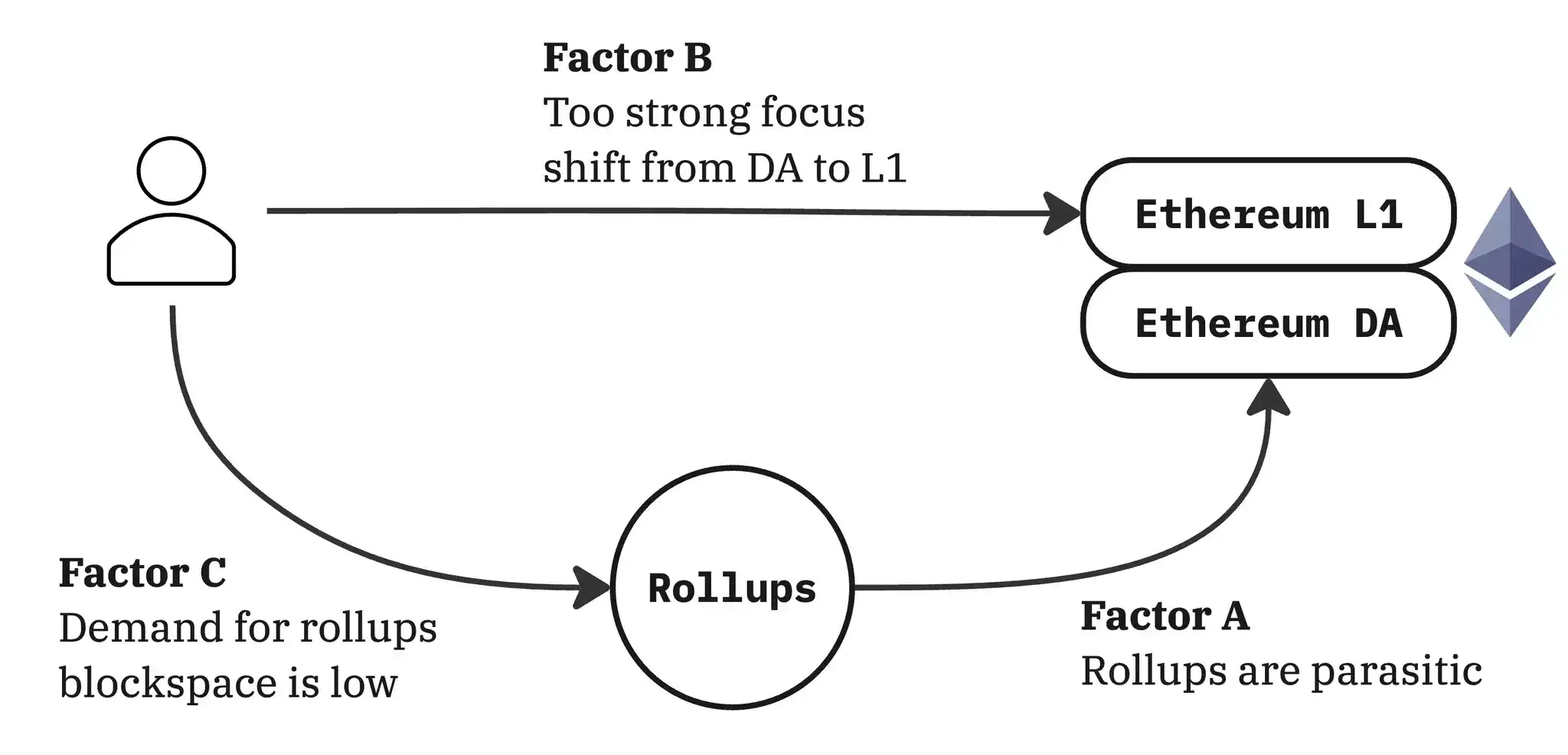
Factor A: Rollup "Parasitism"
While Rollup generates revenue through user fees, it currently does not provide sufficient value back to the Ethereum mainnet. From the data, although this factor exists, its overall impact on income is currently small. Rollup's total weekly revenue is only in the millions of dollars, with lower fees partly because rollup sequencers can support gas limits far higher than the mainnet, so they don't need to charge users high fees like L1 networks.
More importantly, questioning Rollup's lack of mainnet contribution is premature. In fact, the Ethereum community "unexpectedly" adopted a strategy of providing free data availability (DA) space to Rollups to attract as many layer-2 solutions as possible, which is a correct early ecosystem-building approach.
Factor B: L1 Strategic Focus Shifting to DA, Marginalizing Mainnet Development
Since launching the Rollup route, Ethereum's strategic and user growth focus has almost entirely shifted towards Rollup, with mainnet expansion and maintenance relatively neglected. To some extent, this bias is indeed true. When addressing high mainnet fees, Ethereum chose to bet on Rollup, an "all-in" strategy that overlooked L1's potential. Looking back, as Rollup's fragmentation issues gradually emerged and viable L1 scaling paths (like access lists and zkEVM development) were found, the strategic underinvestment in L1 seems excessive.
However, it must be acknowledged that this judgment is based on hindsight. The Rollup route was a pragmatic response to mainnet congestion at the time, and solutions like zkEVM were still far off. Therefore, it was difficult to reasonably allocate resources between L1 and DA. Moreover, even if we now have a clear path to increase L1 gas limits 100-fold, achieving performance above 10,000 TPS and supporting a comprehensive public chain computing platform will inevitably require some form of horizontal sharding. In this context, choosing a Rollup-first strategy was still a reasonable decision.
Factor C: Rollup's DA Demand Has Not Exceeded Mainnet's DA Supply
This is the most critical and overlooked deep-seated issue: Rollup's demand for data availability (DA) space has not substantially exceeded Ethereum's supply. Rollup sequencers are highly efficient when packaging and uploading transactions to the mainnet, with extremely high compression rates, resulting in consuming far less blob space than the theoretical value. Additionally, some user activities this cycle (like meme coin trading) have been diverted by Tron and Solana.
Before the Pectra upgrade (May 7, 2025), calculating with 3 blobs per block, Ethereum's DA supply is about 210 TPS. Until November 2024, this supply will exceed market demand. Even if demand increases, the blob gas price indicates that it has not significantly risen, suggesting demand still hasn't overwhelmed supply. The recent Pectra upgrade will double blobs to 6 per block, further increasing DA supply, far exceeding actual demand.
Therefore, Factor C is actually the fundamental variable affecting Factors A and B. Once Rollup's blob space demand truly exceeds supply, blob fees will enter a market discovery phase, and Ethereum's overall fee structure will undergo a qualitative change.
How to Evaluate ETH's Value? Ethereum's Business Logic
Is ETH a productive asset or a currency? We firmly believe that ETH should primarily be a productive asset, and secondarily a currency. This is because Ethereum's most powerful moat stems from its technological advantages: a trust foundation and stability tested over many years, neutrality and censorship resistance brought by decentralization, leading DeFi ecosystem, high-quality R&D and developer community, and a robust network activity guarantee mechanism. Ethereum is truly an unstoppable "global computer".
Secondly, as a productive asset dependent on technological adoption, ETH's monetary value can be solidified and strengthened. Although ETH as a currency can more easily cross technological iteration cycles, the most prudent path is to first build Ethereum as a technological platform, ensure its economic model is sustainable, and then let its monetary attributes naturally emerge. Conversely, merely "hyping ETH as currency" cannot establish a solid foundation.
In short, ETH's price consists of three parts: the discounted value of future fees, monetary premium (as a store of value, medium of exchange, and even unit of account), and speculative premium (including cultural and meme value). Although the latter two have greater influence, to reinforce these three, the key is to maximize the base network income, which is the foundation of ETH's value.
Ethereum's Long-term Rollup Strategy: Why Is It Correct? The Truth of the Conflict with Solana
Ethereum's firm choice of a "Rollup-centric" expansion route is very clear: it is the only architecture design that can balance security, scalability, and neutrality. From a technical supply perspective, Ethereum is currently the most secure and decentralized smart contract platform. Through validating bridges and data availability layers, Ethereum can "wholesale" its mainnet security to Rollups, helping them build their own chains without reconstructing an entire trust system.
From a market demand perspective, users ultimately do not care which chain they are using—they only care about "which chain offers the cheapest and safest transactions". In the long run, the most rational choice is to be a Rollup, buying security, DA, and consensus, directly connecting to Ethereum. This will naturally form a market convergence phenomenon: Rollups will build their services around Ethereum's "neutral ledger" like enterprises, rather than dispersing to other isolated chains.
Ethereum vs Solana
Based on 2024 fee income, some believe Solana has begun to surpass Ethereum in the block space market. However, Solana's strategy centered on hardware expansion carries high risks, with the network periodically experiencing overload. If blockchain is to realize its full potential by massively migrating financial infrastructure on-chain, Solana will ultimately need to transition to sharded scaling, while Ethereum is already far ahead in security, Rollup infrastructure, and ecosystem adoption.
More critically, most of Solana's on-chain activity comes from the Memecoin craze. Data shows that such trades once accounted for over 50% of its DEX trading volume. However, Memecoin is a short-term, zero-sum game phenomenon—once the hype dies, its "high income" myth will be difficult to sustain.
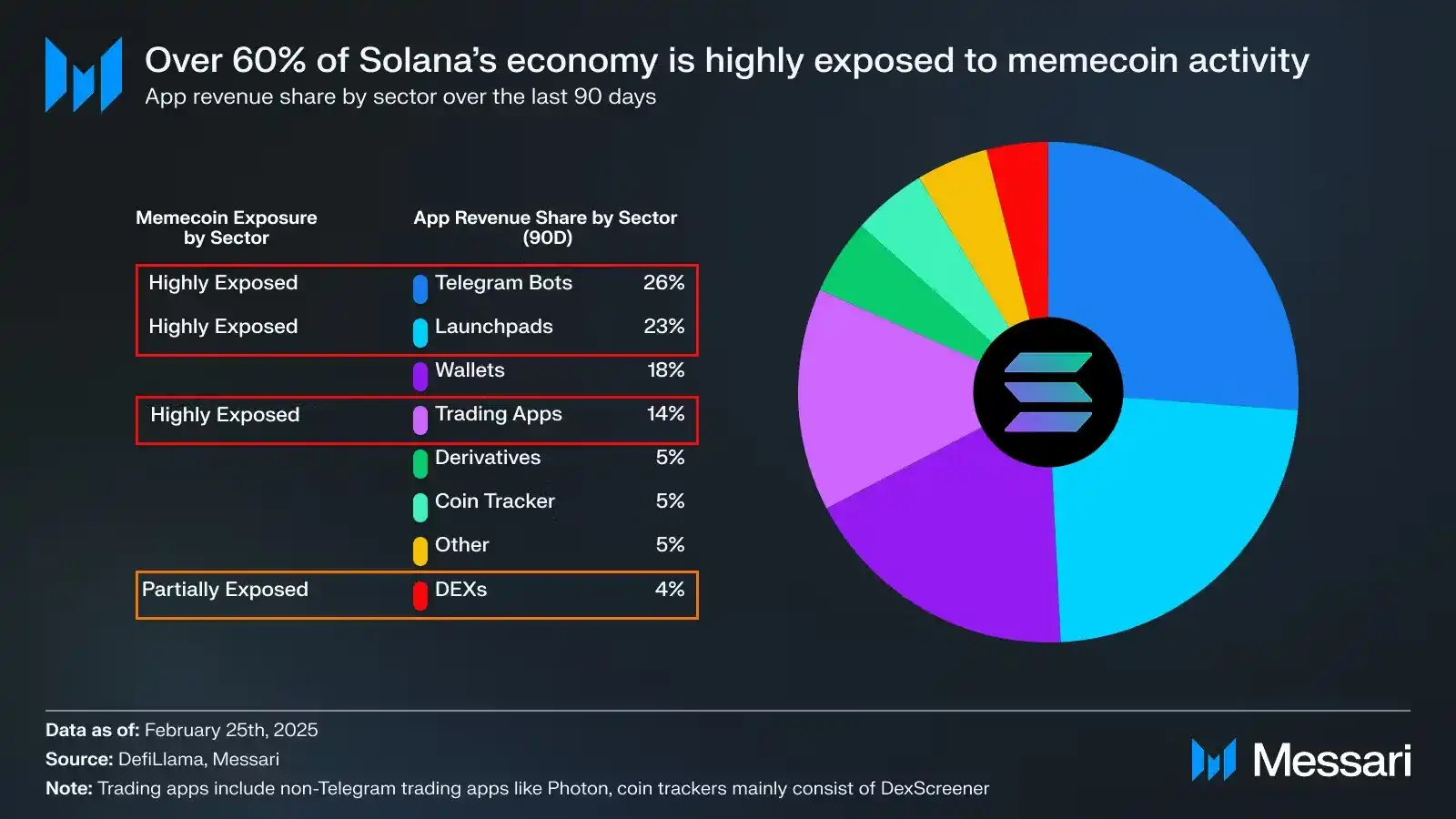
In contrast, Ethereum focuses on high-stickiness scenarios like DeFi, which are not driven by wild speculation but by the on-chain migration of real financial behaviors. The most significant and important difference: Solana's validator nodes are centralized, while Ethereum has the most diverse staking network globally. This decentralization itself is the strongest moat.
To further cover the high-frequency trading market, such as social, trading, and coordination between AI agents, Rollup's TPS can reach 30,000 levels, bringing DA fee income that will exceed $10 billion, with transaction costs still below one cent. Such income is influenced by ETH price and other factors, with the minimum price needing dynamic adjustment, expected to be determined by community consensus, similar to today's gas limit mechanism. In the future, further research is needed on the optimal pricing strategy for blobs, such as improving the correlation with Ethereum L1 fee markets. Additionally, as Ethereum transitions to zkEVM or RISC-V, new technologies like SNARK infrastructure will help improve fee capture efficiency.
The key is that at the current stage, there should be no rush to directly extract value from transactions, but rather to maximally support and promote high-value activities in Ethereum blocks and blob spaces. This will not only generate and enhance network effects but also help Ethereum seize the continuously expanding block space market and solidify its economic foundation. The path of value reflux is thus very clear.
Welcome to join the BlockBeats official community:
Telegram Subscription Group: https://t.me/theblockbeats
Telegram Communication Group: https://t.me/BlockBeats_App
Twitter Official Account: https://twitter.com/BlockBeatsAsia