


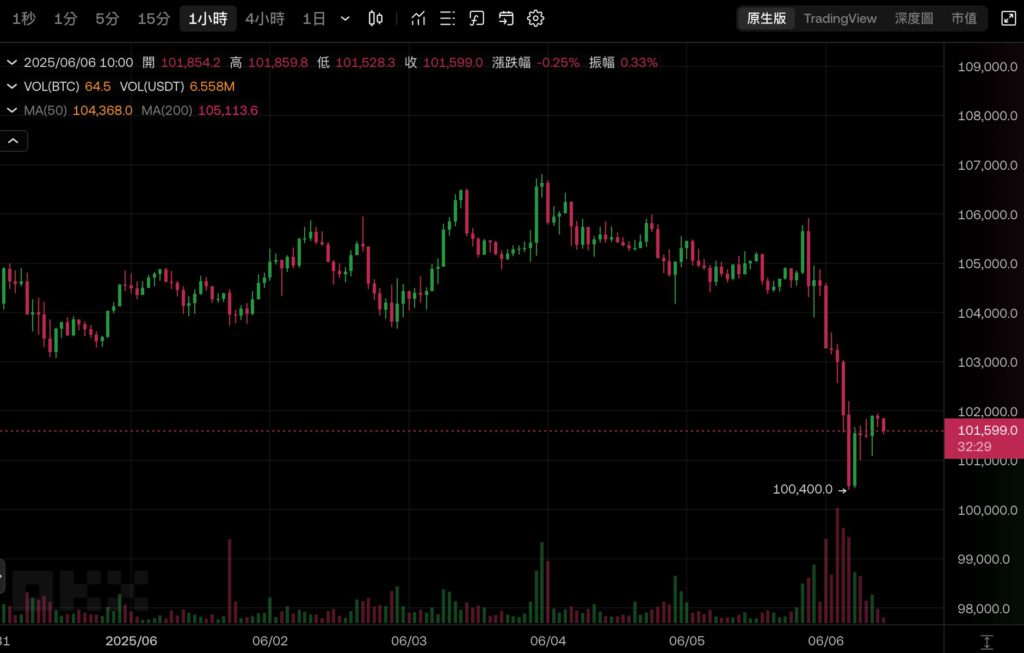
Bitcoin quickly dropped from the $105,000 level last night, reaching $100,400 before the US stock market closing, almost breaking below the $100,000 mark. Some community members attribute this to Trump and Musk's social media confrontation, causing US stock market volatility.
However, Bitcoin is currently trading at $101,599. If it can maintain this price level, even with a potential second dip, it could quickly recover and potentially accumulate momentum for continued growth.
Analyst: Hash Ribbon Indicator Signals Buy
CryptoQuant analyst Darkfost also posted on social platform X yesterday (5th), pointing out that the technical indicator Hash Ribbons has issued its third buy signal in 2025, indicating that the current price level is an excellent opportunity for buying the dip.
He explained in detail in his tweet:
Hash Ribbons issued a buy signal!
I haven't seen many people discussing this, but we recently received a new buy signal from the Hash Ribbons indicator.
This indicator is designed to help us assess the stress levels of the Bitcoin mining ecosystem.
Given that computing power has recently reached a historical high, this is not surprising.
Hash Ribbons simply compares the 30-day and 60-day moving averages of computing power to identify periods of significant miner pressure.
In this case, it's important to understand that this signal is negative in the short term.
Why?
Because when mining becomes unprofitable for some miners, they are forced to sell Bitcoin to maintain operations. (I won't delve into the details of equipment elimination or shutdown, as it's not particularly relevant in this context.)
The key is that these selling pressures often create interesting long-term buying opportunities. It's not complicated to analyze, and this indicator has always been accurate, except for the 2021 China mining ban event.
In summary, this signal tells you that buying at the current price level is a wise move.

What are Hash Ribbons Indicators?
Hash Ribbons is a technical indicator based on Bitcoin network computing power, comparing the 30-day and 60-day moving averages of computing power to assess the relationship between miner activity and market trends.
When the 30-day average is below the 60-day average, it indicates a decline in computing power, possibly due to miners exiting under cost pressure, suggesting short-term market stress. When the 30-day average rises above the 60-day average again, it is considered a buy signal, indicating recovered computing power and increased miner confidence, typically associated with price bottoms or rebounds.
Another Bullish Signal: Bitfinex Leverage Position Data
Meanwhile, crypto analysis company Alphractal recently pointed out on the X platform that Bitfinex's leverage position data suggests Bitcoin price may see further increases. Alphractal stated in the tweet:
When long positions on Bitfinex rise, prices tend to fall; when long positions decrease, prices usually rise.
Bitfinex's leverage position data is fascinating, but it remains overlooked by most analysts. This might be because they don't understand this data or simply consider Bitfinex irrelevant to their analysis. However, tracking Bitfinex's long positions can provide valuable insights into price trends.
Why? Because traders often misjudge market direction, leading to liquidations and forced closures that drive prices in the opposite direction.
Currently, Bitfinex's long positions are declining. If this trend continues, it's a good sign, indicating prices may continue to rise. But if long positions start to rebound, it's a strong signal that prices might soon drop.
Both the Hash Ribbons and Bitfinex leverage long positions indicators currently show bullish signals for the Bitcoin market. For investors, these data points provide a reference, suggesting that current prices might be a long-term buying opportunity. However, given the high market volatility, investors should remain cautious and recommend combining other indicators for a more comprehensive analysis.



