Mao’s “Kill-a-Sparrow” drive In 1958 as one of the early initiatives of the Great Leap Forward, the Chinese government launched the “Four Pests Campaign.” Citizens were mobilized to wipe out rats, flies, mosquitoes. and tree sparrows, which Mao blamed for devouring grain seeds. Neighborhoods organized “sparrow-cide” days: people banged pots and drums to keep birds aloft until they collapsed in exhaustion, tore down nests, smashed eggs, and proudly reported body-counts for propaganda posters. Scale of the cull: Tallies estimate 800M – 1B sparrows killed in little more than a year. Entire local bird communities were also swept up in the frenzy. Blowback: Sparrows eat grain, but their main diet is insects. With their only predator gone, locust and other crop-eating insect populations exploded in 1960, stripping fields already stressed by drought and farming experiments. Human cost: The insect swarms, together with unrealistic production quotas and grain exports, helped tip China into the Great Famine (1959-1961). Estimates of excess deaths range from 15 - 40 million, some historians claim the total human toll may have been 70 million+ as a result of these policies. All by killing something you thought served no purpose. Reversal: By mid-1960 Beijing quietly conceded the mistake: sparrows were dropped from the pest list and replaced by bed-bugs. Birds were even imported from the USSR to restock rural areas. But the ecological damage, and the famine, had already run their course. Chesterton’s Fence Chesteron describes a reformer eager to tear down a useless-looking fence. A companion objects: “If you don’t see the use of it, I certainly won’t let you clear it away. Go away and think. … Then, when you can come back and tell me that you do see the use of it, I may allow you to destroy it.” The lesson, called Chesterton’s Fence, is simple: Before abolishing an existing law, institution or custom, first discover why it was put there. Systems often contain hidden functions; remove them in ignorance and you risk nasty second-order, emergent consequences. Species should be understood this way within an ecosystem. The sparrow campaign is a reminder of this fence: by killing a creature thought only to be a nuisance, an unseen governing force was also removed and unleashed a catastrophe larger than the original problem.

Alexander Berger
@albrgr
06-06
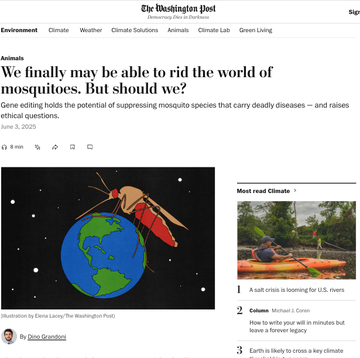
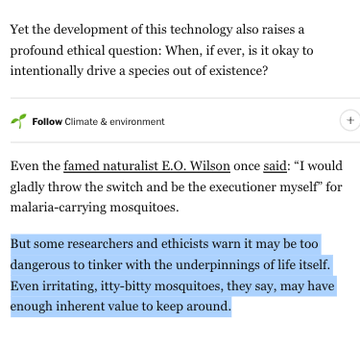
Appreciate this coverage of gene drives but some of the points here are wild... crazy to focus on the "inherent value" of 1 out of 3,500 species of mosquitoes when almost half a million children die each year from malaria. What about their inherent value?
https://x.com/albrgr/status/1841468025146667313…

From Twitter
Disclaimer: The content above is only the author's opinion which does not represent any position of Followin, and is not intended as, and shall not be understood or construed as, investment advice from Followin.
Like
Add to Favorites
Comments
Share
Relevant content