Article Author: Thejaswini M A
Article Translation: Block unicorn

Preface
Bitcoin has Saylor, Ethereum has Joe Lubin.
The co-founder of Ethereum has just convinced a casino marketing company to invest $425 million in programmable currency.
His recent moves include becoming the chairman of SharpLink Gaming and negotiating with sovereign wealth funds to build financial infrastructure on Ethereum. The U.S. Securities and Exchange Commission has just dropped the lawsuit against his company ConsenSys, clearing regulatory obstacles for larger plans.
Lubin's cryptocurrency journey began at Princeton Robotics Lab, Goldman Sachs trading floor, and Jamaican music studios. His approach is methodical: first build infrastructure, then drive application adoption.
Goldman Sachs Exit
Joe Lubin's cryptocurrency story begins with a financial disaster he witnessed firsthand, not an ideological belief.
September 11, 2001: Lubin, as the technology vice president of Goldman Sachs' private wealth management division, witnessed the World Trade Center attack. Seven years later, he observed the global financial crisis from within Wall Street.
His response was unusual. Instead of doubling down on traditional finance, Lubin went to Jamaica to make music.
This was not a mid-life crisis. The financial system exposed its vulnerability twice within a decade, and Lubin was present both times.
His path into Goldman Sachs followed a predictable pattern. He studied electrical engineering and computer science at Princeton University. For three years, he managed the Robotics and Expert Systems Laboratory, focusing on machine vision and autonomous vehicle research. He worked at Vision Applications for a while, developing autonomous mobile robots. He then entered the financial field through software consulting.
By the late 1990s, Lubin occupied the intersection that ambitious tech experts dream of—the combination of technology and massive funds. His Princeton roommate Michael Novogratz made a similar move in traditional finance.
Then, towers collapsed, markets crashed, and Lubin decided the predictable pattern was not worth it.
Disappointed with traditional finance, Lubin moved to Jamaica with his girlfriend and became a music producer.
However, the subsequent story reads more like a field investigation than a retirement.
Bitcoin Discovery
In 2009, while developing music software in Jamaica's dance hall music scene, Lubin accidentally discovered Bitcoin's white paper.
He later recalled, "When I encountered this technology, I experienced the 'Bitcoin moment' that many of us have: it has the potential to change everything."
Lubin's Bitcoin moment differed from typical cryptocurrency conversion stories. His excitement was about providing an engineering solution to systemic problems, not libertarian ideals or financial speculation.
The 2008 financial crisis demonstrated how centralized financial institutions could amplify risk across the entire economy. Bitcoin offered an alternative: a monetary system without intermediary institutions that had just proven themselves unreliable.
For the next four years, Lubin accumulated Bitcoin while most financial professionals scoffed at it. He wasn't building a community or preaching, but learning.
By January 2014, everything changed.
Encounter with Ethereum
"In November 2013, Vitalik Buterin wrote the first version of the Ethereum white paper. On January 1, 2014, I discussed the project with Vitalik and received a copy. That was my Ethereum moment. I was fully committed," he said.
Vitalik envisioned a programmable blockchain capable of more than just value transfer. Lubin, with his background in robotics and autonomous systems, understood its significance.
A few months later, Lubin positioned himself as Ethereum's business architect. Vitalik was responsible for the technical vision, while Lubin was responsible for transforming the white paper into an operational system.
This process was dramatic. On June 7, 2014, the Ethereum founding team gathered in Zug, Switzerland, planning to build Ethereum as a for-profit company. But internal political factors intervened. After private discussions, Vitalik announced the departure of Charles Hoskinson and Steven Chetrit, and Ethereum would become a non-profit foundation.
Lubin and others called it the "Red Wedding," referencing the betrayal scene from Game of Thrones. For Lubin, this was not a setback but an opportunity.
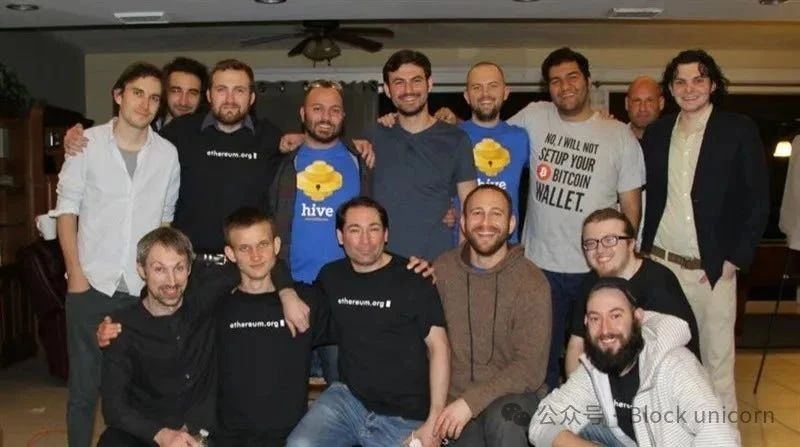
Early Ethereum core team members in the house they rented during the 2014 Miami Bitcoin Conference
The Ethereum Foundation would focus on protocol development. Others would need to build commercial infrastructure to make Ethereum usable for businesses and institutions.
Building Infrastructure Stack
ConsenSys was established in October 2014, launching simultaneously with the Ethereum mainnet. Lubin's approach was systematic: build all the infrastructure needed for Ethereum as a financial system foundation.
ConsenSys didn't bet on a single application but incubated projects covering the entire Ethereum stack:
Infrastructure: Infura provides API access to Ethereum nodes, on which most DeFi applications depend.
User Interface: MetaMask became the primary entry point for millions accessing Ethereum applications.
Developer Tools: Truffle Suite became the standard for Ethereum development.
Enterprise Solutions: Kaleido provides blockchain-as-a-service for enterprises to meet internal build requirements.
Lubin described the early stage as a "chaotic incubator" that spawned over 50 companies. Critics saw it as lacking focus, but Lubin called it ecosystem building.
This approach reflected his engineering background. In robotics, you need to build perception systems, processing systems, execution systems, and coordination protocols. Lubin applied similar systemic thinking to Ethereum.
Progressive Decentralization Theory
Lubin's philosophical framework of using centralized entities to build decentralized systems is called "progressive decentralization".
This concept addresses a practical problem: how to launch a decentralized network when decentralized coordination itself is difficult?
Lubin's strategy is to start centralized, build infrastructure, and then gradually transfer control to the community as the technology matures.
This strategy has had varying degrees of success in ConsenSys projects. Truffle Suite became an open-source project driven by the community. ConsenSys has spun off dozens of projects into independent entities, including Gnosis, reducing direct control over its ecosystem.
But the transformation is not complete. MetaMask is still primarily controlled by ConsenSys, and while Infura has discussed plans for decentralized node distribution, there is no specific timeline.
"There's nothing wrong with an entity with a fixed organizational approach trying to build an entity with a different organizational approach," he argues.
This philosophy allowed ConsenSys to build Ethereum infrastructure without getting bogged down in governance disputes or community politics. It also positioned Lubin as a coordinator of Ethereum's commercial ecosystem while maintaining distance from protocol governance.
Regulatory Victory
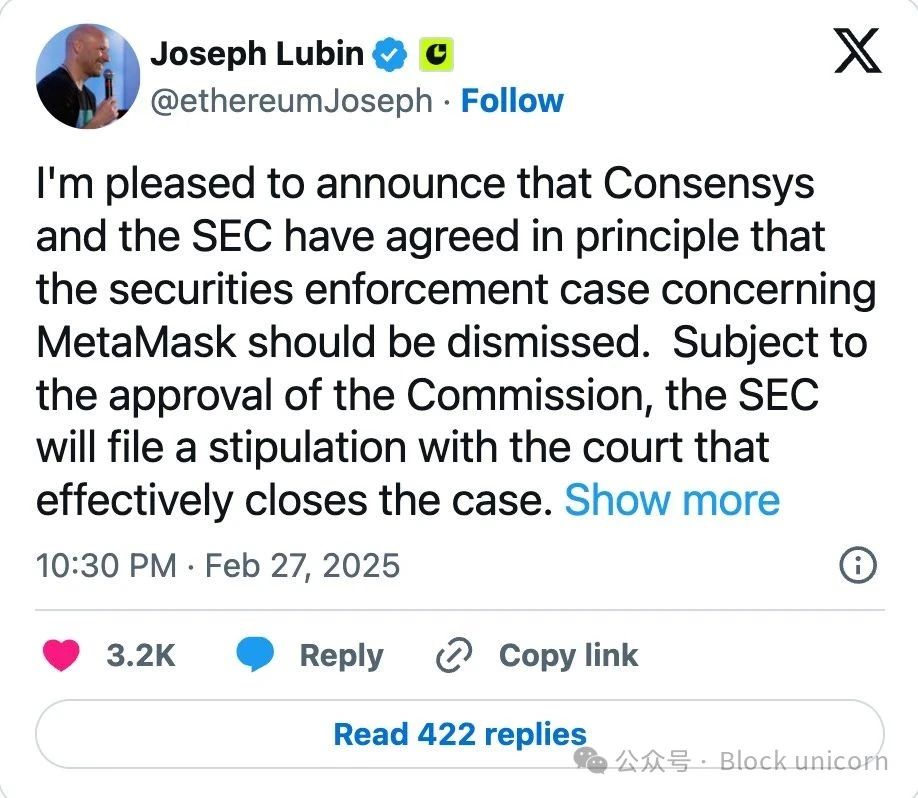
In February 2025, the U.S. Securities and Exchange Commission (SEC) agreed to withdraw its lawsuit against ConsenSys. The case accused ConsenSys of earning over $250 million in fees through MetaMask's staking and exchange services, violating securities laws.
ConsenSys filed a countersuit in April 2024, arguing that classifying ETH as a security would criminalize basic network usage activities.
The SEC withdrew the case under the "new direction" of the Trump administration, with no fines or additional conditions. Lubin stated: "Now we can focus 100% on building. 2025 will be the best year for Ethereum and ConsenSys."
SharpLink Transaction
In May 2025, online casino affiliate marketing company SharpLink Gaming announced a $425 million private placement to build an Ethereum treasury. Joe Lubin became the board chairman.
Comparisons to Michael Saylor immediately emerged.
Similar to Saylor's MicroStrategy, SharpLink uses a corporate treasury strategy to make large cryptocurrency bets. Like Saylor, Lubin positions himself as a public figure for institutional adoption.
SharpLink's stock surged over 400% after the announcement, with a cumulative increase of over 900% in the past month. The participant list includes notable crypto venture capital firms: ParaFi Capital, Electric Capital, Pantera Capital, Arrington Capital, Galaxy Digital, Republic Digital.
Lubin has applied for additional financing of $1 billion for SharpLink, with "almost all" to be used to purchase ETH. If successful, this would create one of the largest corporate cryptocurrency treasuries.
This model represents active utility rather than passive speculation.
Sovereign Wealth Fund Declaration
The SharpLink transaction may only be a prelude to a larger action.
In a recent podcast, Lubin stated that ConsenSys is negotiating with the sovereign wealth fund and major banks of "a very large country" to build infrastructure within the Ethereum ecosystem.
He refused to disclose the specific country. Reports suggest these discussions focus on building institutional infrastructure for the Ethereum ecosystem, including layer-one protocols and customized layer-two solutions.
If true, this would validate Lubin's decade-long bet on Ethereum infrastructure. It would also distinguish Ethereum from other cryptocurrencies: as a foundational layer for national financial systems.
This timing coincides with Central Bank Digital Currencies (CBDCs) moving from the experimental stage to implementation. Governments need programmable money infrastructure, and Ethereum has the most mature developer ecosystem and institutional tools.
Lubin believes this is a logical progression: "Ethereum has a unique advantage in anchoring the next phase of the global financial system."
Our Perspective
61-year-old Lubin leads a crypto empire built around tools to make Ethereum truly usable. ConsenSys's most important creation is MetaMask—a browser wallet that became the gateway for millions to access DeFi.
Without MetaMask, the Ethereum ecosystem might still be limited to the developer realm. The company has also incubated dozens of other projects, from Infura's critical node infrastructure to Truffle's development tools.
ConsenSys didn't hire traditional tech workers but assembled a unique team: entrepreneurs with engineering mindsets, protocol architects who understand business, and corporate experts who can translate blockchain concepts for Fortune 500 boards.
The SEC's victory eliminates regulatory uncertainty for ConsenSys's core products. The SharpLink treasury transaction provides a public market tool for Ethereum's institutional adoption. If sovereign fund discussions materialize, they could position Ethereum as national financial system infrastructure.
Lubin's vision extends beyond financial applications to completely transforming internet architecture—a decentralized World Wide Web (Web 3.0) where users own their data, applications resist censorship, and economic value flows directly between creators and consumers.
He explains: "Entrepreneurs and tech experts are flocking to build a decentralized World Wide Web, Web 3.0. Once you see blockchain's profound impact, you can't ignore it. Each hype cycle wave brings more and larger builder and user communities. For these people, there's no turning back."
His recent actions indicate this vision is moving from theory to practice.