Written by: TechFlow
In the Crypto AI track that releases an AI Meme in a few seconds, as the first AI-driven value discovery engine in the Crypto industry, TrueNorth is undoubtedly special.
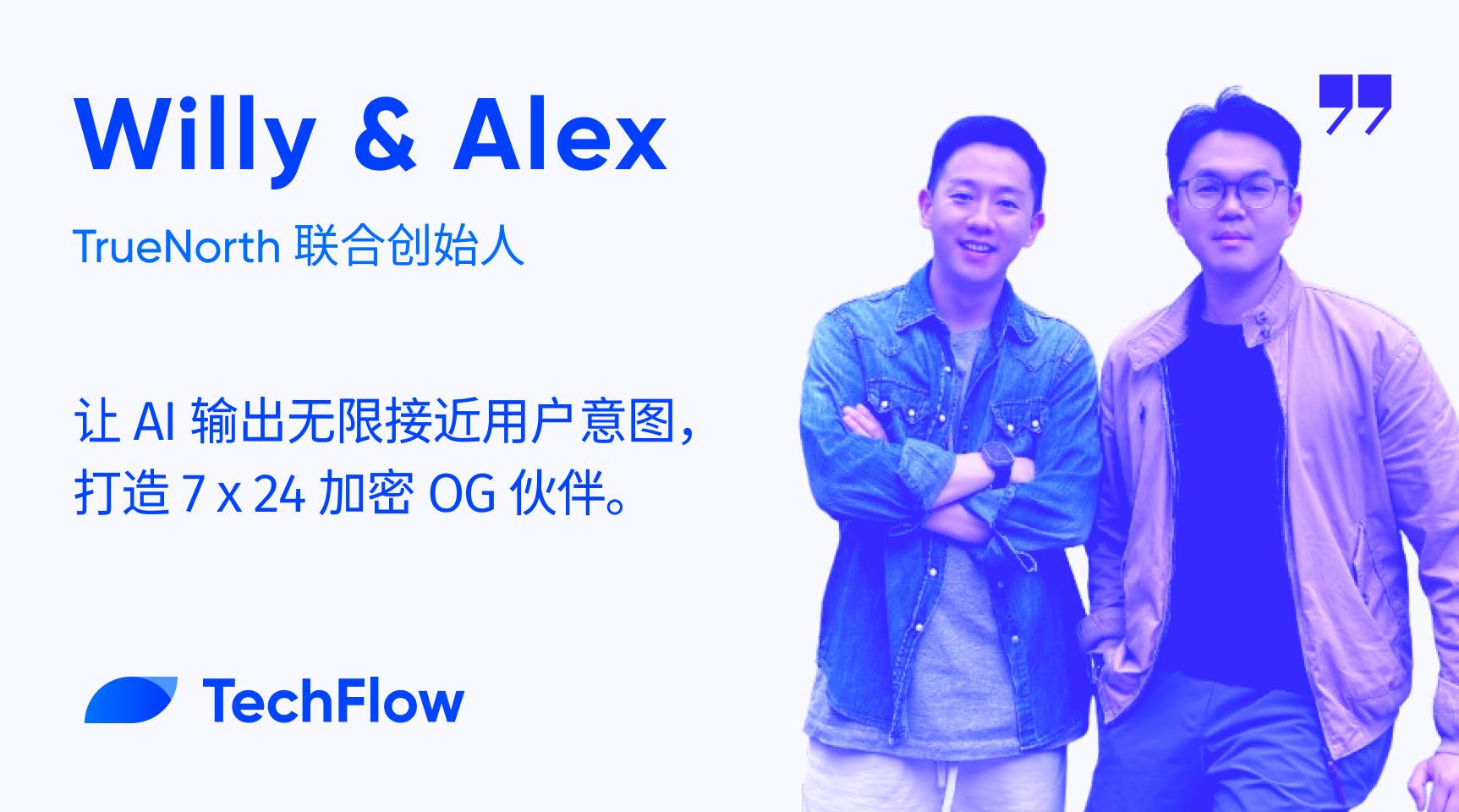
TechFlow advantage of the important opportunity of TrueNorth's internal testing, TechFlow had an in-depth conversation with Willy and Alex, two co-founders of TrueNorth.
"TrueNorth is at the forefront of generative UI /UX, and the front end can dynamically adjust the UI/UX in real time based on the user's investment preferences. At the same time, our Agent search can now achieve a delay of less than 10 seconds in the case of multiple data sources , and can even provide user-level feedback within a few seconds after optimization. Currently, there should be no Crypto Application that can do this," Alex introduced.
But at the same time, TrueNorth has grasped the core demands of Crypto users. Regarding the uniqueness of Crypto AI, the two founders believe:
On the one hand, in terms of the distance between user intention and the ultimate goal, Crypto is the farthest, but AI can significantly shorten this distance; on the other hand, Crypto is very close to money, and user demands are also very direct, to make more money or lose less money. In short, the problems solved by Crypto AI are more focused and more capable of implementation.
Through this in-depth analysis from the dual perspectives of Web2 and Web3, Willy shared how to quickly help users build awareness of TrueNorth:
Crypto is an adventurous journey, and TrueNorth hopes to lead everyone through the industry noise like a compass to find the best outcome.
In this issue, let us follow the perspective of Willy and Alex and explore TrueNorth’s unique positioning, core technological advantages, and future product iteration path in the current fierce competition in Crypto AI.
AI can solve the most painful points of Crypto
TechFlow: I am very happy to have the opportunity to have an in-depth exchange with you. First of all, please introduce yourselves.
Willy:
Hello everyone, I am Willy, co-founder of TrueNorth.
From mid-2022 to the end of 2024, I worked at WOO, a centralized exchange that also has a decentralized trading platform called WOOFi. I started as COO and later became Acting CEO. During my tenure, I led the company's expansion in Europe, Southeast Asia, and South Korea, and the business scale has grown exponentially. I am mainly responsible for the company's overall strategy, including business development, legal compliance, and more importantly, the construction of the WOO ecosystem. I am responsible for following up on the establishment of the WOO ecosystem, DeFi business development, cross-chain integration business (including 14 chains such as EVM chain and Solana) and WOO Token Listing. This is my first journey in the world of Crypto.
Before joining Crypto, I was a Web2 founder. From 2015 to 2021, when Internet SaaS was at its hottest, I started a SaaS company focusing on CRM URP business. At that time, the company had nearly 200 employees. We raised funds from the Angel Round to the B Round, and the largest investors included Shunwei Capital, co-founded by Lei Jun. In 2021, I chose to exit and began to explore Crypto.
Alex:
Hello everyone, I am Alex, co-founder of TrueNorth.
I have an AI background and I studied for my PhD at the University of Michigan, Ann Arbor, focusing on AI eigendomain specific computer. Previously, I worked as a researcher at Intel Labs, focusing on research related to Machine Learning acceleration.
In the second year of my doctorate, I started my first business and joined AI chip company Tianshu Zhixin, where I was mainly responsible for technical aspects related to software and hardware systems and led R&D in North America.
After graduating with a Ph.D., I returned to Shanghai and joined McKinsey around 2020. My main service objects include semiconductors, cloud service providers, AI unmanned retail, games, etc. I have been exposed to a wide range of industries. I am mainly responsible for the product's Go to Market strategy and the implementation of some new business models.
Later, I went to Singapore's sovereign fund Temasek, where I was mainly responsible for technology investment in Greater China and the Asia-Pacific region, covering areas including AI, semiconductors, and Crypto, mainly direct investment in the primary market, secondary market, and some Founder Funds.
After working at Temasek for two years, I joined a portfolio company, Suiyuan Technology, which is currently the largest AI chip company in China, with a post-investment valuation of about 20 billion. I am responsible for the entire product, strategy and capital market-related business. The products mainly include the fourth-generation GPU, and we have also built the largest data center in western China. Capital Market is mainly to help the company go public. Last year, we were doing listing-related work, and we hope to complete the listing on the Science and Technology Innovation Board this year.
Willy and I met during my time at Temasek. Since I have always been in the AI field, after the Agentic AI wave emerged, I saw the potential of the combination of Crypto and AI, and Willy and I hit it off.
TechFlow: Both of you have extensive experience in Web2, and you have both firmly chosen the Crypto + AI track. So could you please share with us what you think is the most attractive feature of this track?
Willy:
When I first entered Crypto from Web2, my biggest feeling was: Web2 flattened information, and Web3 should flatten money . The meaning of "flattening" is that everyone can more easily obtain the benefits that technology brings to users and society. Based on this foundation, I began to think that if Crypto and AI are combined, many different things can be done.
Balaji Srinivasan, former chief technology officer of Coinbase, once wrote a book called "The Network State", which gave me a lot of inspiration and enlightenment: from a macro perspective, for example, the game between China and the United States will accelerate the formation of cultural circles. This cultural circle does not exist in the form of a country, but is based on the Network. Everyone's digital identity, assets, etc. exist in a decentralized form.
I was excited about this idea, so I entered Crypto. But over the past three years, I think Crypto has made slow progress in adoption. There are many reasons for this, such as user experience and compliance. Although some technologies, such as chain abstraction and AA wallet, have developed well during this period, users still do not have a good entry point to enter Web3 and enjoy the advantages of Crypto. It was not until the beginning of last year that I talked with Alex and saw the important role that AI can play in this regard. I thought this was a big opportunity, so TrueNorth was born.
Alex:
One point I want to add is that when I was working in Web2, I saw a lot of SaaS companies and many ToB-related businesses were focused on AI. I discovered this wave of AI very early on, especially the rise of Agentic AI. Agents will significantly change the user's interaction interface or habits.
There are actually several phenomena in Web2, including the group of people who used to do SaaS in Web2. They all hope to provide a very standardized product so that the product can be rolled out and, after being rolled out, costs can be reduced and efficiency increased. However, standardized products cannot adapt well to diverse needs, especially in some complex scenarios, because complex scenarios often require high customization.
Until the emergence of Agent, it can greatly shorten the distance between human intention and ultimate goal realization, and improve the user experience. This shortening of distance has actually already occurred in Web2. For example, in very vertical fields such as law and medicine, the change in the interactive relationship between users and AI has already occurred. I discovered this change as early as a year before Agent entered the mainstream vision. I think this change is no less than the Mobile Revolution, that is, the new UX/UI impact created by the first version of the iPhone smart multi-touch screen.
Agent is such a paradigm shift. The imagination that OpenAI brings to users may be that you chat with the agent by typing, but many agents now pursue the goal that the agent can actively output to the user based on the user's preferences and tell the user what to pay attention to. This was a very important new assumption when we were imagining the agent revolution.
As for why it is Web3, it is because we believe that among all user journeys, Crypto is the farthest in terms of the distance between user intent and the ultimate goal achievement. Simply put, it has the greatest friction. To give a very intuitive example, in Crypto, it is the decentralized Infra that defines the user experience, rather than the user experience defining the Infra in reverse.
Based on this, we believe that Agentic Technology can solve the most painful points of Crypto and better help users to obtain Alpha, financial opportunities, etc. As Willy said, the combination of AI and Crypto can make information and opportunities "flatter" to a greater extent, better serve personalized needs, and smooth the entry threshold of DeFi. We hope to combine AI with Crypto to better solve the pain points of the Crypto community or enhance the experience of more users entering Crypto in the future.
Crypto AI is closer to money and more capable of implementation
TechFlow: Crypto + AI is a hot topic, but many Web2 AIs still have some doubts about the development of Web3 AI. What do you think of these views, whether from the perspective of AI DEV capabilities or products? What do you think is the core value of Web3 AI?
Alex:
Let me answer the first question first: Why is Crypto AI different?
In my opinion, Crypto is an industry that is very close to money, because all transactions in Crypto take place on a transparent, public and decentralized ledger, which means that, to some extent, as long as you dig deep enough, all the secrets can be exposed to the sun. I think this is the biggest difference between Crypto and traditional finance, but in the past, there were not many people involved in Crypto, so not much information was dug up and exposed to the sun.
Based on this point of view, as more and more people enter Crypto, more and more people begin to analyze this data. You will find that since a large amount of on-chain data is a public fact, how can we do more real-time and transparent processing based on this data, and then present this information in a universal way to help more people more easily establish a clearer understanding of Crypto?
On the other hand, precisely because Crypto is so close to money, from the perspective of AI, user intentions are more direct, and there are fewer forks in the process of helping users achieve their ultimate goals.
For example, when you go to a search engine to ask a question, your thinking is very divergent. You may ask about the weather, food, etc. There are many different paths between this question and the closed loop of your intention. But in Crypto, users' questions are very simple and plain. In summary, they are: How do I make money? How do I make more money? Or how do I lose less money? Between the user's starting intention and the end point of realization, Crypto's closed loop path is clearer, and AI can make information equalization based on existing data, helping users to better manage assets, or to put it bluntly, helping to discover more wealth opportunities. I think this is the special feature of Crypto AI. Compared with Web2 AI, Crypto AI solves more focused problems, and based on the on-chain data, as long as it can better aggregate information and better adapt to personalized needs, Crypto AI has more landing capabilities.
After sharing the uniqueness of Crypto AI, the second question is: Why do people think that Crypto AI has not been fully implemented?
If you observe carefully, you will find that the grand narrative of Web2 AI is about how to make breakthroughs in general capabilities. For example, OpenAI can do everything. It can help you with financial analysis and watch the progress of F1 racing. It aims to continuously improve general capabilities to further promote implementation. This vision is very high and the difficulty is also very high, so the real core talents are moving in this direction to some extent.
However, many Web3 agents are committed to solving some practical problems, including UI/UX, user personalization, excessive information dispersion, etc. As I just said, Crypto AI aims to solve more focused problems, but in the process of solving problems, Crypto AI has two stages.
First of all, Crypto AI can be verified or falsified very quickly, because the most direct point of combining Agent and AI is facing Consumer, and users can easily feel whether the product is good or not. Crypto was actually very difficult to falsify in the past . For example, if you build a chain for three to five years, the narrative will change with the cycle, and everyone needs to spend a long time to really see the project clearly, but the pace of Crypto AI is very fast. The first wave of AI is basically all Meme, which is indeed relatively low in terms of technology stack, and its true value is actually unclear. For example, GOAT, everyone thought it was fun when it was first born, but no one really cared about what GOAT was saying. In short, in such a cycle that is easy to be falsified, Crypto AI that faces users directly will indeed suffer a stronger impact.
But problems are accompanied by opportunities. Now that everyone realizes that Crypto AI is more than just a meme, how can we do better on this basis? In other words, how can Crypto AI more accurately solve the problems encountered by users? For example, in some high-frequency and rigid demand scenarios, AI can help users understand why the price rises or falls, what to pay attention to, what to do, etc. I think there are many real problems waiting to be solved, which is also the problem we want to solve through TrueNorth.
TechFlow: Based on your answer, if there is an opportunity to attract more Web2 AI developers to enter Web3, what do you think this opportunity is?
Alex:
From a visionary perspective, our product at Build is exactly this opportunity.
What TrueNorth does is very simple. When you wake up every morning, you will check your wallet to understand whether you have made any money. TrueNorth aims to help you achieve better asset allocation, whether to buy or sell, why the price goes up or down. We are committed to opening up the entire path and making this path very smooth, so that AI can provide personalized services to each user.
Currently, the penetration rate of Crypto is only 5%, but some CeFi users are willing to use similar AI products to manage their assets, thereby capturing wealth opportunities in Crypto or DeFi. So will the product we are making today be the first product used by the next 5% of users when they enter Crypto?
I think this is a goal we really want to achieve, that is, every user who enters Crypto will have asset management needs and must know what opportunities they should discover and capture in this industry. However, with so much information explosion and noise, they need a product that can help them deal with these problems smoothly, so as to guide more people into this industry. I think TrueNorth will be one of the important opportunities you mentioned in the question to attract more Web2 developers to enter Web3.
Simply put: when people first come into contact with Crypto, they think of TrueNorth, and TrueNorth is the product they need to enter the crypto world.
TechFlow: Indeed, many friends are exposed to Crypto for the first time, and even some simple and basic terms can cause them trouble. For example, a friend recently wanted to use USDT to purchase a membership on the external network, but he didn’t even know how to buy USDT or how to transfer money, nor did he know what TRC addresses, EVM addresses, etc. There are many basic problems that need to be solved. Just like Alex shared just now, if it is for very novice users and wants to bridge the Gap between Web2 and Web3, it is indeed necessary to work hard on content or product design, which is also a huge market space.
Willy:
I completely agree with you. I have many friends like this around me. Recently, we were doing some user interviews and learned about many problems with entry friction.
Regarding how to attract more talents to build Crypto, I think it is much harder to do Crypto now than before, especially since some copycats are basically hard to come back, so I think Crypto projects now need to have a very strong ability to discover real needs, which has a lot in common with some Silicon Valley methodologies of Web2, that is, you need to find a very specific pain point and then solve the problem through applications. If you can make this clear, on the one hand, you can influence users because you have found their actual needs, and on the other hand, you can also attract excellent talents to join and solve practical problems together.
After finding the pain points, entrepreneurship is often still a competition of cognition, including the technical implementation of the project, implementation path and strategic thinking, which is also an important factor in attracting talents to join.
The third point is the execution capability. A few days ago, I posted a Twitter to share a picture. Alex just said that many things are difficult to disprove in Crypto, but from the perspective of Application, we need to use some basic dimensions to clearly measure the performance of the product. This is reflected in the execution capability in terms of timely product delivery, etc.
TrueNorth: Your 24/7 Crypto OG Partner
TechFlow : Just now we talked about some product visions: when people first come into contact with Crypto, they think of TrueNorth. Project names often reflect the important vision of the project. Does "TrueNorth" as a project name have a deeper interpretation?
Willy:
TrueNorth was actually proposed by Alex, because we feel that for most users, they are like adventurers embarking on a Crypto journey. Crypto is actually quite dangerous. Not only is it easy to lose money, but it also contains a large amount of information, many traps, and is very complex. So we believe that this adventure needs a guiding force. "TrueNorth" is like the compass when humans first explored the Arctic, just like the aurora borealis, lighting a lamp for adventure explorers on the cold land, pointing out a way, and making the adventure journey less lonely.
In addition, there is a lot of noise in the industry now, and the "True" in our project name is also hoped to lead everyone through the fog to find the truth and help everyone reach the destination.
TechFlow : When facing users who are exposed to TrueNorth for the first time, how will you describe the product in the most concise language to help users quickly understand TrueNorth's unique positioning in the Crypto market?
Willy:
Simply put, TrueNorth is the first AI -driven value discovery engine in the Crypto industry, which means that TrueNorth can integrate diverse data to help users grasp market trends in a timely manner and improve investment decisions and efficiency.
In addition, TrueNorth also has significant advantages in personalized experience. TrueNorth can provide some customized investment information and suggestions based on the user's encryption knowledge level preferences, and optimize the user's asset management level through intelligent portfolio management, that is, our AI Portfolio, which continuously monitors the market around user assets and outputs some signals based on user habits, preferences and future needs. These signals can assist users in making some investment decisions and provide effective risk management, making the entire transaction process simple and efficient.
Alex:
I hope TrueNorth is the first app that Crypto users open every day. We have just talked a lot. Crypto users need to manage wallets, accounts and understand the pulse of the market. In summary, what happened? Why did it happen? What actions should I take?
These three issues are put together. Theoretically, it can be launched to N platforms. We hope that the launch of these N platforms can be based on the needs of users themselves, and then aggregate the information to a place that users trust to help users find the truth behind the data. In a word, it can be summed up as: your trusted partner will lead you to find the direction in the chaotic encryption industry.
Going further, TrueNorth has many functions. If we describe it in an anthropomorphic way, it is like your 7 x 24 hours crypto OG partner. You can go to it for any questions you have in Crypto, and when you wake up every day, you will first use it to understand the trends of the crypto market.
TechFlow : The next interesting question is that sometimes AI also lies. AI hallucinations and other issues have also been criticized. TrueNorth itself also outputs a lot of information to users. How can users believe that TrueNorth's output is trustworthy? Or how do you guarantee the authenticity of the information?
Alex:
This is a good question. On the one hand, TrueNorth has enough data sources that are real-time enough. Our data sources include on-chain and off-chain data: on-chain data includes real-time data from various chains such as Solana and EVM, and real-time data from various chains above; off-chain data includes shill in the TG group, some collusion in the Alpha group, and even some conspiracy groups, conspiracy groups, and some emotions on Crypto Twitter.
We aggregate a large amount of data more accurately, and the underlying agent also uses reinforcement learning to further learn how to refine this data based on real-time market changes. Based on sufficient and real-time data sources, the logic of AI cross-validation forms a closed loop, using the power of a large model to integrate these things and obtain a truth that is closer to the truth.
For example, today you may find that many people are shill on Twitter, or offering enough rewards to push a project into the spotlight of more people, but is this project really a good project? Sometimes it is not like this. Measuring the quality of a project requires more data, such as Market Cap, on-chain liquidity, and future plans of the project. Therefore, TrueNorth is actually a multi-dimensional due diligence, on which the most diverse data is presented to users in the most realistic way, without distorting the output results through other incentive mechanisms.
I think this is one of the very different things about TrueNorth. It provides the most authentic feedback based on market data, which is completely different from many marketing methods that shill orders. I believe this will also bring users a very different experience.
"Thousands of faces" front-end experience, ultra-low latency back-end efficiency
TechFlow : Alex has just shared some technical logic or thinking, so I would like to ask you two to share which technologies are leading in TrueNorth, and which problems have deeply troubled the team when solving related technical problems? Can you please share some interesting stories behind the technology research and development?
Alex:
Our technology base consists of three modules:
Generative UI /UX: TrueNorth uses a dynamic, hyper-personalized interface that proactively adapts based on each investor’s interactions and changing market conditions.
Agentic Flow: Our unique, scalable, intelligent architecture seamlessly integrates discovery and execution through advanced multi-agent collaboration. TrueNorth can infer intent based on historical user behavior and preferences, orchestrating complex investment workflows to reduce cognitive burden and simplify operations.
RL Bootstrap : TrueNorth uses advanced reinforcement learning techniques, including self-play, multi-agent reinforcement learning, and reinforcement learning based on human feedback, to continuously optimize the performance of the agent.
I think generative UI/UX is a very cutting-edge concept. Although many people are beginning to pay attention to it, our application has a core goal, which is to achieve true personalization.
When Willy and I first discussed this, someone mentioned that customization was also attempted in the Web2 era, but the results were not always ideal. However, we believe that Agent can solve the problem that customization for different people was difficult to achieve in the past.
In Web3, generative UI/UX is the key path to solving problems. During the user's Crypto exploration process, whether he is concerned about technical indicators, TLDR summaries, personalized signals, or even a function called "look through someone's sight", which is based on the perspective of a certain KOL or KOL , how can we visualize the things that these users care about? This is what generative UI/UX does, using AI to generate visual content in real time on the front end, including data modules and charts, similar to the widgets in the Apple Health app, completely based on user preferences.
For example, Willy is a long-term investor, and I am a meme investor. We focus on different things, and the products we see on the front end are also different. TrueNorth will dynamically adjust the UI/UX based on the user's investment preferences, which was completely impossible before because the traditional approach is templated. Our breakthrough in generative UI/UX is an important innovation and one of the core highlights of our product.
In the process of overcoming this technical difficulty, the biggest problem is how to better customize it. The advantage of Web3 is that through the wallet connection, the user's transaction records, purchase behavior, etc. can be seen, which provides a good foundation for personalized cold start. Based on this, we have achieved amazing results in the product prototype.
The second story is about Agentic Flow. This concept sounds simple, and everyone will say that it is the second mainstream Framework like langchain, but this thing is easy to make a toy, but it is very difficult to really make it a production-level application.
For example, our Agent search can now achieve a delay of less than 10 seconds in the case of multiple data sources, and can even provide user-level feedback within a few seconds after optimization. Currently, no Crypto Application can do this.
For example, if we want to support hundreds of thousands or even millions of DAU in the future, if we use the existing open source framework, even the best Web2 Framework, it will not be able to meet such technical indicators.
The core challenge we face, in addition to achieving ultra-low latency, is to design an efficient Agent organizational structure. There is an Agent behind each generative UI on the front end. How can it quickly find answers and present them in a personalized way based on user preferences? This involves a series of complex technical problems. The core members of our team were responsible for the production-level architecture of the largest e-commerce and media platform in Southeast Asia, so we made full plans for production-level scalability from the beginning. To achieve a response in seconds, you must build your own infrastructure and technical system from scratch. This is also a problem that many teams (whether Web 2 or Web 3) have not yet paid attention to in AI development, and we have already laid out in advance and completed these technical breakthroughs.
TechFlow: What kind of feedback has TrueNorth received so far in internal testing? Good or bad, can you share some of your observations? Will TrueNorth bring any new features or updates to users?
Willy:
During this process, we found that there are still big differences between different users. For example, old Crypto players and new Crypto players have completely different understandings of the same event and the same data, and they also have completely different expectations of the effects that the product can present. Different users also have different needs for the entire User Journey. Novice users may not have so many assets and are more concerned about exploration and discovery, while professional users expect rapid iterations to keep up with the market. We found some conclusions in the survey, but there are also uncertain parts. We hope to better meet these different needs through generative UI/UX.
Another challenge is the user's trust in AI. Our products not only provide data, but also draw conclusions or summaries by analyzing these data, but it is difficult to make users trust AI's judgment. We believe that we can gradually build users' trust in these results or insights by providing personalized services through generative UI/UX and combining external information endorsement.
Alex:
Regarding future product planning, we have several key directions:
The first direction is continuous personalization . We hope that the product can provide each user with a unique user experience, serve different user journeys, and help them form their own exclusive development path. Therefore, personalization is one of the core functions.
The second direction is the expansion of asset categories and dimensions , from a single token to the aggregation of multiple events. We will start from two directions. The first is Topics, which makes assets and events have time and periodicity, such as the Sino-US game. The other is the expansion of product categories, whether it is mainstream or small market value, and then to many on-chain products, such as RWA, to provide users with more choices and discoveries through more refined granularity.
In addition, I think one of our biggest characteristics is that we pursue a deep understanding of user intentions and proactively recommend. For example, the question that users often ask is "Should I buy BTC now?" In many cases, the Agent answers that it is not appropriate to buy, and the topic ends. But in fact, what users really want to know is "When is the right time to buy BTC?" This is also a very important function of TrueNorth. It will deeply understand the intention behind the question, and for every question asked by the user, the Agent will give you an answer at the appropriate time in the future, so that there is a response for everything.
These features are important initiatives designed around user needs, and we will continue to optimize and implement them in these areas.
Crypto AI Trend: Make the output as close to the user's intention as possible
TechFlow: The Crypto AI market continues to recover. After experiencing the craze of AI Meme, what do you think will be the next hot spot leading the Crypto AI market?
Willy:
I think there are two.
The first category would be products like TrueNorth. TrueNorth actually did not demonstrate the capabilities of AI through the so-called Chat Bot. In the early days, some AI products let users give their money to it, and then it helped users manage their assets. I think this method is too direct, and I think the current infrastructure is not mature enough. Products like TrueNorth do not overemphasize the capabilities of AI, but they do demonstrate the capabilities of AI very well, especially in the user journey. TrueNorth can make users feel that AI can go down and be very close to users.
The second is how to define Agent or Agency, which is a problem that both Web2 and Web3 will face. I believe that Agent must have autonomous automation and multi-step collaboration capabilities to complete complex user needs. However, this field still needs time to grow. Only when the technology and ecology mature can the so-called Agentic Economy be truly realized, which is also the ultimate goal of TrueNorth.
Alex:
Our judgment of the market is reflected in TrueNorth's goals, which can be summarized in one sentence:
Bring user's intent infinitely close to the output .
This is an evolving process: starting from the user's intention, Google provides Link, GPT provides Answer, and Agent can push this boundary further, extending it to Outcome, or even Best Outcome. This means that we have expanded the capabilities of Discovery to Execution. In the process of building all this, we will inevitably go through a process of establishing new people, but our vision will not change. In the future, people will play less and less roles in the entire delivery subject, and the ability of Agent to Agent to collaborate efficiently to obtain the best results will become more and more important. I think this is an inevitable trend.
In this process, the current challenge is how to make users trust the Agent, trust that the content it discovers is true, and hand over these real things to their AI in the future, and trust that the Agent can implement this so-called outcome in a concrete way.
This is a gradual process, but AI technology is developing very fast. The divergence between the intention of Crypto users and the final outcome is not so high. Most people just want to achieve wealth effects or better manage their assets. So from this perspective, the closed loop of the entire development of Crypto AI will be very fast.
This is why, during the entire preparation process, we have actually included the development of the so-called Agentic Economy in the entire product stack. We believe that in the future there will be other people who will also provide very good capabilities, but can they work with us to provide better services to users in this Distribution Layer? I think that as such a core platform, we can promote a complete closed loop from user intent to results, which is also what we think is the future direction.
TechFlow : Last question, macroeconomic factors such as crypto policies, regulatory bills, and tariffs are driving closer connections between traditional finance and crypto finance. We are about to usher in a more prosperous on-chain financial ecosystem and will also face more explosive on-chain information. Do you think this will be an important driving force for TrueNorth's better development?
Willy:
I think it’s definitely a very good thing.
When I was at WOO, I did a lot of work on License Strategy. Comparing the situation two years ago with now, it can be said that the current regulatory environment for Crypto is relatively relaxed, especially in the United States. The Trump family is also doing a lot here, and they must have first-hand information on regulatory issues, so we can do some continuous observation on them.
In general, the current regulatory environment for Crypto is relatively loose, and many regulatory agencies (such as SEC, CFTC, DOJ) have weak enforcement of related cases. After the implementation of MiCA in Europe, no obvious enforcement actions have been seen. This loose regulatory environment is very beneficial to the development of Crypto in the next three to four years.
However, loose regulation may attract some malicious actors to take advantage of regulatory gaps to engage in bad activities. But I think the loosening of regulation is only temporary, and it may be tightened in the future due to problems exposed. Therefore, although the current environment is favorable, we still need to be cautious and not be too aggressive and do something exaggerated.