Tech giant Apple concluded its Global Developers Conference (WWDC 2025) this week, with generative AI being the market's focus. However, Apple only offered interface optimization and device-side enhancements, lacking the "groundbreaking" AI features anticipated by the industry. Bloomberg terminal data shows Apple (AAPL) closed at $196.45 on Friday, down 3.9% over the past five days.
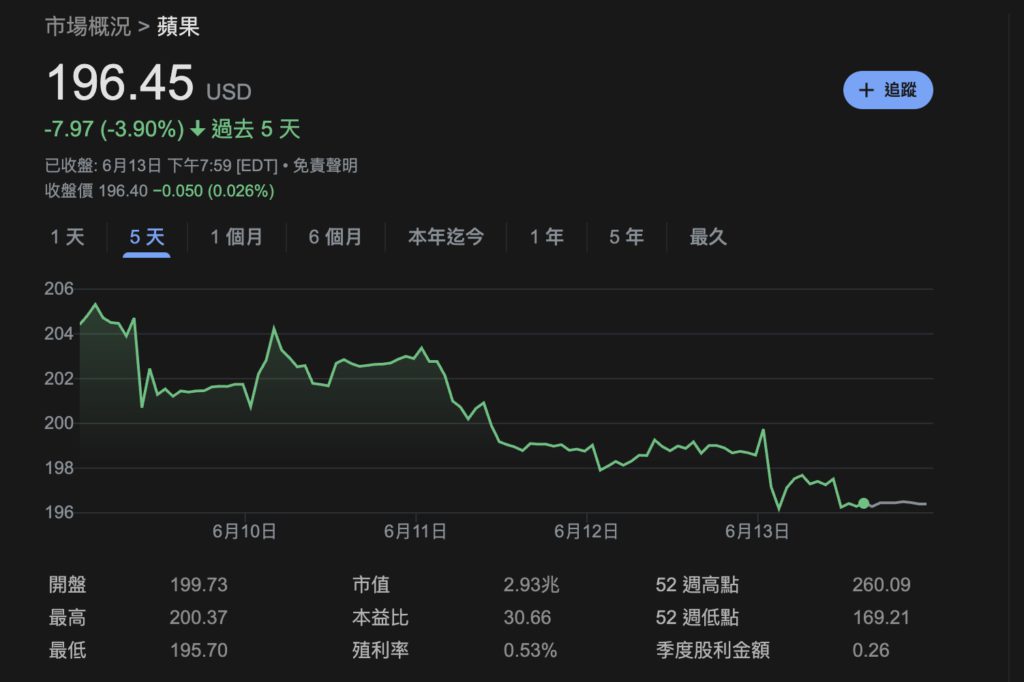
Market Responds Coldly to 'Lukewarm' AI Features
At this WWDC, Apple introduced Liquid Glass UI, enhanced Live Translations, Workout Buddy, and other features, unifying all operating systems under the new name "homeOS".
While these improvements enhance user experience, they do not address large language models or enterprise-level AI services. Apple's Senior Vice President of Software Engineering, Craig Federighi, even admitted that Siri's AI features will not be released in the short term, in stark contrast to Google and Microsoft's accelerated cloud AI package releases.
Privacy First Becoming a Weakness?
Apple collectively refers to generative AI as Apple Intelligence, with a core approach of "computing everything on iPhone" first. When computational power is insufficient, it is then processed by Private Cloud Compute. The company emphasizes that this approach can avoid large-scale user data collection, meet increasingly strict privacy regulations, and maintain its hardware and software integration advantages: automatic playlists on Apple Music, real-time summaries in Notes, and Genmoji image generation all follow this approach.
However, the delayed launch of the new Apple Intelligence has raised market doubts about whether Apple is missing its first-mover advantage. Analysts, including Goldman Sachs, warn that if AI development lags behind competitors, hardware replacement cycles may slow down, and service revenue growth could be limited.
Regarding market commentary, two senior Apple executives, Marketing Senior Vice President Greg Joswiak and Software Engineering Senior Vice President Craig Federighi, recently told The Wall Street Journal that Apple Intelligence is not an app or a chatbot, but an "enabling technology" deeply integrated into the system to enhance user experience.
Joswiak emphasized that Apple wants users to naturally use AI in their daily lives, even "imperceptibly". He also pushed back against external criticism of Apple's AI, subtly suggesting some comments are baseless. Unlike other tech companies, Apple does not plan to launch a standalone AI app, but instead chooses to integrate with ChatGPT, allowing AI to truly blend into users' daily lives.
Apple is betting on the long-tail advantages of ecosystem integration, aiming to maintain product quality and brand trust. However, if this takes too long, it's hard to say that its long-cultivated hardware advantages won't face challenges.
Follow-up Observation: Feature Implementation and Potential Acquisitions
Future observation points include: when will the new Siri officially launch, will Apple Intelligence open to third-party large models, and will there be more aggressive AI acquisitions? If Apple can accelerate feature implementation while ensuring privacy and create new hardware demand, market concerns about its AI competition pace may ease. Otherwise, its cautious strategy could continue to widen the gap with other competitors, creating medium to long-term pressure.