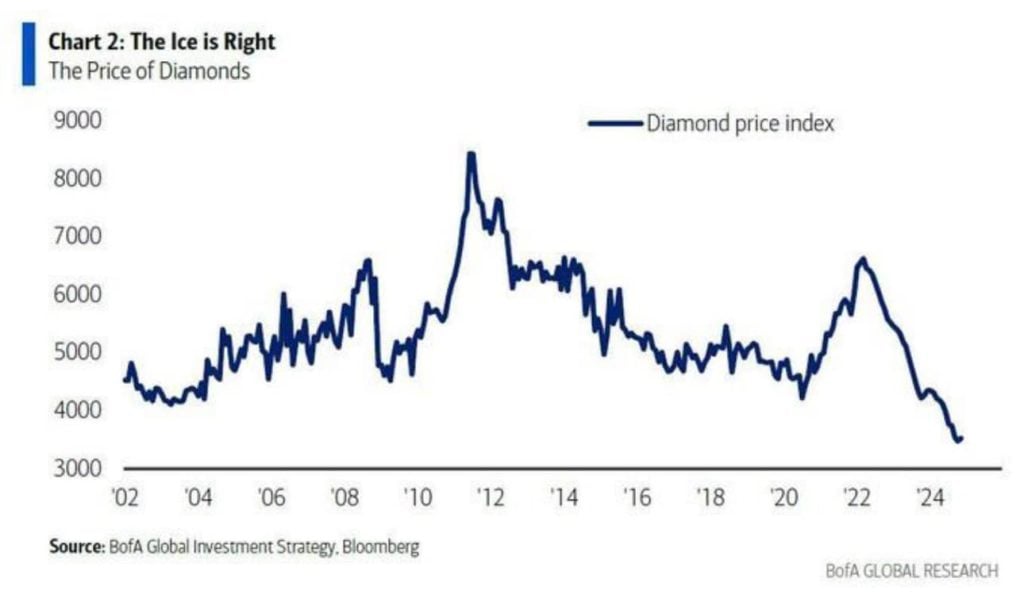
The rare and romantic image of natural diamonds has long been popular, but in recent years, market prices have been declining due to various factors. RapNet Diamond Index data in June shows: the average price of 1-carat diamonds has dropped by 6%, falling 15% this year and reaching its lowest point since 2000.
Market professionals frankly state that this is not just a short-term inventory adjustment, but a structural industry change. ShopGlobalCoin statistics show that the compound annual growth rate of top 1-carat diamonds from 1960 to 2016 was only 2.6%, far below gold's performance during the same period.
Structural Challenges Facing the Industry
Many factors affect the diamond price decline, but can be quickly summarized as follows:
Worsening Supply-Demand Imbalance
Despite manufacturers reducing production, sales are declining even faster, leading to an oversupply situation.
Impact of Synthetic Diamonds
Synthetic diamonds continue to capture market share from natural diamonds. Laboratory-grown diamond prices are only 30-50% of equivalent natural stones. RNZ quotes jewelry retailers saying "engagement ring customers are increasingly inclined to choose synthetic styles". Rapaport once predicted that synthetic diamonds would dominate the US engagement ring market in 2024, accounting for over 50% of engagement ring purchases.
Strong Gold Market Performance
In contrast to the diamond market, gold prices have performed strongly in 2025. Geopolitical risks and a weakening US dollar have driven up related demand.
Industry Reframing the Narrative, Short-Term Focus on Supply Contraction
Facing price bottoming, traditional brands are enhancing emotional marketing, emphasizing the concept of natural diamonds as "billion-year earth crystals", attempting to differentiate from synthetic stones with a sustainability image. Exchange4media notes that major jewelers are introducing traceable origin certificates to add narrative depth.
However, short-term price stabilization still depends on producer production cuts. Goldman Sachs' latest report estimates that only by reducing global rough diamond supply by another 20% can prices potentially stop falling. Currently, all major producing countries have announced production reduction plans. Whether they can reignite demand will determine if they can regain their former glory.