Author: Manman
Contemporary consumption is departing from its original logic.
From Maotai on the national banquet table, to the ape avatars on the Ethereum chain (BAYC), to the trendy toy Labubu on young people's desks, these seemingly unrelated goods are telling the same story in their own ways: We no longer pay for "functionality", but for a certain desire to be seen.
In this consumption structure, the use value of goods has exited the stage, while emotions, identity, recognition, and speculation take over, forming a new era map of "consumption as symbolism".
01 Micro: Consumption Constructs "Personal Image", Not Satisfying Needs
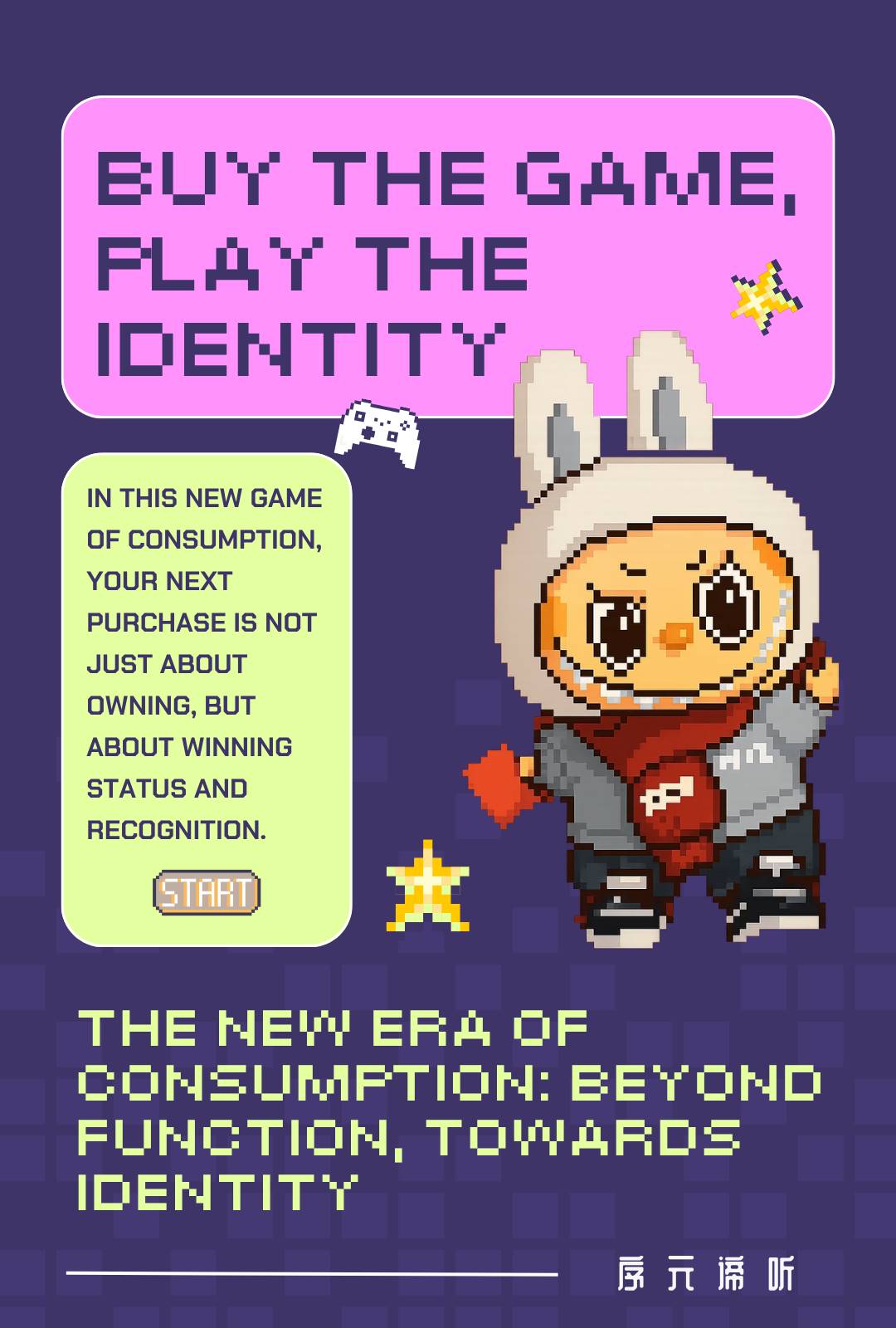
Labubu's popularity is less about successful design and more about precisely hitting urban youth's self-label of "cute with a touch of rebellion". It's not a toy, but a "projection prop" of self-presentation.
BAYC is even more direct - users are not buying an image, but making a public declaration of "I belong to Web3", a ticket to enter a specific circle, a startup key for a virtual identity.
As for Maotai, its social role has long transcended being an alcoholic beverage. You don't need to drink it, but it can "speak" for you at a dinner: a familiar institutional language, a symbolic identity that requires no explanation.
At this level, consumption no longer solves physical "needs", but serves emotional identity, social intentions, and psychological belonging.

"Let me smash it" via Crazy Ride
02 Meso: Consumption Habits Are Structural Responses "Induced by Mechanisms"
Why can these products maintain their heat? They do not rely on naturally grown "market preferences", but on a highly structured "induction mechanism":
Artificial Scarcity: Labubu relies on hidden editions, BAYC on fixed quantities, Maotai on quota systems. Supply is precisely controlled, and scarcity is programmatically manufactured.
Symbol Packaging: All three have strong circle language attributes, serving as carriers of cultural transmission.
Community Amplification: Product preferences are building business cards for social personas, whether "showing off boxes", "displaying apes", or "gifting Maotai", all expanding exponentially with users as transmission units.

Labubu triggers collecting desire, BAYC creates wealth dreams, Maotai maintains social obligations.
They collectively point to a fact: Consumption behavior is actually a group response programmed by "mechanism + emotion + culture".
03 Macro: Asset-ization of Consumer Goods and Behavioral Finance Logic
The most popular consumer goods often have four attributes: price speculation, symbolic scarcity, closed circles, and emotional resonance. This means they are not just goods, but "capital structure bodies".
After these features are stacked, they become "capital structures". Behavioral finance has mature explanations for this:
Anchoring Bias: Early hype sets a high-price anchor, making subsequent consumers naturally accept the premium.
Herd Mentality: When people around are buying and displaying, individuals tend to abandon independent judgment, making following behavior the norm.

Confirmation Bias: Once bought, people tend to collect signals supporting the legitimacy of their decision, suppressing contrary information.
Sunk Cost Effect: The more invested, the harder to withdraw, instead continuing to add to avoid the psychological pain of "admitting mistake".
Speculation, identity recognition, and emotional satisfaction are interdependent in such consumption behaviors, forming a self-cycling symbolic speculative market where prices can easily be lifted.

BAYC's price increase is a conspiracy ritual of speculators, token holders, and KOLs; Labubu's value inflation is inseparable from blind box scalpers and platform strategies; Maotai's "stable valuation" is more like a massive social credit system operating in tacit agreement.
What they reveal is not just "consumption upgrade", but "financial descent": capital logic is comprehensively penetrating the emotions and decisions of our daily lives.
04 Monetary Easing and Structural Conspiracy of "Quasi-Consumption Assets" Expansion
More macroscopically, behind this round of consumption financialization, there is an unavoidable institutional push - global monetary over-issuance.
Since the pandemic, central banks have continuously implemented quantitative easing, with excessive liquidity causing serious traditional asset bubbles. Capital began seeking "structural premium exports". These "symbolic consumer goods" with narrative and emotional anchoring capabilities perfectly serve as ideal bubble containers.

Labubu is treated as a speculative blind box, BAYC once soared in the Non-Fungible Token market, and Maotai has long sat at the top as a "hard currency". They are all completing a task: converting the loose monetary environment into an "emotional asset" reservoir.
Therefore, today's consumption bubble is not a single-point outbreak, but a "top-down" structural conspiracy. It is not just a market phenomenon, but a capital mobilization of cultural carriers by financial mechanisms.
05 The Less It Looks Like a Commodity, the More Expensive It Is
As humans, essentially animals, our only main line task upon arriving on Earth is to get 2000 calories of food every day.

"Damn, wild life" via Xiaohongshu
After the Industrial Revolution, social productivity underwent a qualitative leap, and basic survival needs are no longer the "main line task", but taken for granted.
In today's productive development, what we consume might not just be products, but the result of self-projection and emotional binding.
Labubu is a cute response to loneliness, BAYC is a future-sense self-reference, Maotai is a tacit echo of power language. Standing in different corners of the consumption pyramid, they all let us see a trend: Consumption behavior is becoming or has already become a pet cultivated by capital.
No matter how goods change form, what ultimately pays the bill is the "persona" in our hearts that yearns to be understood, recognized, and distinguished.
So, the things that look less like commodities are the most expensive.
Because they carry too many of our expectations about "who I am", and expectations are the anchor ontology of today's consumer society.
When bulk reaches its upward bottleneck, the pseudo-concept of "middle class" might be the payer for these new "consumer goods".