Author: Chi Anh and Ryan Yoon
This report, written by Tiger Research, analyzes the hidden risks of the cryptocurrency market's irreplaceable dependence on Telegram and examines the structural vulnerabilities exposed by Vietnam's Telegram ban.
Key Points
Exposed Platform Dependency Risk: In June 2025, Vietnam's ban on Telegram led to a 45% drop in user activity within the main cryptocurrency communities in just a few days. This event highlights a critical structural vulnerability: the crypto industry's severe dependence on a single, irreplaceable communication platform.
Lack of Viable Alternatives: Despite exploring alternatives like Discord, Signal, and local communication apps, none could replicate Telegram's combination of global coverage, privacy features, and native crypto user experience. Currently, no other platform can match this set of features at scale.
Rising Global Regulatory Pressure: Governments worldwide are intensifying scrutiny of Telegram under the banner of "digital sovereignty," targeting its stance of resisting data sharing and monitoring. However, Telegram has recently begun cooperating with authorities in certain jurisdictions, temporarily alleviating concerns in key markets.
1. Telegram's Role in the Cryptocurrency Market
With powerful privacy protection, scalable group chats, and bot integration features, Telegram has become the primary communication platform for the global crypto community. These characteristics make it the preferred choice for KOLs and new projects to build communities. Market participants actively use Telegram as their main interaction channel.
Telegram now plays a core role in the cryptocurrency market's structure. Its presence is often taken for granted, but when imagining a major event like Token2049 without Telegram, its deep integration becomes evident—participants would resort to exchanging LinkedIn profiles. Such a scenario clearly feels out of place. At this stage, a crypto ecosystem without Telegram is hard to imagine.
2. Vietnam's Comprehensive Telegram Ban
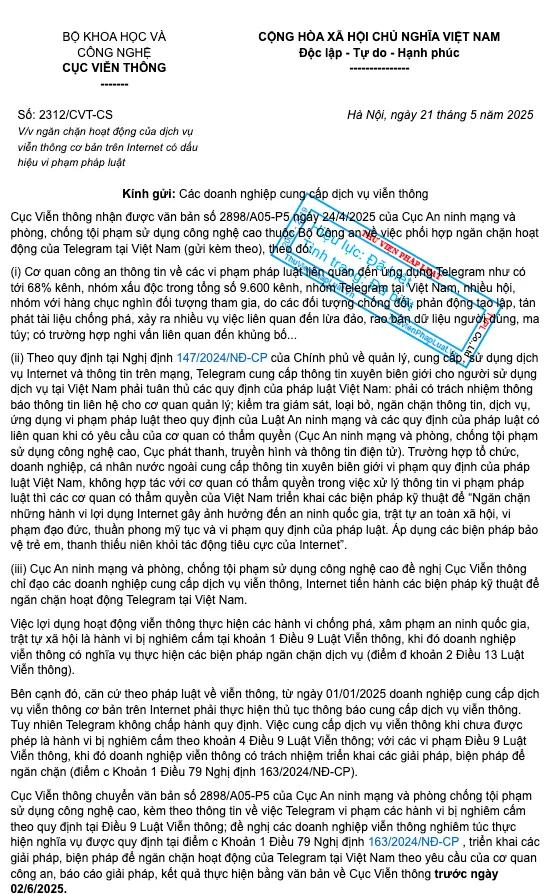
Official Telegram ban order issued on May 21st. Source: thuvienphapluat
On May 21, 2025, Vietnam's Ministry of Information and Communications, at the request of the Public Security Department, issued Order No. 2312/CVT-CS, instructing all telecommunications operators to block Telegram services domestically by June 2nd.
This move immediately caused chaos in Vietnam's entire crypto ecosystem. Vietnam is one of the countries with the largest Telegram user base, and like many other markets, its domestic crypto sector heavily relies on the platform as the primary communication channel. The ban left local crypto projects and users without viable alternatives. Although many turned to VPNs to maintain access, this workaround is at best a temporary, incomplete solution.
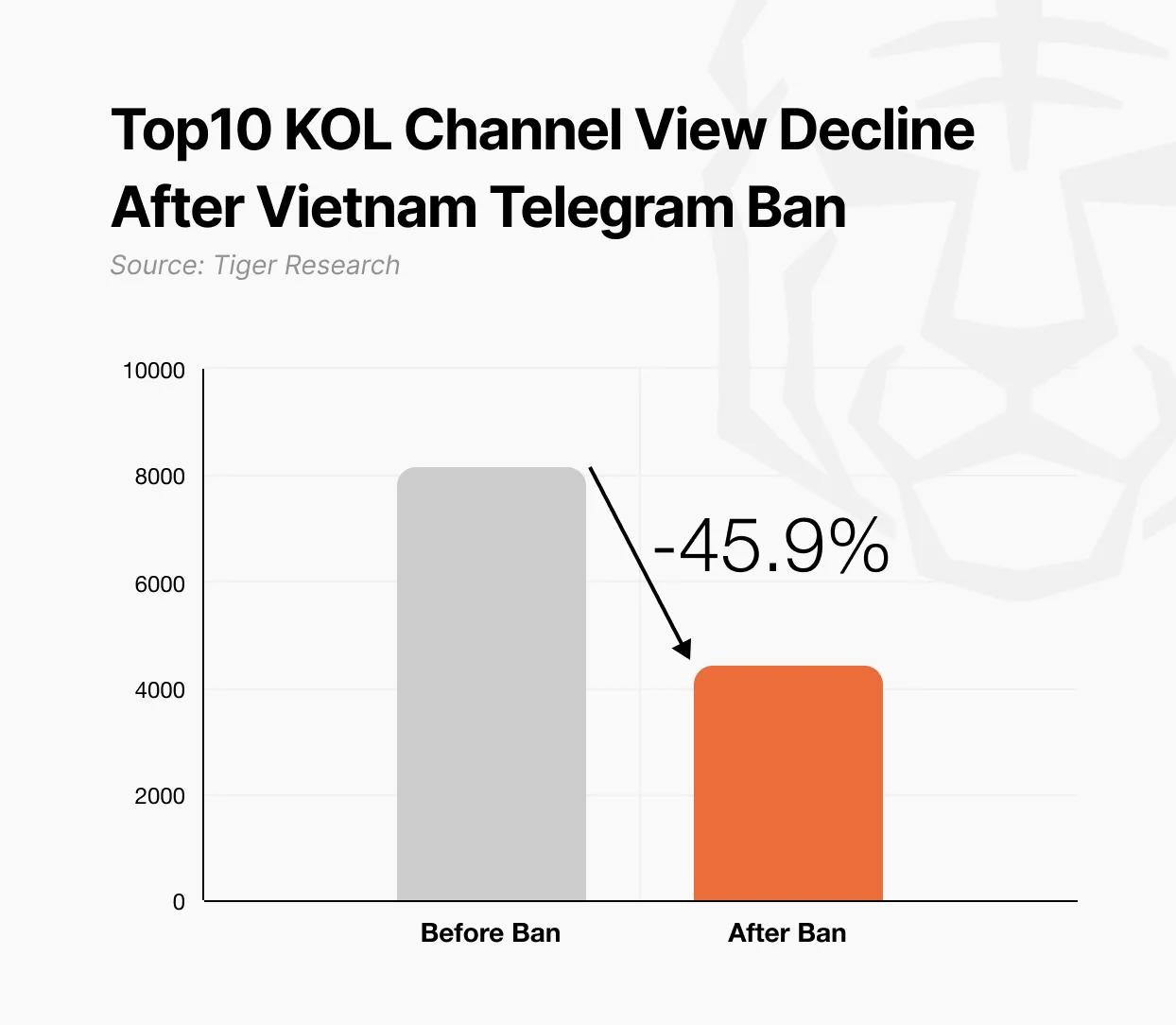
For ordinary users with only moderate interest in cryptocurrencies, accessing Telegram via VPN proved too inconvenient. As a result, many completely withdrew from participation. Within just a few days, the average viewership of Vietnam's top ten crypto communities dropped by over 45%.

Communities are rushing to switch to Discord as an alternative platform. Source: Telegram
In response, community organizers began exploring and promoting alternative platforms. Activity on Vietnamese Discord servers surged, while some communities attempted to use local communication apps like Zalo, aiming to cater to users seeking a lighter, simpler interface.
However, these alternatives could not replicate Telegram's unique balance of usability, privacy, and native crypto features. Despite the ban, most users continue to rely on Telegram via VPN—a workaround, not a replacement.
3. Are There Viable Alternatives to Telegram?
The regulatory pressure on Telegram reveals a structural vulnerability in the crypto industry: its severe dependence on a single communication platform.
As the Vietnam case shows, the immediate response to the ban was widespread VPN use. While this provides a short-term workaround, it significantly impedes ordinary users. Despite growing institutional participation in cryptocurrencies, retail investors still occupy a large portion of market activity. During a period when the market is trying to move beyond its early user base, the dependence on Telegram has become an obstacle to broader adoption.
This has prompted the industry to actively seek alternative platforms. Discord became the preferred option for many Vietnamese communities, offering real-time communication and a developer-friendly environment. However, it lacks the mobile-first simplicity that Telegram provides. Another candidate, Signal, boasts strong security features but offers limited tools for native crypto use—making it an incomplete alternative.
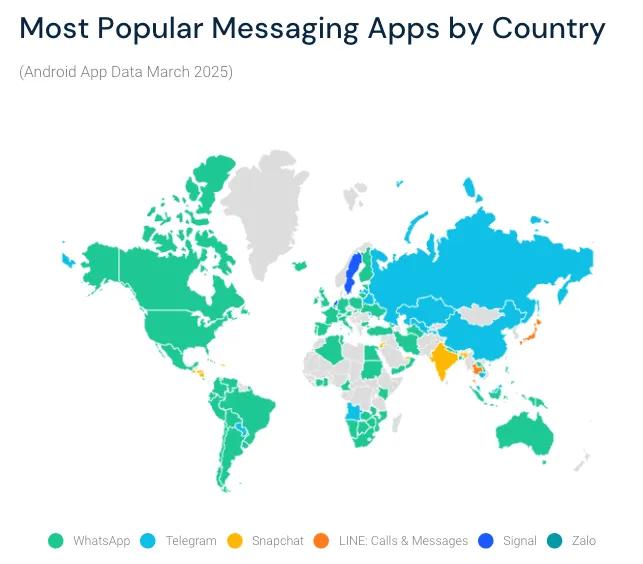
Source: Similarweb
Other communication apps like Zalo or WhatsApp tend to have user bases limited to specific regions. This makes them incompatible from the start with the global nature of the crypto ecosystem, which inherently requires cross-border communication.
Ultimately, the crypto industry has not found a viable alternative to Telegram. While its technical advantages like anonymity, privacy, and bot integration continue to maintain its dominance, the fundamental issue is structural.
Currently, no universally adopted communication platform can operate seamlessly across borders. Due to different communication preferences in each country, finding a single alternative that meets the global needs of the crypto ecosystem remains a massive challenge.
Telegram occupies a rare position in the communication landscape. It does not dominate any single national market, and for many users, it is not their primary app. However, in many different regions, it is typically the second most-used communication tool. This unique status as a universal secondary platform grants Telegram a de facto neutrality that transcends borders. It is precisely this region-agnostic position that makes it so difficult to replace.
4. Growing Regulatory Risks Around Telegram
Despite the lack of viable alternatives, governments worldwide, including Vietnam, are intensifying scrutiny of Telegram under the banner of "digital sovereignty".
This is largely due to Telegram's powerful privacy policy and its widespread refusal to share user data (with only a few major jurisdictions as exceptions). For many governments, the inability to monitor crypto communications remains a core concern.
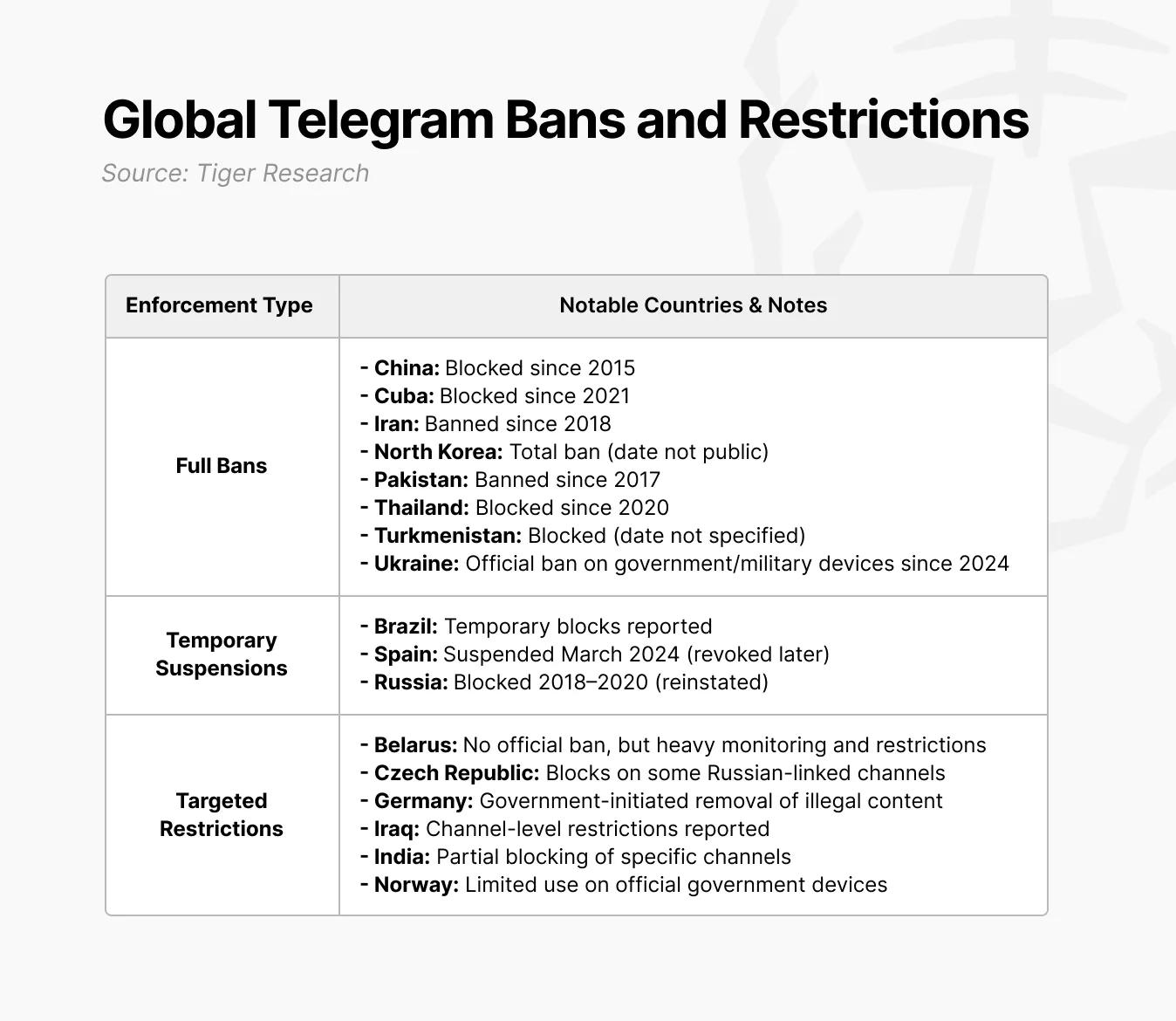
These concerns are increasingly translating into regulatory actions. Countries that have taken measures against Telegram typically follow one of three strategies. The first is a comprehensive ban, often accompanied by efforts to push domestic alternatives. The second involves temporary blockades for specific events (such as legal non-compliance or election-related tensions). The third is selective filtering, where governments allow app access but block specific channels or limit their speed.
The precedents set by these cases foreshadow potential future restrictions. Several countries are currently considering full or partial bans on Telegram. While political reasons vary across nations, regulatory patterns are becoming more consistent. Governments typically justify control through national security, non-compliance with local laws, or public order risks.
In this context, Telegram's response has become a critical variable. Although trigger points differ by jurisdiction, the fundamental issue remains the same: Telegram is unwilling or unable to meet local compliance requirements. In more stringent regulatory environments, tolerance for uncooperative platforms is significantly decreasing.
However, there are signs that Telegram's strategy is changing. After the arrest of CEO Pavel Durov, the company has begun taking measures to improve compliance. A notable example is its release of a transparency report disclosing violators' IP addresses and phone numbers, but this is limited to jurisdictions with strong democratic systems.
Despite the limited scope, Telegram now shows more willingness to cooperate with government requirements than before. This shift is expected to reduce the risk of immediate sanctions in major markets such as the United States.
5. What would happen if Telegram is completely banned?
The possibility of a global ban on Telegram remains low, but government concerns are real and growing. If such a situation occurs, users' initial reaction might be similar to the Vietnam case, with increased VPN usage. However, as mentioned earlier, this is only a short-term workaround.
Source: X
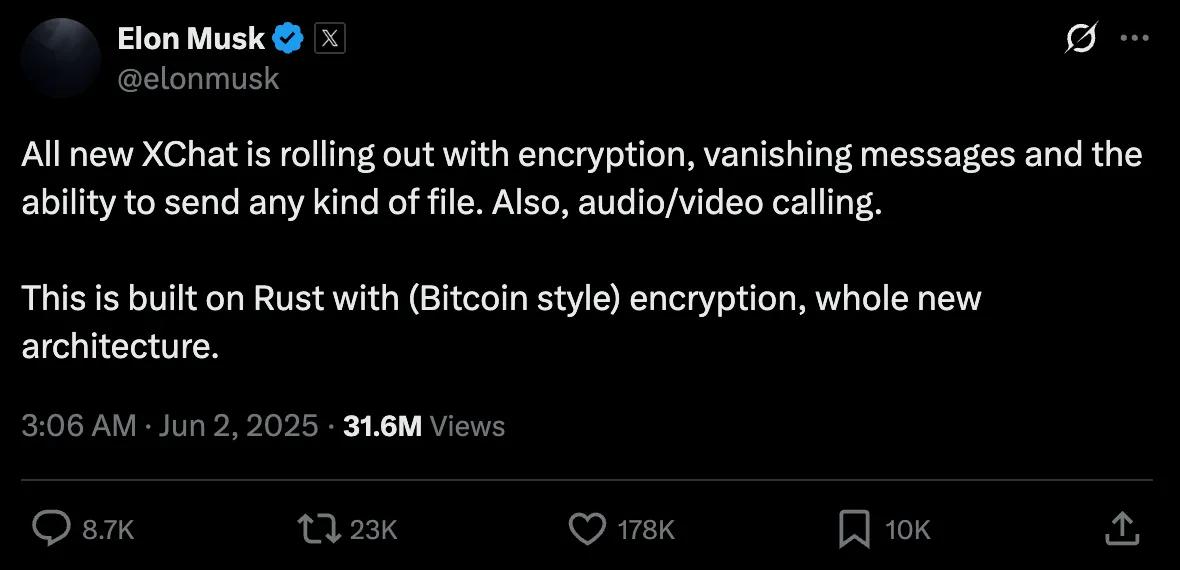
In the event of a comprehensive ban, users will begin migrating to alternative services. As previously discussed, the most viable alternatives are not Telegram clones or local communication apps. Platforms with Telegram's region-neutral characteristics are more likely to gain attention.
Signal, with its recently increased adoption rate, is a potential candidate. However, a stronger competitor might be X's upcoming communication service XChat. Given X's deep integration with the crypto community, XChat could leverage its existing user base for a strong market entry.
However, a more direct risk lies in the potential impact on the TON Foundation. While the TON Foundation is officially separate from Telegram, the two are closely related. Telegram's native T2E (Telegram to Earn) games have been core to TON ecosystem growth. Easy TON wallet usage directly within the Telegram interface is also a key advantage.
The expansion of ban measures turns this integration into a risk point. If Telegram access is blocked, user acquisition and transaction flows for TON-integrated applications will be immediately affected. Even if the blockchain continues to operate normally, the impact remains. As the market views Telegram and TON as a unified platform, TON-based projects directly face reputation and operational risks.
While a global Telegram ban is unlikely, the industry must face the reality that viable alternatives are limited. More broadly, the crypto ecosystem depends not just on Telegram, but on multiple single service points within its infrastructure. If these structural vulnerabilities are not addressed, the industry will continue to be exposed to sudden, external shocks.
The path forward is clear. Reducing over-dependence and achieving platform diversification is no longer optional. It is a necessary survival strategy.