Author: Alex Liu, Foresight News
On the evening of June 24, Aptos announced a collaboration with crypto giant Jump Crypto to launch a new storage protocol called Shelby. This is Jump Crypto's first major move since returning to crypto on June 19. The news sparked a swift market reaction - APT surged by 30%, rising from 4.2 USDT to a peak of 5.13 USDT, marking its best recent performance.
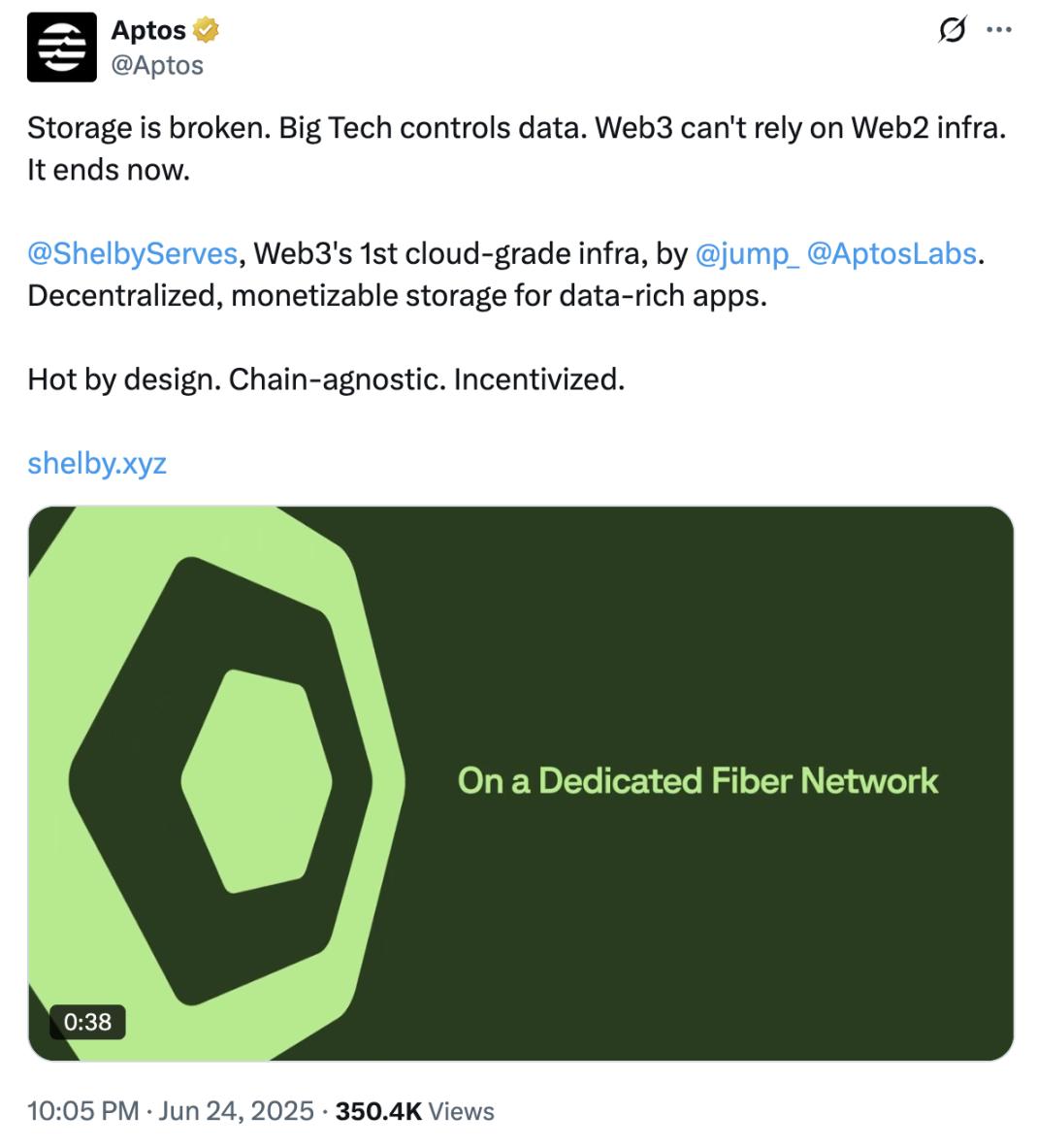
Jump Crypto previously invested in Aptos Labs' $150 million Series A funding round in 2022 and is known for its strategic capabilities and engineering prowess, such as being a major contributor to Solana's highly anticipated validator client Firedancer. As the first high-profile project since Jump's return, Shelby brings attention back to Aptos and creates "imaginative space" for ecosystem revival.
However, there are doubts. Sui was the first to launch a storage protocol called Walrus, so is Aptos simply copying its competitor's strategy? Let's delve deeper into Shelby.
Shelby: A "Hot Storage Protocol"
From Cold to Hot: Changing Web3 Storage Paradigms
In Web3 infrastructure narratives, decentralized storage has always been an unavoidable topic. However, for a long time, this field has been dominated by "cold storage": suitable for low-frequency, long-term data storage, such as Non-Fungible Token metadata and backups. Typical representatives like Filecoin and Arweave emphasize durability and cost optimization but may not be suitable for high-frequency, high-real-time scenarios.
Shelby is a "hot storage" solution proposed to address this pain point.
According to its official definition, Shelby is the first "cloud-grade infrastructure" in the Web3 world, featuring sub-second read times, native incentive mechanisms, and chain-agnostic compatibility. It not only enables data storage but also makes data fluid, usable, and valuable, serving high-real-time Web3 application scenarios like video streaming, AI output, dynamic Non-Fungible Tokens, and game assets.
Currently, Shelby uses Aptos as its preferred settlement layer, leveraging its 600-millisecond final confirmation, 30,000 TPS, and ultra-low gas fees to coordinate real-time data streams. Shelby is scheduled to launch its developer testnet in the fourth quarter of 2025.
Aptos Labs CEO Avery Ching noted in a personal article: "Web3 asset exchanges can now be done in seconds, but data remains static and difficult to use. Shelby aims to solve this critical bottleneck."
Backed by Jump, Shelby is More Than Just "Fast"

While Aptos is known for high concurrency and high throughput, Jump Crypto is a veteran in high-frequency trading and real-time systems. Shelby's claim to "hot storage" is fundamentally rooted in its underlying architecture characteristics:
- Supported by dedicated fiber backbone networks for global node high-speed synchronization;
- Ensuring content localization through edge caching systems with read speeds as fast as sub-seconds;
- Adopting Clay code redundancy mechanism to reduce replication costs while ensuring repair efficiency;
- Native support for usage-based monetization logic through encryption and paid reading mechanisms;
- Supporting smart contract-defined access control and DRM, handling data distribution and copyright protection in one step.
This design is not just about creating a faster IPFS (the most famous decentralized storage network) but attempting to merge Web2 performance standards with Web3 decentralization principles, creating a programmable, monetizable, and scalable data circulation network.
Top-Tier Projects Join, Community Discussions Heated
The rapid 30% surge in APT price is not only due to Jump Crypto's endorsement but also the impressive ecosystem of projects Shelby has attracted - Metaplex, Story Protocol, DoubleZero, etc., representing the most active data-intensive applications exploring Web3 data usage value across different chains.
Metaplex is rooted in Solana, and DoubleZero was even founded by Solana's former strategy lead Austin Federa. Does Jump's deep involvement in the Solana ecosystem participating in Aptos ecosystem development suggest that Shelby truly has something special and has gained widespread recognition?
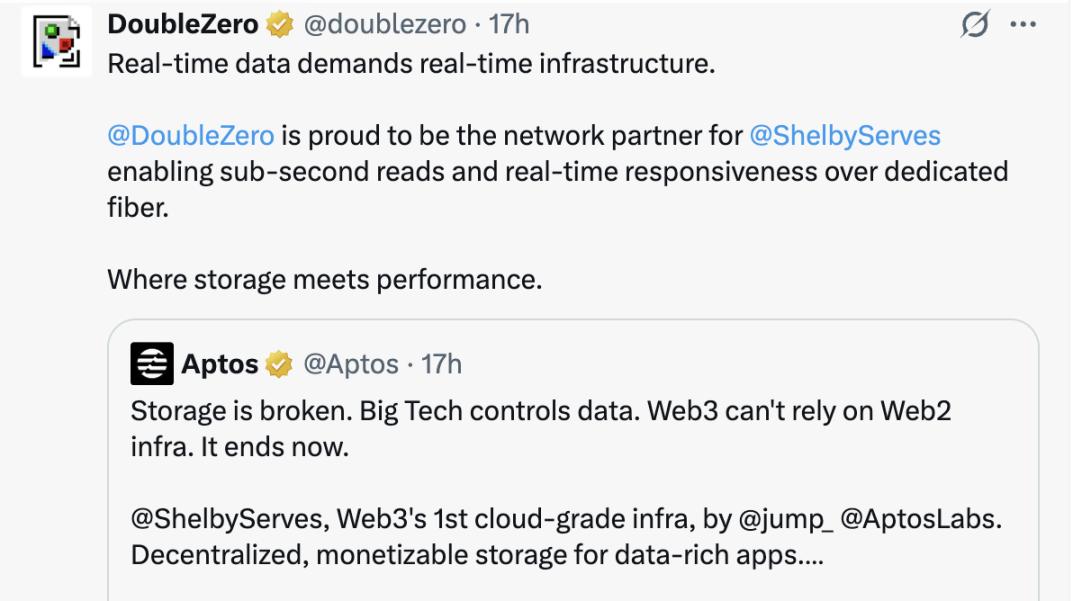
The community's interpretation of Shelby is exceptionally positive.
Some compare it with Walrus Protocol, pointing out their vastly different purposes: Walrus leans towards cold storage and archiving, while Shelby focuses on real-time usage and revenue distribution. The former relies on low-frequency access and audit incentive mechanisms, while the latter transforms each data read into a payment action, fundamentally incentivizing data readability.
Some argue that Shelby's encryption and paid reading mechanism provides a paradigm breakthrough for the long-standing "reading incentive" problem in the Data Availability domain. Unlike projects like Celestia and Walrus, which currently rely on external funding subsidies to maintain services, Shelby directly incorporates user behavior into an economic closed loop, motivating nodes to actively maintain data availability.
A Higher Vision: More Than Aptos' Comeback
While Shelby's release is an important move for Aptos to seek ecosystem breakthrough, its broader significance might lie in its first attempt to deeply integrate content economy, creator economy, and chain-based infrastructure with the "data as native asset" concept. This not only serves Aptos itself but also radiates to the entire multi-chain world through its "chain-agnostic" characteristics.

Aptos Labs repeatedly emphasized Shelby's composability and cross-chain capabilities in its announcement: whether deploying dynamic Non-Fungible Tokens on Solana or building RAG models on Ethereum Layer 2, Shelby can achieve quick integration and revenue linkage through standardized interfaces. It will also expand to chain environments like Cosmos and Modular Stack.
Combined with Aptos' existing Global Trading Engine for value transfer, Shelby complements the value generation capabilities: the former enables asset free flow, while the latter makes content an asset with measurable value. Complementing each other, Aptos is attempting to build a chain-based economic closed loop.
In Conclusion: Possibilities and Challenges of a Comeback
From technical design to collaboration lineup, from ecosystem implementation to market sentiment, Shelby is undoubtedly a high-scoring answer for Aptos at the infrastructure level. When Walrus' massive airdrop ignited Sui's ecosystem wealth effect, Aptos was once viewed as a "bystander". Now, Shelby, backed by Jump, might be its breakthrough to return to the central narrative.
Challenges remain: performance implementation difficulty, developer migration costs, early ecosystem cold start... These will be the real issues Shelby must face. But at least from market and technical perspectives, Aptos is no longer satisfied with being just a "faster and cheaper public chain" but is seeking innovation, betting on a new paradigm of data-driven chain-based economy.
When hot data truly starts flowing, the next wave of Web3 might just set sail from here.