Tahini's, a Canadian fast-food chain, boldly embraced Bit in 2020 to combat inflation and compete with industry giants like McDonald's. Here is their Bit financial strategy.
Tahini restaurant is a Canadian fast-food chain focusing on Mediterranean and Middle Eastern cuisine, continuously optimizing its strategy since integrating Bit into its business in 2020. Today, Bit accounts for over 70% of its reserves, playing a crucial role in its expansion to 62 restaurants within just over a decade.
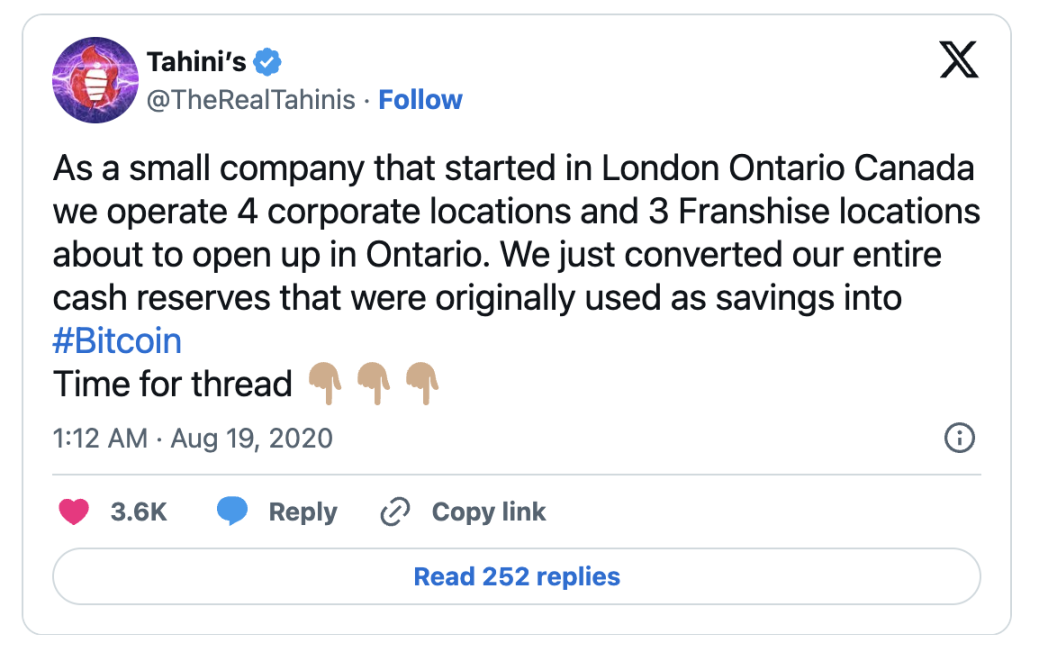
"We continuously invest more funds into Bit," said Omar Hamam, CEO and co-founder of Tahini's, in an interview with Bitcoin Magazine. Omar and his brother Aly Hamam founded their first restaurant in London, Ontario in 2012. Since then, Tahini has grown to 62 restaurants nationwide. In 2020, they were inspired by Michael Saylor and adopted an early Bit financial strategy. This bold move provided them with a fund reserve, enabling them to compete with fast-food industry giants.
"We are competing with McDonald's and Chipotle," Omar stated, "These companies have hundreds of times more funds than Tahini. So, having such an advantage - a financial strategy that makes our financial situation more robust and preserves wealth across time and space - is the best decision we've made for our business."
During their development, the company implemented several innovative strategies, including deploying Bit ATMs in many franchises and a new media strategy. According to Aly, this media strategy brought them three billion views across all social media platforms in the past five years, including a YouTube channel with over 3.2 million subscribers. Of course, their Bit financial strategy was also a highlight.
Aly's Bit Obsession: From Egyptian Currency Devaluation to Post-Pandemic Inspiration
[The translation continues in the same manner, maintaining the specified translations for specific terms]Although there are no strict regulations regarding the best frequency for Bitcoin periodic investment strategies, Tahini chose to purchase monthly, as it aligns with their accounting processes. "Every month we have an income statement. Every month we see our profits and losses. We decide at the end of the month, okay, we want to set aside this much," Omar explained.
As for the investment amount, Omar explained that they do not invest a fixed or percentage-based amount. "It also depends on whether we are investing in the business this month? How are our expenses? Are there any large payments? Sometimes there are many expenses at the end of the year. So you have monthly highs and lows, but the key is to consistently invest funds. How much to invest each month is something you need to decide."
Bitcoin: Sell or Pledge? Tahini's Financial Strategy and Payment Challenges
In terms of realizing Bitcoin, Tahini chose a simple strategy. When the timing is right and business needs are urgent, they sell a portion of Bitcoin, then buy back later following a standard Dollar Cost Averaging (DCA) strategy, integrating capital gains tax into their accounting process. Omar explained: "When you need to reinvest, you always need funds. Let's say you want to run a major marketing campaign as a chain store, right? You need to tap into these reserves. With funds, you have power. The more funds you have, the more freely you can make the right decisions for the company, rather than just doing what you can afford."
Challenges of Accepting Bitcoin Payments and POS System Integration
As a first step in Bitcoin integration, Tahini explored the possibility of accepting Bitcoin as payment for their restaurant. However, a series of challenges forced them to pivot. Many of these challenges still exist among global businesses, involving closed-source payment processing systems and walled garden models.
Omar explained: "Many of these point-of-sale system companies process payments themselves, and their systems are not capable of accepting Bitcoin." These systems are mostly closed-source, with strict API restrictions, making Bitcoin economy integration difficult - a barrier to Bitcoin payment adoption since its inception.
However, merchant friction is not just limited to POS system barriers; the list of features required for merchants to remain competitive is very complex, and most Bitcoin payment systems still lag behind:
"A POS system is not just about payment. It's also about how to build menus in the backend. POS systems provide reports, analyze what you sold, when you sold it, the store's operations, which times are busy, which times are not, and how to request what you've ordered. This is very complex, right? So payment is just the last piece of the puzzle. Therefore, when we choose a POS system, it's not just about the payment system, but also about their functionality and the system's strengths and weaknesses."
Moreover, POS systems integrating Bitcoin also need to support fiat currency to be viable for ordinary merchants today, further raising entry and competition barriers.
Therefore, Tahini chose the next best option: they partnered with Canadian Bitcoin ATM company Bitcoin Well, installing Bitcoin ATMs in 10 restaurants, choosing to receive all machine profits in Bitcoin and allocate them to separate accounts for each restaurant. Although Ali reported these ATMs only generate about 250 Canadian dollars monthly, these "sats streams" (as some in the industry call them) have accumulated since 2021, and with Bitcoin's price increase, each restaurant now has over 40,000 Canadian dollars in Bitcoin balance, which is quite significant.
Nevertheless, Omar remains optimistic about the elimination of these barriers, as interest in Bitcoin payments is stronger than ever. "I think Bitcoin is growing rapidly, many companies are adopting it, people are learning more about Bitcoin, and their awareness of Bitcoin is increasing. So, I believe it's just a matter of time."