Fifteen years ago, in a small apartment near the French Riviera, 21-year-old Johann Kerbrat worked at McDonald's during the day and self-taught programming at night. Now, as a senior vice president and head of crypto at Robinhood, he returns to his hometown with the company's most ambitious crypto product suite.
Cannes 'Past'
"My studio was probably smaller than your bathroom," Kerbrat recalled. Before enrolling at the nearby University of Nice, he quit his job and founded his first fintech startup - a no-code payment company that helped small merchants build e-commerce websites without hiring developers.
"It was the early stage of e-commerce. At that time, merchants either spent tens of thousands of euros hiring agency services or couldn't conduct online business. Our idea was to let people build their own stores without technical knowledge - somewhat like today's Shopify." The timing was perfect. In the early 2010s, online commerce was booming, and Kerbrat's tools gave small merchants a chance to compete. This also made him realize how fragile and expensive the global financial system was.
Enlightenment: Bit White Paper
Kerbrat later recalled that a conversation with a Greek classmate made him aware of the "fragility" of the traditional banking system. That classmate told him how his family's bank accounts were frozen during the Eurozone crisis, bringing life to a standstill. Meanwhile, merchants on his platform continuously provided feedback about high transaction fees, complex refund processes, and credit card fraud becoming an uncontrollable sunk cost.
"Then I read the Bit white paper," he said, "and I thought: 'Well, this is the solution to all problems.'"
It was 2010. Kerbrat began assembling mining machines, deploying wallets, and trying to build Bit-based payment interfaces. He didn't get rich overnight with Bit or choose to be a speculator, but instead tried to understand the real possibilities behind this technology. "At that stage, you realize that cryptocurrency is not just an asset, but a structural transformation."
Leading Robinhood's 'High-Stakes' Crypto
Later, he worked at Airbnb and Uber as a core platform engineer. Before joining Robinhood, he was also VP of Engineering at Iron Fish (a privacy Layer 1 blockchain project), focusing on privacy technologies like zero-knowledge proofs. This experience brought him back to the crypto space and made him realize that "user experience" is the biggest weakness in the crypto industry.
In 2021, he officially joined Robinhood Crypto as CTO and was promoted to senior vice president and general manager in 2023. By then, 13 years had passed since he first opened the Bit white paper.
Under Kerbrat's leadership, Robinhood Crypto has launched several important products:
・In 2022, Robinhood Wallet was launched. It's a non-custodial wallet similar to MetaMask, but with a more concise interface more oriented towards beginner users. He describes it as a "Web3 browser for ordinary people".
・From 2023, they began supporting Bit transfers and on-chain asset withdrawals, marking Robinhood's transition from a "trading interface" to "crypto infrastructure".
・In 2024, he led Robinhood's acquisition of European crypto trading platform Bitstamp, aiming to enter the European market using Bitstamp's over 50 licenses as a lever.
In his view, this was an inevitable choice under uncertain US regulations: "We can't bet our future on <if the SEC relaxes regulations>." He emphasizes that "compliance is not an obstacle, but a market barrier". This is also key to Robinhood's foothold in crypto business.
Glamorous 'Return'
Now, on the Cannes coastline, the same coastline where he once lived and worked night shifts at fast food, Kerbrat is in a Belle Époque mansion called "Château de la Croix des Gardes", participating in the release of Robinhood's most ambitious crypto product suite.

On Monday, the company announced expanding tokenized stock and ETF issuance in Europe, launching crypto staking services in the US, offering perpetual futures for eligible EU traders, and introducing a new Layer 2 blockchain optimized for real-world asset settlement and all-weather trading.
"This is absolutely surreal," Kerbrat said inside the iconic Carlton Hotel, a five-star landmark hotel that was once unattainable to him. "When I was young, I used to walk by here - I never thought I could stay here."
Robinhood New Layout
This release coincides with the first Ethereum community conference in Cannes and Robinhood's recent regulatory approvals in Europe. Robinhood's latest move is its most serious attempt to merge traditional finance with blockchain-based infrastructure. Following this announcement, Robinhood's stock price hit a historic high, with over 100% growth this year.
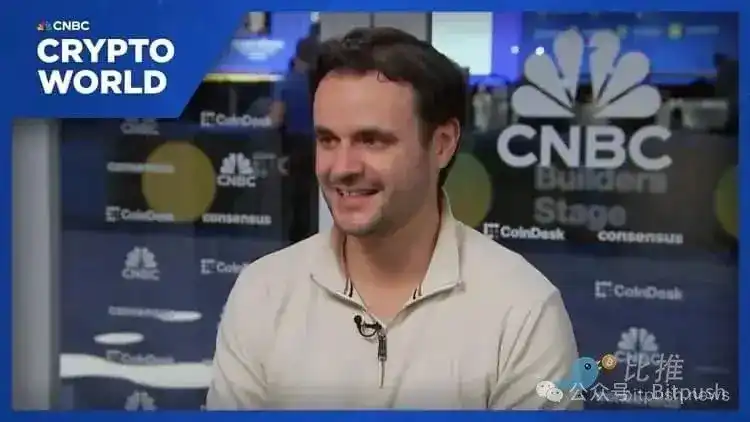
Kerbrat stated that their goal is not to showcase features, but to make cryptographic technology "invisible" in the background, comparing it to a "pipeline". "You don't think about how water flows to your faucet," he said, "you just expect it to turn on and work."
But some "pipelines" still need to be built.
The core released on Monday is tokenized stocks and ETFs, now open to users in 30 EU and European Economic Area countries. These tokens are initially built on Arbitrum, providing trading access 5 days a week, 24 hours a day, supporting dividend payments, and with no commissions or spreads from Robinhood. Eventually, they will migrate to a custom Layer 2 blockchain that will support tokenized assets, seamless bridging, and self-custody.
In the United States, Robinhood is launching staking services for Ethereum and Solana, allowing users to earn rewards by supporting network operations. In Europe, crypto perpetual futures will offer up to 3x leverage for eligible users, with trading routed through Bitstamp. Other upgrades include smart trading platform routing, tax batch management, and advanced charting tools - all designed to make cryptocurrency trading as seamless and intuitive as stock trading.
"When we talk about mass adoption," Johann Kerbrat said, "this is what it looks like. A product people use without needing to understand how it works."
For Johann Kerbrat, who spent his teenage years in Cannes and Nice, this return is more than just symbolic. It bears witness to how far he has come - and how much still feels the same as before.
His father worked in IT, and his mother took care of him and his sister at home. One day, his father brought home a bulky old Apple computer with a black and white screen, which was the "spark" point. At 7, he started trying to play on the computer. At 11, he was regularly writing code. By 17, he had already begun trying to repair internet economy flaws he observed.
Kerbrat's parents deliberately came to watch the release event. He said they still remember those early days - the small apartment, the first lines of code, and endless conversations with merchants who didn't quite believe him - that anyone could build an e-commerce website without understanding programming.
"We chose Cannes because of the license approval and conference here," Kerbrat said, "but I won't pretend it doesn't feel good." He paused for a moment, organizing his thoughts, "I never thought I would return in this way."
Note: Article information compiled from CNBC, Unchained Podcast, Robinhood Investor Relations website, etc.