Taiwanese people are crazy about Threads, with posts ranging from bizarre to dramatic. A recent post caught attention: the author's father announced at a family meeting that children could "inherit in advance" the family assets, but with a condition of paying 3% interest annually until his death. The eldest son signed immediately, thinking "the earlier, the better," while the author was torn, feeling like taking the deal was like being in debt, but not signing would label them as "unfilial".
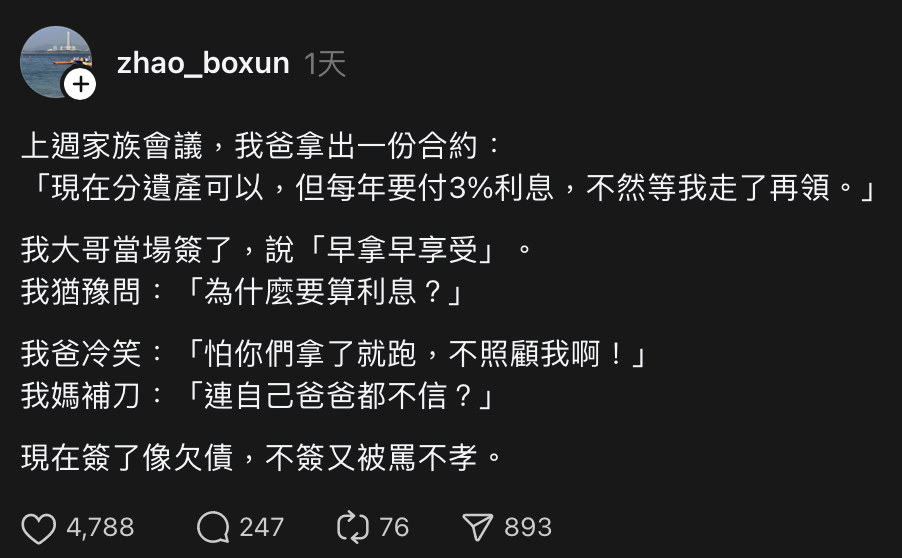
At first glance, this looks like emotional blackmail by the father, worried the children might run away with the money. But if you stop here, you're underestimating this father. This is likely not a family drama, but a meticulously calculated wealth transfer strategy.
The father isn't concerned about filial piety; he's focused on how to smartly transfer wealth to the next generation.
Lending, Essentially a 'Gift' Tax Saving Method
Why make inheritance look like a loan with interest? Because in Taiwan, the "gift tax" and "inheritance tax" are significantly different.
First Understand Living Gifts vs. Inheritance
Gift Tax: In Taiwan, each person has an annual tax-free gift allowance of 2.44 million. Amounts exceeding this are taxed from 10% up to 20%. If the father wants to give his children a large sum, say several tens of millions of New Taiwan Dollars, the gift tax would be substantial.
Inheritance Tax: The inheritance tax-free threshold is much higher, currently at 13.33 million. With additional deductions for spouse and children, the actual tax-free threshold is even higher, with a progressive tax rate of 10% to 20%.
For high-net-worth individuals, leaving property as an inheritance offers much more tax benefits than gifting during one's lifetime. But how can one give assets to descendants? The father in this story likely used a "lending" method to gift assets.
Utilizing 'Conditional Gifts'
The father's "interest payment" requirement with a contract might be legally viewed as a "burdened gift" or "conditional gift". This approach is not only legally tax-efficient but achieves several objectives.
Tax Saving: Through a "lending" form, the father is actually transferring assets to his children year by year, perfectly avoiding high gift taxes. The 3% interest is more of a formality to ensure this financial flow is legally sound and not deemed a direct gift by tax authorities.
Moreover, as long as the contract exists, the father maintains "control" over his property. If children were to take the money and run, he could take legal action.
The Brave Enjoy the World First
In the original post, the eldest son decided to sign the contract to "enjoy early". He likely calculated that as long as he can find investments with annual returns over 3%, this deal is advantageous.
After all, stable investments with returns below 3% could potentially exceed this rate. This typical "opportunity cost" calculation is especially suitable for younger children, allowing them to use family assets earlier and have more time for asset appreciation.
As Nick Maggiulli, author of the financial bestseller 'Just Keep Buying', says: "Providing $100,000 to children in their 20s is far more helpful than leaving $500,000 in inheritance when they're in their 60s."
In modern times, wealth transfer is more complex than just "dividing family assets". It involves intricate tax laws, legal contracts, and market predictions. Many netizens in the Threads post shared various methods of transferring assets to children. However, if the father could transparently explain the tax considerations to his children, the family meeting atmosphere might have been more positive.