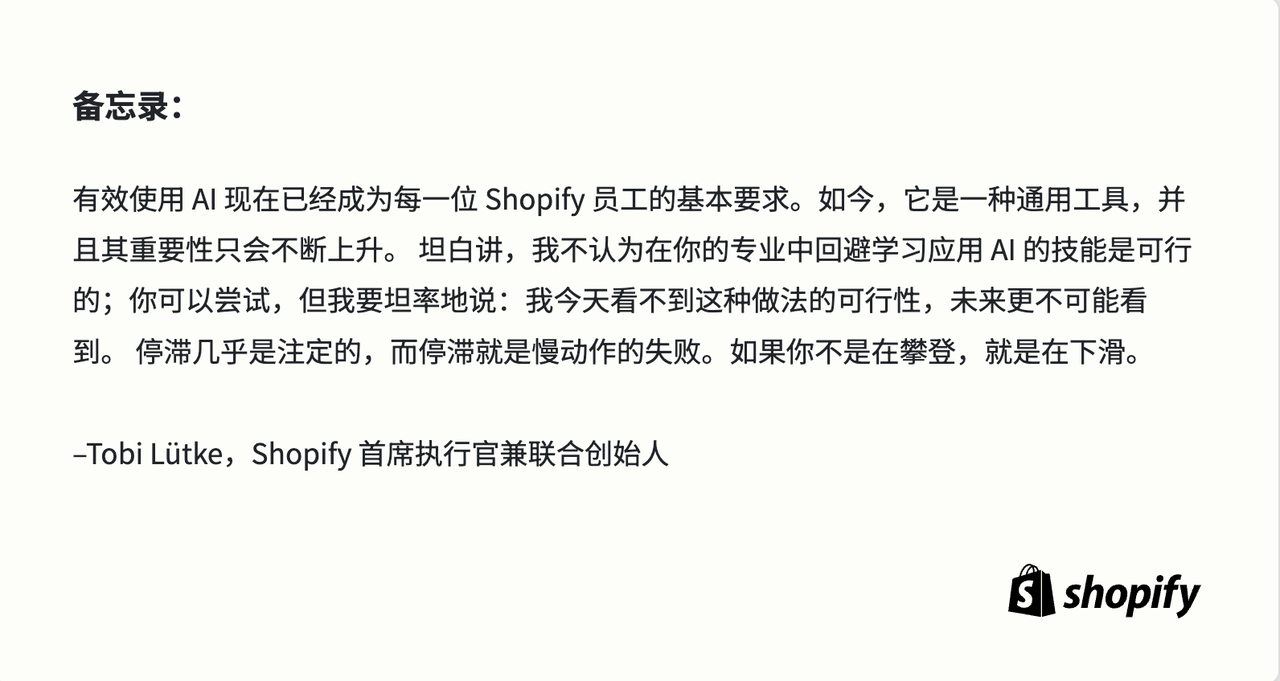
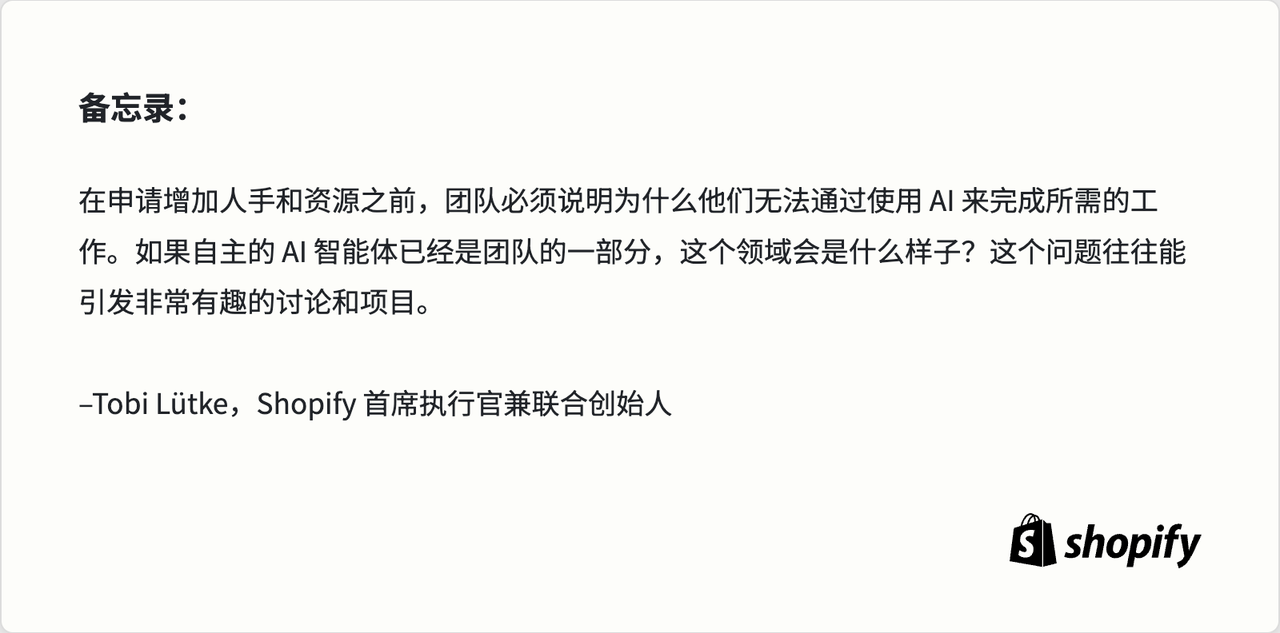
Three months ago, Tobi Lütke, co-founder and CEO of Shopify, issued a letter to all employees within the company , deciding to "all in AI." Lütke mentioned that "effective use of AI technology is a basic expectation for every Shopify employee." This practice subsequently attracted many imitators, including Box, Fiverr and even the Prime Minister of Canada.
Three months later, what changes have actually taken place within Shopify? Is it just a "passionate slogan" from the leader, or is "AI" really being used effectively within the company?
What workflows have changed with the implementation of AI?
First Round Review spoke with Shopify's vice president Thawar, who shared the company's specific strategy for using AI and the actual improvement effects, as well as three "counter-intuitive" insights.
All employees can use AI equally, with no cap on costs.
Let AI show more of its thinking and results instead of hiding them.
Very useful for novices and graduates, especially in the use of AI.
It can be said that Shopify has provided a good example on how to implement AI in a company, from strategic guidance to technology implementation.
Founder Park compiled and processed the article based on First Round Review.
Original article: https://www.firstround.com/ai/shopify
01 All employees use AI “without discrimination”

When many companies promote AI, they tend to open only the most basic tools to all employees, while reserving more powerful models and applications for technical teams. Shopify does the opposite: it allows all employees to use every tool and model introduced by the company.
The logic behind this strategy is that high-value innovative applications may come from any corner of the company, and you cannot predict which one will ultimately stand out and become the use case most worthy of resource investment.
I purchased 1,500 Cursor licenses last year, but quickly realized that demand was outstripping supply, so I had to buy another 1,500. The fastest growing user base is not in engineering, but in customer support and revenue.
Farhan Thawar VP and Head of Engineering at Shopify
To encourage employees to truly use the best and latest models, Shopify has adopted the following three strategies:
Strategy 1: Let the legal team give the green light by default
Change starts at the top. The entire senior leadership team, including legal, must agree that embracing AI is the most important thing for the company. Alignment at the top means that everyone must start with “how to facilitate” when facing key issues such as security and privacy. “If you don’t make ‘yes’ the default option, you are actually defaulting to ‘no,’” Thawar pointed out. “If the rules are vague, then it’s actually a no, and that’s the case at most companies.”
When Thawar decided to introduce GitHub Copilot at the end of 2021, his communication with the legal team was direct: "My first question was, 'We are going to do this project, how can we ensure that everything is foolproof?'" Thawar said. "They replied, 'We will find a way.' There was no objection."
This attitude is in stark contrast to what CTOs at other top tech companies are experiencing. In a WhatsApp group of peers, Thawar often hears them complain about the numerous obstacles from legal affairs.
People in the group always ask me: "Can your general counsel (GC) talk to ours?" We have never experienced the resistance they encountered.
Farhan Thawar VP and Head of Engineering at Shopify
Strategy 2: No upper limit on the budget for AI tools
To achieve the full popularization of AI, cost is an unavoidable issue. As Cursor is widely used within the company, some people began to worry that costs would get out of control. But this is exactly the opposite of Thawar's original intention: he hopes that as long as the tool can create value, everyone can use it without scruples.
Thawar keeps an internal leaderboard to see who’s paying the most extra for Cursor tokens. “We don’t set a limit. I don’t want people to use scripts to bully the list, but it’s a really good indicator of value. We don’t want employees to have any concerns about using AI or the latest models,” Thawar says. “I know people who are proud to be in the top ten for token spending because they’ve done important work with AI.” Shopify’s CTO Mikhail Parakhin was recently named one of them.
“One worrying trend I see when I talk to a lot of CTOs and CEOs is that they obsess over the cost of tokens,” Thawar said. “They think, ‘Can I afford to pay an extra $1,000 to $10,000 per engineer per month for tools like Cursor, Windsurf, and GitHub Copilot?’ So they tighten their budgets.”
This way of thinking is contrary to the goal of promoting AI.
“If your engineers spend an extra $1,000 per month using a large language model (LLM), but their efficiency is improved by 10%, then this investment is a great deal. Any company will be excited about such a ‘cheap’ efficiency improvement.” (Thawar even said that if your engineers can spend $10,000 per month and create value, please be sure to send him a private message, he wants to learn from his experience.)
Strategy 3: Unified AI portal and MCPs
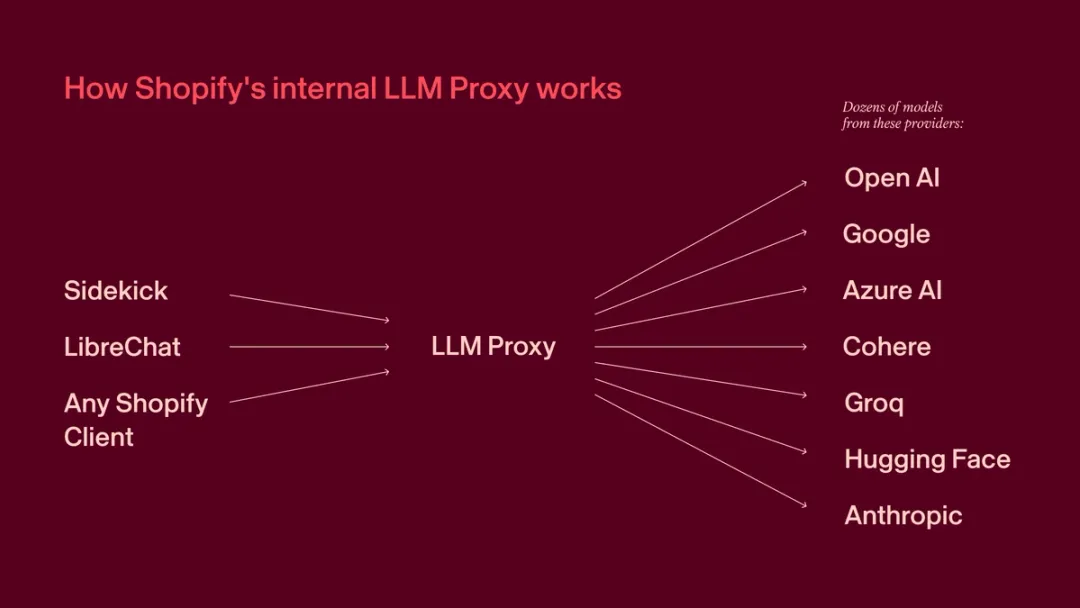
In order to make it easy for employees to use and build the latest AI tools, Shopify integrated all resources into one platform: the company's internal LLM Agent. This agent serves as a unified entry point, allowing users to seamlessly interact and switch with various models. In a production environment, the agent also undertakes important functions such as expansion, tracking, and failover.
Employees can use this LLM to build their own workflows, freely choose various models, and always use the latest version at the first time. The platform has a rich collection of MCPs built in, and users can call them by simply making a request to tools such as Agent or Cursor. There is even an Agent library created by colleagues for everyone to use. It is a one-stop AI workstation that meets all the needs of employees.
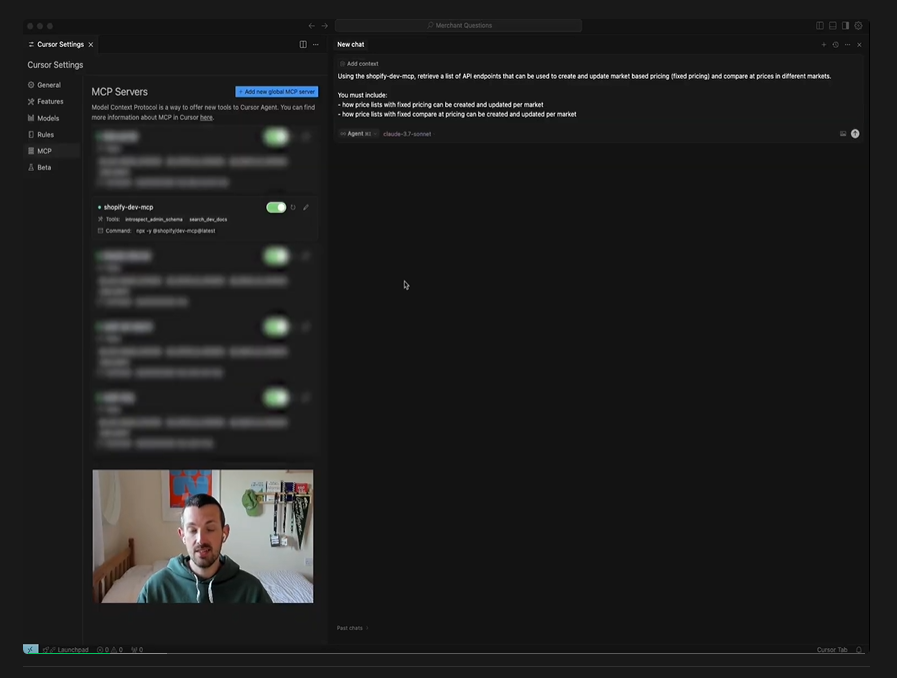
“MCP servers are an important infrastructure layer that connects all the internal tools in the company. Our philosophy is ‘MCP for everything,’” Thawar said. “We make every piece of data in the company accessible through MCP, no matter which tool it is stored in, so that employees can access it at any time and build their own workflows.”

02 AI-based workflow cases
With the MCP, Cursor, and chat infrastructure, the work efficiency of both technical and business personnel has been greatly improved. The following are some outstanding cases from outside the R&D department:
Case 1: A website audit tool that changes the way potential customer sales leads are generated
Website performance benchmark analysis is an important part of Shopify's sales process. In order to prove its industry-leading website speed to potential merchants, sales staff must first audit and analyze potential customers' websites to prove Shopify's advantages with data. In the past, this work was completely manual and time-consuming.
Recently, a non-technical sales representative used Cursor to develop a tool that automatically generates detailed website performance comparison reports. The tool can crawl data from potential customers' websites, compare them with Shopify's benchmarks, and even call internal documents to provide accurate sales communication support.
Shopify’s Chief Revenue Officer (CRO) Bobby Morrison praised this way of thinking and working: “Our top business developers are reinventing every aspect of their work, from market analysis and opportunity identification to developing strategies and building solutions for merchants. The most successful among them are all ‘AI fluent’. They can intuitively collaborate with AI tools and evolve at the speed of AI. AI is not independent for them, but a way of working.”
In Shopify's view, the real opportunity brought by AI is that it allows you to rethink the entire sales model. "For example, in an upsell scenario, a sales representative can have an agent retrieve data in a few seconds while talking to a customer, which used to take a lot of time to obtain. This kind of sales data used to be a scarce resource, but now it is readily available," Thawar explained.
“How will this impact your sales approach? You can make your case more confidently and forcefully, which can open up new channels of communication within the client organization and may even revolutionize the way you make cold calls.”
Case 2: Sales Engineer’s “To-Do” Home Page
A sales engineer integrated the MCPs of his most commonly used tools such as GSuite Drive, Slack, and Salesforce into a personal dashboard built with Cursor. This dashboard can intelligently prioritize his tasks based on real-time information from all tools.
In the past, he had to switch back and forth between these applications. Now, he only needs to open the dashboard every day and ask, "What should I do today?" The system may find that there is an upcoming order in Salesforce, and at the same time notice that he has not responded to an important email from the customer, so it immediately reminds him to prioritize it. Thawar said: "He hardly opens those independent tools anymore. Cursor is his work homepage. He doesn't even need to log in to his email anymore. It's incredible."
This is exactly the kind of return Shopify hopes to see from its AI infrastructure investments, which makes sense for a company known for its infrastructure. “We prioritize developing our internal AI infrastructure, it’s part of our DNA,” Thawar said.
“Rather than spending weeks developing an isolated feature, we would rather invest more time to build reusable infrastructure. For example, we built the LLM agent and MCP server in the hope of building a system that everyone can reuse. Once someone creates an MCP for Slack, everyone in the company can use it directly.”
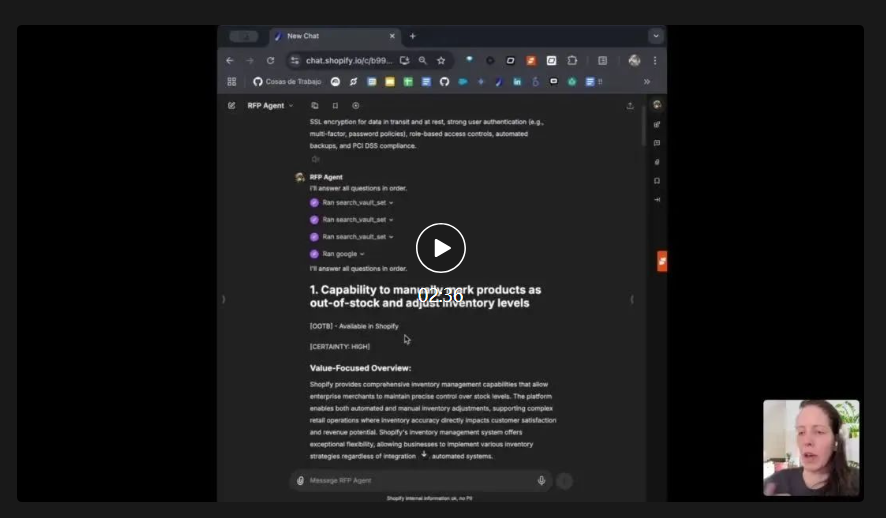
Workflow Case 3: Using RFP Agent to Improve Your Winning Rate
For companies selling to large enterprises, filling out a request for proposal (RFP) is a common occurrence. Each RFP includes hundreds of questions and requires a lot of customization, company background information, and cross-departmental collaboration to complete.
To this end, Shopify's revenue tool team developed an agent that can answer multiple RFP questions at once. This agent is built on LibreChat (Shopify is one of its core contributors), which can call on the internal knowledge base, including public documents, help centers, case studies, etc., and automatically generate rich and well-documented responses, greatly liberating the productivity of solution engineers.
When answering questions, the agent will also give each answer a "confidence score" to indicate whether its information is sufficient. At the same time, it can also learn from past RFP answers that have successfully won orders and store new successful cases in the knowledge base to continuously optimize the quality of future responses.
03 Let AI show more of its thinking process, not hide it
Many people worry that over-reliance on AI will make our brains rusty and alienate us from the work itself. But a counterintuitive fact is that if used properly, AI can give you more details and make you more deeply involved.
“Most people think that the ideal user experience is that you ask a question, the AI gives you an answer, and there’s as little ‘mess’ in between as possible,” Thawar said. “But if your goal is to help people become proficient in a skill, then showing those details is much more effective.”
Strategy: “Context Engineering” for People
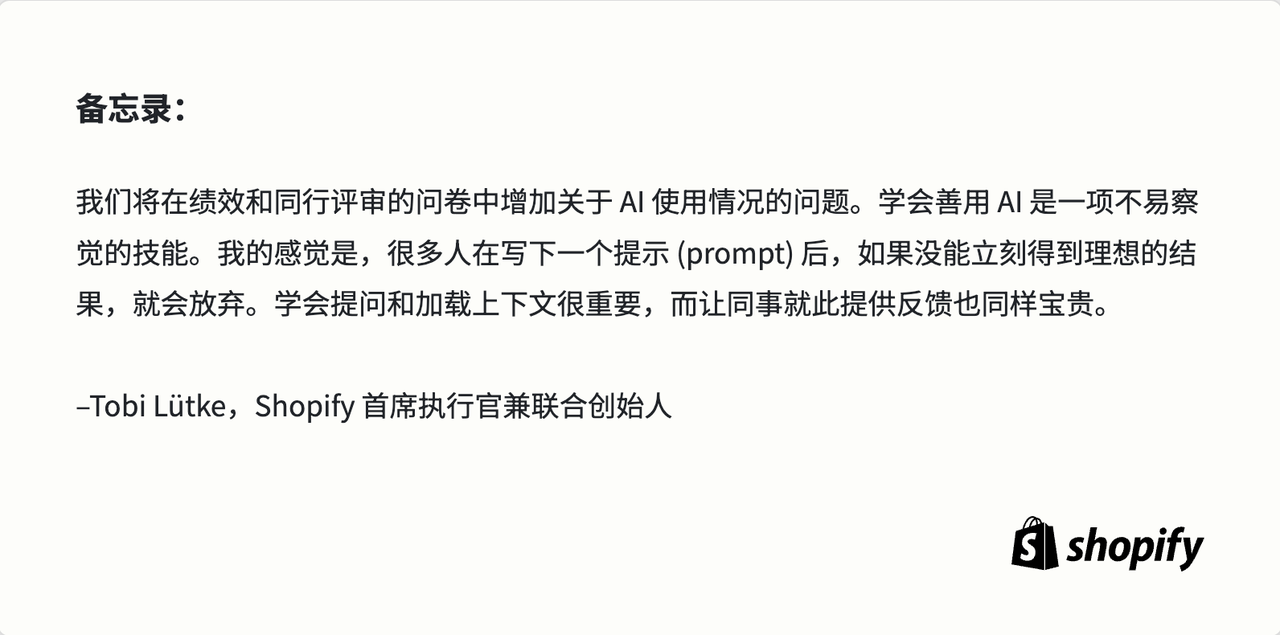
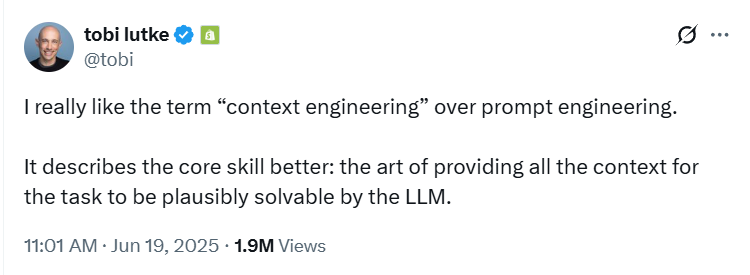
Shopify realized that the key to effectively driving the application of AI lies not only in optimizing prompt words, but also in systematically applying the concept of "context engineering" to employees.
For example: At Shopify, project leaders are required to submit project progress reports every week, which makes the company's project management system an information highway. Now, an AI agent automatically captures GitHub pull requests, documents, comments, and Slack channel information related to the project and writes a draft of the weekly report.
Every Friday, the project leader receives this AI-generated report, but with a series of challenging questions, such as "What specific work did you complete this week?" This forces the leader to critically examine the AI summary and optimize it. They are motivated to find discrepancies with the actual situation and expose potential risks, rather than hastily accepting the completion status, because they hope that the results of their work can be accurately understood.
"Based on the feedback from the project leader, AI will generate a new report. We will compare the final version with the first draft, and AI will learn and evolve based on these rewrites," Thawar said. In the past, writing weekly reports required a lot of time to collect information, but now project leaders can focus on what humans are best at and should do: critical thinking and challenges to make work better.
We found that half of the first drafts of weekly reports generated by AI were approved without revision. These reports were of high quality, in part because the AI incorporated all the relevant information it could access.
Farhan Thawar VP and Head of Engineering at Shopify
Workflow: Roast framework for "complaining" code
Shopify runs one of the largest Ruby on Rails applications in the world. It is always a challenge to enable a large number of engineers to collaborate efficiently and jointly maintain such a large single code base, especially in a language environment like Ruby that advocates "convention over configuration" and encourages developers to play freely.
Shopify engineers have found that AI can be a powerful tool for maintaining code conventions, unified unit testing, and code update specifications. But AI itself is not reliable, it requires clear structural guidance and combined with deterministic tools and principles.
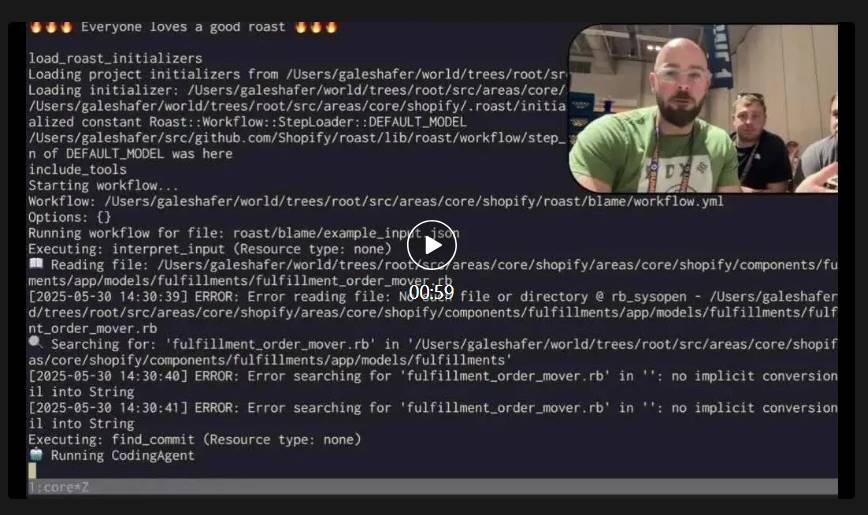
So Shopify developed Roast, an open source AI orchestration framework for code inspection, repair, and iteration. Its name comes from an AI tool of the same name within the company, which provides constructive criticism and improvement suggestions for existing code and unit tests in the form of "roasting". Roast is not a single prompt that must do everything, but allows developers to design and run a feedback loop consisting of a series of small, precise steps with a high success rate:
Roast breaks down the workflow into multiple steps and clearly demonstrates the AI reasoning process at each step.
These steps together form a complete conversation history, making it easier for engineers to trace the AI's decision-making logic.
Its core CodeAgent (built on Claude Code) will summarize each of its actions and the reasons for them.
When performing tasks such as grading tests, Roast will provide detailed feedback on the scores, explaining the "why" and "how" before presenting the final results.
“When you combine deterministic tools with AI tools, they can complement each other’s information and fill in the gaps,” said Samuel Schmidt, a Shopify employee developer who helped develop Roast. Roast simplifies the use of agents and shows the engineers working with them the entire process of their work, making it easier to execute complex processes in a repeatable and scalable way.
This tool has solved many technical problems for Shopify, such as helping engineers analyze thousands of test files and automatically fix common problems, thereby improving the overall test coverage of the code. In the process of solving these problems, the team also explored a new paradigm for using AI to complete complex engineering tasks more reliably, which is also a challenge currently faced by many teams. Therefore, Shopify decided to open source Roast and invite the entire community to jointly shape the future of AI-assisted task execution.
04. Develop a “beginner’s mindset” in product development
Shopify is not only increasing the number of beginners, but is also changing the product development process to place more emphasis on prototyping, a practice of putting yourself in a beginner’s mindset. They believe this is the real key to breaking through bottlenecks and finding solutions.
Strategy: Hire more junior talent
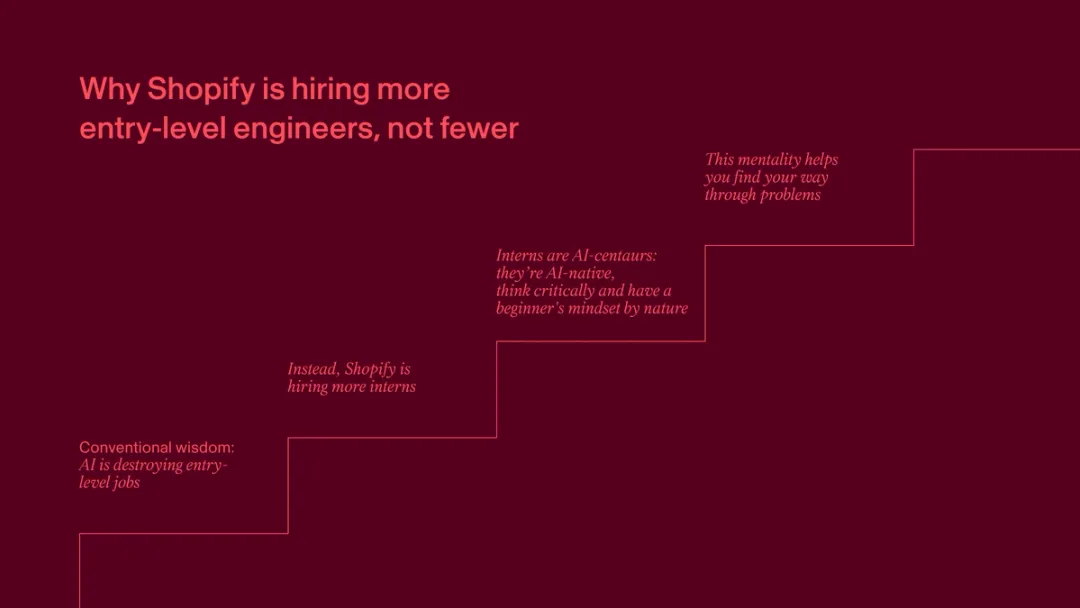
In terms of talent strategy, Shopify deliberately changed its thinking. Instead of staying at the simple superficial understanding that "AI will replace manpower", it established a new principle: "If you can use AI to create outstanding value, the company will invest more resources to support you", and these resources include new manpower.
The traditional view is that AI will destroy entry-level jobs, and engineering graduates generally have a sense of "doomsday" and worry about being unemployed after graduation. But Shopify, on the contrary, hired more interns because they found that these young people are the ones who use AI in the most creative way, and they are born with a beginner's mentality.
After successfully bringing in 25 engineering interns, Lütke asked Thawar what the maximum size of the project could be. “My initial answer was 75 people with the existing infrastructure. But I later took that back and updated the answer to 1,000,” Thawar said.
Thawar has extensive experience in internship project management. He knows that interns can bring vitality, passion and drive to the team. In the post-LLM era, they also bring a new skill: they are natural "AI Centaurs." "They are always curious about new tools and shortcuts. I hope they can be 'lazy' and use the latest tools," he said. "We have witnessed this in the mobile Internet era. At that time, I hired a large number of interns because I knew they were 'mobile natives'."
Strategy: Use more prototypes to find the best path

Now, more prototyping occupies a more central position in Shopify's product development process. Specifically, the company focuses on increasing the ratio between prototype attempts and final builds. This implements a core principle of Shopify, the "green channel of product development": the only way to solve a complex problem is to keep trying. Lütke once said to Thawar: "There are countless bad solutions to a problem, and about 10,000 good solutions. Your task is to find the best solution among those 10,000. What you just showed was just the first solution that worked, not the best solution. Why did you stop?"
“You’re looking at a problem with hundreds of variables and layers, and you have to explore different paths that may lead to a similar-looking end product, but the trade-offs behind them may be very different,” Thawar added.
For example, Shopify’s internal AI chat tool originated from a prototype. Senior engineer Matt Burnett initially experimented with open source tools just to improve internal access to LLM. He iterated on early versions, fixing issues such as data loss and scalability, and exposed architectural flaws by letting colleagues try it out early. Eventually, the tool was adopted so widely that the company formed a dedicated engineering team to run it.
AI usage is closely linked to performance
To measure various dimensions of engineering effectiveness across the organization, Thawar uses an engineering activity dashboard. It tracks who is pair programming, who is interviewing, and, as mentioned earlier, who is using Copilot.
Shopify's data over the years shows that pair programming can significantly improve learning speed. Using this dashboard, the company conducted an analysis to examine the relationship between pair programming time and performance evaluation results. The results show that the longer the engineer's pair programming time, the greater their influence; otherwise, the smaller.
Now, the dashboard also tracks employee use of AI tools such as Cursor, Claude Code, and LLM Agent. A preliminary analysis shows that employees who use these tools also have a positive correlation with their influence. This helps identify tools that can truly create value and their connection to individual performance.
Shopify has already incorporated AI-related questions into its 360-degree evaluation system. Managers and colleagues are required to rate each other's performance in terms of "AI native" or "AI reflective." The company plans to conduct a more in-depth analysis of the relationship between AI use and personal influence after accumulating a few years of data.
Thawar himself also practices pair programming to demonstrate how to use AI. "I pair program with an engineer, partly to observe his approach to problem solving, and partly to promote my ideas. I always have a ChatGPT tab open to show him how I work with AI all the time in practice."
05 Efficiency improvements will reshape workflows
If you could analyze every movement of a professional sports team training or a Michelin-starred restaurant kitchen, you would find that their movement efficiency is as high as 80%. On the other hand, the operating efficiency of a company may be only 20% at most.
“There’s an incredible amount of waste in business simply because we haven’t figured out the best way to do things,” Thawar points out. “It’s obvious that AI can speed up existing processes. But the deeper, less-appreciated value is that it can suddenly make you realize that your processes should be run in a completely different order and based on completely different assumptions. When that ‘aha’ moment comes, you may be able to skip a lot of redundant work or reinvent the process.”
Think about that website audit tool again. Thawar thinks about how it could revolutionize the sales process. “When the cost of producing a website audit report becomes negligible, you could potentially change who presents this data and when in the sales process. For example, you could introduce it earlier in the sales funnel instead of waiting until the account is highly qualified. This could change the types of accounts that sales development reps (SDRs) are approaching,” he says. “This could ultimately lead to a whole new sales process driven solely by the fact that we can produce a website audit report at a very low cost.”
He cited the highly respected but extremely difficult to replicate "Toyota Production System" as an example. AI may be changing all this. "AI fundamentally changes our basic assumptions. You can use it to crack complex combination problems in the production line and increase efficiency a thousand times. This is the real magic. What we are pursuing is to discover this "power of process."