This report, written by Tiger Research, analyzes Camp Network's innovation in AI-native IP infrastructure and its position in the evolving data sovereignty economy.
Key Points
- Data drives AI development, but experts predict data will be exhausted by 2026, creating a severe bottleneck for AI technological advancement.
- Camp Network addresses this issue by enabling users to secure data ownership while ensuring AI pays fair costs for licensed data usage through the "Proof of Provenance" protocol.
- Through this approach, Camp Network simultaneously achieves AI technological progress and intellectual property protection, creating a new economic ecosystem benefiting everyone.
1. Data is Everything We Need
Artificial intelligence technology is developing at an unprecedented speed. Data has always been its core. AI models develop by learning massive text, images, and videos created by humans. In this sense, AI is essentially intelligence built by data.
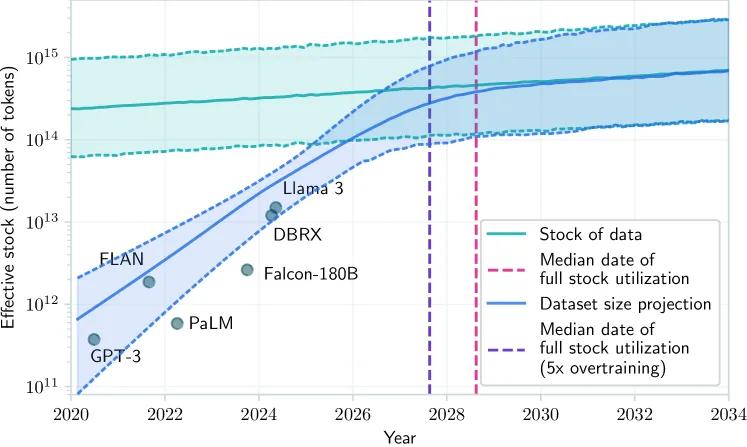
Data Exhaustion Prediction, Source: Will We Run Out of Data? LLM Expansion Limits Based on Human-Generated Data
But data-driven development has reached its limit. High-quality data is running out. Major foundational models like GPT have consumed most accessible internet data. They use these data for training. Easily collected data has been depleted. Future prospects are worse. Recent research shows a worrying trend. By 2026, human-generated data will be almost exhausted, including future content creation.
Now, some large tech companies are scraping user data without permission. They try to address this shortage. Reddit has sued Anthropic for unauthorized scraping. Anthropic used Reddit's data to train its Claude AI. This raises ethical issues. Most users are unaware that companies are using their data. They also receive no compensation.
The current situation creates a vicious cycle. Without new data, the AI industry will hit a wall. Users are increasingly distrustful of unauthorized data usage. Both sides are dissatisfied. Data-hungry companies need more content. Users with data need protection. This sacrifices both AI progress and data protection.
2. Camp Network: Layer-1 Blockchain at the AI x IP Intersection
At this moment, Camp Network takes the spotlight. They introduce cutting-edge infrastructure for the AI era, addressing data scarcity and unauthorized use challenges. Their initial solution was enabling users to carry social data from YouTube, Instagram, and TikTok, like a portable "digital backpack". They leverage this data across diverse chain environments. This approach allows users to directly control their data, ensuring compensation and laying the foundation for enhanced data sovereignty.
Source: Camp Network
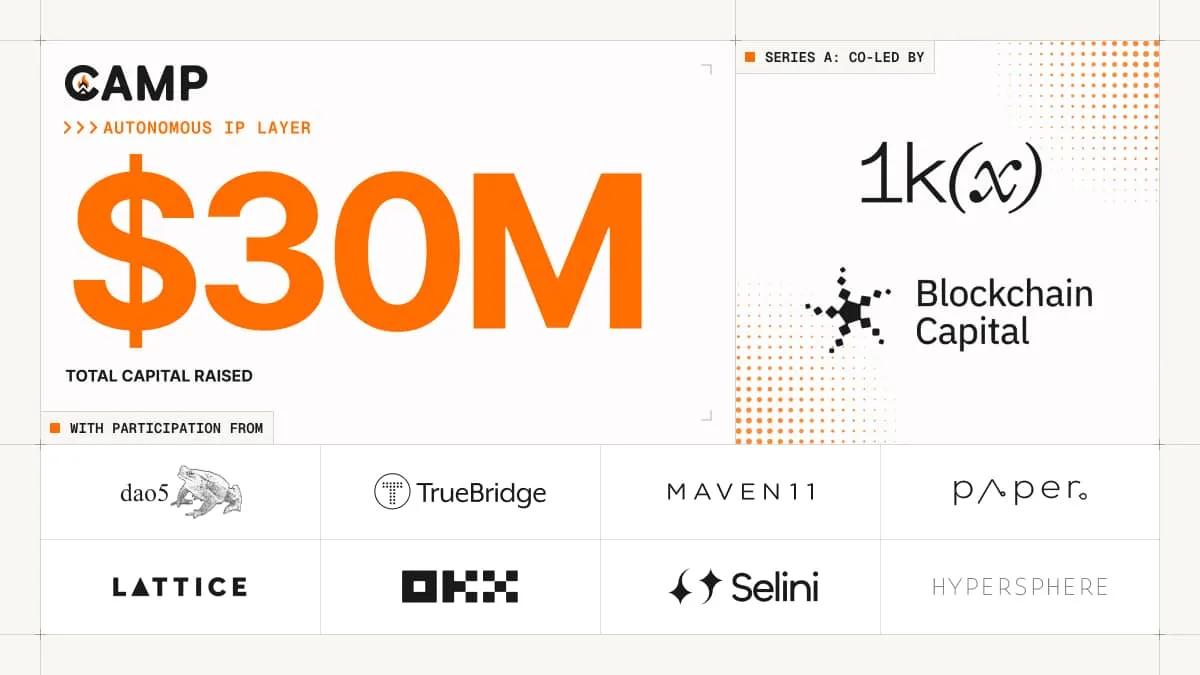
Camp Network didn't stop there. They utilized accumulated experience and technology, helping them expand beyond social data to the intellectual property domain. Their goal is comprehensive user data protection. In 2025, they announced a revolutionary vision called the "Autonomous IP Layer". This marked a significant transformation, attracting $30 million in Series A funding led by 1kx and Blockchain Capital, ensuring a new growth milestone.

Source: Camp Network
Camp Network presents the Autonomous IP Layer as fundamental infrastructure serving the AI and IP intersection. Its core revolves around the "Proof of Provenance" protocol. Users register their data on-chain, with AI utilizing this data layer. Royalties are automatically settled based on preset conditions.
Camp Network provides three components to realize this vision. BaseCAMP and SideCAMP constitute blockchain infrastructure. The Origin framework handles on-chain IP registration and management. The mAItrix framework supports AI agent development. These components work together, building an organic ecosystem from IP registration to utilization and monetization.
The key feature of Origin is constructing intellectual property relationships in a "graph" format. Derivative content of a work becomes a new smart contract. They are connected to the original content through parent-child relationships. Royalties generated from derivative content are automatically distributed to the parent intellectual property. Users can easily view the entire content's lineage.
The Origin framework also attracts developers and creators. The Origin SDK enables developers to easily build intellectual property applications. They do not need complex blockchain knowledge. Core functions are built into the SDK. These include intellectual property registration (Onboard). They include derivative content creation (Remix). They include metadata search (Query). They include income allocation (Monetize). They include permission management (Permissioning). Developers can build a complete intellectual property ecosystem with just a few lines of code.
Origin supports on-chain dispute resolution mechanisms. Intellectual property involves sensitive areas such as copyright infringement. Anyone can raise a dispute about suspicious intellectual property. Camp DAO makes the final ruling. Sometimes the parent intellectual property may enter a dispute state. All child intellectual properties derived from it will automatically inherit the dispute status. This systematically and strictly manages complex intellectual property issues.
Origin is not just a tool for minting intellectual property as Non-Fungible Tokens. It operates as an on-chain copyright system. It transparently tracks everything from the source of creation to utilization and income distribution. It automatically executes these processes.
2.3. mAItrix Framework: A Native AI Agent Development Framework for Intellectual Property
mAItrix provides an integrated SDK for developing, training, and deploying AI agents. It works in coordination with the Origin framework, connecting the entire process into a pipeline. This covers using on-chain intellectual property for AI model training to generating derivative content through AI agents.
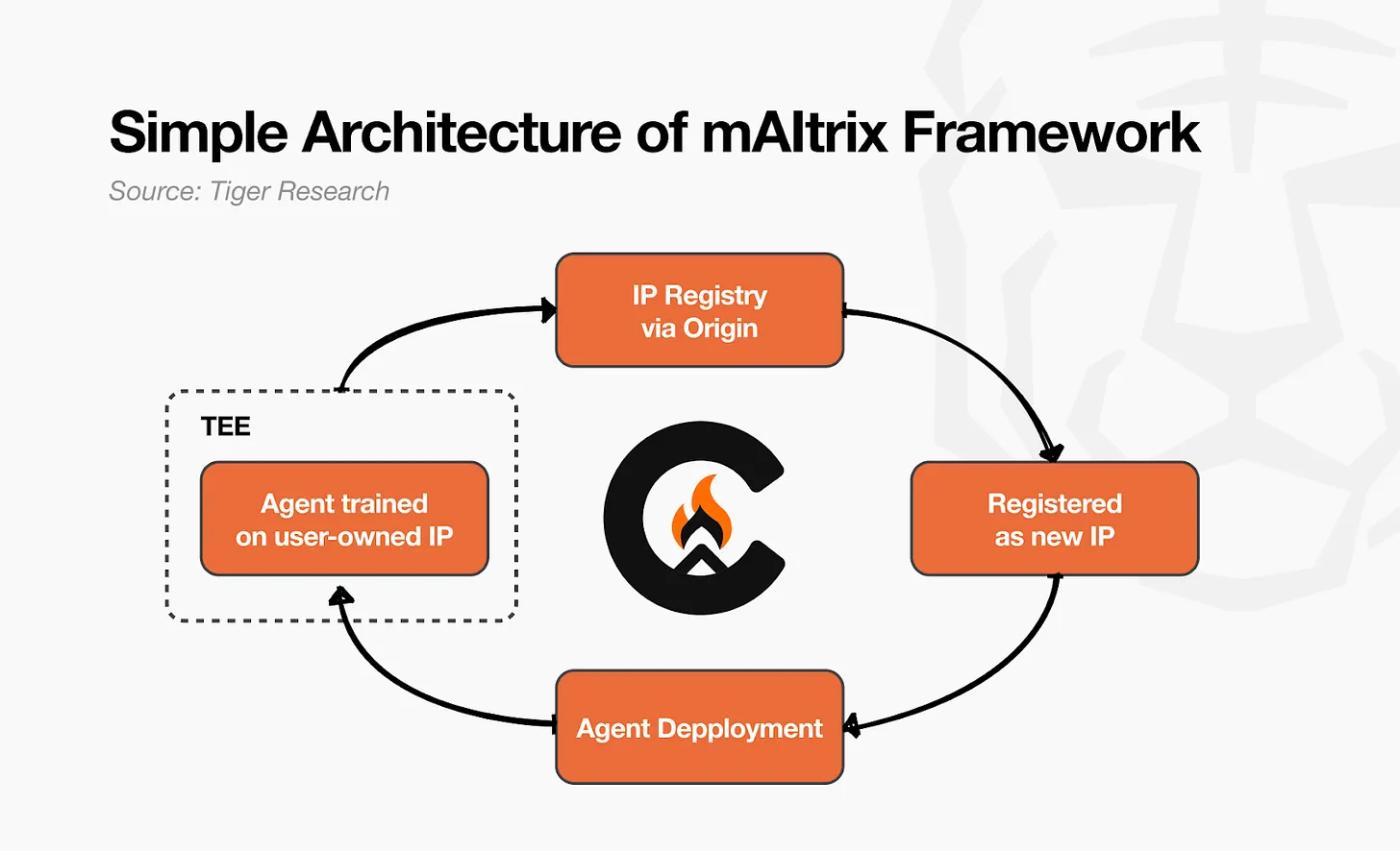
The core focus of mAItrix is on AI training and utilization. It only uses licensed data. Traditional AI indiscriminately collects all internet data. It uses this data for learning. mAItrix works differently. It only uses data with clear ownership. This data is registered in Origin. This enables creators to receive fair compensation. They are paid for their data being used. AI developers can develop AI safely. They avoid legal disputes.
This approach goes beyond simple technical improvements. It presents a new paradigm for the entire industry. In the past, music markets were rampant with illegal downloads. Streaming services like Spotify established fair payment systems. The market even grew larger. Similar changes are expected in the AI and intellectual property market.
mAItrix also simplifies complex processes. It helps deploy AI agents. It helps run AI agents. It builds an environment for multiple AI agents to interact. AI agents developed through mAItrix can themselves serve as intellectual property assets. They are tokenized through Origin. They are registered on-chain. Other users utilize them. Other agents utilize them. Developers receive automatically allocated royalties each time. New content generated by AI agents. This is registered as new intellectual property. It becomes an additional source of income.
mAItrix aims to create a developer-friendly platform. It provides developers with maximum freedom. They can freely utilize any AI model. TEE (Trusted Execution Environment) securely protects sensitive data. TEE refers to Trusted Execution Environment. This prevents external leakage.
Camp Network plans to develop mAItrix in three stages. The v1 version is currently being prepared. It will provide an integrated environment. Developers can directly use intellectual property registered in Origin to train AI. It offers a more user-friendly interface than existing AI tools. The v2 goal is to become an "agent-oriented Vercel". This will enable easy AI deployment. It avoids complex server setups. The final v3 will provide intelligent routing services. Users say "create music" or "generate image". The system will automatically find suitable agents. It connects AI specialized in music or image generation.
3. How is it Different from Other Intellectual Property-based Protocols?
Camp Network takes a different approach from existing intellectual property-related protocols. Comparing it with Story and Soneium clearly shows these differences.

Story and Soneium focus on frameworks for utilizing and managing traditional Web2 intellectual property on the blockchain. Their primary goal is to improve the management efficiency of existing intellectual property. This includes copyrights held by large entertainment companies and media groups. It also enhances scalability. This represents a meaningful approach to helping the existing intellectual property industry undergo digital transformation.
Camp defines user-owned intellectual property as a broader concept. It refers to all digital data and content created by users. This includes YouTube videos, Instagram photos, and TikTok content. All forms of personal data are applicable. Camp goes further. It focuses on integrating these user data with AI. Camp's design is premised on AI and intellectual property integration. AI agents learn from and generate new content using licensed personal data. This is also registered as new intellectual property. This builds a complete pipeline. Camp's core concept is to create a win-win structure. It protects user data while simultaneously driving AI technology development.
Camp's ultimate goal goes beyond simple intellectual property management. It builds a new economic ecosystem where all participants fairly share value. This includes individual creators. It includes AI developers. What Camp provides is not a digital transformation of the existing intellectual property industry. It presents a completely new paradigm of creation and collaboration applicable to the AI era.
4. The Future of AI Technology and Intellectual Property Protection
Data exhaustion and legal disputes represent the current crisis of the AI era. Unauthorized scraping triggers these disputes. They are not future problems. Predictions show worrying trends. By 2026, human-generated data will be almost depleted. Lawsuits from Reddit and Anthropic demonstrate structural limitations. Existing AI development methods have these limitations.
Camp Network precisely offers a fundamental solution to these problems. It simultaneously addresses supply and consumption issues. It utilizes a new ecosystem of AI and intellectual property fusion. These ecosystems are centered on user-owned data. Provenance proof protocols clearly establish the origin of intellectual property. AI learns from the data. It automatically allocates royalties. This transforms one-way data exploitation into a mutually beneficial system.

This approach has already produced substantial results. The Camp ecosystem currently registers 300,000 unique intellectual properties. It has created 4 million unique wallets. This demonstrates large-scale user adoption. Over 60 teams are using Camp Network's infrastructure to develop various applications. Cases combining AI and intellectual property are emerging in multiple fields such as music, gaming, and sports.
Camp Network's role will become increasingly important in the future. AI agents will become ubiquitous. Agents will directly generate intellectual property. They will collaborate with other agents. They will automatically handle licensing. These environments require infrastructure. This infrastructure must be able to quickly track complex relationship networks. It must manage them efficiently. Existing intellectual property workflows are slow and expensive. They cannot meet these requirements. Camp is already prepared for these foundations.
Camp Network's ultimate goal is to become a core solution. It addresses data challenges in the AI era. It aims to become the standard for a new intellectual property ecosystem. It presents a new paradigm. These solutions address the fundamental data scarcity problem in the AI industry. They resolve personal data sovereignty rights. This creates a foundation. Creators pursue mutual benefit. Developers pursue mutual benefit. AI systems pursue mutual benefit. They develop together. This ecosystem has generated over 50 million transactions. Collaboration between AI and intellectual property has become an actual operating economic system. They are no longer just concepts.