


In February 2025, Zora, a social platform in the Base ecosystem, launched the "COIN" feature, and within a few months, Base officially actively promoted the concept of "content tokens". From "Base for everyone" to many tokens that became popular and then quickly disappeared, there was little market discussion.
Until the recent surge in $ZORA price, more and more people began to pay attention and discuss it. A researcher from DelComplex, Sterlingcrispin, reposted a community member's post praising ZORA and sarcastically remarked, "Any low-liquidity token with an exponential price curve is garbage, whether you call it a creator token, cultural token, internet capital market, or music token".
This sparked a discussion among Base's founders. Jesse Pollak subsequently tried to explain the differences between "creator tokens", "content tokens", and "MEME tokens". Solana co-founder Anatoly Yakovenko also joined the discussion, scoffing at Jesse's "content fundamentals" perspective. Their long-distance argument triggered community discussions about "content's fundamental value and speculative frenzy".
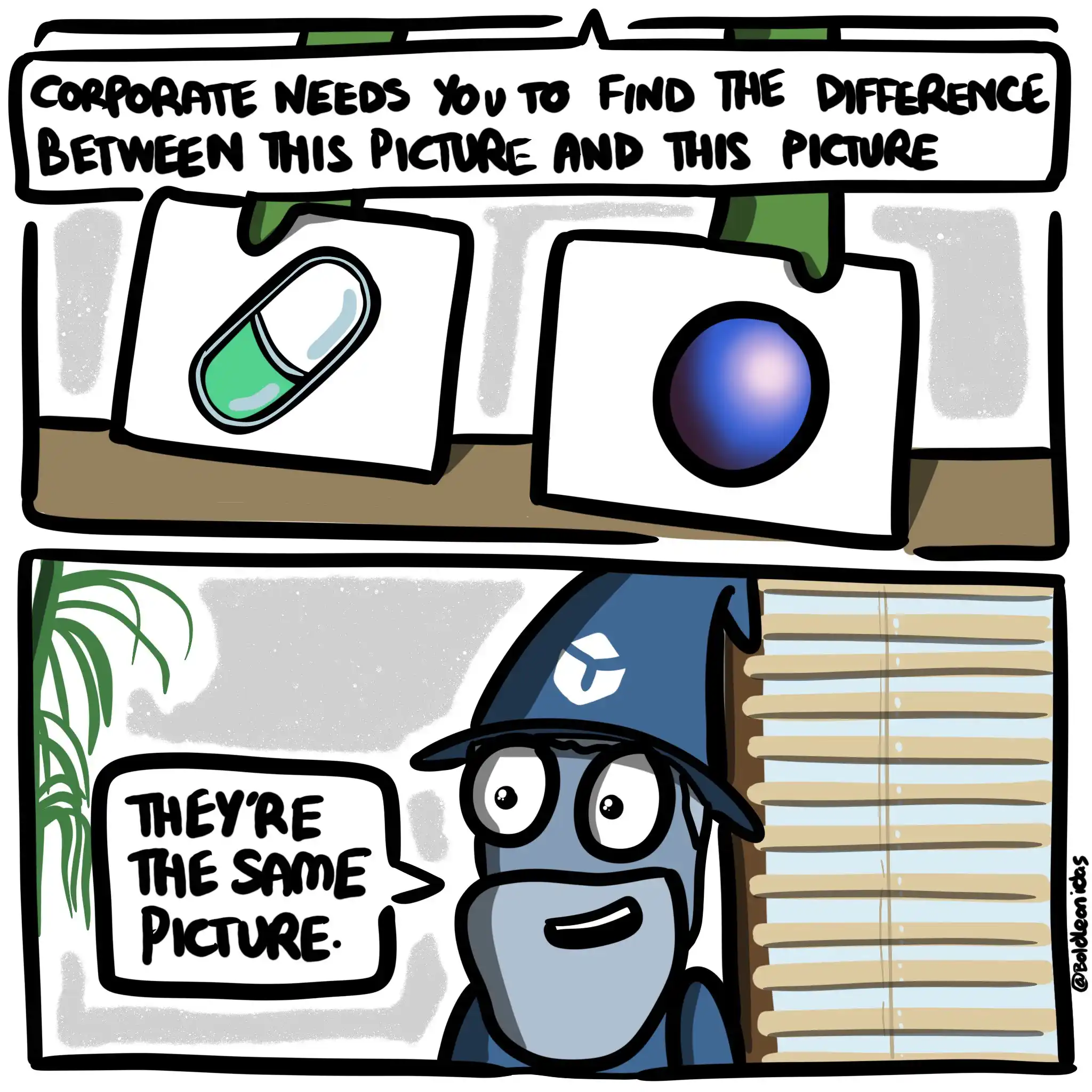
In fact, this discussion has continued since the Non-Fungible Token boom without reaching a conclusion, with the carrier shifting from "blue-chip Non-Fungible Tokens" and "on-chain meme Non-Fungible Tokens" to today's "content tokens" and "MEME tokens". This article will analyze the truth behind this by combining market perspectives, available data, and research materials.
Do Content Tokens Have Fundamental Value?
From an economic perspective, fundamental value often refers to assets that can generate cash flow, usage rights, or long-term utility. This standard is quite common in the stock market, as the business income of the company you purchase stock in is often more related to its stock price. Before this year's "compliance" trend in the cryptocurrency industry, few discussed this standard, as most cryptocurrencies lack actual business lines.
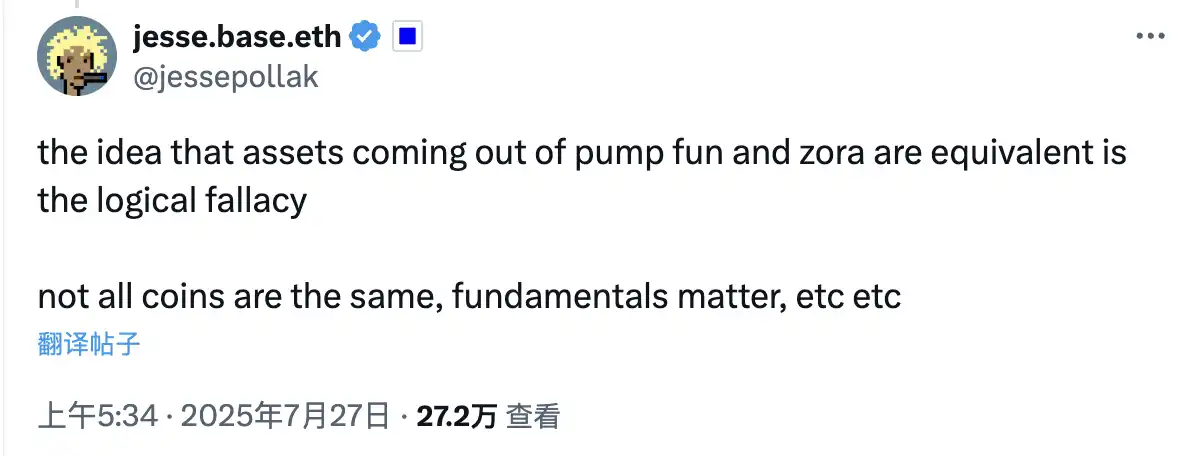
When Jesse raised the discussion, he repeatedly mentioned "Fundamentals Matter", briefly stating that "Content" has inherent value. Toly, after hearing Jesse's response, said his argument "sounds like zero fundamentals". He believes creators entirely rely on personal reputation and social heat to support prices, making these tokens similar to one-time "pump and dump" marketing. If a token truly has fundamental value, its value should not be affected even if the creator sells, because fundamental value should be independent of buying and selling behaviors. This popularity-dependent model differs from assets with actual output or cash flow, making it difficult to call a "fundamental investment".
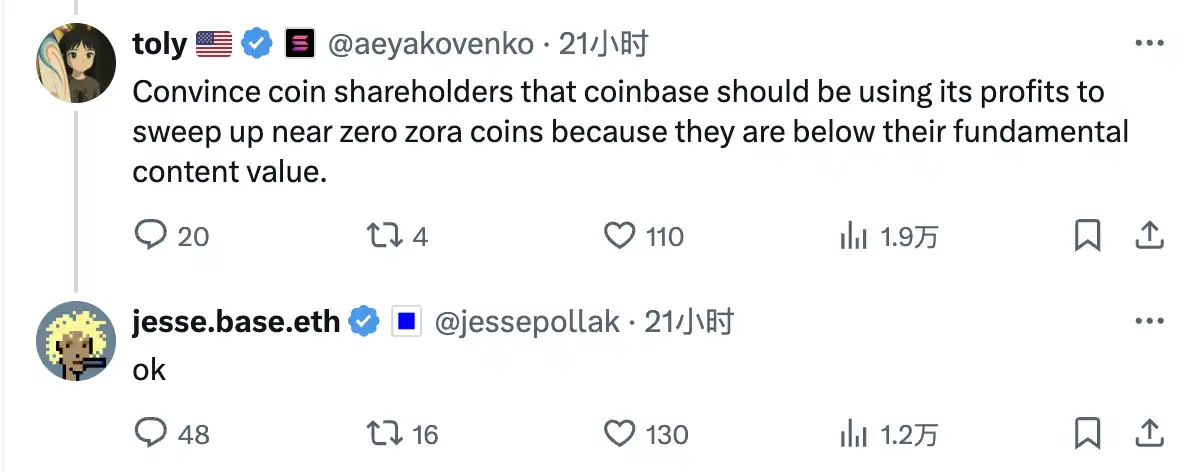
Most content tokens are no different from memecoins, lacking sustained income or equity, with value completely dependent on maintaining creator or community heat, easily experiencing emotional and traffic-driven volatility, potentially even dropping to zero. Toly even directly stated that Coinbase should use transaction fees to buy those zero-value tokens on Zora because they are below their "content baseline".
However, Jesse's perspective might not be groundless. The fundamentals he discusses may not be the effect of a single token (at least not in their current state), but rather a model established after mature distribution systems and copyright economies. Most content tokens are essentially short-term collectibles or gamified products. True "creator fundamentals" require a massive user base, sustained attention, and reasonable revenue distribution, which needs time and infrastructure construction.
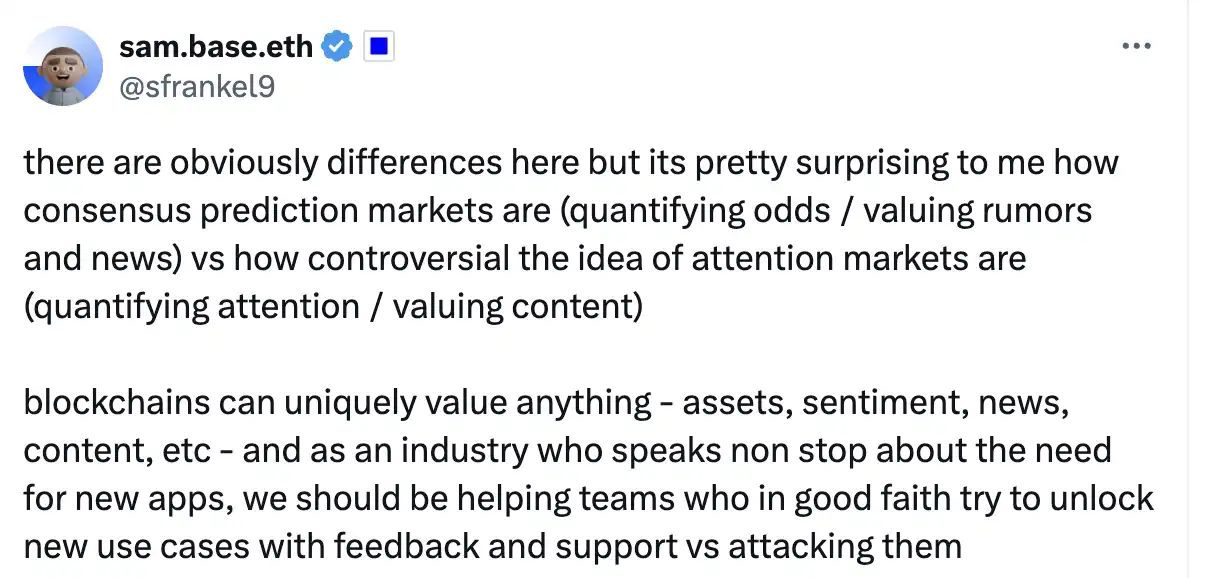
However, this also requires clearer governance and equity design, otherwise it may easily touch upon legal risks of unregistered securities. In the long run, building a decentralized social platform with a social relationship graph and content discovery algorithm is the key to forming a true on-chain content ecosystem. Currently, Zora and other platforms' distribution capabilities are insufficient. Trend's founder Mable Jiang expressed understanding of Jesse's original intention in the discussion and also agreed with Toly's criticism. Just recently, she launched a product on Solana similar to Zora called Trend, highlighting several key points:
Most content lacks value. In today's generative AI era of almost zero-cost content creation, the vast majority of content lacks scarcity and lasting value. Many trending posts remain untradeable even when published by well-known IPs.
The lack of distribution and social graph makes content on Zora difficult to discover and generate value.
Some content indeed has commemorative value, such as recording historical events or artistic moments, and such content tokens might have long-term "weight". But these are rare; most content tokens will not generate trades, which is a crucial reason why most content tokens lack value.
The Wool Comes from the Sheep - Does Blockchain Have a Creator Economy?
The original poster sterlingcrispin mentioned content creation incentives and content distribution issues in further discussion with Jesse, stating that "interacting with the market through binary buy/sell decisions allows buyers and sellers to express their belief in asset value at any time, but this might not be the best way to express belief in content creator value".
He further stated, "The second-order effects and human behaviors of the past decade show that such mechanisms often evolve into highly destructive zero-sum PvP games. Especially for AMMs (referring to Bonding Curve) with low liquidity and exponential price curves, these are suitable for large-scale mature markets with tens of millions or hundreds of millions in liquidity, not small creator scenarios. Most tokens in the market are almost Altcoins. Focusing solely on theoretical paper gains is an idealized ivory tower thinking; the real problem is facing actual human behavior".

Azuki's founder Zagabond commented on this issue, "We shouldn't get angry when someone points out that certain tokens lack fundamental value. It's okay because in many industries, cultural/perceived value is already more valuable than basic value, such as luxury brands, intellectual property/collectibles, meme coins, artworks, etc. Tokenization is just the financial infrastructure to capture this value."
[The translation continues in the same manner for the rest of the text, maintaining the specified translations for specific terms.]Although the "casino concept" of Solana is deeply rooted, its problems have also emerged, with an average of 20-30 thousand new tokens added to the market daily, making it increasingly difficult to attract attention, and the total market value of these Memecoins continues to decline. @thecryptoskanda further analyzed that Solana adopted a migration strategy, first collaborating with OG communities and institutional forces to suppress Pump.fun that "continuously sells SOL", and attempting to establish a more controllable and long-term stable market maker system (LetsBonk), avoiding the uncontrollable "public sea gambling ship" driven by market sentiment. The cooperation with Kraken aims to shift speculative盘 from the old platform to a new sub-platform, continuously providing a "sudden wealth opportunity" for a small number of people to stabilize most users and maintain the financial stability of the SOL ecosystem.
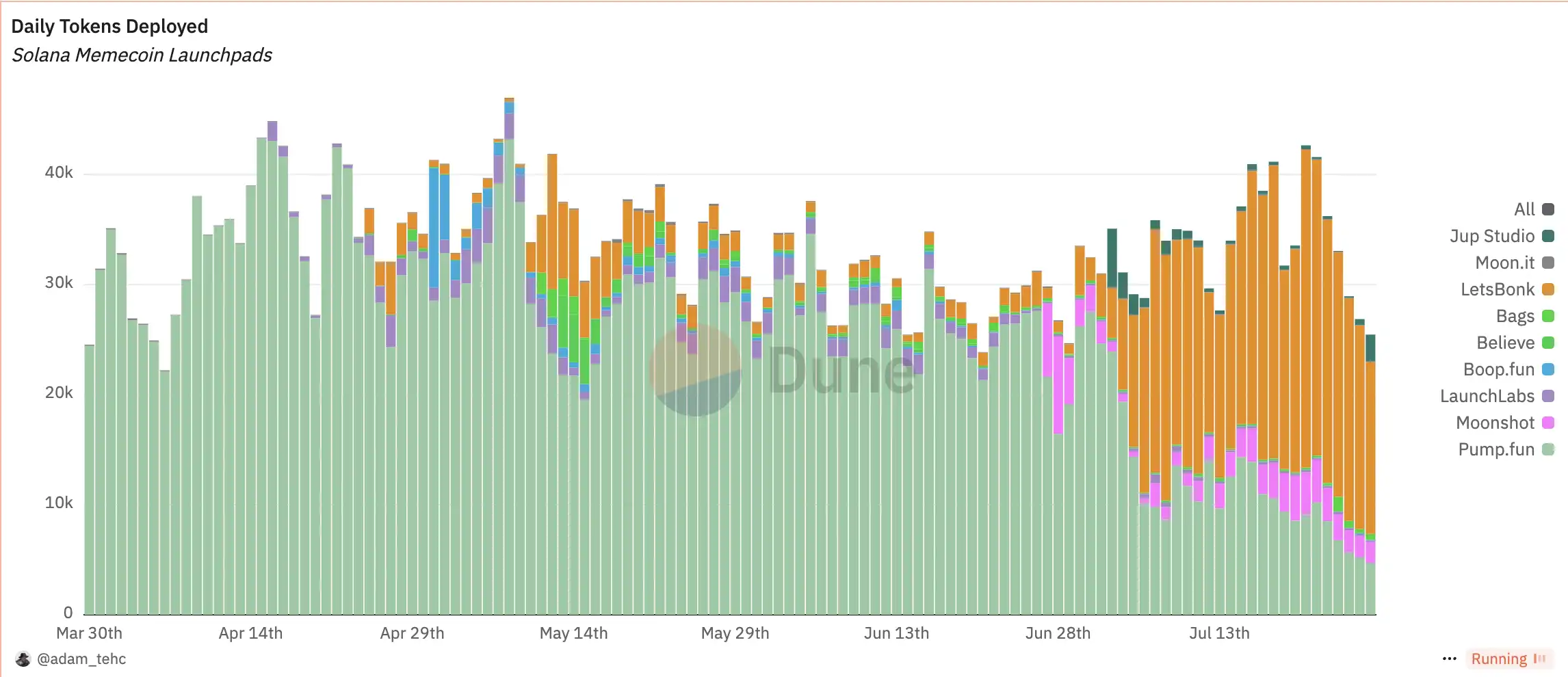
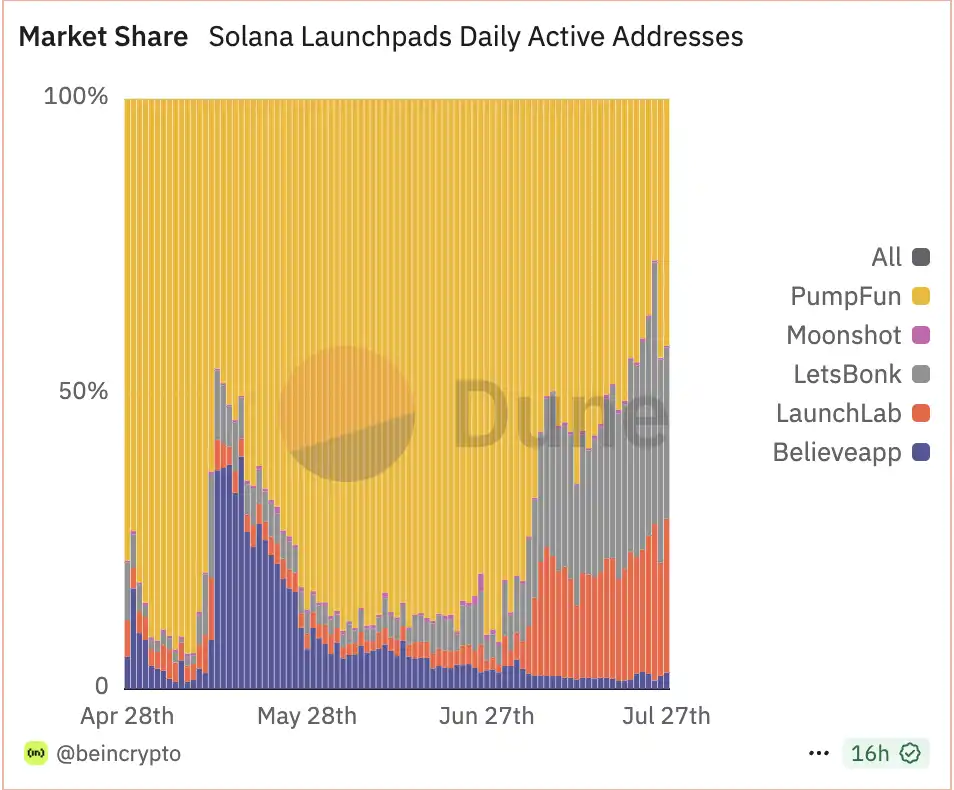
However, the migration strategy is not smooth sailing, encountering significant "bottlenecks" both internally and externally. Within the ecosystem, they successfully pushed BONK, a team that will continue to contribute, to a market share exceeding Pumpfun, but this is merely a stopgap measure. Its positioning is also Memecoins. The true meaning of opening a sub-platform should be the "ICM" and "coin stock concept" they mentioned earlier, but these have not met expectations. The market share of Believe, the leading platform of ICM, continues to decline, and with the emergence of multiple "SCAM startups", the market merely sees it as a variant of Memecoins.
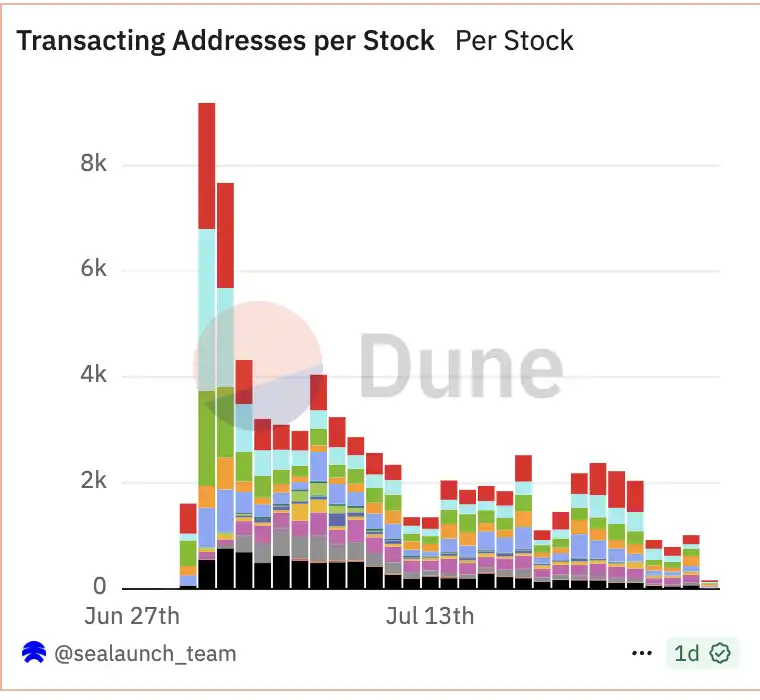
The on-chain US stock concept only sparked discussion in the first few days of issuance, but the actual number of participants is extremely low. In the past week, the total number of addresses participating in all on-chain US stock targets is barely over a thousand. The total trading volume has only accumulated to around 75 million USD in the past month.
Additionally, @thecryptoskanda mentioned that Solana's biggest competitor is not Base, but Binance. He believes Binance is a USDT-based casino, while Solana is a SOL-based casino, and they are in direct competition. Binance attracts SOL's liquidity through mechanisms like Alpha and refuses to list Solana Meme coins on spot/futures, forcing Solana to accelerate building its own closed-loop market.
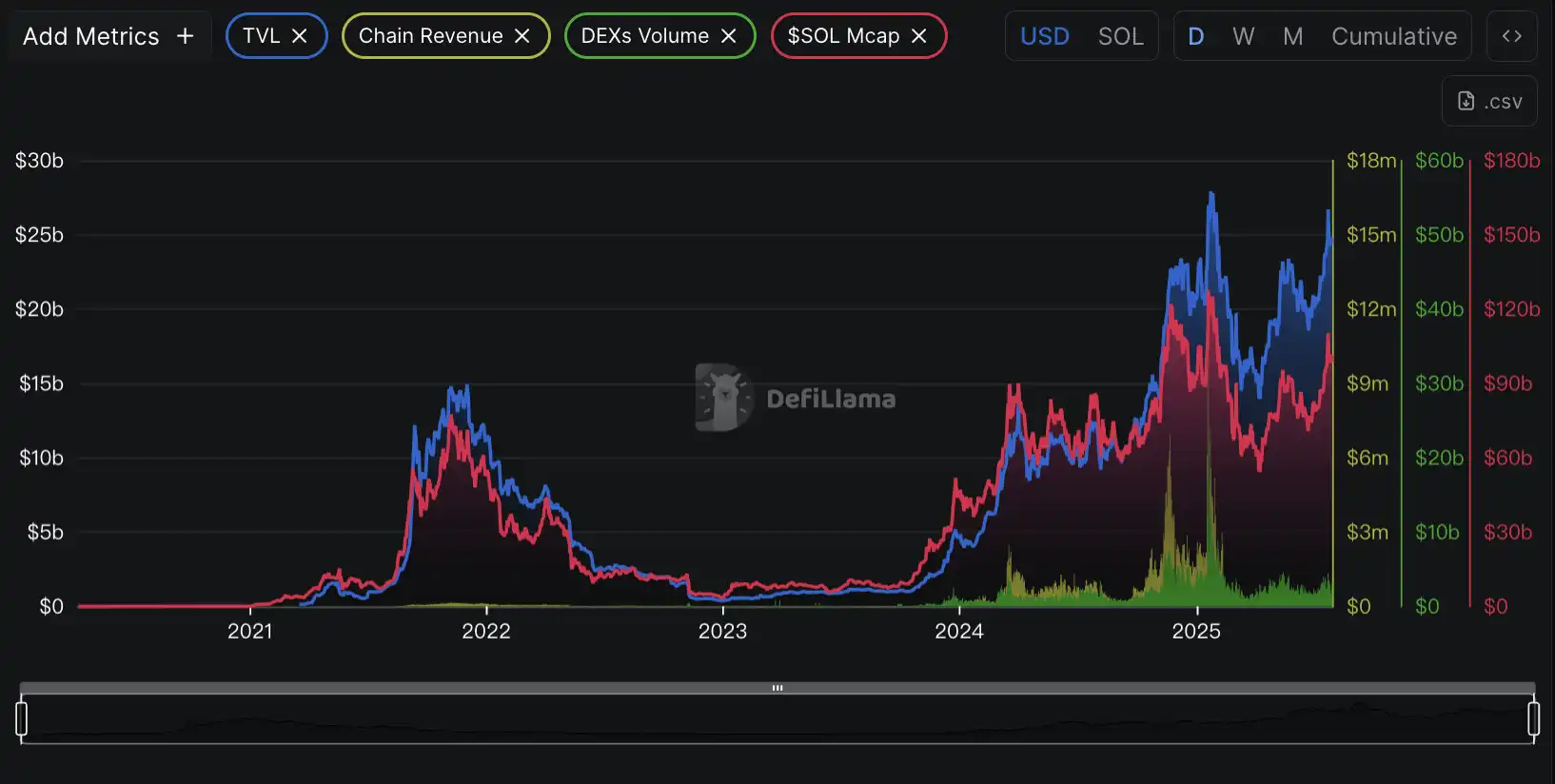
With internal concerns on one side and external challenges on the other, more and more coin stock companies and ETFs are choosing to reserve Solana through deep on-chain binding, either for interest income as a revenue-generating financial product or to maintain the "basic market" of its coin price. Regardless of which, Solana has reached a crossroads that requires accelerating its search for a way out.
They are not arguing about content and Memecoins' fundamentals, but the current basic market of Crypto
The debate between Base and Solana's co-founders around "content tokens" reflects a collision of two perspectives in the crypto field: one hopes to capture the value of the attention economy through tokenization, providing creators with a new income source; the other is wary of speculation and marketing gimmicks, believing that tokens lacking cash flow and use value can hardly be called "fundamental investments".
From existing data and academic research, most content tokens and meme coins have strong Veblen good characteristics, with their value depending on social identity and emotional spillover, rather than intrinsic returns. Platforms like Zora have iterated on on-chain content trading methods, but their user scale is hundreds of times smaller than mainstream social platforms, with the ecosystem still limited to crypto circles. Therefore, the fundamentals of content are largely still a vision, requiring solutions to "attracting and large-scale retention", "IP copyright and ecosystem merchant recognition", and "defining regulatory frameworks".
Under these immature conditions, content tokens and meme coins remain primarily speculative or collectibles, with their emotional spillover similar to luxury goods or trendy brands. For creators, exploring on-chain tools to build community economics is understandable, but they still need to grasp scarcity, value promises, and long-term reputation, avoiding becoming a short-lived traffic game.
In this era, content supply is infinite, but attention is scarce.
Click to learn about BlockBeats job openings
Welcome to join the official BlockBeats community:
Telegram Subscription Group: https://t.me/theblockbeats
Telegram Discussion Group: https://t.me/BlockBeats_App
Official Twitter Account: https://twitter.com/BlockBeatsAsia




