Background: Recently, Base founder Jesse and Solana founder Toly engaged in a heated debate over whether content tokens have value. The Zora platform, which tokenizes every piece of social content posted by users and allows for free trading on the Base chain, has sparked widespread discussion.
The core point of contention is Jesse's belief that content tokens represent the value of different pieces of content, which has its own inherent logic. Toly, however, questions the lack of a value verification mechanism (such as clear rights and interests in advertising revenue sharing). Jesse subsequently acknowledged that this is still a value-based game aimed at rewarding creators. Furthermore, a key factor driving this discussion is the recent significant appreciation of the Zora platform token. This raises the question: Do content tokens actually have fundamentals? Are these fundamentals based on the value of creators' content, or on the inherent prosperity of public blockchain ecosystems like Base? Will this usher in a "second spring" for the content economy?
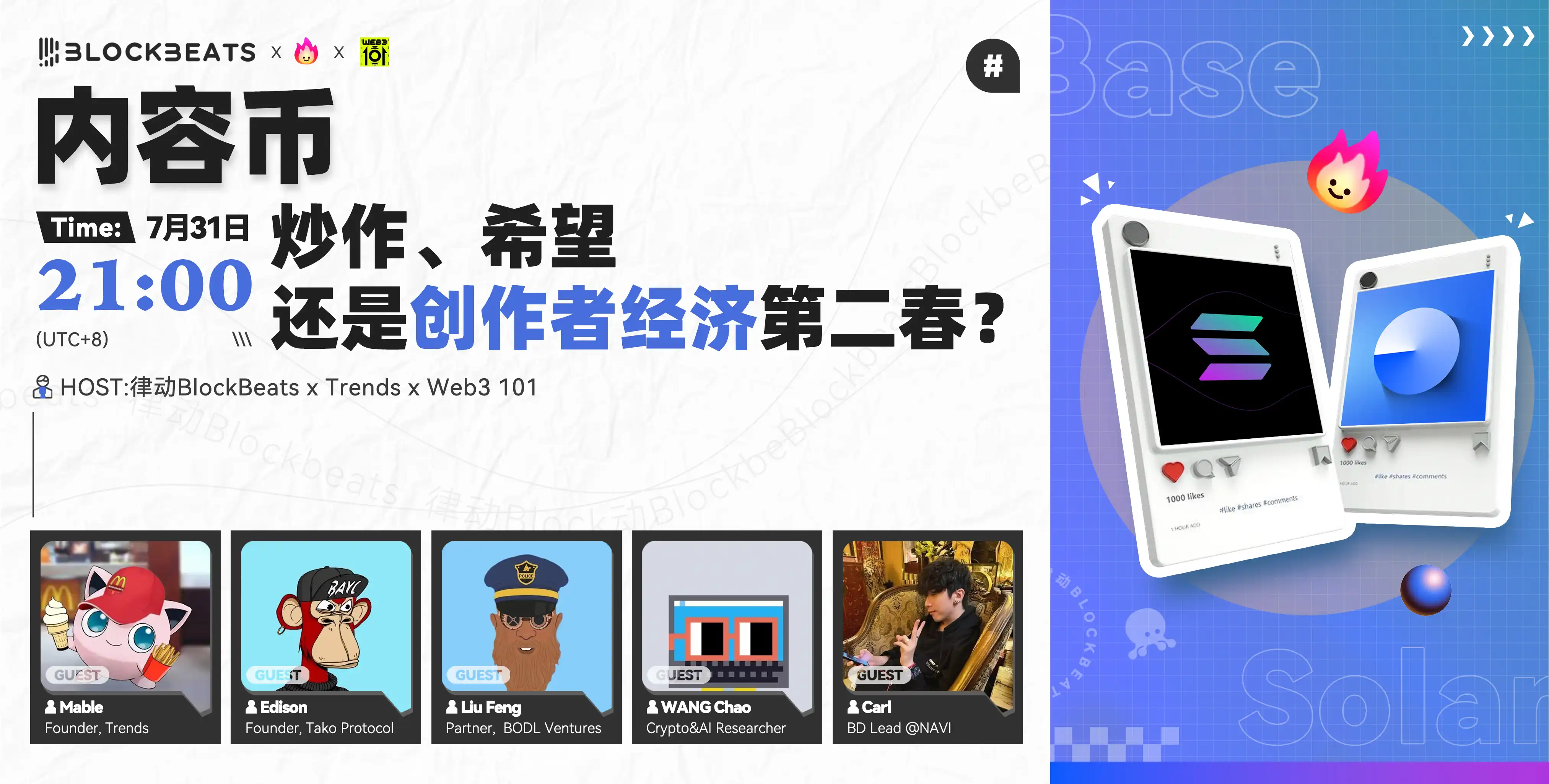
On the evening of July 31st, BlockBeats invited Trends founder Mable, Tako Protocol founder Edison, BODL Ventures partner Liu Feng, crypto and AI researcher WANG Chao, and NAVI Protocol business lead Carl to discuss the development and trends of content coins and the creator economy under the theme of "Content Coins: Hype, Hope, or the Second Spring of the Creator Economy?"
Items covered in this discussion include:
Zora: A platform that turns content into tokens. When a user posts a piece of content (similar to Instagram), the system automatically converts that content into tokens that can be traded.
Pump.fun: A meme launch platform that transforms memes or memes on the Internet into tokens for users to trade.
Friend.tech: A social app where users can purchase private group keys (tokenized access rights) for specific IP addresses based on their preferences. The core hype is based on the social nature of these private keys.
Trends.fun: This initiative aims to bridge the gap between content and transactions by mapping tweets from Twitter to the Solana network and then minting them into tradable tokens.
BlockBeats: Welcome to today's Space, and thank you all for joining us. Today's topic focuses on "content tokens," a hot topic that has recently garnered widespread attention and discussion within the crypto community. First, please briefly state your position on the "content token" debate in one or two sentences.
Mable: The discussion about content tokenization is indeed complex. Overall, I agree with Jesse's basic direction of "content tokenization," but it's important to understand that not all content is suitable for tokenization. In fact, the lack of market trading activity after a piece of content is tokenized indicates a lack of market-recognized value. Toly's concept of "digital slop" is insightful—it reminds us that not all information on a blockchain has transaction value or requires a price. However, I believe Jesse's vision of "a future in which millions of content tokens representing different pieces of information may appear daily" represents a possible path forward.
Edison: I agree with Mable. Jesse's core point is that every piece of content has value. But as Toly sarcastically pointed out, if this is just a gambling game, then be honest about it, rather than using the guise of "empowering content creators" to hype up financial gains.
Liu Feng: I think these content tokens are essentially garbage at present.
WANG Chao: As a recent observer of this field, I just did some urgent background work a couple of days ago. I haven't fully grasped what they're hyping yet, but based on my current understanding, I don't agree with Jesse's position. I think these attempts to analyze and package social behavior or content expression in a highly financialized and structured way seriously underestimate the potential backlash from the introduction of financial leverage on the entire ecosystem. Based on the current situation, I don't believe this is a mature or effective solution.
Carl: I'm not on either side. From an objective perspective, the key trigger for this debate lies in DelComplex analyst Sterling's observation that approximately 80% of the content tokens currently on the Pump.fun platform will eventually lose liquidity or become worthless. This is actually a valuable reference, as Zora is essentially "new wine in old bottles," and its business model hasn't fundamentally broken with the established paradigm. I completely agree with this statement. While Jesse's proposition that "all creative content has value" is certainly worthy of recognition, a detailed analysis of the asset attributes of the two platforms, Zora and Pump.fun, reveals that their fundamental characteristics are indeed difficult to distinguish.
BlockBeats: Do Zora, pump.fun, Trends.fun, and Friend Tech share the same underlying logic for "content-tokenization"? What are the different types of mechanisms (e.g., dual-token models, prediction markets, one-token-per-post bonding curves)?
Edison: From an investment perspective, these products are essentially similar: they all attempt to "transact" or "finance entertainment" content or social behaviors. Looking back at the development of Friend.tech, its initial attempt was to "securitize" social relationships. This goal itself is quite serious, but even so, most projects ultimately fail.
Zora's operating mechanism automatically tokenizes user-generated content, but its problem lies in its lack of openness. While veneered as decentralized, it's essentially a Web2 application with a token system grafted onto it. It requires users to completely migrate to a new platform, like asking them to adopt a new Instagram. This user migration cost is prohibitive. Beyond the token shell, it lacks a deeper value system.
In contrast, Trends.Fun has chosen a different approach: it filters high-quality content from existing social platforms (currently focusing on Twitter) and uses tokenization to incentivize users to discover, mine, and recommend potentially high-quality content. In this process, the token effectively plays a dual role: serving as both an information filter and a value capture tool.
Overall, these platforms all possess distinct speculative attributes, essentially operating within a PvP structure. However, each has distinct focuses: Zora emphasizes original content, Friend.tech focuses on rebuilding social relationships, Pump.fun strives to ignite emotions, and Trends.Fun specializes in content discovery and secondary packaging. While these differentiated approaches diverge in direction, they all explore new possibilities for monetizing content.
Mable: You just mentioned that Zora is not open enough. Can you explain in detail what you mean by “not open enough”?
Edison: The so-called lack of openness stems from the core principle of Web3: composability. Web3 has always advocated for each protocol or application to focus on one purpose, allowing for flexible integration with others. However, platforms like Zora and Farcaster, which we discussed earlier, attempt to build a closed application ecosystem: from account registration to content creation to content tokenization, the entire process must be completed within the same app.
This closed-loop architecture is more like Web2 logic—it requires users to enter a new platform and start from scratch, which presents an extremely high barrier to entry for both content creators and users. The cost is obvious: the volume of content on the Zora platform is far inferior to that of Twitter or other open social platforms, and the quality of content is also limited, making it unable to support a broader and higher-quality content ecosystem. If it were to open up its data interfaces and support cross-platform content access, it could potentially form a multi-ecosystem linkage, similar to how Facebook, Twitter, and TikTok operate today.
Liu Feng: I understand that the reason you're talking about closed access is because Zora requires that content must be generated on its platform and recorded on its blockchain. But the reality is that 99.99% of content is not actually on the blockchain.
Edison: Yes, it not only requires data to be on-chain, but also requires users to use its complete account system and complete all operations on their own apps. This is obviously a centralized, Web2-style logic.
Liu Feng: But from another perspective, Zora's approach also ensures the "nativeness" of the content—content generated within the platform system is what truly "carries" the so-called content token. Simply pasting external links to Web2 content doesn't establish the original ownership relationship, and the content and token are effectively disconnected.
Edison: But the problem is that content itself can be copied. No piece of content is ever truly "owned." Once you post a piece of content, it can be mirrored or referenced on other platforms at any time.
Liu Feng: However, if it's a framework like Mirror, it will indeed put the content on-chain and give ownership to the original author. Mable's Trends actually has a similar approach.
Mable: We store content on Trends, such as deleted tweets from Peter Schiff or Elon Musk, on MetaPixel. We don't simply save a link to the tweet; we archive the tweet itself. Trends creates a mirrored version of the content, ensuring it remains accessible on-chain even if the original platform deletes it.
You just mentioned "openness." I understand Edison to mean that "content creation, dissemination, and tokenization can be completely decoupled." They don't need to occur on the same platform. For example, content can be created on Twitter, disseminated through Twitter's social graph, and tokenized on Trends, which archives and stores it on-chain. This decoupled structure is more aligned with Web3's composability logic and maximizes the efficiency of value capture within each ecosystem.
Edison: Yes, this was the typical idea of the combinatorial architecture in the DeFi world back then.
BlockBeats: In other words, content token platforms don't need to be overly concerned with whether the content is native, but rather should focus on designing mechanisms to identify and capture content worth assetizing. In other words, what's truly important is how to build a PVP game structure between content.
Edison: That’s right. The core question is: how do you find high-quality content that is “worthy of being capitalized”? This is far more important than the platform where the content is originally published.
BlockBeats: From tweet NFTs to Mirror, Friend.tech, and now content tokens, turning content into collectibles seems to have never been successful. Do you think this is a product logic issue? How can we find high-quality content suitable for tokenization?
WANG Chao: I completely agree with Edison's point that "finding good content is paramount." In the past, I wasn't particularly interested in the concept of "content tokens." The reason was that I never quite understood what the financialization of content actually meant. Did it truly create the desired outcomes? If the goal was simply to create hype and drive up prices in the short term, some products have certainly achieved this. But from a more idealistic, non-speculative perspective, I still haven't grasped the true value of these projects. My question is: what kind of assets are worthy of financialization? What is the true value of financialization?
This also leads to another point of consideration: When we discuss "content tokens," what exactly are we trading? Is it the content itself? Attention? Or something else entirely? What behaviors does this mechanism incentivize? What are its ultimate consequences? These are questions that every platform needs to seriously consider. Personally, I believe that if this financialized mechanism can ultimately filter out high-quality content and enable its dissemination, that would be truly meaningful. However, can it truly achieve this goal? I remain skeptical.
Carl: I think we need to recognize that "good content" is also time-sensitive. For example, if someone posts a tweet about a market judgment at a specific point in time that is later proven correct, it can be considered long-term valuable content. However, other content, like memes and emoticons, can also go viral for a short time. These can also be considered "good content," but they are time-sensitive. Therefore, when discussing "content monetization," we must also recognize that some content is long-lasting, while some is short-lived.
The current market practice of tokenizing content is essentially still PvP. You create a meme, then issue tokens, others buy in, and the price goes up in price, eventually leading to the majority of tokens being worthless. This aligns with Sterling's point, which I quoted earlier: most of these platforms are just "new wine in old bottles." They appear to offer new concepts, but at heart they're still old-fashioned speculative games.
Liu Feng: I'd like to raise a rather basic but essential question. Just now, Brother Chao mentioned that "we don't need to explicitly define content coins." I generally agree, but there's one point I think deserves further discussion: Are those meme coins being hyped on Pump.fun considered "content coins"? This is a point I'd like to ask everyone: Do we need to redefine the boundaries of "content coins"?
BlockBeats: This happens to be our third topic today. There seems to be a trend of creator economy platforms becoming meme-like, and meme launch platforms becoming creator economies. So, are today's content coins, like memes, driven by hype and attention? Where is the line between content coins and meme coins?
Liu Feng: I think these are all excellent questions. I'd like to start with the topic of "Where is the line between meme coins and content coins?" In a narrow sense, we generally understand what a "content coin" is. But taking Pump.fun as an example, people have attached many narratives to it. Some consider it a live streaming platform, others a platform for creating trending content, or even a news platform.
So, the question arises: Are the content tokens generated on Pump.fun truly "content coins"? The platform incentivizes users to create content, which is essentially a function of content coins. But if this content ultimately becomes just meme coins for hype, then are they still content coins? This is the first question I want to clarify. The second question is: if the incentive mechanism for content tokens is solely based on attention, is it sustainable?
Mable: I'll start by responding to the previous question. Professor Wang Chao just asked a core question: "What is valuable?" The concept of "value" we're discussing today is actually completely different from how we understood it in 2018 and 2019. Back then, we believed that valuable tokens were meant to be held long-term, either succeeding or going to zero.
But a token is essentially a data container. It can hold a lot of content, yet be incredibly lightweight. I agree with what Carl just said: everything is ephemeral. If 99% of content is destined to disappear, why should we expect 99% of tokens to last?
Therefore, the value of a content token depends on whether it carries real attention, sentiment, or consensus at a certain point in time. Content that has no current value, even if minted as a token, will not attract any buyers, even if it comes from Elon Musk.
Some believe that people themselves set the price of content, which is true. However, this is also a front-end issue for many content platforms. If everything relies on celebrities, then only a very small number of people's content will gain traction. However, at Trends, we've discovered that KOL trading isn't limited to content from influential influencers. Content from smaller accounts can also be widely shared due to specific contexts. This has less to do with the creator's identity and more to do with the content's ability to attract attention in specific contexts.
I'm a big fan of the saying, "Not all content is of equal value." Some content is simply terrible, so naturally it won't be bought and will naturally be eliminated by the market. I believe market mechanisms can filter out content tokens that truly embody consensus. This consensus may not be "noble" or "correct," but it must be authentic, because only true consensus can generate funding.
Regarding Professor Liu Feng's question about the difference between meme coins and content coins, I have my own interpretation (not necessarily the official stance of Trends): Pump.fun is attempting to turn livestream content like segments into tradable assets, which is a valid direction. However, its current product design still leans more towards "transactions over content," with its core focus on generating hype rather than building a social network.
If we trace back to the original Pump.fun, its data container carried abstract concepts and internet culture. It was devoid of context and relied solely on community consensus for dissemination. In contrast, on Trends, Meow's article titled "Social Monies" went viral multiple times across different social graphs and contexts, being constantly rediscovered and shared, leading to repeated revaluations of its token value. This demonstrates that content tokens can be reactivated as the environment changes.
This highlights a key difference: content tokens can be "combined and reused across contexts," while memes are more like "snapshots of abstract emotions." While you could argue that the uniformity of memes contributes to centralized liquidity, if we approach the concept from the perspective of "content tokens," they emphasize the ability of content to express and capture value across time and space. This, in my opinion, is the biggest difference between them and meme coins.
BlockBeats: You just mentioned the composability of content tokens. What exactly does this mean? How can different content tokens be combined?
Mable: Let me give you an example (this isn't a product plan, just my personal idea): For example, if you want to create a token related to Vitalik, you could certainly choose to tokenize it directly. However, another approach is to select content tokens that have been frequently traded and consistently maintain a certain market capitalization, and bundle them into a "basket." This basket represents a collection of content that Vitalik has published and that has been proven valuable by the market. This doesn't necessarily represent Vitalik's "lifetime value," but it does represent a portion of the market consensus that has been "preserved." Therefore, trading such a synthetic content token might be more valuable than directly trading Vitalik's securitized token.
Carl: It sounds a bit like packaging all of Vitalik’s representative content coins into an ETF or content index (Index Token)?
Mable: You can understand it that way. But it's also important to be clear: if you truly tokenize all of his content, a lot of it will inevitably become worthless. I don't believe every piece of content he posts will be traded or assigned value over the long term; only a portion will truly "stay." The content that survives after being filtered by the market is truly of relatively long-term value. This value is inherently relative; it's simply more enduring than other, more "short-lived" content.
BlockBeats: So to put it simply, content coins are often concrete and point to specific content (such as a tweet or a video); while meme coins are more abstract and carry a kind of emotion or cultural consensus. Can it be understood this way?
Mable: Yes, at least the early memes were indeed in this form.
Edison: I had a sudden epiphany about the logic of content tokens while doing a podcast with Professor Liu Feng and Jack. My definition of Web3 is actually very simple: the ideal state of Web3 is that "posting a piece of content is as easy as posting it on WeChat Moments," but from the moment this content is published, it becomes a tradable asset.
If our blockchain infrastructure is high-performance and low-cost enough, then theoretically, every piece of content published will not only generate information but also create assets. On traditional social media, publishing content simply generates data, making it nearly impossible to effectively price and trade. In Web3, however, our content can be assetized at a fraction of a cent, thus possessing liquidity and market pricing power.
BlockBeats: So your logic is: by making every piece of content "assetized", you can filter out the truly valuable content from the massive amount of content, right?
Edison: Exactly. You don't need to worry about whether the content in your Moments is correct or not. As long as it's widely accepted at a certain point in time, its value will naturally be reflected. This assetization mechanism itself acts as a filter, helping us discover truly valuable content.
BlockBeats: This perspective is quite interesting. In the past, we might have measured "good content" by looking at its traffic performance and long-term citation value. But if we measure content using an asset-based approach, wouldn't that add a "price discovery" dimension, or even create a completely new content discovery mechanism?
Edison: That’s right, and that’s why I pay attention to Trends.fun. It allows me to truly see the possibilities and future space behind “content assetization”.
WANG Chao: I think it's actually quite integrated right now. There's actually an interesting phenomenon happening in this space: the line between meme coins and content coins is becoming increasingly blurred. Take meme coins like those on Pump.fun. They're incredibly honest and straightforward about being meme tokens. Therefore, these tokens are 100% driven by hype and attention. This purity has become their defining characteristic.
On the other hand, content platforms like ZORA and Friend.Tech are indeed trying to inject more value into their tokens. For example, if you analyze Friend.Tech carefully, it does have a value system, but it's unstable and its value is difficult to accurately measure. ZORA currently rewards creators and developers with tokens, which is a step in the right direction, but honestly, the added value isn't compelling enough; it still has a strong meme-like nature.
Interestingly, both sides are learning from each other. On the meme coin side, Pump.fun has begun to promote itself as a creation platform, seeking a more substantive narrative. Meanwhile, content platforms are particularly envious of memes' virality and market popularity. This two-way learning and integration is giving rise to new gameplay opportunities. I think this trend is particularly worth observing, as it reflects the market's search for a balance between maintaining the virality of memes while establishing more sustainable value propositions.
Liu Feng: I'm thinking about the essence of content value. It seems that whether it's platforms like Pump.fun (which doesn't really focus on content itself) or the now popular concept of "content tokens," they're essentially driving traffic and incentives through content creation.
Now, the so-called content tokens that another group of people are talking about also hope to drive traffic through the process of continuous content creation. Through the transactions just mentioned, the so-called critical point, or short-term consensus, seems to be what we can see at present. It is all because of traffic that these consensuses can be generated. So everyone is still monetizing traffic and attention. It seems that this is the only value at present. This contradiction of value
The core logic of these two models is essentially the same: both attempt to build short-term consensus through traffic aggregation during the content creation process. The current observation is that this market consensus can only be achieved with sufficient traffic. Therefore, the ultimate business logic seems to point in the same direction: monetizing traffic and capitalizing on user attention. Currently, this appears to be the only path to realizing the value of content, reflecting the inherent contradictions in the value creation process.
Mable: This is a particularly interesting story. I've noticed that some content has very few readers on Twitter, but is actively traded in private circles. This made me realize that the current consensus monetization model is undergoing subtle changes. In the past, it was difficult to monetize all public and private traffic using a single "container," or to monetize across various sectors using this "container."
Previously, our methods of monetizing traffic were fragmented: public domains relied on pageviews, private domains relied on subscriptions. However, through the "container" of content tokens, we have for the first time achieved the goal of consolidating consensus across these various channels around a single underlying asset. Imagine issuing a content token: if the market recognizes the traffic value of this content, even if not everyone understands this correlation, as long as a certain number of people accept the logic, the token can flow freely between the public and private domains.
This creates a new possibility: the token acts as a thread, connecting the consensus value scattered across various channels. Although many people still struggle to understand the equation "high likes = high financial value," once some pioneers begin to accept this logic, the token's CA (contract address) itself becomes the best communication medium.
The most ingenious aspect of this mechanism is that it is no longer constrained by the traffic rules of a single platform, but instead allows value to be discovered, recognized, and traded anywhere. While this shift is still small, it does represent a completely new way to condense value.
Liu Feng: It’s a process of value discovery for assets similar to the so-called long tail.
Edison: This actually touches upon a fundamental difference between Web2 and Web3. In the Web2 era, traffic was the end point, and platforms pursued a pure attention economy. But Web3 has taken a crucial step forward—traffic is only the starting point; the true end point is to build consensus on value.
For example, some Web2 projects boast tens of millions of users. However, if this traffic doesn't translate into lasting value recognition (for example, if no one is willing to pay or hold), the value will eventually drop to zero. Conversely, some NFT projects may have a small initial user base, but holders strongly believe in their value. This strong consensus can actually support a lasting price.
Therefore, Web3's innovation lies in its establishment of a value conversion mechanism from traffic to consensus. Traffic is merely the seed; consensus is the harvest. The creation of wealth is essentially the process of building consensus. This explains why, in the crypto world, a small community of genuine fans can be more valuable than millions of general traffic.
Liu Feng: Based on this, can you analyze, for example, the situation Mable just mentioned, what is the mentality of traders of the so-called private domain content tokens?
Mable: What I meant is that there is a content in the public domain, and some "headliners" have a large buying interest in it, but it doesn't have any social media reach. However, they can put this content token, or the content token they discovered, into their own private group.
Liu Feng: I see. What you are actually talking about is the monetization of traffic from the front of the vehicle.
Mable: Yes, it depends on how you define it. It is his private influence.
BlockBeats: Base and Zora are indeed on the right track in some respects. The market remains heavily focused on traffic value, even though content tokens are inherently more focused on aggregating private value. The core of content tokens is the need to first build a small but highly engaged community of supporters who value the content. These core supporters form the initial purchasing power base. However, it's undeniable that the attention economy and traffic effects remain key drivers of the current market.
Professor Mable's data analysis of Base and Zora also confirms this. The data shows that content tokens alone can drive considerable transaction volume. In contrast, the Solana ecosystem faces challenges in its token issuance mechanism, such as high rental fees and fees for infrastructure like Metaplex. This explains why Professor Mable places such emphasis on traffic as a key metric.
Mable: We need to clearly distinguish between the number of assets issued and actual traffic. In the current environment, especially with Twitter flooded with AI-generated content and automated replies (what we call "talking nonsense"), it's difficult to accurately measure true traffic and influence. Even with promotional campaigns, it's difficult to gauge their actual effectiveness; this superficial prosperity often carries false elements.
The core point is that large-scale asset issuance does create more opportunities for participation, which is a fundamental condition for achieving mass adoption. For example, assuming Solana issues 50,000 tokens daily, with a deployment cost of $2-3 per token, the total daily cost reaches $100,000. Increasing the issuance to 500,000 would significantly increase the cost pressure. In contrast, Solana's current cost structure remains high, which is why derivatives projects have previously invested heavily in developing automated tools (bots).
The premise of all these discussions is that for market mechanisms to effectively filter value, a sufficient volume must be available. For the Zora platform, the challenge is that if all content is limited to native distribution on Zora, even if assets are tokenized, the vast majority (perhaps 99.99%) will likely lack real value. In contrast, Twitter might only need to tokenize 10% of its high-quality content to generate effective transactions. With such a limited pool, achieving value discovery is indeed challenging.
BlockBeats: So the number of participants is also very important.
Mable: I think so. In a typical high-quality content ecosystem, 5% of people create content, while 95% read it. An investor I was discussing with at Trends pointed out that many creators with keen online acumen but limited initial capital might discover hundreds of high-quality pieces of content daily and generate revenue from a 5% conversion rate. This model is theoretically feasible, and it's quite telling. However, if the distribution cost per piece of content reaches $2-3, then the $150 daily investment for these people does constitute a substantial barrier to entry. This not only dampens creative enthusiasm but also, to a certain extent, limits the diversity and development of the ecosystem.
BlockBeats: Professor Mable just mentioned that a lot of content is generated by AI. So does AI-generated content, or content tokens, have value?
WANG Chao: First of all, I believe that some AI content does have value, but whether it remains valuable after being packaged into tokens depends on the design of the entire system. It's important to clearly distinguish between the value of the content itself and the value of the content token. In reality, all data has certain asset attributes, even data stored on personal computers. However, these attributes are typically weak and difficult to standardize for pricing. The "data integration" initiative currently being promoted by governments and various institutions is a good example—they are attempting to transform traditionally accumulated data into standardized assets through specific valuation mechanisms, even though this data may not fall under the purview of Web2.
Regarding the development of Web3, I believe there's nothing inherently wrong with putting information like social network content on-chain. However, putting it on-chain and packaging it into a financial asset, a potentially highly speculative financial asset, are two different paths, and I remain skeptical. Putting information on-chain certainly creates many possibilities, but it doesn't necessarily require excessive financialization. Current designs often focus too much on efficiency and liquidity, while ignoring the complexities of the real world. While this exploration direction is valuable, a theoretically perfect financialization solution faces various challenges in reality, including human nature and institutional pitfalls. Whether it can truly be implemented and sustainably developed remains a major question.
I have reservations about the free market perspective. As a free market supporter, I believe that a completely free market mechanism may not necessarily produce the desired results, although this possibility does exist. This is a supplementary comment I would like to make to the previous discussion.
I'd like to take this opportunity to expand on my thoughts. Today we're discussing content tokens, but throughout the history of crypto—whether it's content tokens, DAOs, or other areas—there's a core underlying logic: we seek to remove as much human factors as possible from the system, or rather, minimize human characteristics. This philosophy pursues the creation of a theoretically near-perfect automated system through carefully designed mechanisms, maintained and executed by a perpetually operating network. This design does exhibit unique aesthetic value and practicality in certain areas, but I've begun to question whether it's applicable in all scenarios. In fact, the early stages of this concept can be seen in the ideological vein of the cypherpunks, for example. Early on, I fully subscribed to this theory, but after observing numerous projects in action, I've begun to question its absolute design approach.
Design in the cryptosphere inherently marginalizes subjective human values. Take the DAO, for example. Regardless of its current effectiveness in practice, its original design concept was to construct an organizational operating framework in a highly abstract manner through consensus mechanisms and smart contracts. This model attempts to replace the reliance on human judgment and subjective decision-making in traditional organizations with a standardized, programmable system of rules. This design approach is indeed innovative—it attempts to create a collaborative system that is not dependent on individual subjective value judgments but is instead automatically executed by coded rules. However, the question remains: can this extreme level of abstraction truly completely replace the complex interactions and value judgments inherent in human organizations?
However, this design approach overlooks a crucial element: the subjectivity of the listener or participant. We need to consider the role of human initiative, judgment, and social connections within these mechanistic systems. Beyond the mechanical execution of contract terms, should other dimensions of participation be preserved? In the realities of human organizations and social operations, these non-mechanical elements of interaction are crucial. While Bitcoin's success theoretically demonstrates that streamlined design and the elimination of certain "problematic" factors can create highly efficient systems, this model is difficult to replicate across all sectors. For most projects, simply eliminating the "human element" is unlikely to lead to success.
Take, for example, the once-popular Play-to-Earn app. It essentially turned entertainment into labor. In this process, the core elements of gaming were systematically stripped away: the joy of resource exploration, the sense of growth brought by challenges, and other intrinsic values were marginalized, replaced by the mechanical, repetitive act of gold farming, whose sole purpose was profit. Far from liberating players, this design had the opposite effect: it failed to attract true gamers, ultimately attracting primarily professional gold farmers from places like the Philippines. This reveals a deeper problem: when we overemphasize economic incentives, we can actually undermine the intrinsic value of the activity itself.
This model can indeed be packaged as a high-sounding concept, such as being touted as a "decentralized job opportunity" where workers can earn $5 or more a day from home. From a narrow perspective, allowing workers in certain regions to earn an extra $5 a day isn't a bad thing. However, this doesn't mask the underlying design issues. However, this doesn't explain some fundamental design issues. The current liquidity fetish in the crypto space, including the design of certain content tokens, faces similar dilemmas. When tokenization is oversimplified, it often strips away many elements that we may not clearly perceive but are actually crucial. While I can't find the most appropriate term at the moment, the core question is: does this simplification undermine the integrity of the original system?
The current crypto space's obsession with liquidity, including the design of certain content tokens, presents a similar dilemma. When tokenization is oversimplified, it often strips away many crucial elements that we may not fully perceive. While I can't find the most appropriate term, the core question is: does this simplification undermine the integrity of the original system?
BlockBeats: To summarize, when the financial logic of cryptocurrency is combined with social, cultural, and other content sectors, it often leads to a potential problem: the spirituality and creativity inherent in human creation are easily marginalized. For example, with content tokens, current mainstream practices tend to emphasize large-scale issuance and market screening mechanisms—a practice strikingly similar to AI content production: massive amounts of content are generated, and algorithms and market forces select a few successful examples. This process significantly weakens human subjectivity and creative participation, potentially leading to a loss of substantive connection between content tokens and their creators.
Liu Feng: Professor Wang Chao's perspective has indeed elevated the discussion to a new dimension. Our previous conversation focused primarily on relatively concrete aspects like tradability and financialization, somewhat simplifying content tokens into a game of chance. This discussion rests on an underlying assumption: that the free market can discover value through consensus. The reality, however, is clearly more complex. Yet, many things in the world are untradable.
Content creation driven by human emotion is unique. Many of our creations are driven by emotion, and the emotional resonance they imbue is incredibly valuable. However, attempting to accurately reflect this through transactions is often difficult. Many precious emotional connections and resonances cannot be simply quantified or traded; even the most genuine content value often resides within specific relationships.
Overdevelopment of financialization can indeed lead to value nihilism. When we reduce everything to mere transactional assets, we risk losing the most essential, hard-to-trade dimensions of value. While most people's creative skills aren't necessarily high, one reason AI content currently struggles to replace them is consensus and emotional connection. This is the dilemma of AI content tokens: even if consensus-building mechanisms can be technically simulated, without the emotional underpinnings of consensus, their value is inherently different. This raises a deeper question: should we reserve space for values that cannot be financialized but are vital to humanity? This is especially true in a field as inherently imbued with human qualities as content creation.
It's true that AI can't create many valuable things, such as content that requires real emotions and life experiences. Conversely, AI can also do things that humans struggle to achieve. For example, programmatic content like monitoring whale transfers, if turned into a tradable product, would be far superior to manual work. So, the key lies in the needs—AI and humans each have their strengths; there's no need to choose one over the other.
The real difference isn't who created it, but whether it's actually created, whether people find it useful in a certain time, place, and context, and whether it can actually elicit some kind of feeling, emotional connection, knowledge, or even information. So, I think Edison is right: Don't discriminate against AI creations, but don't underestimate the unique value of human creations either.
Edison: Let me give you a real-world example: Everyone's obsessed with AGI right now, right? If AGI were to suddenly appear one day, its first words would be incredibly precious—I'd definitely trade them for Bitcoin. So, it's not about who creates the content, but whether the content itself resonates with people.
Carl: I frequently follow and trade AI-related tokens, so I think I have some say. I don't think their value can be completely denied, but there's an interesting statistic: if you look at Coingecko, the average lifespan of all AI-plus-blockchain projects from 2023 to 2024 was only five to six months. To put it bluntly, it depends on whether you can maintain community interest and token value. These AI content tokens are indeed prone to hype. During a recent market rally, many tokens saw their value increase 30-40 times in just two or three days, or even 100 times in a week. However, the projects that truly survive quickly find practical uses for their tokens once their market capitalization rises. They try to "squeeze" the tokens, such as exchanging tokens for AI tools to generate content; rewarding contributors who provide high-quality data or AI models; and allowing token holders to vote on the direction of AI development. Ocean Protocol is a good example; its token economics is designed around a data marketplace. So, I believe we shouldn't limit our thinking to simply whether AI content tokens have value. The thinking can be broadened to include how to increase the value of tokens.
In fact, not just AI tokens, but any project must consider how to increase the practical use of its tokens. In this fiercely competitive and low-barrier-to-entry market, the key to survival, or even becoming a leader, is to find a long-term, sustainable development path. The projects that have survived from last year to now have all capitalized on the market trends while diligently implementing practical solutions, giving their tokens real practical value.
Mable: In the future, half of all social media content will likely be AI-generated. By then, the source of that content (human or AI) may no longer be crucial. If we're simply discussing this issue, I think it's because my generation takes financialization more seriously. The younger generation (especially those born after 2005) understands the financialization of content completely differently. For them, expressing their opinions with tokens is as natural as expressing likes or retweets. This isn't an investment in the traditional sense, but rather a new way to express value.
The backdrop to this trend is that the cost of content production has approached zero. In an environment of extreme information abundance, people rely on scarcity to forge consensus. Tokens precisely provide this scarcity. This doesn't mean that all content will become mechanized. For example, podcasts, a medium that emphasizes human connection, may have low data transmission efficiency, but this very inefficiency creates a unique sense of intimacy. I don't think this is contradictory. It doesn't mean that everything will be reduced to a form of labor or become impersonal.
Of course, on the other hand, there are some media that do not emphasize efficiency, such as podcasts. The human vocal cords can only transmit 10 BYTES of information data per second, and the conversation is slow-paced. When listening to podcasts, you often listen to your contact and feelings with the person, so it is not just listening to the content. Therefore, there is no strong transaction attribute, and there may be some ownership attributes.
Returning to the previous topic, the key point is that we may be taking financialization too seriously. When tokens serve as data containers, switching from one content token to another is essentially an exchange of information and value. For example, with GameFi, it's not entirely limited to users who farm gold. Some would argue that financialization can better monitor this, which is perfectly reasonable. I've also often wondered why younger users participate in projects like xxx.Fun (such as Pump.Fun and Trends.Fun). They may not be motivated solely by speculation, but rather by seeking new forms of expression. This generational cognitive difference may be precisely the future trend we need to understand.
Liu Feng: I would like to follow up on this. According to what you said, the content tokens in this "container", or the types of content that can be contained in it, are actually not as rich and colorful as we think.
Mable: That's not the case. You can pretend to be anything you want, but I don't believe people will trade like crazy on podcasts. But you can also issue coins, and some people are willing to buy them, and some people can hold them. That's what I mean.
Liu Feng: But theoretically speaking, this is not a good carrier. Instead, the simple and rough view is the best?
Mable: It means short form content. I think it’s definitely more suitable.
Liu Feng: Over the next decade, the forms and distribution methods of content will inevitably undergo dramatic changes. Just as we couldn't imagine short videos becoming mainstream media ten years ago, platforms like TikTok have completely reshaped the content industry. When the medium of communication changes, not only does the form of content change, but even the way we discuss the value of content will be completely different. We should actually look at this issue from a different perspective. The forms and distribution methods we understand today are likely to be completely overturned in the future. If tokens truly become a mainstream content carrier, the rules of the game for the entire content industry will be rewritten. Just like back then, who could have imagined that short videos would replace text and images as the primary content format?
Edison: Yes, and that's actually foreseeable. With the rapid development of AI technology, the speed of content production and data generation will increase exponentially—perhaps 100x, 1,000x, or even more than it currently is. The traditional "post-like" model will be completely overturned, and the productivity of these previous-generation actions will be directly amplified, leading to an unprecedented data explosion across the entire internet. But the key point is: the total amount of human attention is constant; there are only 24 hours in a day. This leads to a fundamental contradiction—when content supply expands infinitely while demand (user attention) remains constant, the rules of the game for the entire content industry will inevitably be reshaped. As Professor Liu mentioned, future content production methods and dissemination mechanisms will require completely new solutions.
Liu Feng: Everything is changing. Think about how we expressed our likes and dislikes of content decades ago: if we didn't like a program, we'd turn off the TV; if we didn't like the content, we'd throw away the newspaper; if we liked it, we'd share it with friends. In the internet age, likes and forwarding links have become new ways of interacting. In the future, buying and selling itself may become our most direct way of responding to and interacting with content.
Perhaps we can think about this from another perspective: As Professor Wang Chao mentioned, content forms that cannot be carried by content tokens and are not suitable for financial dissemination will become more valuable in the real world. Precisely because they are incompatible with this new system, these seemingly "outdated" interaction methods actually retain the purest core value.
In this new landscape, financialization will become the underlying logic—it's the essence of this sector. Two models will coexist: precious human interactions that cannot be tokenized, and a new, thoroughly financialized content ecosystem. This may be the most interesting part of the future.
BlockBeats: Let's discuss one last question that everyone is particularly concerned about: Is content tokens truly poised for a resurgence? What are the necessary conditions for a resurgence?
Mable: I posted a tweet today, originally hoping to spark a discussion within the Solana team about the importance of performance. While previous discussions of low latency have been somewhat joking, or perhaps suggesting the need for a high-performance public blockchain, I believe a truly global smart contract settlement layer must achieve high performance. The industry's value exchange mechanisms are already quite mature (though not perfect). The next key breakthrough is how to lower the barrier to entry through performance improvements, allowing more people to join the ecosystem. This, in my opinion, is the most important direction.
Liu Feng: I definitely hate this kind of financialization. I used to be fed up with this approach to directing and disseminating content. But last time I spoke with Edison, he gave me a real aha moment: Why are we overthinking this? In the future, we might be issuing billions of tokens every day, each with a specific purpose. That's the true explosion—or, as the trendy term now suggests, "emergence." Just like how AI's quantitative transformation suddenly led to a qualitative shift, entirely new content formats, distribution methods, and token use cases will naturally emerge.
We should boldly imagine scenarios like this, embracing scenarios that will challenge all of our expectations: the future may see a content ecosystem that completely overturns our current understanding. Looking back at the past 30 years of the internet, we can see that in the early 2000s, during the peak of QQ's popularity, reporters reported on how QQ would monetize its memberships and whether QQ figurines would eventually sell more than Disney. The most cutting-edge commercial imaginary was selling memberships and QQ figurines. Who could have foreseen the current boom in short-form video and livestreaming e-commerce? Therefore, we must now transcend our limitations and boldly envision possibilities that seem far-fetched. Just as no one could accurately predict the shape of the mobile internet 20 years ago, the future of the content token economy is bound to exceed our current imaginings.
BlockBeats: So, Mr. Liu's underlying thinking is the same as Mr. Mable's. If the current content is too rubbish, it's because we haven't released enough. We need more high-quality content.
Liu Feng: But there may be more garbage in the future, but it doesn’t matter. Treasures can be found in the garbage, so there is no need to worry too much about it.
Mable: But isn’t this mechanism just a mechanism for filtering out garbage?
Liu Feng: It is also possible that all that is filtered out is garbage.
Edison: The mission of Web3 in our industry at this stage is actually very clear: after the current meme craze, perhaps the issuance of new assets will break through the current 50,000-100,000 per day to 5 million or even 50 million. As the Meme coin craze demonstrated, when asset creation reaches this level, true mass adoption and ecosystem innovation will naturally emerge.
WANG Chao: My views largely align with those of the previous speakers. While my discussion just now was more negative or critical, I remain a strong supporter of innovative exploration. I believe that any emerging technology needs to be validated in practice, and no project can be perfectly designed at its inception—all successful startups mature through continuous iteration. Therefore, I have always believed that these types of innovative attempts are particularly worthy of encouragement. Personally, although I no longer directly participate in project operations, as an investor, I often invest in projects that seem a bit "odd" or even have a clearly low success rate. My reasons for this are, first, that I believe innovative attempts themselves are worthy of encouragement; second, that the process itself, whether successful or not, is extremely valuable. Therefore, I sincerely hope to see more teams exploring and experimenting in this area.
Carl: I completely agree with this point—the experience gained from failure is equally valuable. This also applies to investment. Investment targets vary widely, often investing in a team or founder to determine their passion, or investing in a specific track to determine its innovation. Investments come in many forms, too, whether directly investing in a startup or purchasing tokens—they are essentially ways to participate in the market. However, to ensure the sustainable development of the content sector, many key issues still require in-depth discussion.
I personally dabbled in related fields in 2021 (I won't discuss the specific failures here), and I've come to realize that sustainability is the core of the long-term survival of memes or content tokens. Creating and sustaining market hype is a challenging problem.
In addition, I hope to see more exploration of the content ecosystem, such as incentive mechanisms: how to balance token rewards to motivate content creators while attracting investors; the balance between speculation and investment: how to distinguish between short-term speculators and long-term supporters and coordinate the interests of both parties?
The content space is indeed incredibly challenging. Having personally attempted and failed, I understand the difficulties—sustainable community operations are crucial, while external factors like market cycles also need to be considered. Ultimately, I hope to see more innovative models emerge in this space, rather than simply replicating existing platforms (such as the "invest in content, issue tokens, list on Curve, and let the community fend for itself" model). Content tokens are still a relatively new concept, requiring more mature mechanisms to drive their development.
BlockBeats: Today, we conducted an in-depth discussion on the question of whether content tokens have value, extending this discussion to include an analysis of AI tokens and the future of content consumption. This discussion encompassed multiple dimensions, encompassing considerable depth and breadth.
Here, I want to briefly summarize: the current question of "whether content tokens have value" may itself contain some misunderstandings. The key at this stage is to create richer content assets and attract more participants. Through large-scale practice, we will have the opportunity to screen out the content asset forms that may generate value in the future - these forms may exceed our current imagination.
I'd also like to emphasize a key point for the audience: cultivating online sensitivity is crucial. As more diverse content assets continue to emerge, I suggest you consider the mindset of meme investing and think deeply about how to build broader consensus or explore other innovative paths.
Due to time constraints, we regretfully need to end today's space. Once again, thank you to all the guests for participating in the discussion today, and thank you to all the listeners for joining us. See you next time in space.
Space link: https://x.com/i/spaces/1vAxRDOWWqkGl
Click here to learn about BlockBeats' BlockBeats job openings
Welcome to join the BlockBeats official community:
Telegram group: https://t.me/theblockbeats
Telegram group: https://t.me/BlockBeats_App
Official Twitter account: https://twitter.com/BlockBeatsAsia