Nanjiang Has Red Tangerines, Still Green in Winter: Countertrend
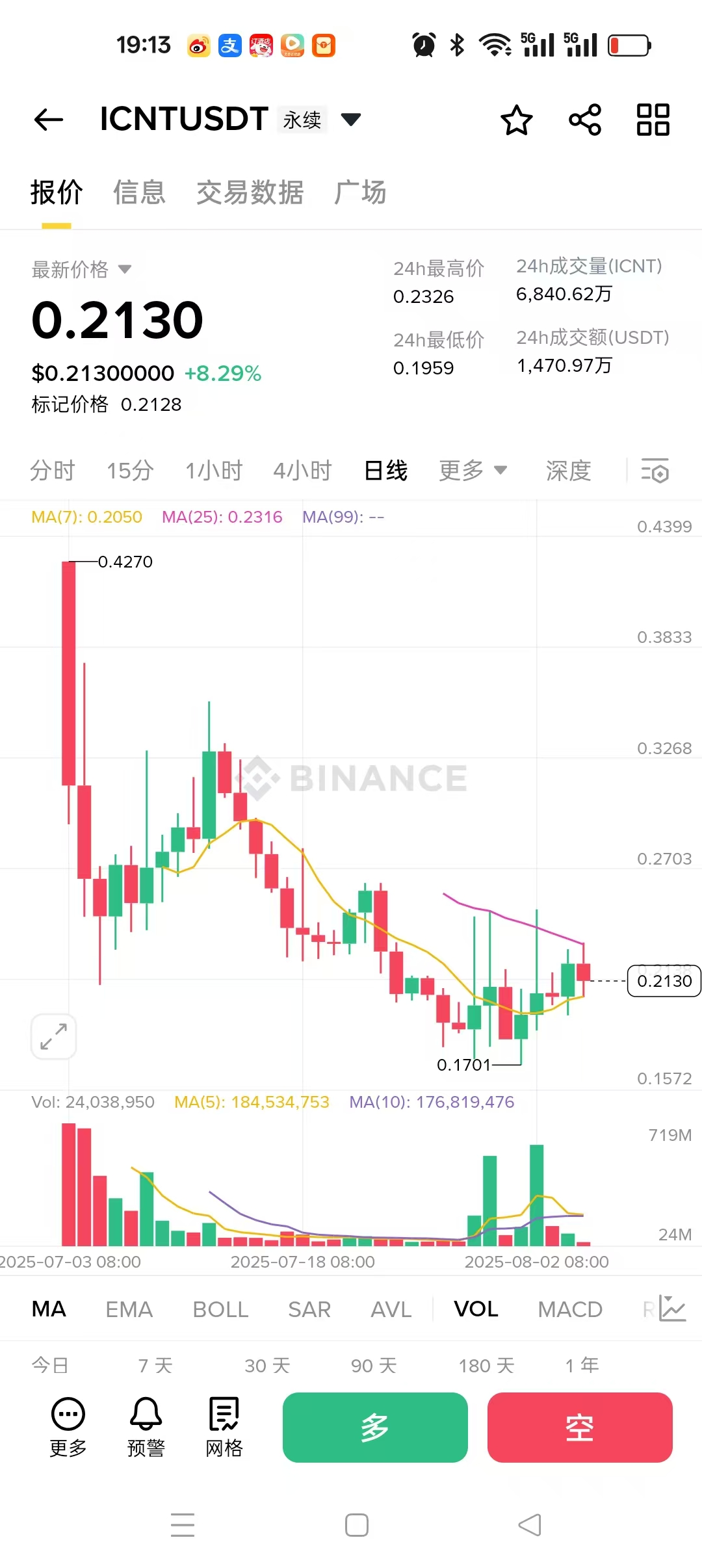
Discovered this token in Binance Alpha, while the market was declining in early August, but $ICNT seems to show signs of countertrend exploration.
Testing support level on the daily chart, with a long upper shadow in late July and increasing trading volume in the past week. Further observation is needed to confirm the support level.
Warm Ground Nurtures, Resilient Heart: Diving into Differentiation
The new token's market still requires observation. However, price support may be related to the project's fundamentals. Impossible Cloud Network (ICN) appears to be an ordinary DePIN project, but diving deeper reveals its noteworthy aspects.
Product and Services
❚ Surface Level
Superficially, the ICN network is similar to most DePIN projects.
The ICN network consists of ScalerNode and HyperNode nodes, along with Builders and $ICNT stakers. Where:
Hardware providers establish ScalerNode nodes, executing storage, computing, and other tasks,
HyperNode nodes are ICN protocol validators, responsible for evaluating and supervising ScalerNode nodes to ensure the network's integrity and reliability.
Builders in the ICN ecosystem use various hardware resources to develop and establish applications, being one of the key user types.
$ICNT holders can choose nodes for staking and receive corresponding rewards.
The entire DePIN network generates revenue by providing storage, computing, rendering, and other services, with rewards distributed to nodes and token stakers.
❚ In-depth Analysis
In fact, other DePIN projects are either storage, computing, or network service-based. Impossible Cloud Network (ICN) is constructing a comprehensive, composable DePIN network.
The ICN network will soon be a comprehensive DePIN network composed of multiple hardware types including storage, CPU, GPU, and network infrastructure. Builders can use distributed hardware combinations in the ICN ecosystem to build truly decentralized applications.
Therefore, the future ICN will be a large DePIN, a decentralized large-scale computing ecosystem.
[The translation continues in the same manner for the rest of the text, maintaining the specified translation rules for specific terms.]The second difference is that on the supply side, Filecoin currently has over 1,400 active miners, Arweave has over 400 active miners, while ICN has sold around 30,000 nodes, with 1,009 different node operators. Moreover, ICN mainnet has only been online for a month, and participants' enthusiasm is even higher.
In Conclusion
Through in-depth exploration, focusing on project progress and ecosystem operations, and comparative analysis, we can discover that compared to what is superficially seen, the ICN network essentially has more distinctive products, a larger ecosystem, and more proactive operations.
More Distinctive Products
Different from existing dePIN, the ICN network product will be a decentralized integrated network composed of multiple hardware types.
For enterprise-level users, the existing ICN network, through decentralization, has dispersed monopoly profits, enabling enterprise users to obtain high-quality, low-cost services.
For Web3 users, in the future, Builders can build decentralized applications based on ICN without needing to purchase storage on one dePIN and computing power on another... They only need one ICN network, which on one hand forms larger economies of scale, providing lower costs; on the other hand, hardware matching within the same network can achieve higher performance.
Therefore, ICN's product will be a high-quality and low-cost large dePIN.
Larger Ecosystem
Although ICN mainnet has only been online for a month, network development started in 2023, and enterprise-level cloud storage platforms began as early as 2021. ICN currently already has a large number of enterprise-level users (1,000+) and has sold numerous nodes in the Web3 domain (around 30,000).
More Proactive Operations
ICN is providing hardware services as rewards to Web3 applications, collaborating with exchanges and Web3 platforms, and is very actively transitioning from Web2 to Web3, promoting the integration of Web2 and Web3 ecosystems.
So in the dePIN ecosystem, while "peach and plum trees" are widely known, the benefits of the "tangerine" might be less understood - speaking of planting peach and plum trees, isn't this tree also providing shade?