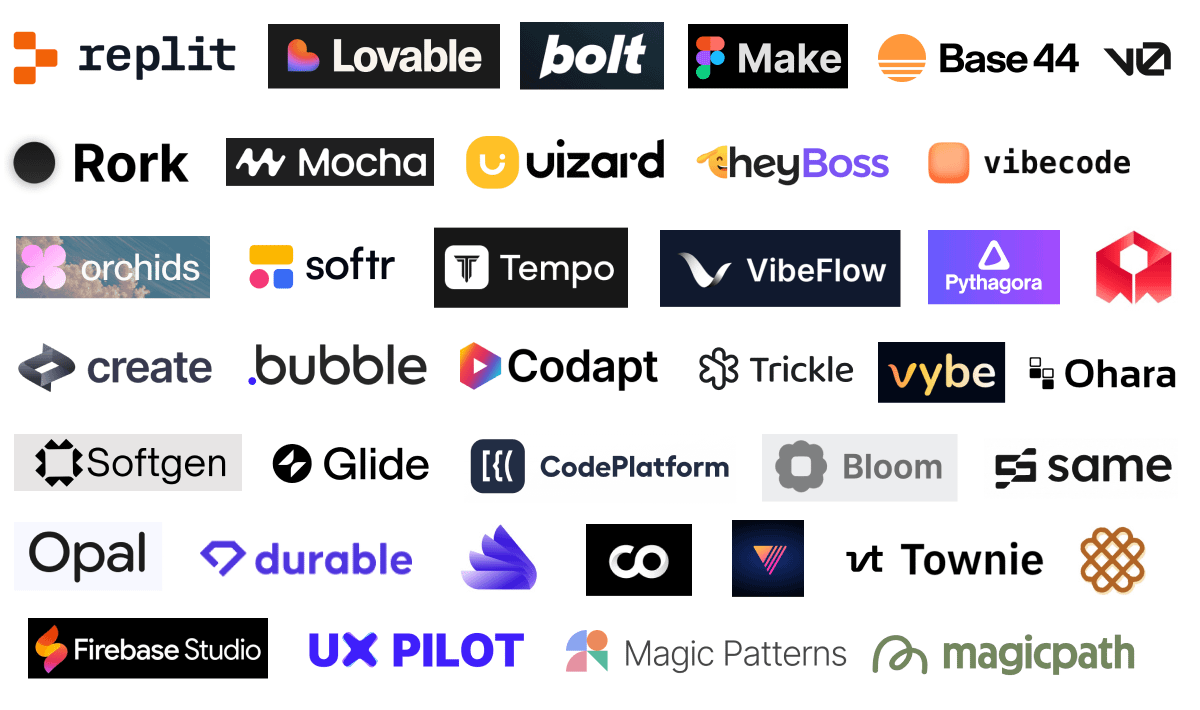
Have you noticed that AI application generation platforms are heading in a completely unexpected direction? Many originally thought this would be a bloody zero-sum game, with everyone fighting to the death in a price war, ultimately leaving only one dominant player. But reality is surprising: these platforms not only aren't fighting each other, but are instead finding differentiated positioning and coexisting in different market segments. This reminds me of the development trajectory of large language models, which was equally unexpected and equally inspiring.
Just yesterday, a16z's two partners Justine Moore and Anish Acharya jointly published an analysis article "Batteries Included, Opinions Required: The Specialization of App Gen Platforms". Their observations about the AI application generation platform market deeply inspired me. They pointed out that these platforms are experiencing a differentiation process similar to foundational models, shifting from direct competition to specialized development. This observation made me rethink the development rules of the entire AI tool ecosystem and reflect more deeply on the myth of "universal platforms". I have always believed that "no universal code platform can dominate everything". Now, too many people are building applications with AI, with extremely diverse usage scenarios: prototype design, personal websites, game development, mobile applications, SaaS platforms, internal tools, etc. How could one product possibly excel in all these domains?
My judgment is that this market will inevitably move towards segmentation. A consumer-grade application designed for beautiful landing pages will definitely not be the same product as an enterprise-level internal tool builder. The former needs Spotify integration and might go viral on TikTok; the latter needs SOC 2 compliance and must be sold top-down to CTOs. This market is large enough to support multiple companies valued at billions of dollars. Becoming clearly the first in a specific use case, focusing on the functions, integrations, and market strategies required by that scenario, might be the winning strategy.
PS: I recently started a startup myself, precisely doing a vertical specialized Vibe coding product, and have quickly closed a Pre-seed round of financing. If any VC firm partner also favors this direction and has some research, welcome to add my WeChat (MohopeX) to chat. We are also recruiting founding team members, interested friends can look at the end part to submit their resumes.
Insights from Foundational Models: From Substitutes to Complements
[The rest of the translation continues in the same professional manner, maintaining the original structure and meaning while translating to English.]Data/Service Wrapper Applications need to aggregate, enrich, or present large existing data services or third-party services, such as LexisNexis or Ancestry. The infrastructure must support operations on large datasets. The core challenge for such applications lies in data processing capabilities and integration complexity, rather than interface aesthetics.
Utility Applications are lightweight, single-purpose applications that solve highly specific needs, such as PDF converters, password managers, or backup tools. Most horizontal platforms have already done well in generating these applications. These applications are characterized by clear functionality, relatively simple logic, but high requirements for reliability and performance.
Content Platform Applications are built for discovering, streaming, or reading content, such as Twitch or YouTube, and require specialized infrastructure to support content distribution. The technical challenges for such applications mainly involve large-scale content distribution, real-time streaming processing, and personalized recommendation algorithms.
Business Center Applications are platforms that facilitate and monetize transactions, focusing on logistics, trust, reviews, and price discovery. These applications need to support integration of payments, refunds, discounts, etc. In this domain, compliance, security, and the complexity of financial integration are key challenges.
Productivity Tool Applications help users or organizations complete tasks, collaborate, and optimize workflows, typically with extensive integration with other services. These applications require a deep understanding of enterprise workflows and existing tool ecosystems.
Social/Messaging Applications enable users to connect, communicate, and share content, usually forming networks and communities. The infrastructure must support large-scale real-time interactions. The challenges for such applications lie in handling social graphs, real-time communication, and content moderation.
What I observe is that each category has its unique technology stack, integration requirements, and user experience considerations. A platform focused on e-commerce application generation would have built-in payment processing, inventory management, order tracking, and deeply optimize these processes. A platform focused on data dashboards would invest more effort in data visualization, real-time updates, and complex query optimization. This specialization is not just a difference in features, but a variation in entire product philosophy and technical architecture.
Deep Logic of Market Segmentation
From a deeper perspective, this market segmentation reflects the complexity of software development itself. In the past, we were accustomed to viewing software development as a unified field, but in reality, different types of applications have completely different challenges and constraints. Mobile applications need to consider touch interactions, battery life, offline functionality; web applications need to consider browser compatibility, SEO, responsive design; enterprise internal tools need to consider security compliance, existing system integration, and permission management.
When AI begins to automate application development, these differences become even more important. An AI system skilled at generating attractive landing pages would have training data, prompt engineering, and output optimization centered around visual appeal, conversion rate optimization, and marketing effectiveness. An AI system skilled at generating enterprise-level internal tools would have a completely different focus: data security, system integration, user permission management, audit logs, and so on.
I often see teams trying to build "universal" AI application generation platforms, hoping to meet all users' needs. But this approach overlooks a key point: conflicts in optimization goals. When you try to simultaneously optimize aesthetics and enterprise compliance, you often compromise in both directions. Specialized platforms can avoid such compromises and excel in specific domains.
This reminds me of the evolution of traditional software development tools. We once had some "super IDEs" that tried to cover all development scenarios, but ultimately the market fragmented: there are tools specifically for web development, tools specifically for mobile development, tools specifically for data science. Each tool provides an unparalleled experience in its professional field, which is more valuable than a tool that can do everything but is not proficient in anything.
In the AI application generation field, I expect to see similar fragmentation. There will be platforms specifically for e-commerce website generation, with built-in Shopify integration, payment processing, and inventory management. There will be platforms specifically for data dashboard generation, skilled at connecting various data sources, creating interactive charts, and setting up real-time updates. There will be platforms specifically for mobile application generation, understanding iOS and Android design guidelines, push notifications, and app store optimization.
Insights from User Behavior
... (rest of the text continues in the same manner)I observed an interesting phenomenon where different platforms are beginning to diverge in their selection and optimization of AI models. Platforms generating beautiful interfaces may use more image generation models and design-related training data. Platforms generating backend logic will use more code generation models and software architecture-related training data. Such targeted optimization has significantly improved the performance of each platform in its professional domain.
More importantly, different types of applications have completely different criteria for evaluating generation quality. A consumer-grade application might prioritize interface aesthetics and user experience smoothness, even accepting less elegant code. An enterprise-grade application, however, would focus more on code maintainability, security, and scalability, even if the interface is plain. These differences in evaluation criteria determine that different platforms need to adopt different optimization goals and quality control mechanisms.
I particularly noticed that some platforms are beginning to differentiate in deployment and operations. Platforms focused on personal projects might offer simple one-click deployment to static hosting services. Platforms focused on enterprise applications need to support complex deployment pipelines, multi-environment management, monitoring and alerting functions. These differences may seem subtle but have a decisive impact on the final user experience.
Evolution Direction of the Ecosystem
From a more macro perspective, the specialization trend of AI application generation platforms actually reflects the evolution direction of the entire software development ecosystem. We are witnessing a transformation from "tool-centered" to "result-centered". Users are no longer concerned with what tools they use, but what results they can obtain. This transformation creates enormous opportunities for specialized platforms.
I expect that in the next few years, we will see more vertical AI application generation platforms emerge. There will be platforms specifically for game development that understand game engines, physics systems, and level design. There will be platforms for educational applications with built-in learning management system integration, progress tracking, and personalized learning paths. There will be platforms for medical applications that comply with medical data protection regulations like HIPAA.
This verticalization trend will not only change product forms but also transform industry talent requirements. Specialized platforms need compound talents who understand both AI technology and specific industries. A platform generating financial applications needs people who deeply understand financial compliance, risk management, and trading systems. This change in talent demand will further consolidate the competitive advantages of specialized platforms.
I also observed that specialized platforms are beginning to collaborate rather than compete. A platform focused on frontend generation might establish a cooperative relationship with a platform focused on backend generation, jointly providing end-to-end solutions for users. This collaborative model creates a more open and cooperative ecosystem where each platform can focus on its core strengths.
In the long run, I believe this specialization trend will drive the entire AI application development field towards higher maturity. When specialized platforms are deeply cultivating each细分领域, the overall industry level will be improved, and users will obtain better experiences. This is a win-win situation: platforms can establish deep moats in professional domains, users can obtain more targeted solutions, and the entire ecosystem will become richer and more diverse.
My Predictions and Thoughts
Based on these observations and analyses, I have several predictions about the future development of the AI application generation platform market. I believe that within the next three to five years, we will see the market clearly divide into several main categories: rapid prototyping platforms for consumers, template-based application platforms for small businesses, customized internal tool platforms for large enterprises, and specialized platforms for various vertical industries.
In each category, 2-3 leading companies will ultimately emerge, gaining competitive advantages through deep specialization and ecosystem building. These platforms will not try to replace each other but will continuously deepen within their respective domains, providing specialized value that other platforms cannot match.
I am particularly optimistic about platforms that can establish deep moats in specific vertical domains. For example, a platform focused on catering industry applications that deeply integrates order systems, inventory management, staff scheduling, and financial reports would be difficult to replace by generic platforms. The accumulation of industry knowledge and professional integration is something generic platforms find hard to replicate.
I also believe user behavior will fundamentally change. As the switching costs between platforms decrease, users will become more "tool-rational", choosing the most suitable platform based on specific needs rather than being loyal to one platform. This change will further drive platform specialization, because only by being the best in a specific domain can a platform secure a place in users' toolboxes.
From a technological development perspective, I expect more significant divergences in AI model training and optimization among specialized platforms. Different domain applications have varying requirements for AI generation quality, which will drive platforms to develop more targeted AI models. We might see models specifically optimized for code generation, interface design, business logic, and more.
Finally, I believe this specialization trend will redefine the standard of "platform success". In the past, success often meant the most users and broadest coverage. But in a specialized world, success might mean the deepest influence in a specific domain, highest customer value, and strongest professional capabilities. This change in success standards will create more diverse business opportunities and make the entire industry healthier and more sustainable.
Overall, the specialization trend of AI application generation platforms is not just an inevitable result of technological development, but a sign of market maturity. When user needs become more diverse and specialized, the limitations of universal solutions will be exposed. Platforms that can deeply understand specific user group needs and provide targeted solutions will have advantages in future competition. This market is large enough to support multiple successful specialized enterprises, with the key being finding the right positioning and going deep.